



A council’s recent announcement that it intends to reduce the speed limit in urban, residential areas from 30mph to 20mph – a move the local authority says will be “beneficial” for people cycling, walking, and wheeling – has been greeted with righteous indignation by opposition politicians, who have described the plans as “nuts”, “extremely worrying”, and guaranteed to “upset” constituents.
Bournemouth, Christchurch, and Poole Council’s deputy leader told a meeting this week that it was the local authority’s “intention” to introduce a “default” 20mph limit in built-up areas throughout the conurbation, similar to the widespread implementation of lowered speed limits in Wales last autumn.
The announcement comes three months after the council’s environment portfolio holder Andy Hadley pledged that a full consultation would take place before a decision was made on the matter.
This week, the Liberal Democrat-controlled administration’s deputy leader also indicated that meetings will be held with residents and campaigners, such as the 20 is Plenty road safety group, over the coming days to gauge the level of local support for reduced speed limits, the Daily Echo reports.
“Will BCP Council implement a 20mph default speed limit? Yes, that is our intention,” Millie Earl told the council meeting, adding that the local authority is “keen to hear the views of the whole community”.
““There will be some roads that are exempt on the basis of need and capacity. It is also likely that the roll-out will take some time working alongside communities and finding the needs for funding such a widespread change.”
She continued: “20mph, by default, in a built-up urban area would be beneficial to people walking, wheeling, and cycling and as highlighted would also benefit public health and air quality.
“I represent the Newtown and Heatherlands ward and we have seen the benefits of large-scale 20mph speed limits which were introduced in 2010 and extended in subsequent years to cover almost all the ward.”
The announcement was praised by Poole resident and Cycling Rebellion founder Adam Osman, who said the reduced speed limits would “really encourage more cycle journeys”, as well as improving health and reducing serious injuries and deaths on the roads.
“We need to halve the number of miles driven in order to meet climate change goals even if we switch all cars to electric,” he said.
However, the prospect of 20mph speed limits in residential areas was not met with the same enthusiasm across the political aisle, with local Conservative politicians rushing to condemn the “out of the blue” and “extremely worrying” announcement.
“Not only was this announcement before any consultation, but according to Cllr Earl was because ‘that is what the Three Towns Alliance councillors campaigned on during the local elections’,” Conservative councillor Phil Broadhead, whose tweet criticising the proposals – posted during this week’s council meeting – was met with several locals welcoming “safer streets”, told the Echo.
“Many of us warned that voting for these parties would see a return to anti-car measures, and this announcement, coupled with others such as the closure of Poole Park to through traffic, again without pre-consultation, shows that we were right.”
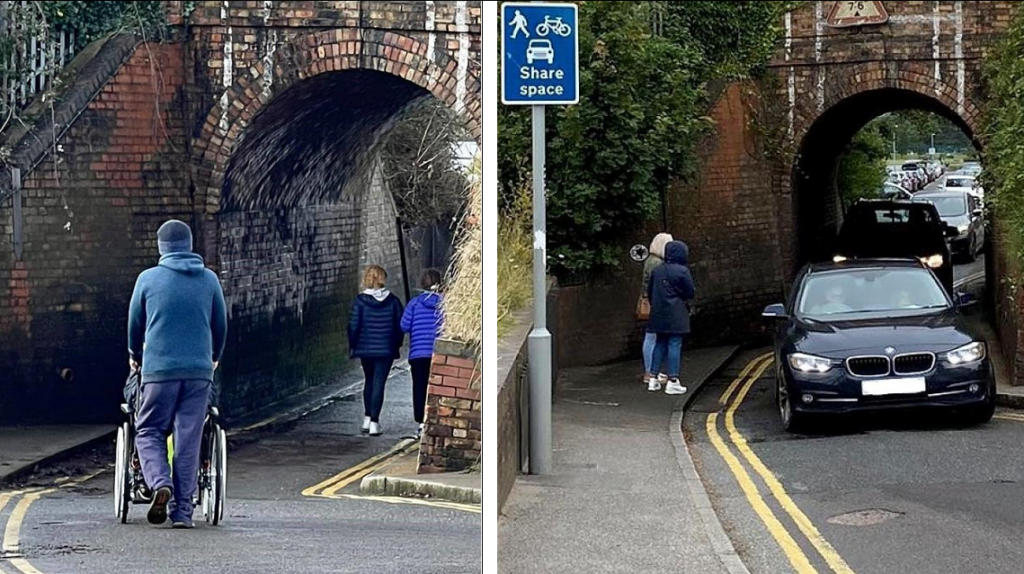
The council’s closure of the narrow Keyhole Bridge in Poole Park, referred to by Broadhead, came after Cycling UK launched a judicial review against the then-Conservative administration’s decision to reopen the road, which had been temporarily closed to drivers in 2020 as part of a bid to encourage active travel and provide pedestrians and cyclists with a safe route on a narrow, dangerous road hitherto used as a rat-run by motorists.
However, over the course of the following two years, the Conservative-controlled council ignored two public consultations, showing the vast majority of residents supported the road’s permanent closure, by choosing to reopen the underpass to motor traffic, prompting Cycling UK’s appeal.
Meanwhile, arguing against the widespread lowering of speed limits in his constituency, Poole’s Conservative MP Sir Robert Syms also added: “I would support 20mph near schools but a general policy I think is nuts. It is unpopular in London and in Wales and it will upset my constituents if implemented.”
While Sir Robert dismissed the widespread implementation of 20mph speed limits across Wales in September as unpopular, the initial analysis of the measure’s impact suggested a “dramatic” change in traffic speeds, with the results hailed as “astonishing and far greater than would have been predicted”.
An initial report by transport and public health data analysts Agilysis in the wake of the new speed limit’s introduction showed an average reduction in vehicle speed on new 20mph routes of 2.9mph.
Agilysis’ Richard Owen said the “marked” drop demonstrated that Welsh drivers had “on the whole” accepted lower speed limits and “have changed their behaviour accordingly”.
And Rod King MBE, a campaign director at 20’s Plenty for Us added that he was confident that the much-discussed move will make routes “far more pleasant for walkers and cyclists”.











51 thoughts on ““We warned that voting for these parties would lead to anti-car measures”: 20mph speed limit plan to “really encourage more cycle journeys” slammed as “nuts” and “extremely worrying””
Boohoo.
Boohoo.
Good to see more brave political leaders following in the footsteps of Mark Drakeford’s fine example, putting safety ahead of driver convenience, as it should be.
Crocodile tears for the opposition members from me. Anti-car? Cars are inanimate objects, I’d rather we ended road violence and ended the suffering of bereaved family and friends.
Exactly – decades of “anti
Exactly – decades of “anti pedestrian / cyclist ” policy is obviously cool with these numpties
Proudly “anti car” – or is it
Proudly “anti car” – or is it more to do with:
The 4-5 daily road deaths, and a load more serious injuries; all of us always under threat of a sudden, violent end.
The destruction of all the travel alternatives – people driving who can’t afford it or are simply too old to be safe
Air pollution curtailing lives – often of those who don’t directly benefit from a car
Debilitating Noise pollution in the worst spots “I wouldn’t wanna live there”
use of cars / vans to facilitate crime at all levels
The car-scape – urban areas designed to facilitate cars; lives bounded by major roads, scruffy car parks, horrid underpasses, roundabouts, one ways etc
driving is boring in reality – tiring, frustrating, often isolating
Politicians, why try to appease drivers? whatever you do, it will be spat right back at you.
Quote:
So, they made it clear what they intended to do and people voted for them anyway (unlike certain political parties who put stuff in their manifestos and then quietly forget about all those promises once elected).
Good on them.
Wales wasn’t first by the way
Wales wasn’t first by the way even though it is invariably used as a reference, Scottish Borders Council brought in a blanket 20mph to replace 30s about 3 years earlier.
On a different note, be careful what you wish for, CTT (cycling time trials) have said that they will not sanction events that pass through 20mph limits, this will put many courses out of commision, leaving mostly the main dual carriageway ones. Possibly another nail in the coffin of a sport that is struggling at grass roots level already. If this is an safety / insurance issue (riders doing 30+ when cars are doing 20) then I suspect that triathlon and road racing may have to go the same way and we will only be left with a few expensive closed road events.
As a resident and voter in
As a resident and voter in said conurbation, I can see the benefits of reduced speed limits, as long as they don’t put speed jumps on all the roads. I live on a main road, speed limit is 30, but most drivers go between 40 and 50, unless they are in a queue. There are 4 schools within 1/2 a mile of me. The 3 towns have too many cars, and poor roads. Closing Poole Park to through traffic is absolutely needed too, so glad I voted against the Selfservatives
ah, nuts another Bournemouth
ah, nuts another Bournemouth Echo story with comments closed by mid morning because drivers are going barmy about this, absolutely haywire.
20 mph means slow cars and
20 mph means slow cars and commercial vehicles in low gears and higher RPM producing higher rates of emissions … that’s called physics …
As we’ve seen in Wales it also means the cancellation of bus routes and longer response times for emergency services.
Be careful what you wish for ….
20 mph means slow cars and
20 mph means slow cars and commercial vehicles resulting in less aerodynamic drag and rolling resistance, producing lower rates of emissions … that’s also called physics.
Some vehicles will do worse at 20 MPH than at 30 MPH, some will do better. They’re both near the flat range at the top of the MPG curve, bottom of the L/100km curve.
andystow wrote:
There is also the fact that drivers accelerating from rest to 20 instead of 30 mph use less fuel, creating lower emissions. I’m sure I read that 20 mph traffic is steadier, it surges less, which results in less acceleration and braking by each driver.
And of course if 20 mph means more people cycle or walk then it means fewer vehicles on the road in the first place so further lowering emissions (based on the current situation where EVs are a minority of vehicles).
And I’m definitely in favour of fewer dead children. And adults.
TROOPER74 wrote:
[ multiple citations needed]
Presumably by “physics” you may mean engineering and human factors? It’s a little more complicated than that (e.g. TfL on this topic, this post on new research at the 20’s plenty site).
Bus routes? They’ve rearranged lots I see – not surprising. Apparently there’s some discussion about whether buses should be exempt. Personally I don’t think that makes sense, unless e.g. they’re putting in bus lanes where they don’t get slowed by cars and other vehicles.
Emergency services? Do you have any data on that? The Senedd have you covered. They can go the speed they need, limited by the willingness of drivers to get out of their way. The change was supported by e.g. South Wales Fire Service. Presumably you’re referring to some comments by a fire chief that firefighters might be delayed getting to the fire station and that might effect response?
It means less crashes and so
It means less crashes and so less damage to their precious vehicles.
And less dead children.
You’d think – but because the
You’d think – but because the accelerator pedal is magnetically attracted to the floor this means there’s no time to look out the windscreen when trying to keep it under 20. Plus pollution.
Much safer and more environmentally friendly to build expressways everywhere for 50mph+ travel. America shows the way.
ktache wrote:
I didn’t realise dead children where a metric …. Is that the best you can come up with …. you’ll be telling me I’m a Nazi next … oh and you and yours never use cars, delivery vehicles, HGV”s etc … and your bicycle was not made in a robotic factory manned by modern slaves …..
Right ….
Are you as worried about
Are you as worried about emergency vehicles when you’re the only occupant in your car & sat in a traffic jam?
We’ll call you a nazi? Is that the best you can come up with?
TROOPER74 wrote:
Fortunately chrisonabike has rebutted all your other comments.
We’re not talking about banning motor vehicles, just that they go at a safer and more appropriate speed on urban roads.
Which is it? Robotic, or manned by modern slaves?
Modern slavery is a scourge which affects much of manufacturing and other industries. Outrageous as it is, I’m struggling to see the relevance of this to driver being limited to 20mph on urban roads.
How to say “I haven’t read
How to say “I haven’t read any factual reports, just the DM” without saying it.
“20 mph means slow cars and
“20 mph means slow cars and commercial vehicles in low gears and higher RPM producing higher rates of emissions…”
What cars are people driving? I’ve never experienced higher revs at 20mph vs 30mph.
Emissions, if anything, have been lower in my experience.
TROOPER74 wrote:
The most important factor on emissions in urban driving due to its stop/start nature is the amount of energy required to reach the permitted speed limit from a standstill. It takes 2.25 times as much energy to reach 30 mph as it does to reach 20 mph. That’s called physics too.
TROOPER74 wrote:
l
Isn’t this just your opinion. Can you please let us know your competence and supply references and / or maths.
In my experience, driving an automatic camper in Wales, keeping to the speed limit was easy without over reving and fuel consumption was low. In my opinion many drivers need to learn how to drive economically in 20mph zones.
I think a cyclist should know how much more power they need to go faster or to accelerate up to speed in the first place.
Maths may be a little
Maths may be a little difficult for this one as he appears to have no concept in the idea that dead children can actually be counted.
I’m guessing his basic physics will be found to be a little wanting too…
ktache wrote:
It’s like dead cats – an image so emotive that rationality leaves the building.
On the flip side that means that in fact x plus 100 dead children raises no more outrage than x.
In one sense we were unlucky – we “stopped de kindermoord” quite successfully, but “cars won”. We kept all the cars and the speed, and “made kids safe” by moving all the kids away from any roads (and increasingly inside, except when in cars).
ok, one more time for the 20
ok, one more time for the 20 mph driver myths
speedometer watching/ I’ll get bored / doze off – “I’m incompetent”
cars aren’t designed for 20 mph – better stay out of all those jams then (which your gearbox has survived thus far)
it can’t/ won’t be enforced – driver lawlessness fully evident
more pollution – less actually, but thanks for the threat – and for the acknowledgment that you cause pollition.
roads will wear out more quickly because (something something) cars are putting their weight on the same spot for longer – ew kay. Maybe have a smaller car for starters?
20 mph ambulances – less cars causing congestion would speed them on their way to the extent that this is even a real issue – availability of crewed vehicles (not stuck at hospitals is the major determinant, and paramedic vacancies); likewise with buses – delayed and deprived of passengers by cars. I’d happily exempt both from 20 mph.
outside schools is OK – nice attempted containment trick, but shame the existing rules aren’t working all that well.
The degree of driver hysteria about 20 mph suggests that 30 mph isn’t going that well. Another pensioner knocked over by a car – this needs to end.
After that, it usually drifts into doom and conspiracy theory the witchery de nos jours : it’s all about control, “they” are taking everything away from “us” (yeah, global warming’s gonna do all that), 15 minute cities, banning all cars (don’t threaten me with a good time!), something something corruption.
Incomprehension that councillors have got elected on this sort of ticket. Anything not to engage with the issue,
it’s funny how the solution
it’s funny how the solution to ambulances being stuck in traffic isn’t ever to just stop blocking them with your car and take the bus/bike/walk..
We have 20 mph throughout
We have 20 mph throughout much of Southampton now as part of a phased roll out. My observations are these:
It’s much more pleasant to walk or cycle when people are driving at 20.
Driving at 20 makes no significant difference to journey time.
Most people ignore the new speed limit.
Dangerous driving has increased. Once you’ve ignored the 20 then there’s no higher limit to ignore, so why not drive 40.
When I’m driving (at 20) I’m often overtaken by other cars, even when it’s dangerous to do so. I’ve noticed an increase in other dangerous manoeuvres, such as running red lights, or driving at an extended distance on the wrong side of the road to skip the queue and turn down a side road. Some drivers seem very frustrated.
Congestion and overall traffic levels are still below what they were before COVID.
bensynnock wrote:
I think overtaking should be made illegal in 20mph zones, including overtaking bicycles.
This would make prosecuting drivers who are breaking the speed limit easier to do from dashcam footage and reduce pointless MGIF/close passing of cyclists.
There are some cyclists that
There are some cyclists that go really slowly and I think making it illegal to overtake them (safely) is the wrong approach.
1. There is no reason to criminalise safe behaviour – if I am behind a very slow moving vehicle, e.g. less than 10mph, I can reasonably expect to be able to find a spot to safely overtake at 20.
2. Making drivers stay behind cyclists going e.g. less than 10mph (which many non-trained cyclists might do, especially if there are hills/inclines etc) is going to serve to create angry motorists and more anti-cyclist aggression and rhetoric which I for one am keen to avoid.
Carior wrote:
I think you’re exaggerating how much delay a 10mph cyclist is going to cause to a driver. Typically, it’d be in the order of seconds, but I suppose you could find rare examples where the delay might be 1-2 minutes. If motorists are unable to deal with a small delay without resorting to a toddler-like outburst, then I doubt that they are emotionally equipped to be driving on our congested roads and they certainly shouldn’t be taking out their immaturity on cyclists.
The real cause of delays and congestion on our roads is other drivers. It’s just divisive rhetoric when people blame cyclists for the situation on the roads.
However, I do agree that (safe) overtaking should be allowed on 20mph roads. We’ve had 20mph limits here in Bristol for a few years and I have no problem with being overtaken by drivers who leave enough space. I think current laws are sufficient and they just need to be enforced with a bit more vigour.
hawkinspeter wrote:
seconds if they are looking for a place to safely overtake, much longer if overtaking is forbidden.
This segment is 0.7km, and at 20mph would take a driver 1.3 minutes, but my typical ride time is 5-6 minutes.
https://www.strava.com/segments/8838335
hawkinspeter wrote:
And I have no problem with being one of those cyclists who occasionally overtakes cars in the 20mph limits. Yes, (very slightly) downhill, and I reckon the main cause of their slowness is congestion but the 20 limit helps.
More importantly, the road environment did improve, especially for pedestrians – much easier to cross the road – with the introduction of the 20mph limit.
Carior wrote:
pretty sure I’m at less than 10mph once the graident goes much above 5%, i would not want a line of cars following me up the 11% incline on the road that my road leads out on to.
I have made similar
I have made similar observations here in Wales since the adoption of the new default limit last year. I totally support the new limits, but alas we have had many issues with poor implementation by the local councils in some areas that have added to the ire of many drivers, and confused others. Add to that the disregard to any road laws by many may drivers, and the net result is we now have a nation of drivers who have very quickly become accustomed to ignoring the posted limits, and driving at what ‘they’ think is an appropriate speed. Consequently cycling on the roads is now possibly even more dangerous than it was before!
I think you’re
I think you’re oversimplifying it. It’s not all drivers and it’s not everywhere. The parts of Bangor I go are nicer places to ride and walk as most drivers are driving slower than before. I spend less time in other local villages but they seem OK too. Personal observations, admittedly, but it doesn’t look like “a national problem” from my experience so far.
Admittedly there are some drivers that don’t give a f**k but then they are the ones that didn’t care for the 30 limit either. I see more speeding in the evenings when the roads are less busy, and particularly away from the main through route.
Just how many councils have implemented it badly? Who defines what is a poor implementation? How much of the fuss you see/hear is just noise made by the usual suspects and echoed by entitled drivers?
Anti-car? It seems to me
Anti-car? It seems to me that you can either be pro-car or pro-people, not both, and it’s pretty obvious which the tories are.
Speaking of which, I think the greatest lesson from Mr Bates vs the Post Office is that that is how the powerful always treat the plebs, and that the plebs can only win by getting together. In BC&P the plebs voted for it, but the party of the powerful don’t like it.
This is a positive story, but
This is a positive story, but the outrage-generation factory that is road.cc has to troll us with daft comments by opposition Councillors.
HarrogateSpa wrote:
Watch out, they don’t like being called out…
Left_is_for_Losers wrote:
if they make daft comments we will call them out for daft comments, and these conservative snowflakes will just have to live with it.
I called them out once and
I called them out once and they flexed by suspending me for a month..
Left_is_for_Losers wrote:
Actually they are extremely thickskinned about it, as evidenced by the fact that you have continually abused them/the site without any sanction. You got banned under your previous (thisismy)username for racism, bullying, libel and personal abuse, not for “calling out” the site/staff.
The ongoing war against
The ongoing war against motortwats.
The dangerous motoring hobby
The dangerous motoring hobby needs to learn its place.
Well if they all drove at 30
Well if they all drove at 30 in a 30 etc etc Councils wouldn’t have a problem to sort out, how about adhering to the highway code for starters, it’s not actually that difficult, but no, certain members of society are above the highway code and then injure, maim, kill people, children and in some cases even kill their own children. The Government do every thing they can to protect people from themselves, but no, some people just believe they know better.
Quote:
maybe voters took that as a promise and voted according for pro people measures.
Good. Nothing but ancient old
Good. Nothing but ancient old codgers and feral *ssholes driving around. I have to go to visit my parents a few times a year, it;s torture. Hideous place
I’m an older person, and I
I’m an older person, and I live in America.
Personally, I think here in America a 15 mph zone should be the speed limit in school zones instead of 25, kids are killed at 25, though most people drive 10 over in school zones anyway, so 15 means they’ll be driving 25, whereas now they’re going 35. Cops are spotty, sometimes they watch for speeders in school zones, but most of the time they don’t.
Same is true for residential areas, here in America most residential neighborhoods are 35 mph, these should be posted for 25 because everyone drives 10 over. Very few policing agencies patrol neighborhoods for speeders.
On freeways I think we need to up the speed limit to 85 during the day and 75 at night. But, in order for that to work in the USA, we would need to strictly enforce lane usage, we get people loffing along below the speed limit in the fast lane, forcing others to pass them on their right which isn’t safe, but the cops here do nothing about it. Traffic would move a lot better if people stayed in the right lane unless passing, that is the standard in Europe, and it should be here too.
A few lefty inner city
A few lefty inner city suburbs in Melbourne Australia are bringing in the equivalent of 20 mph speed zones, getting this response from the Victorian top cop;
Victorian Police Chief Commissioner Shane Patton has slammed a Melbourne council’s decision to expand the number of roads with 30km/h speed limits as “ridiculous”.
Speaking on ABC Radio Melbourne, Chief Commissioner Patton was questioned about the City of Yarra’s proposal to limit more roads to 30km/h in the inner-city suburbs of Fitzroy and Collingwood, as reported earlier this week.
“I just think that’s ridiculous, 30 kilometres,” Mr Patton said live on air.
Did he have any justification
Did he have any justification for his statement or was just spluttering “ridiculous” his entire argument?
People are getting more and
People are getting more and more stupid as the years pass. I don’t exactly know what’s causing it, but would bet that it’s probably a direct effect of the ever increasing “nanny state” making the people more childlike. Whatever the cause, the effect is undeniable and we are becoming a people who could no longer look forward further than we could throw, and yet often proclaim to be wiser than people of old. Is this not the definition of a fool? We have become fools and we deserve everything that’s coming for us as inevitable consequences. Maybe, after, if we aren’t wiped out, we can grow to be wise again.
If by nanny state you mean
If by nanny state you mean all of the services provided by local and national government that keep us alive longer and less likely to sustain injury then frankly most people would be dead, injured or starve to death with out it. In my experience Nanny State tends to be a trope trotted out by politicians to justify cutting services to vulnerable people.
“I would support 20mph near
“I would support 20mph near schools but a general policy I think is nuts”
But how do people get near the school in the first place , Sir Robert?
Oxford added multiple
Oxford added multiple features at the same time: 20mph, replaced main road parking with cycle lanes, stopped through side streets, and make most parking resident only. Most came during the COVID reduced traffic.
It’s certainly made life more pleasant within local neighbourhoods, for cycling, walking and lower traffic noise. Access into and around the city is much harder by motor vehicle, which of course includes bus!
In my experience BCP has huge traffic flows with people rat-running all over the place. I would suggest the measures be introduced gradually, especially the step of stopping side roads.
20mph limits are good – it takes a little while to get used to but that aspect makes for much lower stress. A traffic jam in a 20 limit is just a stuck as – in a 30 limit you get to the next jam sooner and spend more time in it.