


You may have heard that professional road cyclists use extra special bikes, and you may be wondering what exactly they are getting that you aren’t. Let’s have a look at what sets pro bikes apart from the ones you can buy at your local bike shop, what makes them so eye-wateringly expensive, and finish off with some tips and tricks on how to emulate the pros.

An appealing part of professional cycling is that you can walk into a bike shop and ride away on a road bike very similar to the ones ridden by the likes of Tadej Pogačar, Jonas Vingegaard, and Wout van Aert.
Broadly speaking, the answer to the question of whether pro bikes are the same as the ones that you or I can buy in the shops is: yes.
UCI rules say that any equipment used in racing, including bikes, must be commercially available to the consumer. The only exceptions are prototypes. Riders are allowed to use prototypes, but authorisation is granted only for equipment that is in the final stage of development and which will go on sale within 12 months.
So if you want a Tour de France bike, you can buy one, although you will need to spend a lot of money – usually north of £10,000 nowadays.
That said, the bikes used in the Tour de France aren’t always identical in every way to the ones out there in the shops. The brand and model may be the same, but the pros sometimes have specifically modified bikes that cater to their needs and preferences.
Nothing is as simple as yes or no, so let’s dive a little bit deeper and look at the individual parts that make up a pro bike. There are plenty of tips we can take away, too.
Frame

> The bikes of the Tour de France
The central component of any bike is the frameset, and the top-end models you’ll see in bike shops are always the same as the ones that the pros are riding, unless it’s a bike that is yet to be officially released, like the new Factor (above) that was raced at the 2025 Critérium du Dauphiné.
Pro bikes have the lightest, stiffest versions of those frames, and they often have them well ahead of general sale, with the Tour de France being a showcase for many new bikes.
Even if you can’t have it as soon as you see it in the Tour, you will eventually be able to get your hands on a frame that’s the same as that of your favourite rider. As mentioned above, UCI rules require that all equipment used in pro racing is made available to buy. A rider could be later disqualified if any prototype equipment they use didn’t become available to buy within 12 months.
Paint job
One area where pro frames may differ from those you can buy is in the paint. Professional cyclists often have custom paint jobs unique to them or their team, and the Tour de France showcases many new limited edition designs for the occasion.

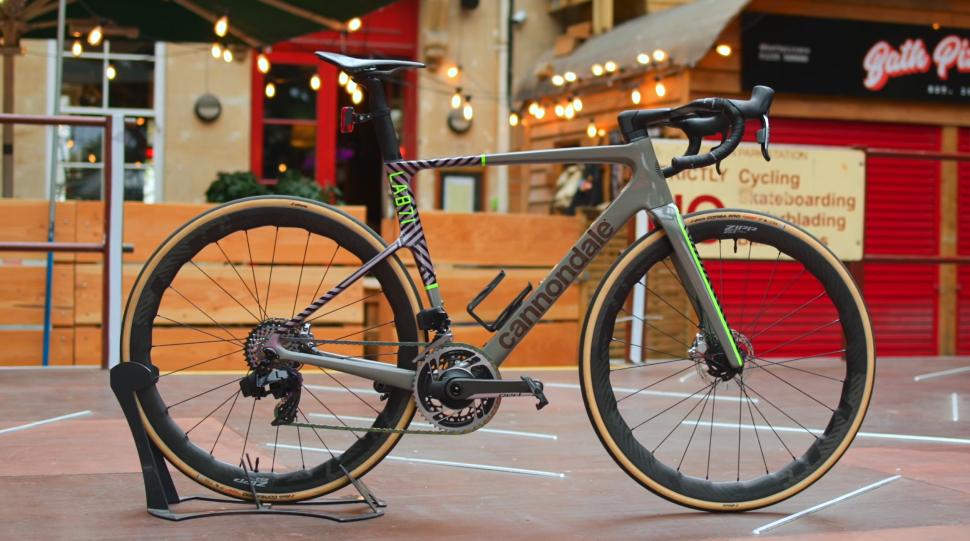
EF Education–EasyPost Cannondales sometimes have special paint jobs for major races, such as the one above from the 2023 Giro d’Italia – although these designs were unique and not available to the public.

Trek often uses Lidl-Trek’s Madones to show off the latest finish options it is offering through its Project One custom bike builder, such as the one above that’s just been launched, and last year you could get Mark Cavendish’s custom paint job on a Wilier Filante SLR, but it would have cost you an additional €2,000 on top of the starting price of £9,710.

Every gram counts in professional cycling, so manufacturers go to great lengths to reduce weight wherever possible, including in the paint. The paint finishes are often lighter than normal, as standard paint can add 100g or more. Okay, that’s not a massive amount, but it’s all important when you’re looking for every possible advantage.
Yann Le Fraillec, the Chief Product Officer at Van Rysel says, “The paint is very important when you buy your bike.
“Sometimes it’s not understood by customers why we decide to have a raw frame on the RCR, because when you purchase the white one, you sometimes have almost a 100g gap.
“For the RCR Pro, the design was to be the lightest possible. So, this is the main difference, just the paint”.
Geometry
Despite being able to get your hands on a frame that’s the same as your favourite rider’s, there have been some instances where riders have requested their sponsors make one-off bikes with special geometry just for them.

That list includes names like Fabian Cancellara and Peter Sagan, who both previously had custom-made versions of their team’s race bike because they didn’t like the geometry (the frame’s measurements) of the standard-issue bike.
When you’re one of the biggest names in the men’s professional peloton, you can request things like that. But on the whole, bike brands have a certain number of frame sizes approved by the UCI, and pro riders use the same frame geometries that you can buy.
Bike position

This isn’t strictly a difference between shop bikes and pro bikes, as you can set your bike up in any way that you choose; but professional cyclists often have more aggressive positions. The number of pro riders with long, low and narrow positions is greater than you’d see on the average club ride.
The bikes in a shop will be set up differently for one key reason, and that is comfort. Generally, they will feature a wider and higher handlebar position that is also closer to the saddle. This will often be more comfortable for the average person who is buying the bike.

Pro riders have access to regular bike fittings to ensure an ideal fit and maximise their efficiency and comfort, while also stretching every day to keep them comfortable in what can look like back-breaking positions.
They may also have personalised adjustments to their handlebars, stem, saddle, and pedals based on their riding style and body proportions.
A good shop will always adjust the position for you, so you can replicate those super-low racer positions if you want, and you have the flexibility to hold them.
Components

One significant difference between the bikes available in bike shops and those seen in the Tour de France is in component selection. We can mix and match components, wheels, and tyres to suit our preferences, whereas professional cyclists are required to use the equipment provided by their team’s sponsors.

There are occasions when riders discreetly use equipment from other brands and cover up the logos. For example, Peter Sagan used a stem from Zipp despite the US brand not being a Bora-Hansgrohe sponsor. No problem! A few lengths of electrical tape over the Zipp logos sorted that.
We don’t see as much of this as we used to, most riders sticking to their team’s sponsors, but it does still happen.
Groupsets

As with bike frames, there’s rarely any groupset component on display that you won’t find on high-end bikes in your local bike shop, although pro riders often have access to the latest and most advanced versions of these groupsets before they are made available to us.

The choice of groupset depends on team sponsorship, and of the 18 men’s WorldTeams in 2025, 13 use Shimano groupsets and four are on SRAM. Only Team Cofidis uses Campagnolo groupsets this year.

You might find the odd pro bike sporting a power meter that isn’t sponsor-correct, but the electronic shifting provided by the three main groupset manufacturers is so good that we rarely see anyone stray from their sponsor products.
Riders may also swap out the standard outer ring for one with more teeth, particularly if a stage is set to end in a fast sprint or in a flat time trial, or switch to a single chainring setup.

The shifters are an area where pro bikes may differ from one you can get off the shelf, but it doesn’t mean you can’t make the same modifications. Back in 2019, we did see some of the SRAM-sponsored Trek-Segafredo riders using Shimano’s Di2 sprint shifters instead of the SRAM Blips.
These modified satellite shifter buttons allow riders to shift gears when resting their hands on the tops of the bars, and you can certainly buy these special shifters with your new bike. We’d recommend asking the mechanic to fit them for you.
Wheels

Many of the bikes in your local bike shop will come with aluminium wheels, whereas you won’t find stock aluminium wheelsets anywhere near a pro bike.
Carbon fibre wheels are the only option for the pros because they offer superior performance. They are often lighter, more aerodynamic and stiffer, each of which contributes to increased speed.
While the wheel choice of the teams comes largely down to the sponsors, it’s not uncommon to see non-sponsor wheels used. Ineos have used wheels from boutique German brand Lightweight in the mountains, while Aerocoach wheels have featured in time trials. In 2023, we also saw some Astana Qazaqstan riders using Hed wheels although the team was sponsored by Corima at the time.
Tyres

As with most other parts of a bike mentioned here, unreleased tyres are often found on the pros’ bikes before they are available to the public. For example, we saw Vittoria’s Corsa Pro tyres used throughout the spring classics in 2023 before they were released at the start of the Giro d’Italia.
These prototype tyres are typically tested and refined during races to gather performance data and feedback from top cyclists before being launched onto the market.
Weight
> 8 upgrades to make your road bike better than a new one
Bikes used by professional cyclists have to adhere to a minimum weight regulation, which has been set at 6.8kg for UCI-sanctioned events for many years. As a result, pro bikes are often built to meet or slightly exceed this weight limit. You’ll occasionally see a pro rider’s bike fitted with a mid-range component rather than a super-light option just to get over that 6.8kg minimum.
> Should the UCI’s 6.8kg bike weight limit finally be reduced? We weigh up the pros and cons
There’s greater flexibility in bike weight for those of us who aren’t constrained by UCI regulations. We can explore lighter bike configurations than the pros, which is particularly advantageous if you enjoy hill climbing or just want the lightest bike on the group ride – although lightweight components are rarely cheap. That’s one of the things about cycling: the more you pay, the less you get.
Some tips and tricks to get a ‘pro’ bike
Tape is your best friend

A team’s mechanic will always have electrical tape to hand, and it can be very useful for stopping rattles and unwanted movement. For example, riders often use tape inside their computer mounts to stop their bike computer from going walkies.
 Pro team mechanics will sometimes put a short strip of bar tape along the centre of a rider’s pedal body , or even use felt pads, to stop unwanted movement there. It’s another neat trick you can copy.
Use aluminium parts
As mentioned above, the UCI enforces a 6.8kg minimum weight limit for bikes at UCI-sanctioned events.
If a pro bike is a little light, riders will often opt for an aluminium handlebar or stem to bring the weight up a touch. These are also less likely to snap when there is a pile-up… and if there’s something we can be certain of, it’s that there will be plenty of pile-ups in the Tour de France.
The versatile Sharpie
Aside from signing autographs, looking closely at some pro bikes – especially the tyres and saddles – and you’ll occasionally see that someone has been busy with a permanent marker.

Sponsors spend a lot of money supporting pro teams and it doesn’t look good if one of the riders would rather go elsewhere for a particular component. A sponsor isn’t going to like a rival brand’s logo on team bikes.
If an important rider doesn’t like the sponsor’s saddle, say, they’ll sometimes just use their preferred perch and scribble out the logo. Tyre logos are occasionally blacked out too.
It happens less and less often these days, though, because if a rider goes rogue, someone will notice and slap it all over social media.
Sponsorship logos… everywhere
While paint jobs on pro bikes aren’t always as distinctive anymore, the sponsors of the jersey, groupset, wheels, power meter, brake pads and even the team owner’s family plumbing business get their logo somewhere on the bike.
Pro bikes and kit often start with the same design that you can buy in the bike shop, but can end up looking very different after the sponsors have got to work.

So, to summarise, brands want pros riding and winning on their bikes to make them more appealing to consumers, and this means many manufacturers offer versions of professional bikes for sale to the general public. They are inspired by their professional counterparts, but may have slight modifications to suit recreational riders.
While you may not be riding a perfect replica of a professional cyclist’s bike, you can get pretty close.
Which pro team bike would you most like to buy? Let us know in the comments section below.


24 thoughts on “Tour de France bikes vs the bikes you can buy in the shops — are they actually the same?”
Quick reminder:
Quick reminder:
No cyclist should be buying the top of the range £12k “superbike” road bikes unless money is literally no object (in which case, maybe still buy a middle range bike and give 7 grand to charity…). If you are a good enough rider that the extra couple of percent those top end bikes give you vs a decent middle range bike makes a difference, your sponsors are paying for your bikes. If you think you are good enough but you aren’t sponsored and given free bikes…you aren’t good enough. Spend the extra money on training or riding holidays or a million other things which will make your riding experience better.
Thanks for the tip.
Thanks for the tip.
mark1a wrote:
Lol that reminds me when I
Lol that reminds me when I was on the train with my bike, just as I was recovering from a bout of Pacreatitis (I went from 11.5 st to 8st in a few months). A roadie sat beside me with his bike and told me, I was better to lose weight from the body than spend on losing it from the bike. I didn’t want to get any lighter !
Quick reminder. You dont get
Quick reminder. You dont get to tell someone what they spend their money on whether they are gifted amateur level or fat lad at the back or all the gear but no idea – thats on them – not you.
Secret_squirrel wrote:
Well said. End of the day, there are a lot of things more damaging to the environment, both local and global, to spend your spare cash on – expensive holidays, flash motor vehicles etc, and what would one rather share the road with, someone on a £12,000 bicycle or someone in a £100,000 Chelsea tractor? Good luck to anyone who can afford it!
Secret_squirrel wrote:
In the world of marketing, it can easily feel like you have to have the best possible bike to enjoy cycling or do well at it. This is 100% not the case and on an article where its basically saying “buy a bike that costs as much as a house deposit so you can be like the pros” its worth having the truth at the bottom.
We see comments all the time that “cycling is getting too expensive” because people feel like they need to buy these bikes and it puts people off even getting involved in cycling.
You are right, it isn’t up to me what people do with their money and if they want to waste it on something pointless that makes them feel good then that’s definitely their own choice. But there is no way you can argue with a straight face that the ameteur racer or the fat lad at the back *SHOULD* be riding the same bike as MVDP or Pidcock.
I stand by the point that nobody, and I really mean nobody, should buy the top of the range bikes that the pros are being given by their sponsors. They don’t make sense for anyone who pays for their own bikes.
Patrick9-32 wrote:
No, but I’m not sure that anyone did. On the other hand, you did try to argue that they *SHOULDN’T*, when really it’s entirely up to them.
It would probably have been a more interesting article if it had been ‘What difference is there really between these TdF wannabe bikes and normal people money bikes, though.
I mean, nobody should buy a
I mean, nobody should buy a watch that costs more than £100 to tell the time, especially as nearly everyone’s ability to tell the time is largely the same, yet somehow there is an absolutely enourmous industry devoted to encouraging people to do just that.
At the end of the day, people can buy whatever they like, be that a £12k bike to make them happy about riding around the park, or something else entirely. And buying a bike that’s as much as a house deposit does make you more like the pros, by definition, you’re riding the same bike as them, that’s more like a pro than I am when I’m riding my bike.
I’m also not sure I saw anywhere in the piece stating that you should buy one of these, just that it’s an option to if that’s what you really want.
On Pidcock bikes: a review of
On Pidcock bikes: a review of his mountain bike noted that it is far too skittish for all but the most supremely capable bike handler. Similar true for road bikes. The very low aero position is not good for traffic. I’ve seen a few folk on them and they actually ride slower than me for a variety of reasons of handling and coming to cycling late but with deep wallets (I’m 69 and ride a relatively low and long position and have done so in and around London for 50 years).
E6toSE3 wrote:
I would argue it with a
I would argue it with a straight face. Who are you to tell someone what they can spend thier money on?
The “fat lad at the back” knows he isn’t going to be riding like Pogacar because he paid £12k for a bike, but he likes the bike and the equipment.
Sounds to me more like y9u have a massive chip on your shoulder because you can’t afford something and have decided to voice your opinion because for some reason you feel entitled to put down people for thier choices in life. I believe that you should keep these unwanted and unnecessary comments to yourself.
True. But there are more
True. But there are more serious reasons for amateur not getting TdF bike. Pro bikes being lower and narrower with short wheelbase makes them skittish – potential safety issue for amateurs especially in traffic or group ride but even solo. Brake pads – pros aim to brake minimally and, with closed roads and other bikes moving in same direction, that’s feasible… but not for us, so we need different pads. Lights, tools, pump… lots of stuff we need to take
The brake pads the pros use
The brake pads the pros use are not different to the ones everyone uses on Dura-ace bikes. Why would they change them.
E6toSE3 wrote:
What absolute nonsense! Pick a TdF bike and actually compare with it’s retail counterpart. Let’s say the Scott Foil, as used by Team DSM. The Foil “Ultimate” frame used by the pros has exactly the same geometry as the Foil 105 retail model, with only the carbon type, and layup being different. So same wheelbase, same frame height. As for being “narrower”, by which I can only assume you mean the bars, when you buy a bike costing even half what the top models cost from a half decent bike shop, they will give you a proper bike fit and supply bars to suit you based on shoulder width.
Patrick9-32 wrote:
There are many here because the place provides a consumer-addict heaven of marketing gush and exciting bikefrocks. They’re never going to get beyond their “I can spend my money on wot I like” mindset, despite the amusing fact that they’re spending their money on what the advertisers would like them to spend it on then coming up with various rationalisations-after-the-fact to justify “their (ha ha) choice”.
But, after all, this makes sense, as their objective isn’t to have a better cycling experience but to have a better posing experience. They are what they own and nothing much beyond that. 🙂
Cugel wrote:
Here he is again. Needs an insult, reaches straight for something stereotypically female. What would be wrong with a bikefrock, exactly?
Your “I know better than you consumerist sheep” schtick is just as much a pose as anyone spending their own money on something they want, only they’re not also showing off that they’re a weird old misogynist at the same time.
Brauchsel wrote:
Something like this?
If you can afford £12k plus
If you can afford £12k plus associated clothes, computer, second and third bikes for more day to day use, etc, you can, and likely do, give £7k to charity as well as doing pro bono work and help out at food bank etc.
Not me. I could only afford 2nd hand or last season bikes. £1,600 for what had been £3k+ a year before. Clothes from out of season bargain bins.
You do you and everybody else
You do you and everybody else will do them.
You buy what you like/can afford and everybody else will do the same.
If somebody wants to buy a 12K bike and they can afford it, well as far as I’m concerned they can buy it. It’s their money, as long as it was obtained legally they are entitled to spend it howver they legally like.
If they want to donate money to charity instead, well that’s great too. If they don’t want to donate, then so be it.
I don’t think any better or worse of any person if they do or don’t donate to a charity. Their money, as long as they aren’t harming anyone with their spend, then spend it how you wish.
To some people 1600 is an obscene amount of money to spend on a bike, wonder what your reaction would be if somebody told you that you should only spend 500 and donate the rest to charity?
Missing item: brake pads.
Missing item: brake pads. Pros ride on closed roads with other bikes and support cars all moving in same direction. They aim to brake almost never. We have to brake much more so need different heat dissipation and wear life.
Brought home to me after moving from a part of London where I could do an exhilarating 14.2 mile Royal Docks & Isle of Dogs circuit flat out just easing up to arrive at the few traffic lights as they turned green. In SE London, the hills are great but traffic means braking to stop at lights on downhill, double-parked cars, all lead to both slow speed and high speed braking. Nowadays, my old Docklands circuit has gone: tens of thousands of flats with side roads, junctions, traffic lights, bike lanes mean it’s now a trundle, not a thrill
Arcea B&B Hotels Bianchi
Arcea B&B Hotels Bianchi
Gesundheit
Gesundheit
I ride a pro bike, just an
I ride a pro bike, just an old one. Jean-Claude Garde’s 1989 Super U Raleigh made by Cyfac…..