



For many roadies, wheel stiffness is treated as a moral good. A stiffer wheel is a more efficient wheel. A more efficient wheel is a faster wheel. A faster wheel is a better wheel. End of discussion. Except… it isn’t.
Talk to wheel engineers long enough and a different picture emerges; one where stiffness is less a finish line and more a tuning knob. Turn it too far and things don’t just plateau; they can get worse. Harshness creeps in. Grip fades. The bike skips instead of tracks. Power feels “direct” right up until it doesn’t.
> Check out the best road bike wheels 2026 — transform your road bike with some shiny new hoops
“Stiffness is definitely something that’s slightly misunderstood,” says Paddy Brown, senior development engineer at Hunt Bike Wheels. Paddy spends his working life developing wheels and then trying to break them so the rest of us don’t have to. “Beyond a certain point, stiffer is not a performance benefit.”
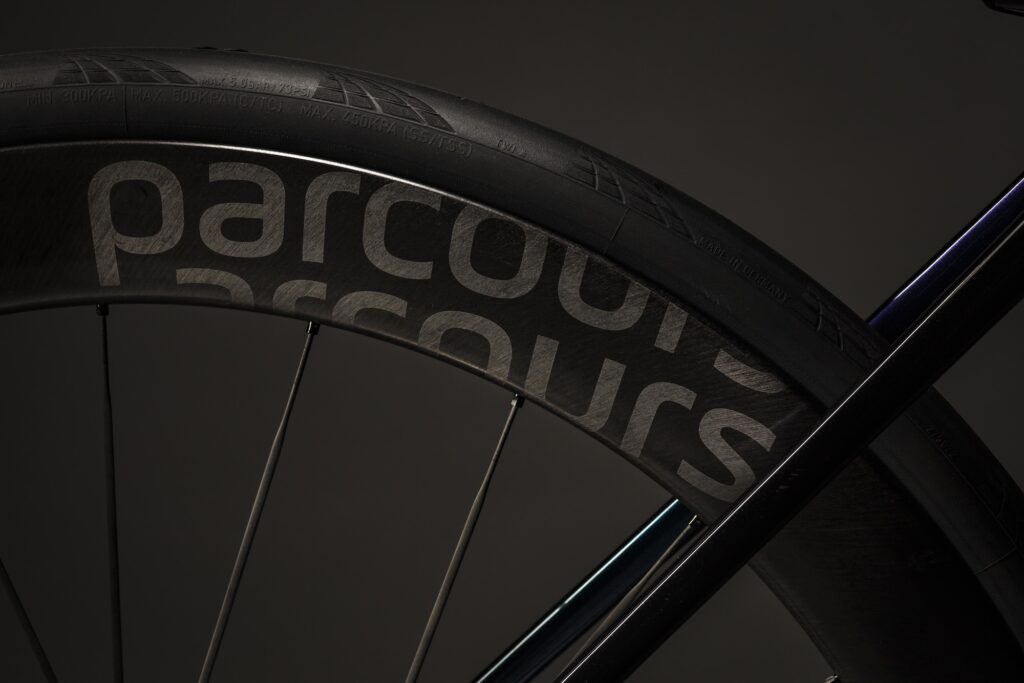
Parcours founder Dov Tate says, “Stiffness often gets marketed as performance, but ultimately it’s a property rather than a pure benefit. Stiffness is only a benefit if it’s appropriate for the application. As an example, a wheel that’s too stiff will deflect less, forcing the tyre to absorb more of the input from the road surface. That changes the behaviour of the contact patch, losing traction, comfort and in the end, speed. Stiffness alone doesn’t make a wheel fast.”
Why roadies love wheel stiffness
The appeal is obvious. When you sprint out of the saddle or wrench the handlebar on a steep climb, you’re loading the wheels laterally and torsionally. Any flex feels like wasted effort. Brands often boast that their new wheels come with increased rigidity and reviews praise wheels for being “stiff and direct.” Roadies learn, early and often, that flex is the enemy. But what most riders mean by stiffness is really feel. And feel is a slippery thing.
When we talk about wheel stiffness, we’re really talking about:
- Lateral stiffness – resistance to side‑to‑side flex
- Radial stiffness – resistance to vertical deflection
- Torsional stiffness – resistance to twisting forces under pedalling or braking
When most of us refer to wheel stiffness, it’s usually lateral stiffness that we have in mind. This is what keeps the rim of your wheel straight when you sprint hard, climb out of the saddle, or throw the bike into a fast corner. A laterally stiff wheel won’t flex much when you rock the bike from side to side, while low lateral stiffness can feel spongy.

“A wheel needs to be stiff enough,” Paddy says. “But as long as nothing is rubbing on the frame in a flat-out sprint, little energy is being lost.
“Stiffness is often more of a feeling than a performance metric. A wheel has got to be stiff enough, but going stiffer and stiffer and stiffer, it’s more of an impedance factor… If it’s stiff enough, it’s not slowing you down, whereas if it’s too stiff, it probably is.”
A bicycle wheel: it’s a work of art
The discussion hinges on how bicycle wheels work. A spoked bicycle wheel is a pre-stressed structure. The spokes are tensioned, and under load they lose tension rather than compress. What matters isn’t just how tight the spokes are.
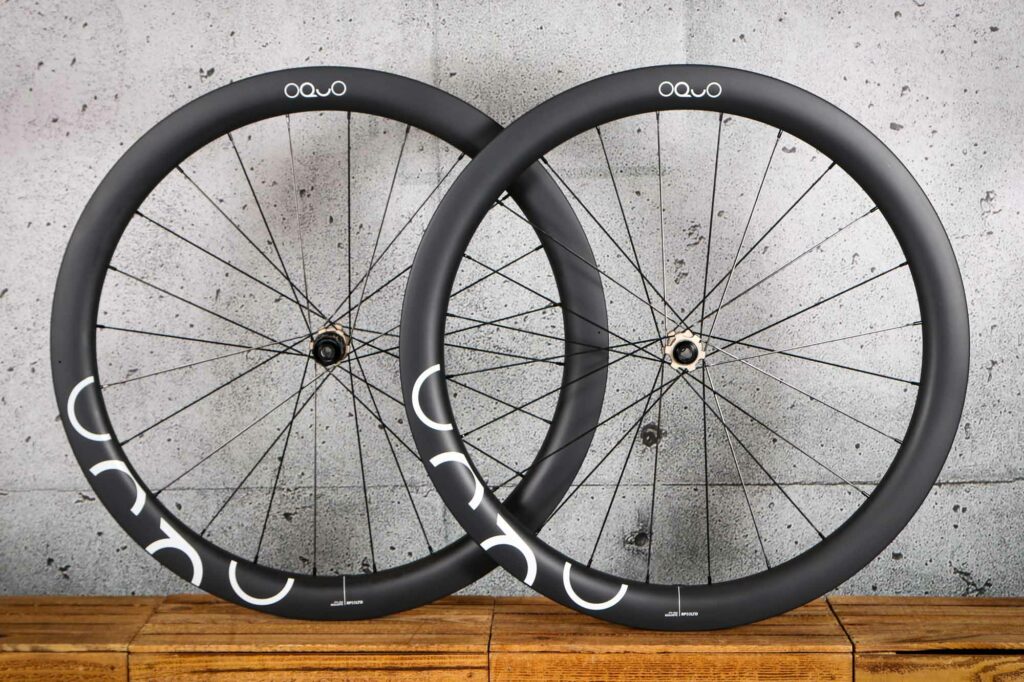
“Spoke tension will have a small effect, but increasing spoke tension won’t make a wheel stiffer in the way most people think,” Paddy explains. “As long as spokes stay within their linear spring range, they give up force evenly. The first 10kg of tension behaves much like the last 10kg. Increasing the spoke tension won’t achieve the goal of making a wheel stiffer.”
Actual stiffness comes from various sources…
Dov says, “A deeper rim (or a wider rim) will increase the second moment of area (I), whilst rim material (material stiffness, E) will also have an impact. Stiffness is proportion to EI. That applies to both radial and lateral stiffness. Radial stiffness has the biggest impact on compliance/comfort, whereas lateral stiffness prevents what riders would perceive as ‘flex’ in the wheel.
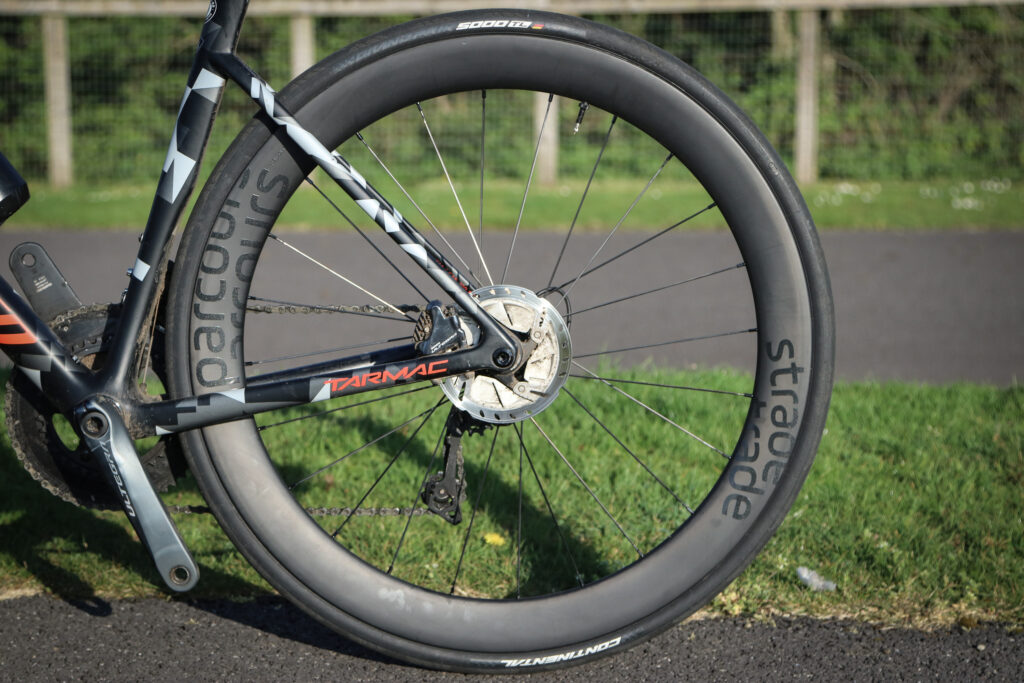
“Material has an impact, but with carbon you can also consider how the lay-up can change the overall stiffness. A well-designed rim can focus more on lateral stiffness without overemphasising radial stiffness, maintaining ride quality.
“Spoke count, gauge and pattern also have an impact, as well as spoke material. Carbon is naturally stiffer than steel, but a thinner gauge carbon spoke may well be less stiff than a super-thick bladed steel spoke. Then you can also add spoke count (higher = stiffer, all else being equal) as well as hub geometry (wider or higher flanges increase the bracing angle to increase lateral stiffness) too.”
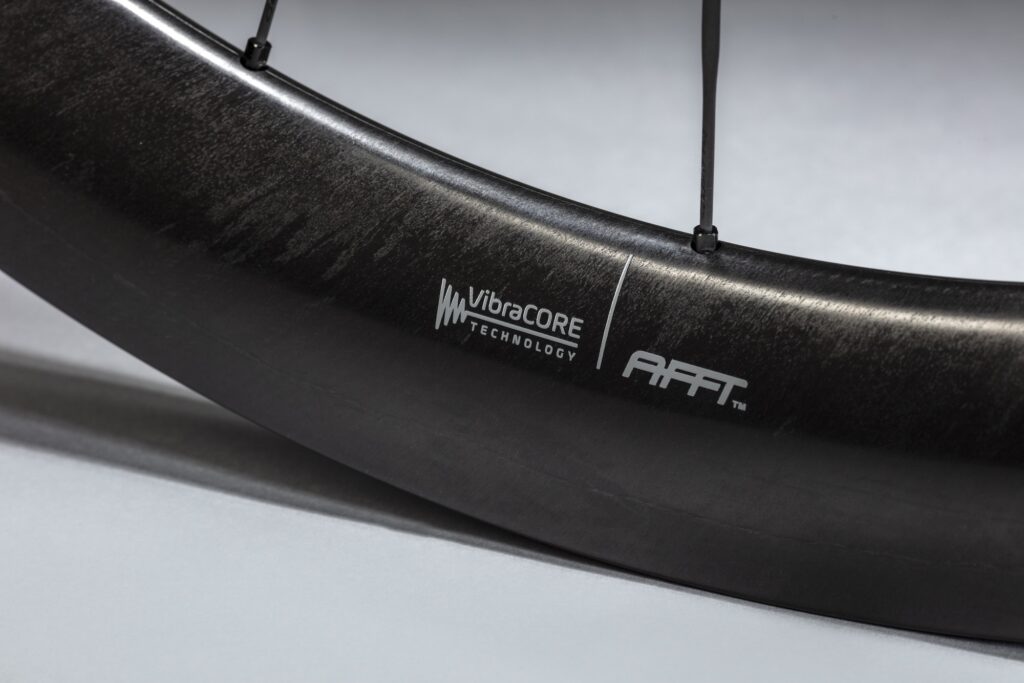
As an adjunct, it’s worth noting here that Parcours has just started using VibraCore tech – incorporating recycled carbon in the rim structure – which is said to reduce the vibrational energy transferred, equivalent to lowering tyre pressure by 10–15psi, without any losses in rolling efficiency or handling precision.
“VibraCore adds another dimension to the discussion as we can introduce a higher level of radial and lateral stiffness without an associated cost in terms of ride comfort.”
Paddy says, “Unless you’re talking about a really deep carbon section, rim stiffness isn’t the main thing. Layup, lacing, and spoke count make a far bigger difference.”
This is where modern wheel design starts to look less like brute force and more like an artform.
Carbon spokes, fewer of them
Take carbon spokes. They’re having a moment, largely because they tick two seductive boxes at once: they can be light and stiff. But even here, the goal isn’t to chase maximum rigidity.
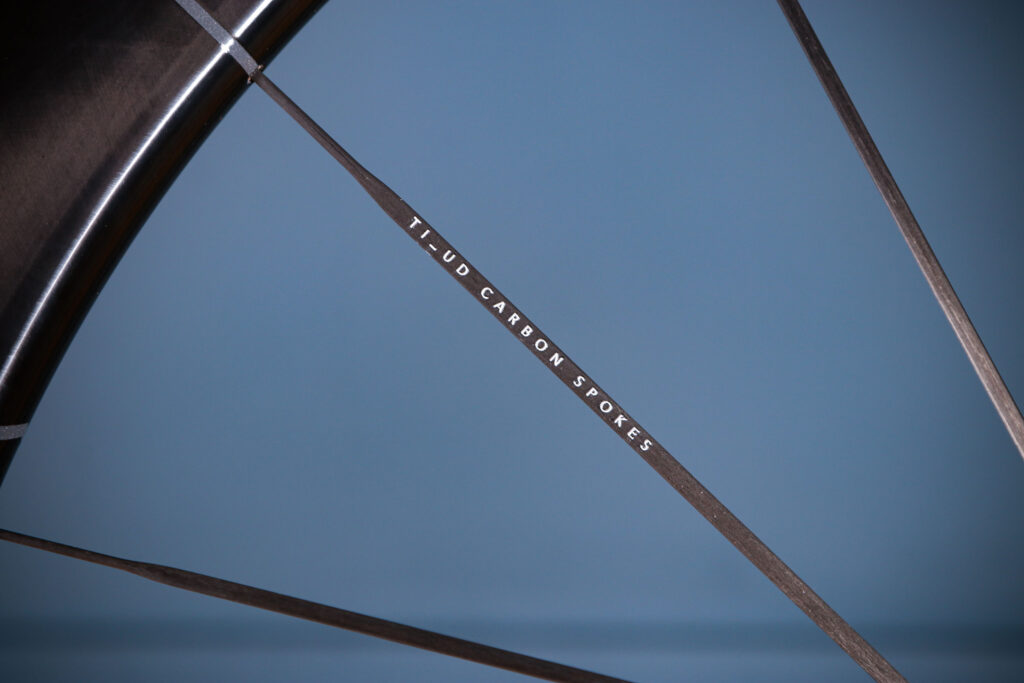
“Not all carbon spokes are the same – we use different gauges and different layups – but typically we see a carbon spoke being about 30% stiffer [than a steel option], so when we load it to tension, we see about 30% less deflection in elongation in that spoke,” Paddy says. “So we tend to use fewer of them at a higher tension to give a similar ride feel. Because of that lower elongation on the spoke, the wheel will be slightly laterally stiffer and feel more sprightly.”
But we’re not talking about a night-and-day difference here.
“I liken it to going down a tyre size,” Paddy says. “Like going from a 30mm to a 28mm tyre. There’s a bit more feedback, but two rides in, you’re probably not going to tell the difference.”
That’s a recurring theme: changes that look dramatic on a spec sheet often fade into the background once tyres, pressure, and roads enter the mix.
Playing tricks with spokes and hubs
Things get really interesting when engineers use asymmetry to tune stiffness and tension. Clearly, your bike isn’t symmetrical. First of all, there’s the drivetrain to consider, and these days there’s a good chance that it has disc brakes, and wheel designers need to take this into account.
“Typically, you’re looking for the most even balance and spoke tension across the wheel,” says Paddy. “For most front disc wheels, the difference between the sides is small enough that you can get away with using a one-to-one pattern [an equal number of spokes on each side], and that gives you the most even spoke tension, but that often requires not using just one hub flange diameter. Your disc-side flange has to be a certain size, whereas your non-disc side [the drive side] front flange can be much smaller because there’s just a small bearing in there.”
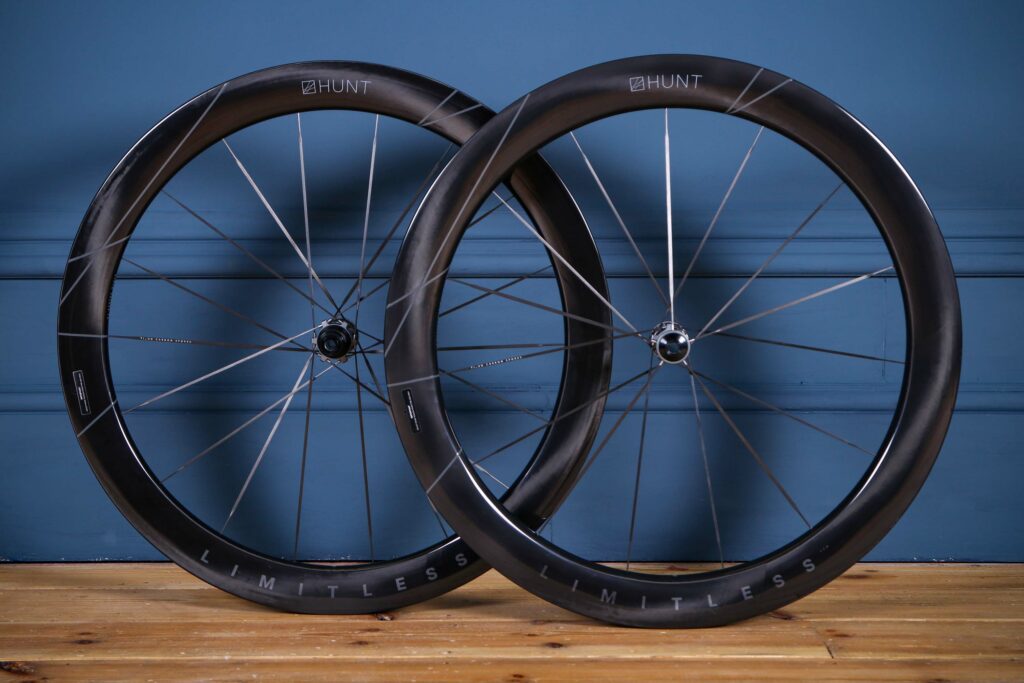
We recently told you about Hunt’s 5AM Limitless wheelset. The front wheel comes with just five spokes going to one side of the hub and 10 to the other.
“On our two-to-one lacing, the five radial spokes on one side actually have more carbon in them than the 10 on the other side,” explains Rob Fields, Hunt’s head of engineering and product.
Each spoke on that side uses more carbon tows – bundles of individual carbon fibre filaments – to balance tension and load across the wheel. Fewer spokes, but each doing more work.
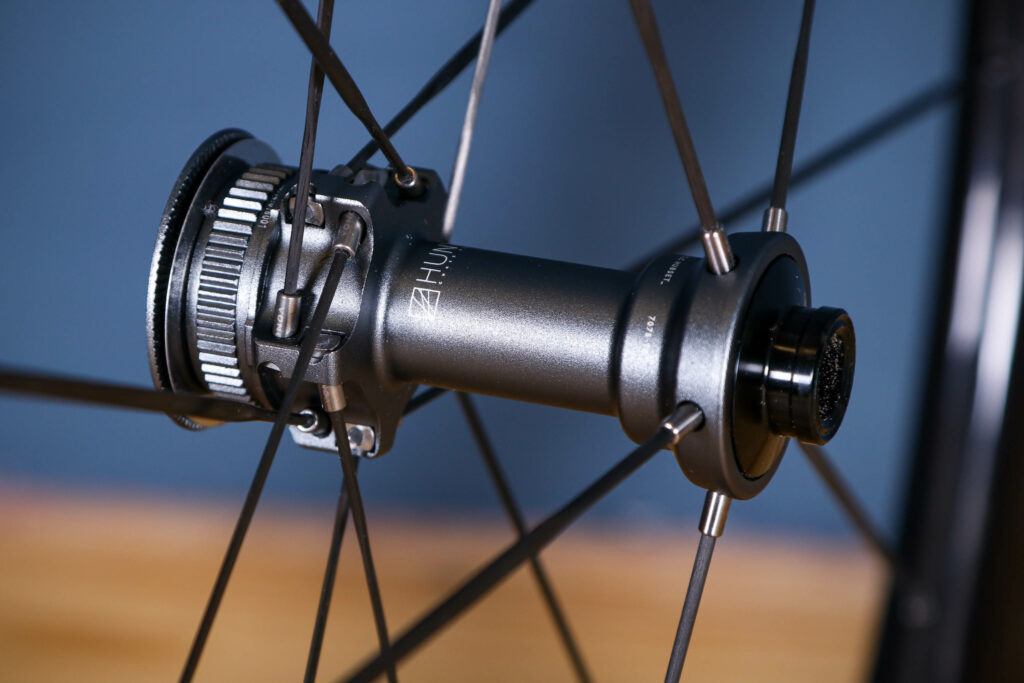
“I’ve not seen anyone else pairing different carbon spokes on the same wheelset. I’m not saying someone else isn’t doing it, but I haven’t seen it yet.”
This kind of tuning allows designers to chase aero gains without ending up with floppy wheels or wildly uneven tension.
“On our new top-end wheels, dropping the number of spokes has meant that we can have a very balanced spoke tension with a slightly larger disc-side flange at the front,” says Paddy.
“In this case, having fewer spokes gives us a big aero advantage, and that was something we were chasing. This is a way of playing with the geometry of the hub and the spokes to achieve a really low spoke count while also having very high tension in all of the spokes.
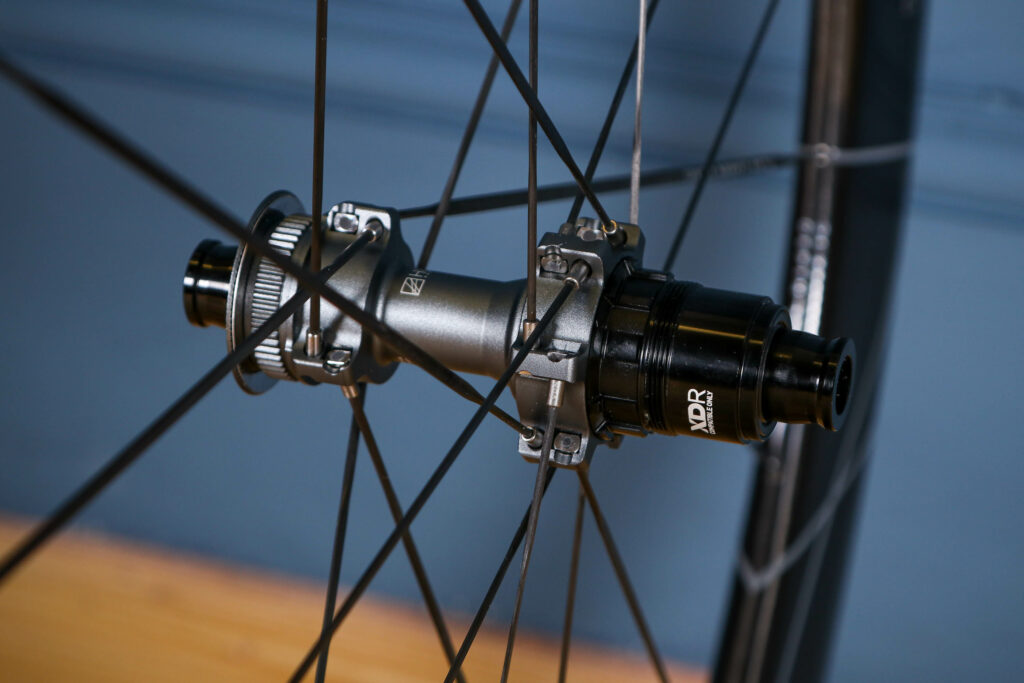
“That’s just one example. At the rear, you’ll often have a larger flange on the driveside because you’re facilitating all of the internal guts of the freehub and the drive system. You often see non-driveside flanges on one-to-one wheels being larger than is strictly necessary to package the wheel, so you can have a more even spoke tension, but that comes with a weight penalty.
“On our really high-end stuff, we’ve gone two-to-one there as well, because that lets us reduce the size of the flange, and to let the driveside do most of the rotational work and have an equal lateral force on both sides.”
It’s all getting quite technical. Isn’t there a safety/durability issue to be considered when you drop down to just five spokes going to one side of the wheel, though?
“If you break one of these high-tension carbon spokes, there’s not very much clearance in a modern road frame for that wheel to go round,” says Paddy. “If you’re in a bike race and you break a spoke, that’s probably your day done – unless you’re a professional and you can just get a new wheel.
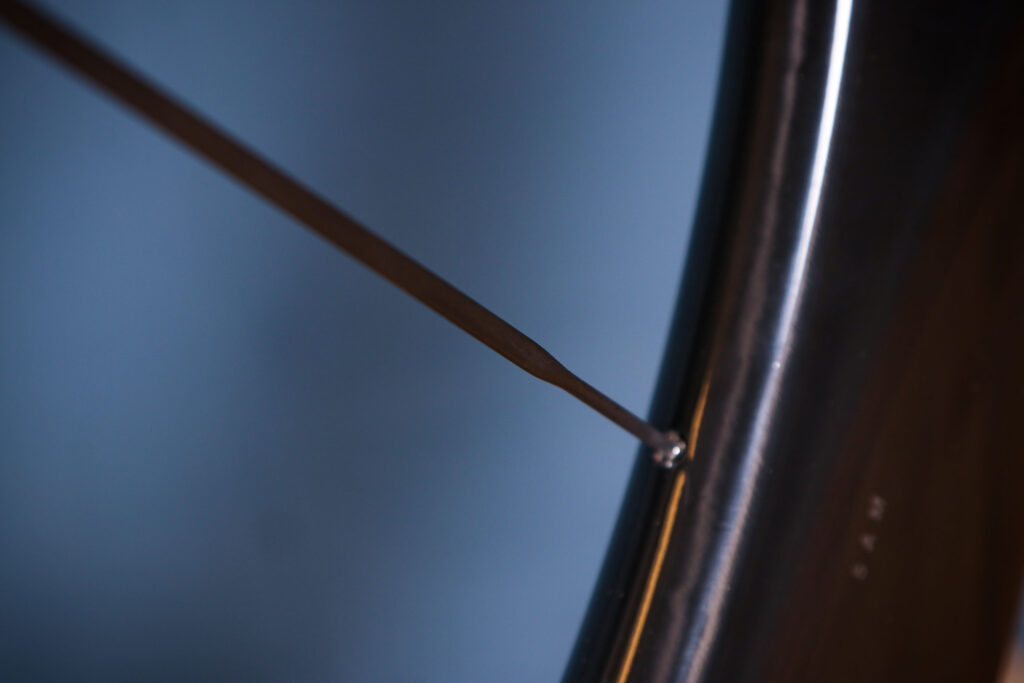
“Also, the carbon spokes are not trueable from the outside. You would need to take the rim tape off to true it, and that is the case with every carbon spoke on the market at the moment that I’m aware of.
“However, they’re the same spokes that we use on our mountain bike wheels and they’re significantly stronger than steel spokes. It’s not something that we will roll out across our entire range, but for a high-performance product, it’s a trade-off that we are making. These are the sort of trade-offs implicit in using some of this cutting-edge tech that saves you a couple of hundred grams out of a wheelset.”
And then there are the tyres
Even with all this nuance, wheels are only one part of the equation.
“If you model the system as lots of different springs, you’ve got frames, forks, wheels, and then this great big rubbery tyre around the outside of it which has the biggest impact on that ride buzz feel,” says Rob.

That’s why wheel stiffness is so hard to isolate in the real world. You might change the tyre make/model or width, and something as simple to control as tyre pressure has a big influence on how your bike feels. All of these elements can get mixed together in your perception, and two riders can use the same wheelset and come away with completely different impressions.
“You’ll hear someone describe a wheel as ’stiff and direct,’ but what does that mean to me?” Rob asks. “Your ’stiff and direct’ is probably different from mine.”
The rider changes things
Now add a rider into the equation. A 60kg climber dancing up a mountain and a 85kg sprinter aren’t asking the same thing of a wheel, so does the right level of stiffness vary according to the rider?

“Yes, although with a caveat,” says Dov. “Clearly, a heavier rider with a higher power output will put more force through a wheel, so optimal stiffness will increase accordingly. However, when you then consider the trade-offs (reduced compliance, increased fatigue), you may not want to go all-in on pure stiffness. You’ve also got to consider the overall system (including the tyre and tyre pressure) which complicates things further.”
And what about the type of riding you do?

“The benefit of increased stiffness varies according to use case, yes,” says Dov. “On smooth tarmac, high lateral stiffness is a genuine benefit, especially in a road sprint scenario where lateral forces are high and you want power transfer to be as efficient as possible. However, roads are rarely ideal and max sprint efforts aren’t a regular feature of most rides. That changes things such that a super-stiff wheel might not be the fastest on the road.
“Moving into gravel, you see even more of a demand for compliance. This goes further in the mountain bike world, although that’s not an area of expertise given Parcours’ focus on road and gravel.”

Heavier mountain bikers might gravitate toward burlier wheels, while smaller riders can get away with lighter setups without noticing a whole lot of difference.
“We put rider weight limits on things as a rough guide, but it’s all on a continuum,” Paddy says. “What you ride, how you ride, where you ride – it all matters.”
Can stiffness work against you?
“The wheel needs to be stiff enough that it’s not flexing too much, but beyond a certain point, that extra rigidity of the wheel is probably actually just leading you either to reduce your tyre pressure or causing it to skip more across rough surfaces,” says Paddy.
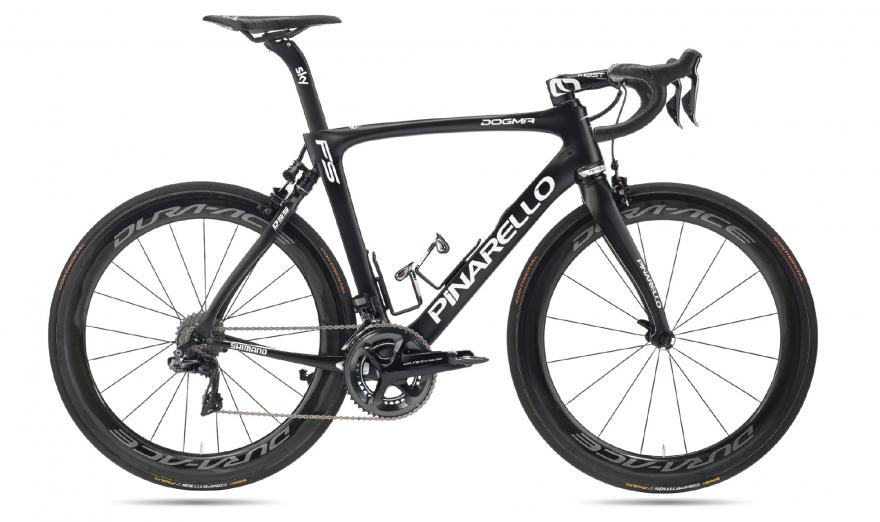
If your wheel skips, grip suffers, and power delivery becomes inconsistent. This has been considered at the very highest levels of racing. Paddy points to experiments done during the Team Sky era, when riders were encouraged to sprint on the suspension version of the Pinarello Dogma because the bike stayed in contact with the ground better.

“The riders didn’t like it because it was heavy, but the idea was sound,” says Paddy.
“It also depends on where you ride,” Paddy adds. “North of Scotland versus Southern Spain: these are very different road conditions, and what optimal looks like will be completely different.”
So… should you care?
As mentioned earlier, wheel stiffness is often more about feel than efficiency or speed. That doesn’t mean stiffness is irrelevant. It means it has a floor, below which wheels feel vague and unpleasant.
Keep making wheels stiffer and stiffer, though, and differences become marginal – and sometimes negative.
Instead of asking whether a wheel is stiff, it’s better to ask whether it’s stiff enough for your weight, your roads, your tyre choices, your riding style… All of this feeds into what feels fast and confident.
Focusing on wheel stiffness for its own sake is a dead end. Looking for balance is where the real gains live.
So what should we be looking for when we buy a wheel? We’ll leave the last word to Dov.
“The honest answer is that it depends on how and where you ride. If you’re a sprinter looking to win a WorldTour stage, you’ll prioritise lateral stiffness above all else, whilst most riders will likely prefer a more radially-compliant build. Overall, I’d suggest that if the manufacturer can at least explain and justify their product and the decisions that went into the specification then you’re likely on the right track, versus one who just uses ‘stiffness’ as a selling point and equating it to performance.”











5 thoughts on “Stiffer wheels, better rides? Not always – and here’s why”
I cant help but feel this was talked about years ago before them pesky disc brakes appeared making spoke count higher and spoke tension lower so you dont tear the wheel apart under braking. Now its talked about like its revolutionary
Isn’t that in the nature of wheels?
Indeed, it’s one of those issues that seem to go around in cycles.
I mean, thats kind of how things work. The bike industry has been alternating between lighter and more aero for a few years now. You make a bike more aero then you try and make it lighter. Then you do it again and again. If it was that easy to do, they would all have been doing it from the start “hey, just make that bike really light and really aero”.
If it was that simple to do what they are doing now, they would have done it 10 years ago. The engineering challenges on rim vs disc bikes are very different and it takes time to address the pitfalls.
I’m not convinced by the “too stiff” arguments portrayed as usually the tyre deflection amount will dwarf the amount that spokes deflect. I can appreciate that if the wheel is “skipping”, then you’re going to be wasting energy, but that seems more of an argument to reduce tyre pressure than to introduce flex into the wheels themselves.
I’d like to see some actual testing numbers around wheels, lateral stiffness and deflection amounts.
(The vibration absorption of different carbon lay-ups sounds reasonable to me, though)