


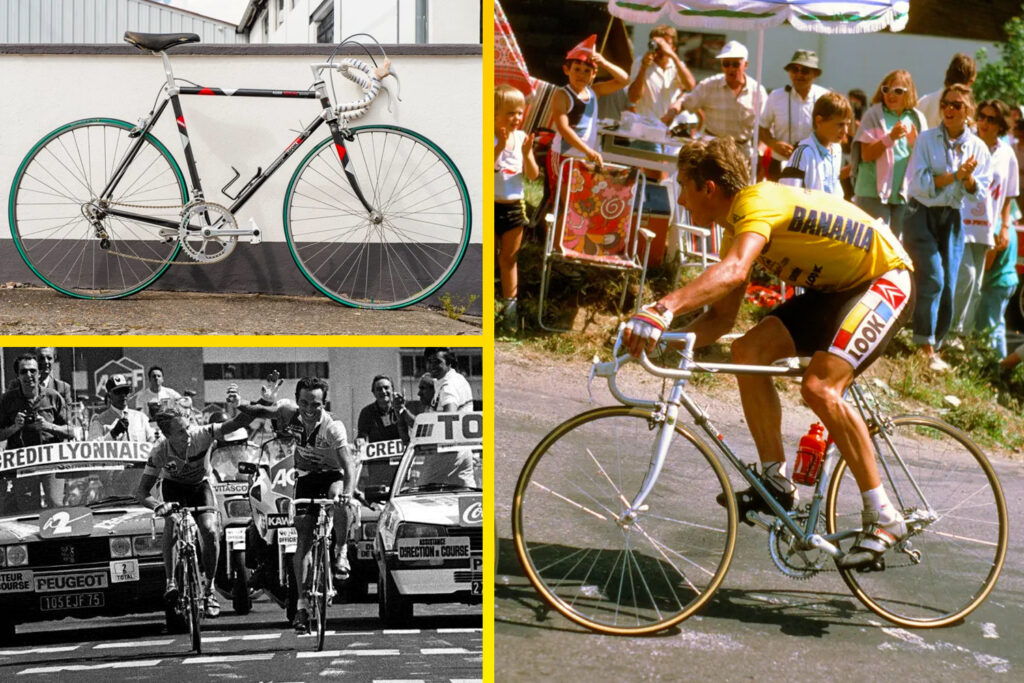

Greg LeMond’s 1986 Tour de France-winning Look KG86 ended an unbroken line of winning steel-framed bikes that stretched back to the first edition in 1903. It was also a first for carbon fibre too, featuring carbon fibre tubes and aluminium lugs, joined together using aerospace glues. It was also the first bike that Look had built using these materials and this technique.
It was a technique first used by ALAN Bike, from Padua, Italy, in 1976. Since their formation in 1972, they had used aluminium tubes and lugs joined together using aerospace-grade glues. By 1976 they had started to use Toray Industries carbon fibre tubes for the main triangle.
French brand Vitus had also begun to experiment with carbon-tubed/bonded frames in the late 1970s. It is worth noting that early bonded frames were very light, but that inconsistent manufacturing and primitive adhesives could mean that some were prone to bonding failures.
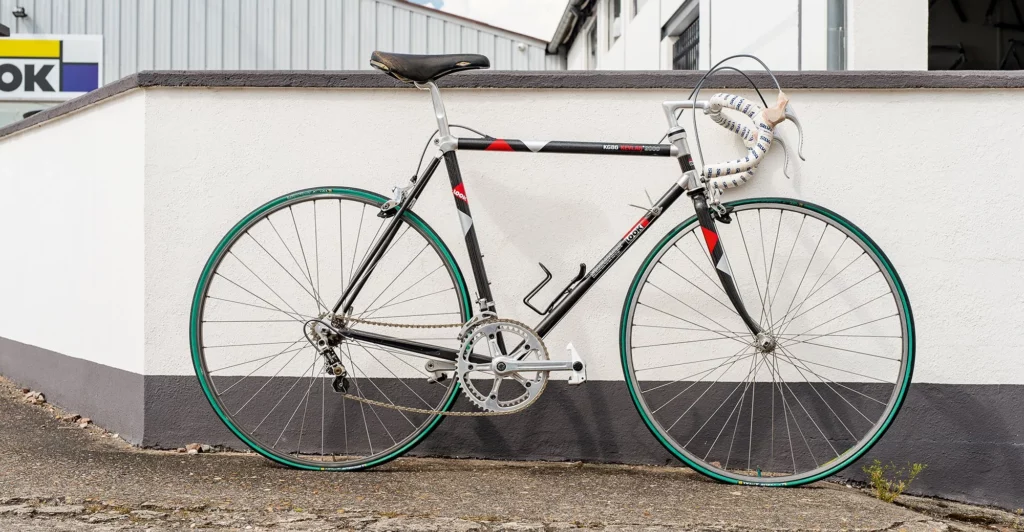
By the mid 1980s Look had decided, in great secrecy, to develop their own design. The KG86 was built by hand in their Nevers (France) headquarters.
Whilst the frame still used aluminium lugs, this design used carbon fibre tubes for the main triangle, head tube and chainstays, as well as the fork. The tubing came from TVT (Technique du Verre Tissé) who had developed a method of wrapping carbon fibre sheets around a pressurised bladder to create a strong and lightweight tubing for aerospace use. Kevlar was also introduced to the carbon fibre to bring more stiffness and improve the handling of the bike.
LeMond’s KG86 was fitted with a Campagnolo C-Record groupset, tubular tyres, and also featured the Look PP65 clipless pedals that Bernard Hinault had debuted the previous year.
Interestingly, in 1987 Trek brought out its first carbon fibre tubed bike, the 2500. It used three carbon tubes for the main triangle, bonded into aluminium lugs, much like the ALAN – however it developed the technology further creating the OCLV (Optimum Compaction, Low Void) process to make monocoque frames, and in 1992 released the 5500 model. This eventually went on to win the 1999 Tour with the (now disgraced) Lance Armstrong, and it was the first monocoque carbon fibre bike to do so.
1986 Tour de France: The rivalry
Since the late ’70s Hinault had dominated the Tour, and in 1985, as team leader of La Vie Claire, he was chasing a record-tying fifth victory. The younger LeMond, who was strong enough to win, was ordered to help Hinault secure this victory, which he did. A grateful Hinault promised that the next year, 1986, he would return the favour and help Lemond to victory.
The betrayal
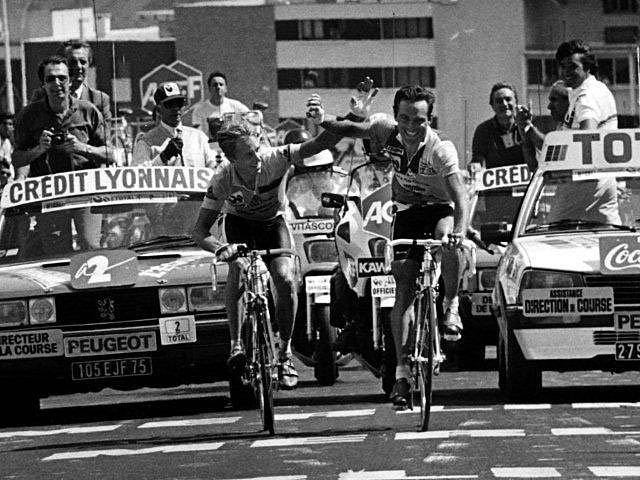
Despite his promise to help LeMond, Hinault repeatedly attacked his teammate, but claimed that he was “soften[ing] up” the peloton! LeMond felt that the attacks and aggressive racing was in breach of their prior agreement. The two teammates broke away from the peloton on stage 18, over the Alpe d’Huez, showing an astonishing display of dominance. They crossed the finish line arm in arm. However Hinault made LeMond fight all the way to Paris, but in the end it was LeMond who clinched the title for the 1986 Tour de France. It was the first victory for the American rider, and ended Hinault’s reign, who retired at the end of the season.
1989 victory









4 thoughts on “Remembering Greg LeMond’s Look KG86 from 1986, the first carbon fibre bike to be ridden to Tour de France victory”
“Greg LeMond’s Look KG86 from 1986, the first bike at the Tour de France featuring carbon fibre”
Uhm, no. There were carbon tubed bikes at the Tour before this, earlier in the 80s. E.g., David Millar rode a Vitus made, Peugeot branded bike in 1984. Which is hanging up in Billy Bilsland’s (well, Neil Bilsland’s now 😉 ) bike shop in Glasgow now. That may not have been the first carbon tubed bike in the Tour either.
Road.cc should be aware of that, cause you did a story on that bike before! Search for “Glasgow bike shop acquires Robert Millar’s 1984 King of the Mountains bike” on road.cc!
I’ll add a link in a follow up comment, as anything with a link gets stuck in moderation forever.
Road.cc’s own story on Millar’s ’84 “Peugeot” Vitus-made carbon bike: https://road.cc/content/news/107781-glasgow-bike-shop-acquires-robert-millar%E2%80%99s-1984-king-mountains-bike
@Paul J Think that’s just a slip of thought rather than a lack of knowledge, the subheading gets it right, “the first bike frame made out of something other than steel to be piloted to Tour de France victory”. They clearly meant “The first winning bike at the Tour de France featuring carbon fibre.”
LeMond seeming to gift the stage win on the Alpe d’Huez to Hinault was a power play, LeMond showing his confidence that Hinault would not beat him. Hinault’s forced smile shows he knows it. The badger could no longer dominate.