


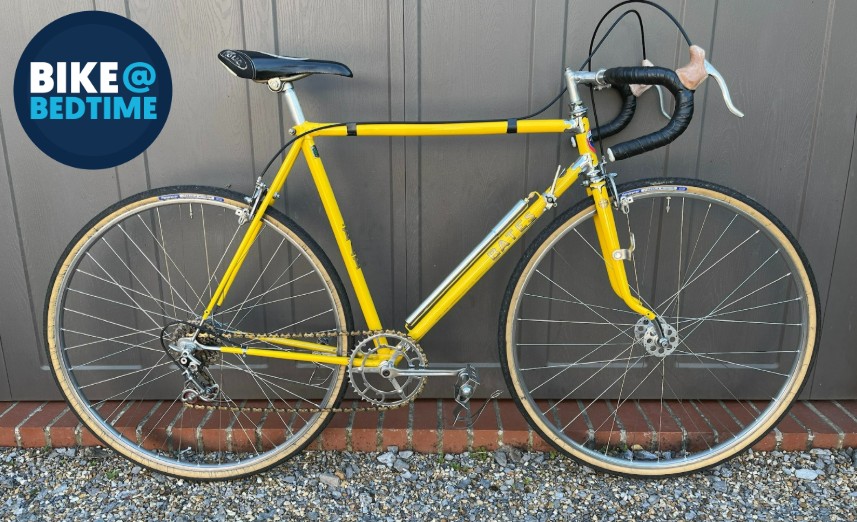

When this bike was found in a garage, it was in a sorry state. With cheap 1970s components and the original frame paint long since gone, it was in sore need of a restoration. It was sold to the current owner, Dave Duke, by a friend. Dave instantly recognised the Diadrant fork that was such a distinctive feature of the Bates bikes of the time. The frame number meant that it was a B.A.R. or ‘Best All Rounder’ model as it had a ‘U’ prefix, and that it had been built in 1948.
These frames used Cantiflex tubing, a variant of Reynolds 531. This was a steel tube which had a larger diameter in the middle of the tube, to increase stiffness, whilst still being able to use standard sized lugs. Cantiflex tubes had been patented by Bates and were exclusive to them. This frame has Cantiflex tubes on the top tube and down tube only, whilst the seat tube is a straight 531 tube.
It was the Diadrant fork that was such a unique visual feature associated with Bates Cycles. At the time amateur racers couldn’t ride with a maker’s name visible on the frame and be featured in the cycling press, as strict rules were in place banning commercial advertising. That meant that certain makes, such as Bates, Hetchins and Pari to name a few, were inclined to add highly distinctive features that readers could identify even without names being present.
The fork was also said to provide some extra compliance and bump-taming, so it wasn’t all for show. The ‘Best All Rounder’ moniker and the addition of features such as the unique fork and the Cantiflex tubing shows that the concepts of allroad and ‘one bike to do it all’ aren’t exactly new things – even if genre-blurring technologies such as disc brakes, tubeless tyres and modern suspension forks were a long way off in 1948.
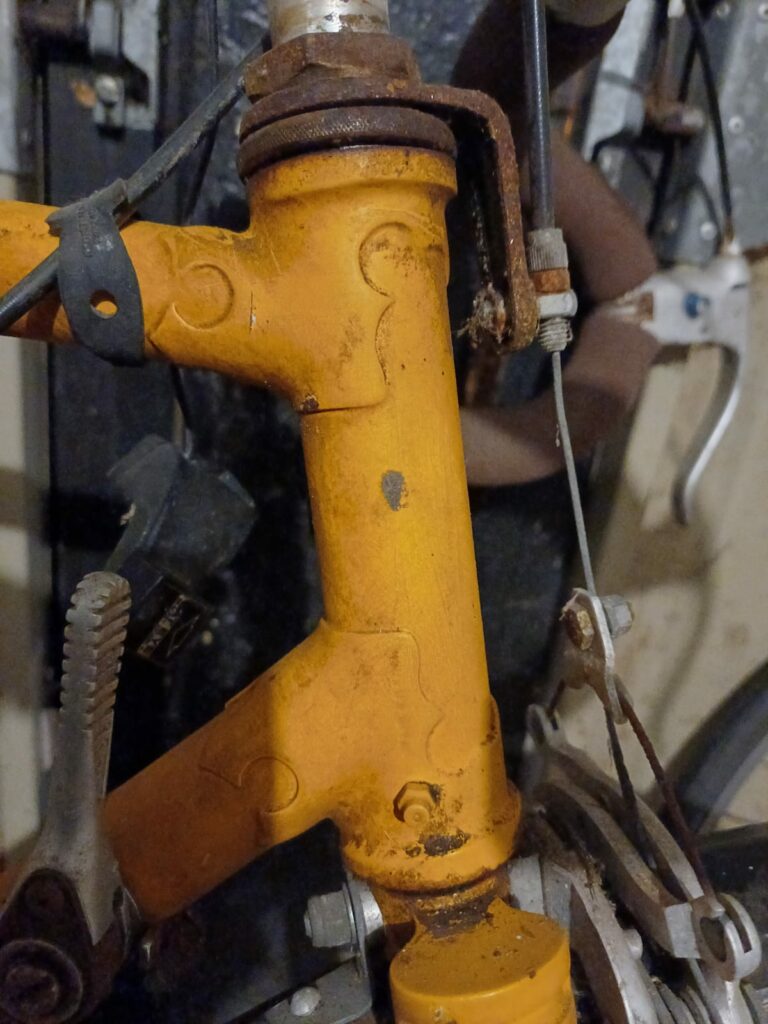
So, what colour to paint it? A dash of colour on the steerer tube gave a clue. Then a chance meeting with a fellow Bates owner from Portsmouth, who had a B.A.R. in the original yellow and was five frame numbers apart from this one corroborated the choice. Yellow!
With the chances that both bikes may have been built in the same week, it was possible that a batch had been painted at the same time too. This couldn’t be confirmed after this amount of time, but it made good sense. That dash of original paint had made the difference. The frame needed retracking, as well as having a dent or two filled. All the work was done by Atlantic Boulevard in Bury. Atlantic Boulevard also confirmed that the straight, and non-cantiflex, seat tube appeared to be the original one too.
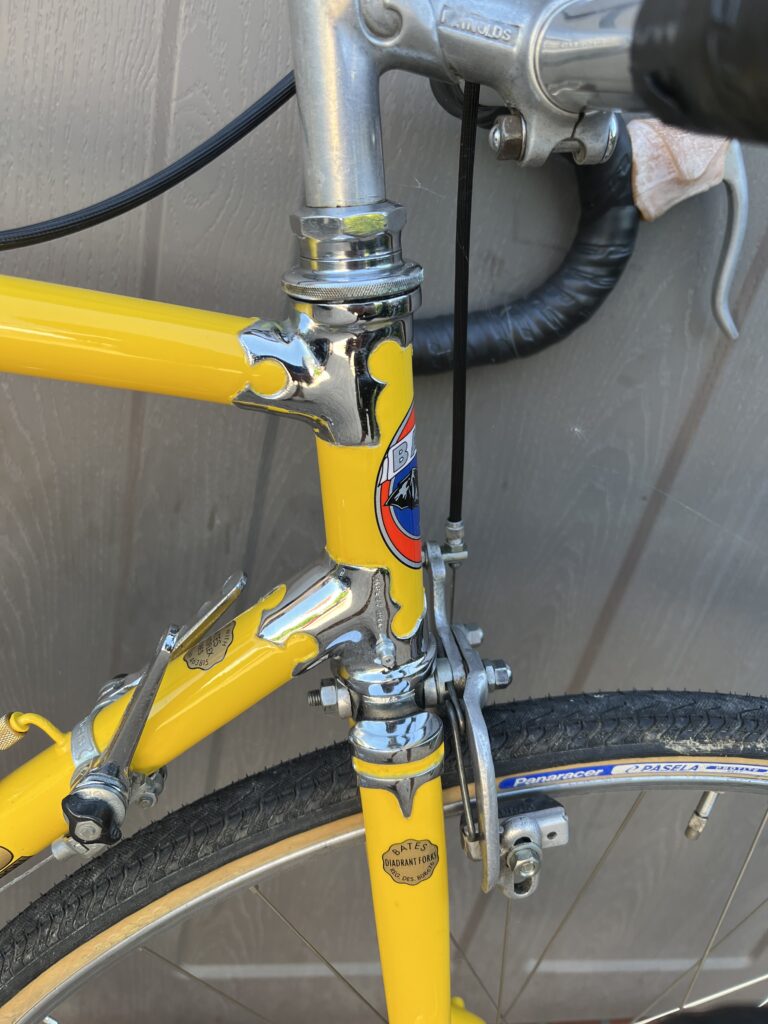
As part of the restoration, the head tube lugwork, fork crown, fork and rear ends were chromed before the paint was applied. The period correct waterslide transfers were sourced to finish off this stage of the restoration.
Band-on shifter and cable guides were used, as rear derailleur gearing was wanted for this build. Originally the bike was likely to have been either a single speed or a 3-speed Sturmey Archer hub, as was common at the time. Dave decided to used a more modern parallelogram design, a Huret Svelto, rather than a Benelux reverse plunger type of rear derailleur to make it more usable.
Interestingly, the Bates catalogue from the time had Simplex Professional, Cyclo or to order as options too. This was for the ‘Super’ model however. As was common at the time, the derailleur hanger is a bolt-on attachment. Dave is still waiting to fit the top tube cable clamps, which will be finished soon. Some insulation tape was used as a temporary shakedown ride alternative.
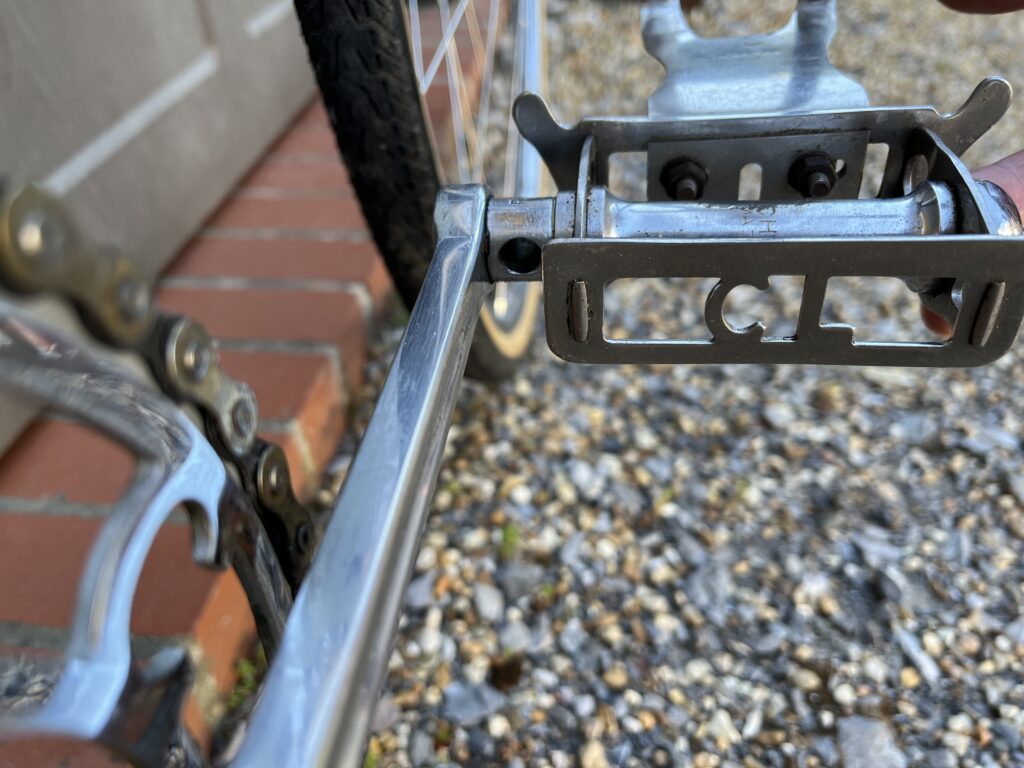
The bottom bracket shell features a grease port to keep the bearings in good condition, and the Chater Lea single ring chainset uses the cotter pin system to join the crank to the bottom bracket axle. The Chater Lea pedals have a hole through the axle rather than the more common 15mm spanner flats. This is to allow a ‘Tommy bar’ to be slid in when removal is required.
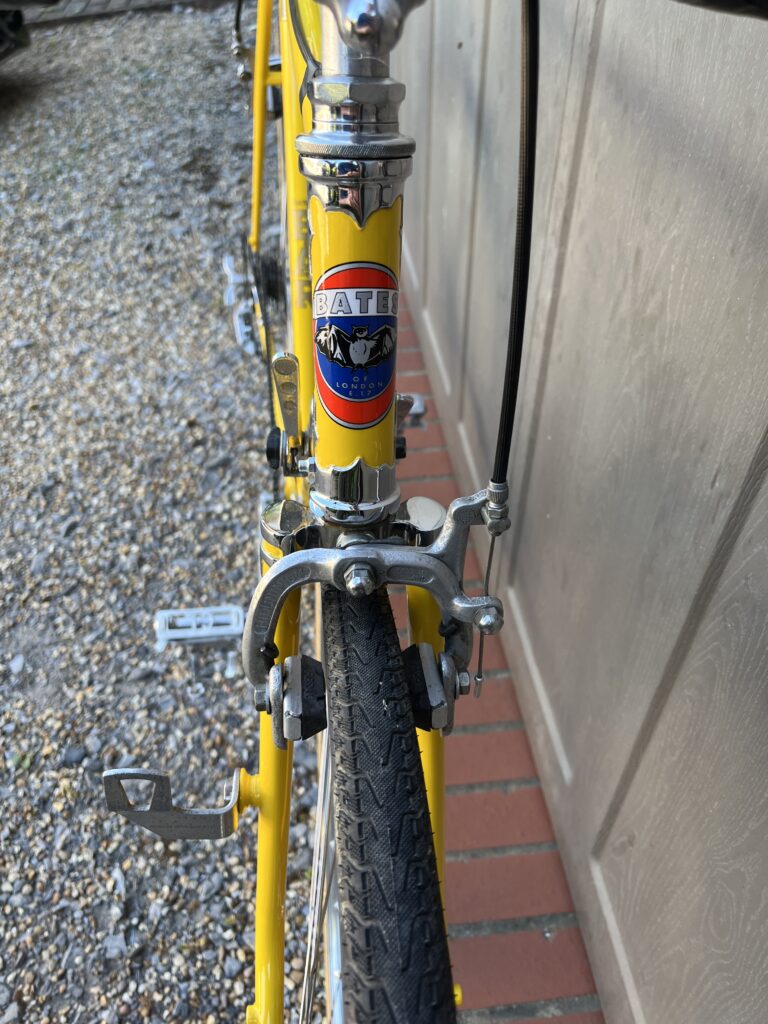
The headbadge, which reads ‘Bates of London, E17’ prominently, features the Bates Bat emblem. From 1927 until 1947, Horace Bates had been in business with his brother Eddie (E. G. Bates), but a split in 1947 meant that Eddie kept the Barking Road shop, when he formed E. G. Bates Cycles, and Horace retained the other shops.
As with other brands at the time, the lightweight bike boom started to end in the 1950s. By 1954, Horace was forced to scale back his operation, and he moved to a single shop in Westcliffe-on-Sea, Essex. Although Bates (of Westcliffe) still made frames, their output had dropped to a mere 130 frames from 1956 to 1963.
The brake levers and calipers are from GB. This brand was formed by Gerry Burgess and they used hiduminium alloy to create their components. They were amongst the first to use post-war aluminium scrap, supposedly from military aircraft, to create their brakes. The hiduminium had a higher proportion of magnesium in the aluminium alloy than normal. and resulted in the dull grey finish. Apparently it can’t be polished up to a shiny finish either.
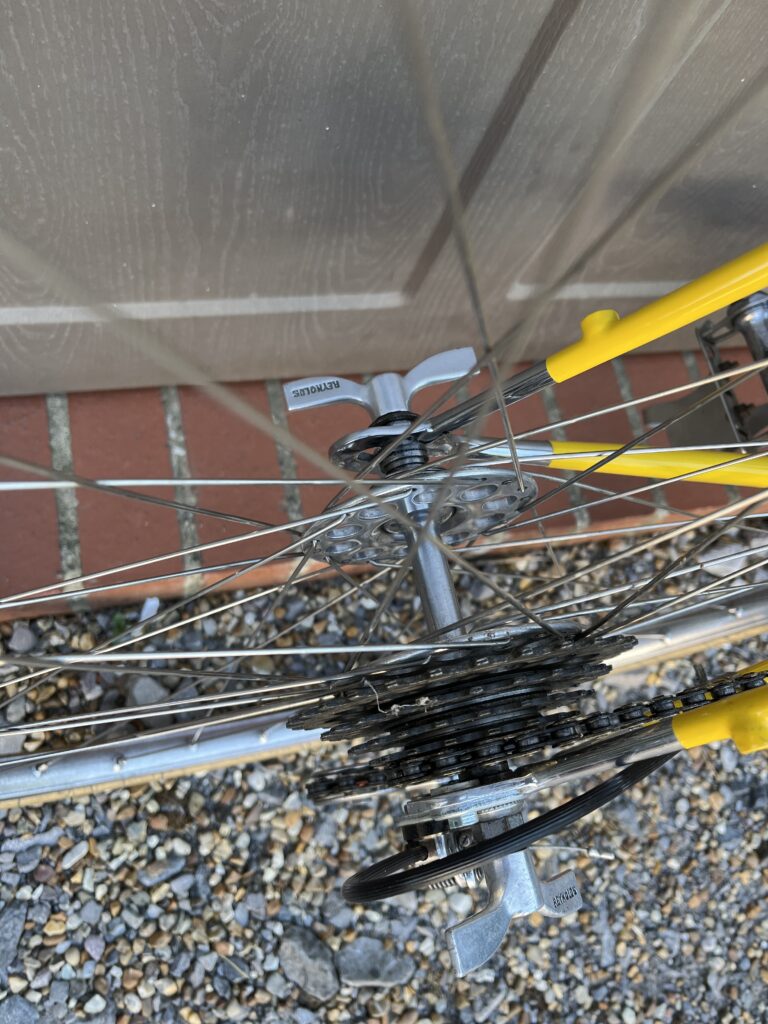
The large flange Airlite hubs have been paired with Weinmann Alesia aluminium 27″ rims. They ideally needed to be joined using older 14/15/16 gauge spokes, which are slightly thinner than modern spokes.
Whilst the spoke holes could be drilled larger, it was advised against by the wheel builder as he thought it could weaken the build. Reynolds wing nuts are used to keep both wheels in place.
The Bates Catalogue from 1949 gives the price of the frame and fork, complete with head and bracket assembled and seat pin as £14 17s 6d, which would be roughly £750 in 2026. Chrome forks would cost an extra 27s 6d (around £70 today), whereas a chromed fork crown was 6s (£15). To put this in context, in 1947 the average weekly wage for an adult male industrial worker in the UK was about £6 8s, the equivalent of around £330-340 (2026).
Dave reports that the B.A.R. “rides brilliantly”, and with its steeper frame angles it responds well to steering input. He says that this racing model from the Bates range really “wants to go”. All in all it’s a very pretty bike which, despite being nearly 80 years old, can still be ridden with great alacrity!
For more curiosities, check out our Bike at Bedtime archive here
















2 thoughts on “One of the first bikes to do it all: A deep dive into this lovingly restored Bates B.A.R. from 1948”
I just love these old, beautiful, hand crafted bikes! From the artistic head badges to the striking, sculpted lugs. However, I noticed in the original rusty photo, the brakes are center pull and ‘new’ brakes are side pull. Which did it originally come with? I did see, of course, that you did make some changes from the original.
Whereas I want brazed or welded steel or titanium. When we had to have tight fitting lugs for 753, I wanted the lugs as plain as possible. Just as well people have different tastes. I had a hankering for 953 frame and fork but eventually reconciled myself to a carbon fork when I found that they didn’t, after all, crack or turn into carbon dust after a couple of years – I now have a carbon fork which seems fine after 26 years. Then I found that the steel for 953 had to come from the USA, and production is now paused due to tariff wars, so I switched consideration to 853. Then I found that the steel for 853 has to come from Germany, so I thought ‘Sod it, I’ll go for Fairlight 853 welded in Taiwan’ which is the present plan.