


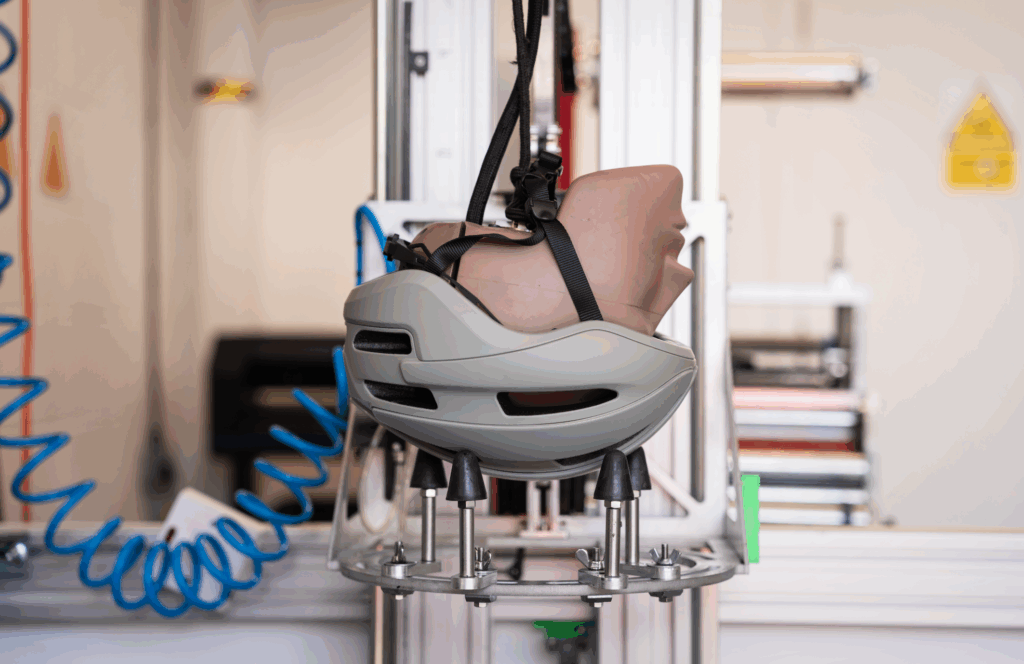

Canyon has become the first brand to include the new RLS (Release Layer System) in its cycling helmets, a new technology designed to reduce concussion risk by addressing rotational forces during impact. The people behind RLS claim their own studies show the tech can lower the risk of concussion by around four times compared with conventional helmets, and the first helmet to feature it – the Canyon Deflectr Trail – is currently ranked number one on Virginia Tech’s helmet ratings.
What is RLS, and how does it work?
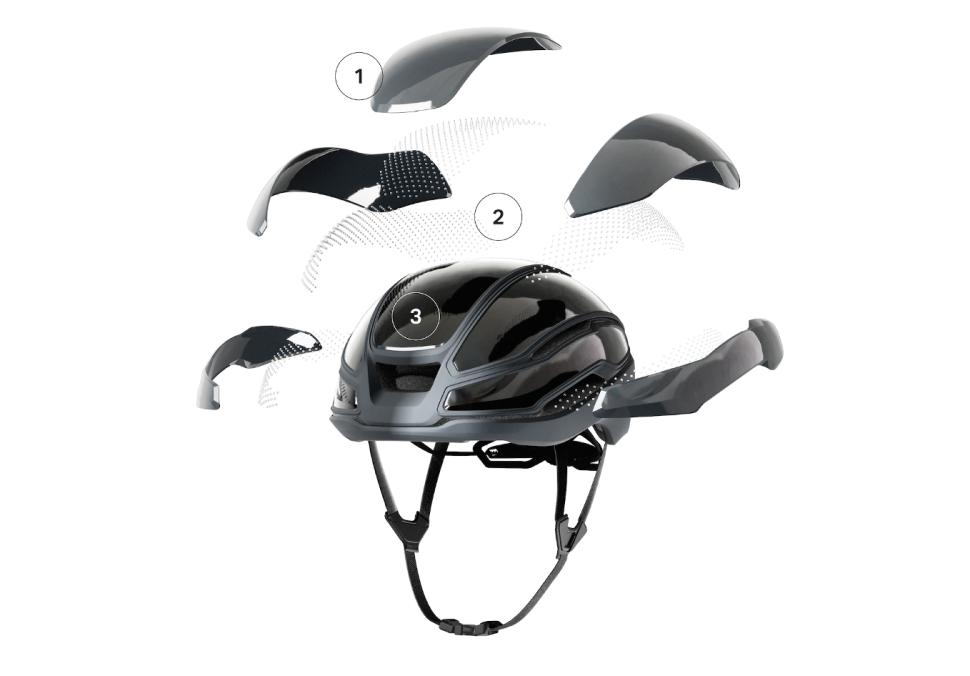
RLS stands for Release Layer System. It’s a new patented helmet technology developed by engineers in East London to reduce concussion risk. It works by allowing panels on the exterior of a helmet to roll and release upon impact, a design intended to dissipate rotational force that can cause life-changing brain injuries.
While addressing rotational forces isn’t new (systems like MIPS and WaveCel have offered solutions for several years), RLS takes a different approach. A patented layer under the helmet shell activates when a significant impact is detected, allowing the panels to release their grip, roll on lightweight bearings, and further redirect rotational energy away from the brain.

We asked what happens if the panels of the helmet release after an impact. The PR company representing RLS gave us this detailed response: “If the panels have been released due to a crash, we hope you’re ok. And yes, now it’s time to replace your helmet. In other words: Release. Rejoice. Replace.
“If the panels have been released and your helmet was not involved in an accident or damaged by a significant impact, it is possible to reattach a panel using the original Dual Lock connectors. Simply re-position the panel in its original location and apply gentle pressure to snap it in place.
“If you have any doubts about the condition of your helmet or the RLS panels, it should be replaced… If a panel is missing or incorrectly attached, the helmet will perform like a conventional helmet in some impacts.”
So, while minor issues may be fixable, any helmet involved in a serious impact should be replaced, as is usually the case.
The RLS back story
We’re told that RLS was discovered ‘almost by accident’. Founder Jamie Cook (also co-founder of HEXR, the 3D-printed custom helmet company) noticed that in one crash, an outer shell of a 3D-printed helmet released and dramatically reduced rotational forces. Cook and his team then developed a controlled method of release using small lightweight bearings, which became RLS.
The first RLS-equipped helmet to hit the market will be the Canyon Deflectr Trail helmet, releasing this autumn. Canyon worked closely with the RLS team to integrate the technology, becoming the first brand worldwide to launch with it. Over the coming months it is expected that RLS will announce further brands and partners that will incorporate the technology.
Ben Hillsdon at Canyon told road.cc: “We are always on the lookout for new technologies and innovations to incorporate into our products. We believe that RLS is a technology that can make a meaningful improvement on what could otherwise be the worst day of someone’s season. In MTB missing days on the bike due to a concussion sucks, and we feel RLS could make a huge step to cutting these missed days.
“We see huge potential in RLS and will continue to expand its use where it makes a difference to riders, but we will also make sure we have a range of helmets tailored to different budgets and different usage, and will always strive to find the best solution for each project.”
Why is protecting against rotational force so important?
The brain is highly sensitive to rotational motion, which occurs in the majority of cycling crashes and is a leading cause of traumatic brain injury (TBI). Rotational forces can result in concussions and long-term cognitive impairments, so helmet brands and the likes of Mips have pivoted towards developing impact protection systems that they claim can provide some protection against these forces.
Could RLS helmets be better than non-RLS versions?
We are told that independent studies suggest RLS can reduce the risk of concussion by around four times compared with conventional helmets – that is, helmets without rotational protection systems such as MIPS. As far as we know, there are no independent studies specifically testing an RLS-equipped helmet vs a Mips-equipped one yet.
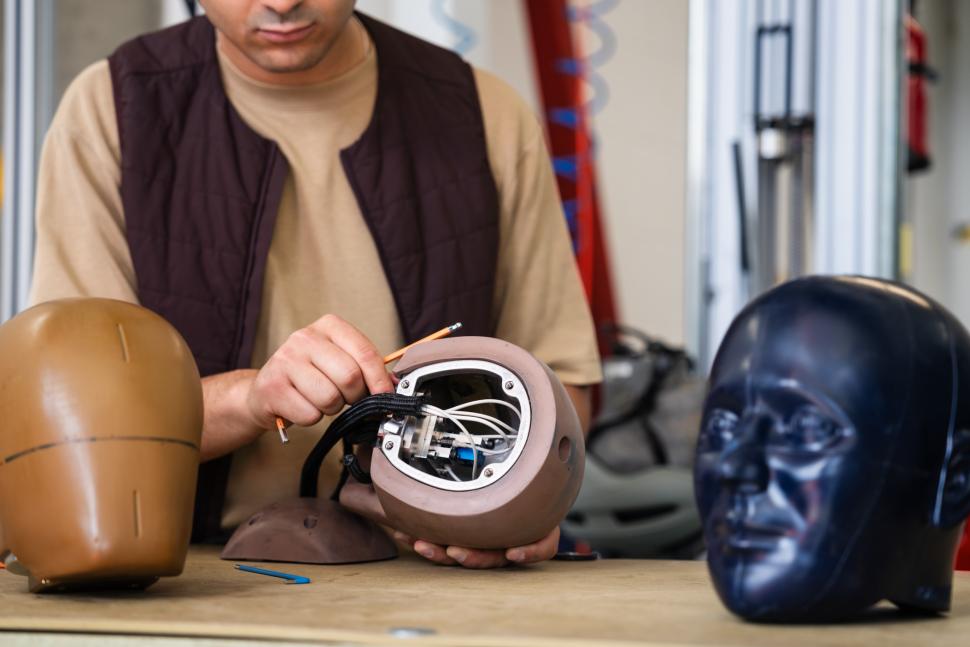
Tests conducted at the University of Strasbourg found that helmets equipped with RLS reduced peak rotational velocity by 56–66% across different impact locations, which is said to correspond to a 68–84% reduction in the probability of brain injury according to the Abbreviated Injury Scale.
While we’re awaiting details on how RLS stacks up against helmets with systems like MIPS, this weekend saw the top two helmets on Virginia Tech’s ratings updated as RLS models.
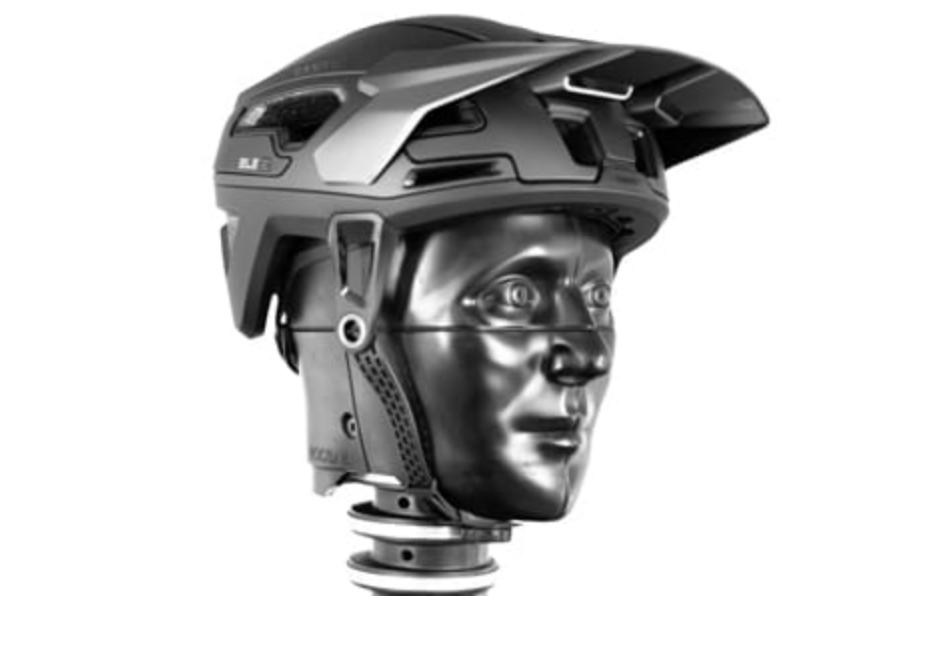
The Canyon Deflectr RLS and Hexr’s own Miden RLS helmet both scored 5/5 for safety. Virginia Tech has tested 281 helmets using the STAR (Summation of Tests for the Analysis of Risk) system, which evaluates a helmet’s ability to reduce both linear and rotational acceleration across a range of scenarios.
Helmets earning more stars are associated with lower concussion risk, meaning these RLS-equipped models are currently ranked ahead of models that use MIPS or other proprietary safety systems.
With the technology now entering the consumer market, it could represent a notable step forward in helmet impact protection for cyclists. Crucial to the road cycling market in particular will be how much (if any) extra weight the RLS tech could add to the average helmet. Hexr’s previous solution, a 3D-printed inner honeycomb structure that was said to perform exceptionally well in oblique impact tests, received a middling reception in its road.cc review back in 2019, with our reviewer criticising the 352g weight of Hexr’s eponymous debut helmet.
We’re told that more helmets featuring RLS will follow Canyon and Hexr in the coming months. For more information on RLS helmet tech, head over to releaselayer.com.









16 thoughts on “Could this new helmet impact protection system be better than Mips? Canyon backs RLS tech that claims to “reduce the risk of concussion by 4x” versus conventional helmets”
While I’m sceptical about
While I’m sceptical about marketing claims, high scores in Virginia Tech’s independent test results speak volumes. It’s impressive that RLS-equipped helmets took the top two spots in Virginia Tech’s ratings.
Let’s hope that we see some more road helmets equipped with RLS. And, crucially, I hope that further independent research is done on RLS versus MIPS.
Could we also see motorcycle helmets adopt RLS?
I do wish these helmet
I do wish these helmet marketing wonks would leave off all the rubbish about absorbing, dissipating or redirecting energy – it’s all hokum.
What matters is linear and rotational acceleration experienced by the head/ brain, and rotational velocity (since that imparts a linear acceleration). Exceed whatever the limits are and the brain suffers injury.
In simple terms, explain how the helmet reduces the sudden-ness of changes in linear and rotational speed, and the maximum rotational speed, experienced by the head.
Quote:
Hmm. Looks like it would be more accurate to say the layers will slide when a force threshold is exceeded, in a purely mechanical effect. But I guess that wouldn’t sound quite so exciting and high-tech.
Super evolution. Keeping us
Super evolution. Keeping us safe!
Whilst we can only welcome
Whilst we can only welcome advances in helmets, I can’t help reflecting on the fact that the helmet industry denied the existence of rotational injuries for thirty years, and I can’t help thinking that this is just another marketing ploy.
As we know from the failure of helmets to reduce the death rate of cyclists, despite the helmets being certified as effective, laboratory results frequently don’t transfer to the real world. We’ve had helmets for some years which claim to reduce the risk of rotational injury, but has there been any reduction in the death rate?
The death rate is the only reliable metric to measure the effectiveness of helmets, since it’s much easier to diagnose and less susceptible to observer bias.
i thought there’d been two or
i thought there’d been two or three recent studies showing a significant reduction in fatalities/TBI in those wearing helmets.
But of course there’s going to be wild variability in circumstances so hard to draw reliable conclusions.
I wonder if part of the reason this is being taken much more seriously is the sudden discovery (over the last decade or so) of the seriousness of concussion and just how long it can take to recover.
StevenCrook wrote:
There have been lots of studies claiming to show that helmets are fantastically effective, but their methodology is the least reliable and the authors can frequently be shown to be biased. The most reliable studies, epidemiological, with demonstrably objective researchers, show no reduction in the death rate with increased helmet wearing.
I’m no helmet fanatic, but:
I’m no helmet fanatic, but:
Death rate certainly isn’t the only metric we should care about. Even if we could say conclusively that helmets (or helmets with better rotational impact protection) have zero impact on probability of death, if we could nonetheless say just as conclusively that they reduce rates of head injuries/concussions etc., there would be merit in wearing (better) helmets.
Whilst deaths may be a nice easy metric to measure, that doesn’t translate to it being more helpful for statistical analysis. If nothing else, deaths are relatively rare compared to non-fatal injuries, so your sample size is much smaller.
OnYerBike wrote:
Death is the only reliable metric. If helmets were effective in reducing rotational injuries, the most dangerous, there would be an effect on deaths: there isn’t, they aren’t. And helmets don’t prevent concussion.
All other measures of helmet effectiveness is open to diagnosis mistakes and observer bias and cannot be used to determine the effectiveness of helmets.
Helmets were promoted by helmet zealots for thirty years because they were so effective at preventing death. When it is shown that they don’t prevent deaths, the zealots switch to ‘well, they prevent concussions and things.’ Why would you believe someone who has lied to you for thirty years?
Burt, I recognise and
Burt, I recognise and understand your cynicism, and yes the stats don’t show great benefits in reducing deaths. Apart from in the dodgy papers. Hey, maybe slight benefits are being masked by other factors, there’s a lot more bigger cars out there and it’s all about energy transfer.
I’m going to wear a hat, it feels really weird when I don’t. I have a good hat, POC kortal race mips, my head feels enclosed, rather than the hat just sitting on the top of my head. Best hat I’ve had, ventilation is excellent and great retention. And the POC mips system may make my foolish solo crashes a little less severe on the brain. I can say for certain that my hat wearing has saved my forehead some big lumps and my scalp nasty lacerations. It’s the reason to wear it.
I realise that there will be very little protection if I am involved in a severe collision with a motor vehicle, but at that point, every little is going to help. Maybe.
It is a nice bright orange, and with the anchored exposure axis with piggy backed redeye contributes to visibility, giving them as much help as possible. Helmet light giving me better vision when hooning through those dark woods and off road downhills.
My mother made me get a helmet, part of the deal of me getting a bike after getting run over on Farnborough’s clock house. 21 in ’92. Marin palisades, that years fresh in, range built up for the rep. Crowthorns Berkshire cycles. My bicycle obsession started then. Injury insurance coming so I could go up a bit from the destroyed Peugeot racer. She paid for the hat, so I got a better one than if it had been for my penniless self, and she let me find an acceptable one. Big purple specialized. Was going to put it on and ride near home, then put it in the bag, sneaky like, but it was easier just to wear the thing. Within a few months I’d already used their free crash replacement. My improving hats have matched my improving bicycles.
You know I believe in helmet choice, and cast no aspersions on others decision. But if you are going to wear a hat, wear a good one, I wear mine a lot.
ktache wrote:
Absolutely – once you’ve avoided any “quantum” nonsense (“AI-enhanced” now?) and conspicuous consumption * don’t stint and get the most comfy and effective possible; if you use one it’ll be on your head a lot.
Good “activity autobiography” also!
I used to be “never without” but- perhaps from years of having car free (cycle) paths – I’m now “not”. But habit … so now it seems I always need a cap or wooly hat in winter or i feel “naked”.
* if you’re not fussed / don’t need to assert membership of some tribe.
I don’t think it has been
I don’t think it has been “shown that they don’t prevent deaths”.
I think it’s fairly clear that helmets are a very minor component of road safety, and that thing like proper infrastructure are much more important.
And at a population level, inactivity is a far bigger risk, so getting more people onto bikes (even not wearing helmets) will reduce deaths overall.
But, as far as I know, the evidence is still that, all else being equal, if you have a crash (a very, very small proportion of rides), and that crash involves a head impact (some, but not all, crashes), then wearing a helmet has a positive expected effect on the outcome (less likely to die; less serious injuries).
OnYerBike wrote:
— OnYerBikeThat’s exactly what the TRL report said, that helmets prevented 16% of deaths, and the media seized on that and it was headline news everywhere. The only problem being that it wasn’t true. Despite a pretty comprehensive examination of the facts, they couldn’t find anything which showed that helmets saved lives: so they invented it. The 16% was literally plucked from thin air, there was literally no evidence to support it, but the media didn’t care, they just kept repeating it.
I repeat, the epidemiological data shows no reduction in the death rate of cyclists as helmet wearing rates increase. If your proposition was true, the opposite would be the case.
I’m not quite sure which the
I’m not quite sure which the “TRL” study you are referring to is, but helmets.org have compiled a fairly comprehensive list of studies, most of which appear to support a benefit of helmet use in the event of a collision: https://helmets.org/statspage.htm
I’m sure some of those studies are flawed, and I would certainly be interested to see the epidemiological studies that you have identified that show no effect, to understand how the authors have managed to adequately control for all the possible confounding variables.
Helmets.org is one of the
Helmets.org is one of the most vociferous helmet organisations on the planet, and that list of studies excludes any study which might cast doubt on the effectiveness of helmets. As you so rightly point out, some of those studies are indeed flawed, and I don’t consider any of those listed in ‘Injuries: all ages” to be reliable. Some of the studies quote Thompson, Rivara and Thompson (TRT) studies, which is an immediate red flag and indication that either the researchers don’t know anything or are biased. They even list TRT studies, including the Cochrane Study which broke every rule of Cochrane Studies. Cochrane Studies used to be the gold standard of meta-studies, but with that single publication, their reputation is forever trashed. Also listed is Jake Olivier, the Australian equivalent of TRT.
But they do list the TRL study ‘The Potential for Cycle Helmets to Prevent Injury:
A Review of the Evidence TRL Report PPR 446 – Findings. They also quote the bit about helmets saving lives “A specialist biomechanical assessment of over 100 police forensic cyclist fatality reports predicted that between 10 and 16% could have been prevented if they had worn an appropriate cycle helmet.” but they somehow forgot to mention that there was absolutely no evidence to support that claim, and that the main report did not find any valid evidence that cycle helmets reduced the death rate of cyclists.
I can’t be bothered to look through any more, and anyway, I’m sure you get the idea.
Rather more independent and much more reliable, even if not updated for five years, is https://www.cyclehelmets.org/ which does include all studies, both for and against helmet compulsion.
I am unclear who is
I am unclear who is responsible for helmets.org and therefore can’t comment on whether the owners of cyclehelmets.org are likely to be any more independent. I find helmets.org to come across as fairly unbiased and transparent, if opinionated.
Helmets.org do link to cyclehelmets.org: https://helmets.org/shouldi.htm – they aren’t trying to hide opposing views.
I haven’t looked through all the studies cited on cyclehelmets.org, but none seems to refute my point. They mostly seem to make valid points which strongly argue against mandating helmets as a policy intended to improve public health. I absolutely agree with that position.
But I can’t find any that argue that, all else being equal, if you have a crash, you’re no better off wearing a helmet.
Let’s take the first one: “Cutting through the controversy about helmet effectiveness”. This study basically argued that the health disbenefits of mandatory helmet laws putting people off cycling outweigh the benefits of wearing helmets, a position which I just said I agree with. But the whole article is predicated on the value of “e” being positive; if “e” is zero (or even negative) then wearing a helmet has no benefit in a collision, in which case there is no argument to be made – it would be trivially true that there is no point mandating helmets.
How about the next one “Bias in older research, no net benefit from helmets in later studies”. Makes some perfectly reasonable sounding points about biases and flaws in certain studies (haven’t dug into the statistics enough to say for sure I agree with their findings). But even that study concluded: “Do bicycle helmets reduce the risk of injury to the head, face or neck? With respect to head injury, the answer is clearly yes, and the re-analysis of the meta-analysis reported by Attewell et al. (2001) in this paper has not changed this answer. As far as facial injury is concerned, evidence suggests that the protective effect is smaller, but on balance there does seem to be a slight protective effect. The risk of neck injury does not seem to be reduced by bicycle helmets.”
I can’t be bothered to look through any more, and anyway, I’m sure you get the idea.