



A driver has received a suspended sentence over the death of a leading University of York academic who was killed while cycling on the Isle of Wight in 2022 — the fatal collision caused by the motorist reversing into the rider’s path, before driving away from the scene with a smashed rear windscreen which he claimed to believe was caused by a falling tree branch.
Timothy Cale was sentenced at Portsmouth Crown Court last week, the Isle of Wight County Press reporting on the sentencing hearing where the 59-year-old motorist was handed a one-year sentence, suspended for two years, as well as a three-year driving ban and an order to complete 200 hours of unpaid work.
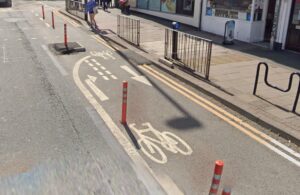
Cale was convicted of causing death by careless or inconsiderate driving, a jury unanimously finding him guilty following a six-day trial in November. The court heard how Cale reversed from New Barn Lane onto Shorwell Main Road, the site of the collision seen in the picture illustrating this story.
Professor Simon McQueen-Mason, a leading academic at the University of York, was hit and pronounced dead at the scene. He suffered devastating injuries when he was struck by Cale reversing onto the road, which Professor McQueen-Mason was descending at the time of the collision.
The court heard how collision investigators gave evidence that Cale’s account would have meant the rider had nine to 11 seconds to see the vehicle while descending the hill at the 30mph speed limit. Braking marks were found on the road and the experts agreed that the Land Rover’s positioning at a 40-degree angle on the road just after a blind bend would restrict visibility.
The prosecution successfully argued the manoeuvre met the threshold for careless driving, prosecutor Russel Pyne telling Cale that while it “may have saved him a few seconds” it “led to a catastrophic collision and the loss of life”.
Witnesses phoned the emergency services and tried to treat the cyclist, although the local press reports they were met by “horrific injuries”. Cale was seen driving away from the scene with a smashed rear windscreen, something he later claimed to have believed was caused by a falling tree branch.
When Cale returned to the scene later he claimed he had returned to remove the branch from the road and denied any wrongdoing to the police. In court he said he was “devastated” and in “total shock” but maintained “I don’t consider my driving as careless”.
The judge suspended his one-year prison sentence for two years and he was also banned from driving for three years.

















33 thoughts on “Suspended sentence for motorist who killed cyclist with “careless manoeuvre” before driving off and claiming he thought smashed windscreen was caused by falling tree branch”
“I apologise sincerely, but I
“I apologise sincerely, but I don’t consider my driving as careless,” Cale said. Could a judge ever find a better reason to actually send a murdering driver to jail to help him get the point? And what was the judge’s name? He/she deserves the attention.
I really don’t know what some
I really don’t know what some judges will need to send someone to prison for a driving offence. The offence this driver was unanimously convicted of carries a sentencing range and this sentence is very much at the lower end. I fail to see any mitigating circumstances and if anything the failure to admit even now that his driving was below standard by some way should be seen as exactly the reverse of mitigation.
Probably because most judges
Probably because most judges are drivers and are guilty of careless acts while driving, which didn’t lead to death or serious injury, but makes them think that could have been me driving.
I suspect drivers like this
I suspect drivers like this get the benefit of this three times. Once when the CPS downgrade dangerous to careless, once when the jury potentially aquit in the face of overwhelming evidence and finally when the judge then goes for the exceptional hardship or there but for the grace of god go I and sentence them to a small fine and maybe a bit of community service.
cmedred wrote:
Anyone who says that after killing someone and clearly driving in a manner no careful driver would, should be banned for life as they are clearly not capable of driving safely, with respect for other road users.
Justice might have been better served if he was forced to ride a bicycle for the duration of his ban, and it would be interesting to hear his opinion after his ban expired, and he’d had three years of other drivers doing what he did to him.
Who would drive away from a
Who would drive away from a scene knowing that they had a broken window, even if they thought it was a branch mysteriously falling from the sky? It’s just taking the mickey, using an excuse like that.
Surely such a blatant lie should be considered aggrevating circumstances?
Surely such a blatant lie
Surely such a blatant lie should be considered aggravating circumstances?
It should be, but juries and judges have become accustomed to accepting such obvious lies as ‘ I thought I hit a bag of potatoes’ as a means of getting offending drivers off a genuine penalty in favour of a joke one; I thought I hit a fridge, seems to have been used in a real case recently?
wtjs wrote:
If we had a working justice system, those kinds of excuses should be used to disqualify someone from ever driving. If you are unable to tell the difference between a living person and a bag of potatoes or a falling branch, then you do not have the skill required to control a motor vehicle safely. It’s similar to people with eyesight problems – they are not allowed to drive as they are not considered to be safe on the roads.
This is the fundamentally
This is the fundamentally ridiculous part of the whole thing. Everything that people say to excuse and explain their shit driving should be ammunition to ban them and punish them.
“I’m a dangerous driver because when the suns in my eyes I just drive as if it isn’t”
“I’m a dangerous driver because I pull out without looking”
“I’m a dangerous driver because I don’t check before I make maneuvres so I didn’t see that cyclist lit up like a christmas tree”
“I’m a dangerous driver because I routinely overtake cyclists on blind corners and let luck decide if I crash”.
Instead, all of these admissions are used to explain why it wasn’t their fault. Why they couldn’t be held accountable. How it was bad luck.
Incompetence Paradox again.
Incompetence Paradox again. From nearly 10 years ago: https://beyondthekerb.org.uk/the-incompetence-paradox/
wtjs wrote:
Ah yes, but let’s not forget it wasn’t just any bag of potatoes, but one that had fallen from the sky …
…
https://www.cyclinguk.org/blog/duncandollimore/mason-verdict#:~:text=or%20if%20something%20had%20come%20from%20the%20sky%2C%20a%20bag%20of%20potatoes
wtjs wrote:
The woman who hit and killed Mick Mason didn’t claim that she’d hit a bag of potatoes, she said that she thought a bag of potatoes had fallen on to the bonnet of her car.
And she still got acquited. One of the most blatant miscarriages of justice I’ve ever seen.
the little onion wrote:
to expand on your first question, is the kind of person who knowingly drives from the scene with a broken window (from a branch ?) also the kind of person who turns around and drives back again to remove said branch from the road for the benifet of others ? I don’t think so
Why return to the scene later
Why return to the scene later “to remove the branch”?
I suspect Cale returned to the scene to find out what had happened to the cyclist. I find it hard to believe that he didn’t look in his rear view mirror as he drove away.
The man appears to be a liar.
Once again your life as a
Once again your life as a cyclist is terrifyingly worthless
Jesus fucking christ
Jesus fucking christ
Sometimes there are just no words
Leaving the scene and
Leaving the scene and especially leaving someone to die should mean a lifetime ban. If someone cannot take responsibility for their driving and is that selfish and inconsiderate, then I don’t want them ever in control of a large vehicle.
When someone shows you who they are, believe them.
The rot starts with the
The rot starts with the terminology and the breakdown of offences in Part 1 of the Road Traffic Act 1988. Sub-par driving is split into a dozen different offences to meet how bad the driving was, and whether it causes death or serious injury, and whether the driver should have been driving at all at the time.
What a spaghetti!
If I get in a car and reverse if onto a major road close to a bend, that’s not ‘careless’. It’s a deliberate choice to be so casually unconcerned about the consequences of the manner of my driving that ‘careless’ doesn’t cover it. Making separate offences of causing death or serious injury separates the act of bad driving from its consequences if luck happens to be on their side.
What should be done? All the above should be one offence, such as Negligent Driving. It’s a blanket offence. If you drive below – however far below – the standard required to give due consideration for the immediate environment and circumstances, you’re guilty. It could be a fine and points (or even an awareness course); or life imprisonment.
GMBasix wrote:
“Negligent” is a rather minimising word I think. On the one hand that might be good (people more likely to agree and convict than on some charge than labelling someone a “danger” or even a “killer”). OTOH I wonder if judges will be immune from that effect when sentencing…?
I deleted quite a lot form
I deleted quite a lot from the first draft of my manifesto. I like a relatively neutral word – I think “careless” is minimising, and the concept of “causing death by careless driving” just feels like an oxymoron. Negligence can be applied to near miss or to a plane crash.
You’re right: I don’t think judges are immune from the bias of being shy to accuse, but I think they are better trained to address a situation objectively, they give a detailed explanation of their decisions, and they (and their sentencing decisions) are more accountable when they get it wrong. (I actually think there’s a lot to be said for removing jury decisions from some trials on that basis.)
I like less ‘negligent’. It
I like ‘negligent’. It carries a clear meaning of failure to meet the obligations that are or should be understood. And for the most serious outcomes, there is consistency with the language of gross negligence manslaughter
GMBasix wrote:
May be we need “driving not in accordance with the highway code” to replace careless or inconsiderate driving. Much easier to convict as at present careless is defined by precedent and we’ve seen too many drivers get away with driving which needs to be punished in some way recently. This would make it a lot easier to prosecute close passes and NMOTD 944 would be a no brainer.
Bungle_52 wrote:
Hmm… I would agree something like failing a driving test / a more standards-based approach seems wise. But now thinking: how good a grasp of the Highway Code does the average person have? And particularly any of the parts around cycling?
You’d hope that conscientious jurors who weren’t sure of their understanding would at least follow court “expert advice”. But that very much depends who’s providing that and their grasp of the whole!
Over the years we’ve seen some plain incorrect assertions from some of m’learned friends – which have then not been challenged. More concerning in a couple of recent tragedies the expert crash investigator appeared to have a decided “windscreen perspective” in their testimony to the court (eg. the Grimsby bus crash https://www.bbc.co.uk/news/uk-england-humber-66787656 ).
chrisonabike wrote:
Any defined offence that requires a deep breath to be able to say in one go is going to loose its punch in the public mind. It might work in court, but people [think* they] know about careless driving and dangerous driving. [* i.e., it’s driving that’s below my own level of driving, &/or anything I wouldn’t do in this situation with the benefit of hindsight, iinnit?]. Just like ‘vehicle excise duty’, the long-standing soubriquet replaces the mouthful and, just like ‘road tax’, the meaning shifts (or sticks, if you like).
I don’t hope that jurors would be conscientious enough in Road Traffic Act cases to defer to court experts. I rather suppose they will mentally pat the little pink cards in their wallets and purses and think, well, I know about driving, don’t I? And isn’t the point of a jury that we bring our wisdom to the situation? Well, in part, yes. But that prior knowledge bias is the grit in the eye.
And it’s exacerbated because it is defined in the apparent moving average of how a competent and careful driver would drive. If a juror is a driver but not a cyclist, there is a bias in that understanding of what is careful and competent, because he’s[**] an expert driver with loads of experience, so he doesn’t need to listen to that bit where “careful” is carefully explained in front of the victim’s widow.
The bench-ed ones are generally accountable for the pronouncements they make in court, and their judgements and guidance can be reviewed. As a non-expert, casual observer, it seems to me that there should be a lot more of that, but I think the principle is there. I think that counsel should be held more accountable for wild interpretations of the law – just as I think politicians should be more accountable for their false representations of facts in public. A sharp rebuke from M’lud for a fanciful case for exceptional hardship should be recorded on their file for the next judge to see. They may be acting on their client’s instructions, but “my client will suffer exceptional hardship” becomes “my client wishes it to be heard that he will suffer exceptional hardship”, and we all know what we’re saying.
And then juries should be required to give a narrative account of what led the jury to believe that a case was made or unproved, and to what extent the jury was happy with the outcome. We need to understand more about a decision and the strnegth of that decision. We need to be able to say that the jury failed to comprehend what amounts to negligent driving.
[**] “He” is a 48-year old male driver, dosed up on Top Gear, who passed his test 31 years earlier, avoided the cameras, no intervention for the little habits he’s sequentially introduced into his driving over 3 decades, not had any follow-up training, not done any reading on changes to the Highway Code, not reflected constructively on incidents in his day-to-day driving, and depending on the general gist of the highway Code which was enough to pass his test (before separate theory tests were introduced). He thinks he’s an expert because he’s got a clean licence (apart form those 3 points he got back then, but that was a sneaky camera van just after the… anyway he’s careful and it wasn’t his fault – anybody could have got caught; and the accident where the other car came at me and I had to hold my ground and force him back but it ended up being 50:50 on the insurance because what does Big Jobber know). Or it could be a she, or possibly a rabbit hole. It’s just that this one is a he. Anyway, he thinks it’s the cyclist’s responsibility to look after ther own safety.
GMBasix wrote:
You could still call it careless or inconsiderate driving just change the definition from below the standard of a competent and careful driver to driving not in accordance with the highway code. The HC is the set of rules we are asked to abide by when we use the roads but it is only used in civil cases and the police do not even consider it when dealing with incidents that are reported to them at the moment as far as I can tell. This means that drivers can bully their way through situations and as long as the cyclist gets out of the way the police will do nothing. If the cyclist doesn’t get out of the way then a civil action can be brought but that may be too late for the cyclist.
You could, but the Highway
You could, but the Highway Code is not an absolute arbiter of care. You can, in principle, depart from the guidance and still demonstrate why that is a careful decision. Equally, you can demonstrate apparent compliance with the Highway Code and yet still be at fault: there are scenarios on which the Highway Code is tacit or vague and case law and other guidance comes in.
Moreover, the wells of the existing definitions are poisoned. What is needed is a departure from current terms and clear definition.
GMBasix wrote:
Wow I’ve been doing it wrong all these years then. I thought the highway code was the rule book. Could you give some examples of where I’m complying with the highway code but I am still at fault and vice versa. I would be very grateful.
Bungle_52 wrote:
Not sure if these examples are strictly going against the Highway Code, but here’s a couple of possibilities:
If an emergency vehicle is approaching behind you and the most sensible way of giving them room to pass involves going slightly over the stop line at a red traffic light in order to pull up onto the pavement.
If a cyclist doesn’t have reflectors on their pedals, but has reflectives on their tights and shoes.
The Highway Code is guidance, though I think all of the “must” declarations are backed up by the relevant traffic law. The other recommendations might be referred to in court cases if they’re arguing about liability percentages as that can show a lack of attention or consideration to other road users.
You forgot common scenarios
You forgot common scenarios like sudden acceleration to well above the speed limit when a chimney is about to fall on you or a terrorist appears. Or stopping in places which are obviously illegal to do so because you had to delivery a baby or cope with some other unexpected emergency and obviously not for some more trivial reason like having forgotten to go to the loo before you drove…
Those are fairly clear-cut
Those are fairly clear-cut examples of offences, but where the variance is in the enforcement decision, not a judgement:
Going over the stop line as above is an offence. I would be surprised if police in a car would pull you over for allowing an ambulance to pass, where no other harm is caused and the action was otherwise reasonable and carefully undertaken. A red light camera would provide precise evidence – if you trigger the criteria (which will entail a degree of tolerance for calibration/parallax), you won’t meet the basis for dismissing the penalty (although you might have the benefit of a course alternative).
Not having pedal reflectors is so widely flouted I doubt it even registers on most collision reports. But it’s still an offence after sunset.
Neither is defined by the Highway Code as an offence; they are defined by statute and subordinate regulations and applied as rules in the Highway Code.
Treatment of a roundabout is probably a better example. The rules of a roundabout are simple in the Highway Code, but case law adds issues where the simple rule may or may not apply, depending on the circumstances.
If you fail to keep a safe distance from the car in front and you have a collision with the vehicle in front, you’ve failed to follow rule 126. However, if a vehicle has just emerged or changed lane in front of you then stops suddenly, that option has been taken (probably criminally) out of your control, and the civil (and probably criminal) liability shifts. The Highway Code doesn’t explain that directly (although it may be inferred from other rules).
A red light camera would
A red light camera would provide precise evidence – if you trigger the criteria (which will entail a degree of tolerance for calibration/parallax), you won’t meet the basis for dismissing the penalty
Yes, you certainly need highly precise technology to convince the legal system to prosecute red light offending drivers – Lancashire Constabulary just couldn’t be sure on these whether an offence had really been committed:
The problem is not the technology, it’s persuading the police that passing traffic lights at red is a real offence, when it’s committed by drivers. That’s because the police say ‘but everybody does it!’
I don’t think the number of
I don’t think the number of different offences are an issue per se. For example, compare it with crimes involving violence / physical harm. There’s assault, ABH, 2 types of GBH, 2 types of manslaughter and murder (and probably others I’ve missed). With additional laws for offences that are racially or religiously aggravated or comitted against an emergency worker.
The situation was worse before death by careless driving was introduced – you could kill someone with your car and if your driving wasn’t deemed dangerous you’d probably only get 3 points and a small fine.
I’d argue the main issues are with the wording of the current law and with the tendancy to “downgrade” dangerous driving to careless driving.
Utterly pathetic sentence.
Utterly pathetic sentence. The driver has come away with some minor inconvenience for taking someones life due to their lazy, stupid incompetence. Why should this morn go home to his family and get behind the wheel again in three years. Shameful lack of justice.