


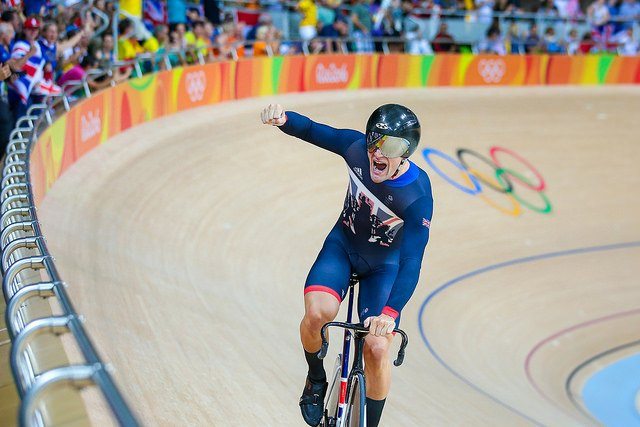

Olympic champion Callum Skinner believes that the International Olympic Committee (IOC) will not be able to prevent athletes from taking the knee when the postponed Tokyo 2020 Games finally get underway in a little over three months’ time.
Instigated by former San Francisco 49ers quarterback Colin Kaepernick in 2016, when he knelt during pre-game renditions of the US national anthem to protest against police brutality and racial injustice, the practice has been adopted by athletes worldwide to show solidarity with the Black Lives Matter movement.
Just last week, one of the most striking images of it was widely shared on social media when the entire Arsenal team took the knee ahead of their Europa League quarter final return leg in Czechia while opponents Slavia Prague – whose player Ondrej Kudela is serving a 10-match ban for racially abusing Glen Kamara of Glasgow Rangers – remained on their feet.
Lacazette ✊❤️ pic.twitter.com/aHlh1SYr00
— Football on BT Sport (@btsportfootball) April 15, 2021
There had been calls for the IOC to modify its Rule 50, which bans athletes from participating in any type of “demonstration or political, religious or racial propaganda” during the Olympics.
However, this week the organisation announced that following a consultation launched in June last year to which 3,500 athletes around the world responded, it would not be modifying the rule, saying that the majority supported it.
In response to that announcement, Skinner told The Times that it appeared that the IOC was “intent on exercising control when they don’t have any.
“If an athlete wants to take the knee, they will take the knee,” he said.
“People get frustrated by ‘Black Lives Matter’ because they see it as a political movement,” he added.
“But at its core it’s fighting for equality and that is something the Olympics should 100 per cent stand behind.”
The Scot, who won gold in the team sprint at Rio in 2016 and added silver behind fellow Team GB rider Jason Kenny in the keirin, retired from cycling in 2019.
He is athlete lead of the Global Athlete movement, which on Wednesday said that the IOC’s “archaic approach to limiting athletes’ rights to freedom of expression is another sign of an outdated sport system that continues to suppress athletes’ fundamental rights. The competitors are humans first, athletes second.
“We acknowledge that the IOC conducted a survey among athlete groups. Global Athlete had the IOC’s survey independently reviewed by several social science research experts that concluded the research methodology was both leading and flawed.”
Another of the group’s members, the Irish karate athlete and world champion kickboxer, Caradh O’Donovan, said: “One cannot survey how people feel about human rights and freedom of expression.
“These types of surveys only empower the majority when it is the minority that want and need to be heard.
“Once again, the IOC has favoured suppression over expression,” she added.
Global Athlete’s statement continued: “Today’s recommendations further dictates when, where, and what athletes can speak. This is the opposite to freedom of expression.
“The Universal Declaration of Human Rights states that ‘everyone has the right to freedom of expression; this right includes freedom to impart information and ideas through any media and regardless of frontiers’.
“The Olympic podium is a media of communication to the world, and the Olympic frontier cannot be a barrier to human rights.
“Global Athlete hopes every athlete attending the Olympic and Paralympic Games uses the United Nations Human Rights Declaration to guide their decision on when and where to exercise their right to stand for social and racial injustice,” the group added.
“Do not allow outdated ‘sport rules’ to supersede your basic human rights.”


















43 thoughts on “Olympic champion Callum Skinner says IOC can’t prevent athletes taking the knee”
Give us a break for this
Give us a break from this endless virtue signaling! a person of good character shouldn’t feel the need to show-off or give into the vanity of others.
So were John Carlos & Tommie
So were John Carlos & Tommie Smith virtue signalling at Mexico ’68?
I think you should add Peter
I think you should add Peter Norman to that list. His allyship are an important lesson for many of us who don’t just want to be observers.
Absolutely – I just couldn’t
Absolutely – I just couldn’t remember his name when I posted. His story is relevant because he also faced sanctions and consequences for his allyship. Australia was incredibly racist when he did that
alexuk wrote:
— alexuk
or the need to show support for others who may be less fortunate than themselves. Much better to look on silently. Maybe tut in private.
cqexbesd wrote:
thank you for saying this more eloquently than I could.
?
“Virtue signalling”, “BLM is political” are all code for I’m entitled and see no reason to change even though others aren’t so lucky. Either unconsciously or consciously the people making those statements are part of the problem.
How presumptious and naive of
How presumptious and naive of you, to assume someone can’t support others that are less fortunatue, unless they kneel. It also sounds like your friend below is calling me an un-caring biast racist, because I simply won’t play the childish kneel game. How sad. Your parents and teachers have clearly failed you.
alexuk wrote:
It’s a shame you got personal. But could it be that in fact you are the one that has been failed? Or have you and I both been failed in different ways?
If you refuse to see the significance of athletes choosing to take a knee, even when they know it may bring sanctions by a governing body, deselection or worse, then it’s hard to understand why anyone would think it is virtue signalling.
If athletes wish to take a knee then they are making a strong statement; it’s your view that it is childish and/or virtue signalling. But how do you know it is either of these things?
You don’t have to agree with it, of course, but it’s a pretty unambiguous statement. Why is it childish? Is any type of individual public protest therefore childish? Was Gandhi childish? What about Muhammad Ali? Or even the IRA hunger strikers in 1981? Were they all childish?
alexuk wrote:
Nobody’s forcing you to kneel dude, entirely voluntary, and cq didn’t suggest otherwise. A rather petty response to a reasonable point.
By banning it they’ve just
By banning it they’ve just made it happen. Probably in the athletics stadium, and probably on the 100m podium,
If they fine them; someone will pay the fine for them.
If they take the medal away; no-one else who competed will accept the medal.
If there’s a ban, it will end up in the courts, and be bankrolled by whichever of Adidas/Nike/Puma are sponsoring the athlete.
Freedom of expression is
Freedom of expression is great – I’m all for people kneeling down if they want to, but also for people to carry all lives matter banners and boo if they like – all personal choice isn’t it provided it is within the law
“I’m all for… but”
“I’m all for… but”
A classic way to undermine a line of argument you disagree with.
“I’m all for cycling but”
“I’m all for saving the planet but”
“You can protest, but not like that.” (i.e. where it’s visible)
I’m with Callum Skinner on this. By opposing the choice of athletes to make this gesture the IOC is part of the problem.
Tommie Smith, John Carlos and don’t forget Peter Norman.


And anybody who dismisses the act as virtue signalling really has no clue, or they are playing the same repression game as Nige.
Complete non-sequitur you’ve
Complete non-sequitur you’ve posted there I’m afraid Simon.
The “but” in my post referred to the hypocrisy of the “freedom of expression… provided you agree with me” crowd, and advocated freedom of expression regardless of viewpoint. I complete support the guy’s right to express his opinion, provided Chloe Dygert is allowed to express hers.
Can’t remember you defending her though.
Nigel Garrage wrote:
Have I misunderstood? I’ve seen the terms you used many times before.
Have we get it wrong? Were Chloe Dygert & Quinn Simmons actually on the side of the oppressed and adding their support to those fighting centuries of oppression and racism? Or did they both give the appearance of supporting that oppression and racism?
Perhaps some tweets and emoji were misread and everyone and their dog got the wrong interpretation.
It’s funny how people fighting for equality are compared to someone using fascist or racist language and actions. They are too often considered as equal and opposite sides of a perfectly reasonable argument.
Athletes don’t have to be on
Athletes don’t have to be on your side, or on the side of “the oppressed”, whoever you decide that group should be. For example, I think a child growing up today in Blackpool or Hull on average is probably more disadvantaged than one growing up in London, regardless of their race or other personal characteristics, but I accept you might think otherwise. That’s the point of freedom of expression – it has to cut both ways.
By contrast what you’re talking about is an arbitrary, authoritarian moral code which has to conform to your world view, where people’s actions have to be continually weighed against a litany of potential offence, with their entire livelihoods, reputation and careers in tatters if they step out of line.
So when I post I’m all for freedom of expression, I mean it. No if or buts (other than that I expect it to be reciprocated).
Nigel Garrage wrote:
What did that poor strawman ever do to you?
Nigel Garrage wrote:
I never said they did.
I merely agreed with Callum Skinner that they shouldn’t be penalised or punished if they chose to do so. I would also not want any participant to feel obliged or pressured into making a similar gesture.
I’m not the one deciding who is ‘oppressed’. Perhaps you’ve missed some of the news in the last year, or even the last century or two.
I don’t know if children growing up in Hull are more or less disadvantaged than those in London or elsewhere. This isn’t really about being disadvanted, whether financially or otherwise; it’s about racism. If you investigated thoroughly I suspect you would find that children with black and brown skin are abused far more than their white peers and disadvantaged to a greater degree if you eliminate other factors.
Simon E wrote:
Do you have any evidence for this greater degree of disadvantage?
The Sewell report indicated that disadvantage was not necessarily related to race especially when looking at separate ethnic minority groups rather than treating all BAME people as one group.
The Sewell report has come
The Sewell report has come under a lot of criticism, so its results should be taken with a healthy bit of scepticism: https://www.theguardian.com/world/2021/apr/04/sewell-report-contradicts-evidence-on-race-and-health-inequality
A great deal of criticism,
A great deal of criticism, and a fear that it would be used by some to say that everything is now fine, nothing more to do.
Lot of cherry picking, and objections from people whose work was used. Some whose name appeared denied ever having anything to do with it. Even some that there was a fair bit of alterations by No 10 after the commision had finished with it.
I asked the post doc in my lab what he thought about it, born in pakistan, became british a few weeks back, his reply, Boris got the report to say what he wanted it to say.
The Sewell report has been
The Sewell report has been criticised but I’d also take the criticism with a healthy dose of salt.
Most of the criticism I’ve read (particularly in the guardian) seems to skirt around the central findings and in particular around the data they are based on.
The report doesn’t deny the existence of racism and, in fact addresses overt racism frequently.
The report questions the impact of systemic racism and explores the life prospects of people from multiple ethnic backgrounds referenced to the prospects of the white majority.
They find that many ethnic minorities have a positive pay gap in comparison to the white majority and their children have a greater chance of success than those from the white majority.
They then question the existence of widespread systemic racism (which is different from overt racism) given the findings above.
I have not seen a single criticism of the report mention those findings.
Full report is here if you are interested:
https://www.gov.uk/government/publications/the-report-of-the-commission-on-race-and-ethnic-disparities
Rich_cb wrote:
You get it Rich_cb. I’m frankly bored of this thread I opened up so I’ll leave with this final quote:
“If you have always believed that everyone should play by the same rules and be judged by the same standards, that would have gotten you labeled a radical 60 years ago, a liberal 30 years ago and a racist today.” – Thomas Sowell
Nigel Garrage wrote:
Which is all well and good, but the question is, who gets to draw up those rules and set those standards?
That Guardian link that I
That Guardian link that I posted is not so much a Guardian opinion piece, but a signed letter by Dr Chetna Sharma, Dr Emma Sherwood, Dr Gemma Slater and Dr Ahimza Thirunavukarasu on behalf of 253 public health specialty professionals across England.
The report cites employment, income and location as factors that explain racial disparities in Covid-related deaths, but ignores the fact that systemic racism underlies these differences. The data shows that once these socioeconomic factors are accounted for, black men are still twice as likely to die from the virus than white men. Racism affects outcomes throughout life: black babies in the UK have over twice the risk of being stillborn and black mothers have four times the risk of death in childbirth. At the end of life, black Caribbean, Pakistani and Bangladeshi people live up to nine years fewer in full health compared with those of white backgrounds. Contrary to the report, such differences cannot be addressed by changing individual attitudes alone.
I did read the link.
I did read the link.
There may be systemic racist reasons behind the disparity in covid mortality but there may well be other reasons.
The Sewell report argues that the cause of such disparities in other areas are far more nuanced. I would be surprised if that were not also true for Covid.
Who should be the arbiter of
Who should be the arbiter of what is acceptable protest and what is unacceptable?
Public opinion in the UK is very different to public opinion in other parts of the world.
Would an Olympic podium protest against gay rights be acceptable if the athlete was from a country in which public opinion supported their stance?
A simple test would be if you
A simple test would be if you’re trying to highlight that a sub-group has diminished rights or whether you’re trying to reduce a sub-group’s rights.
e.g. suppose a country was dominated by brown-eyed people and disproportionately imprisoned blue-eyed people, then a protest in favour of blue-eyed rights should be acceptable. If the same country had a protest that blue-eyed people should be deported as a matter of course, then that should be unacceptable.
hawkinspeter wrote:
So intellectually bankrupt… for example, Tommy Robinson and his cabal are both a subgroup and far more likely to be imprisoned than the general population.
According to what you’ve written, protesting in favour of Tommy Robinson should be acceptable, but having a protest against him would be unacceptable.
Nigel Garrage wrote:
Yaks-Milk Lemon and his merry men aren’t more likely to be arrested due to their race or religion. Their increased likelihood of being arrested is largely due to their activities….
Unfortunately things are
Unfortunately things are never usually that clear cut.
Imagine a Christian athlete who regularly spoke about the sin of homosexuality.
Should they be able to use the Olympic podium as a pulpit?
If you suppress the Christian views are you then diminishing the rights of a sub group yourself?
Freedom of religious expression was one of the very first civil rights after all.
I’d say that they have every
I’d say that they have every right to speak their mind about their belief, but when it comes to applying that to people who do not share their belief then that should not be allowed. I’d consider that athletes have every right to use an olympic podium to express their views and it would also be appropriate for them to be penalised if they’re spreading hate and looking to deprive others of rights.
We’re in to subjective
We’re in to subjective territory again unfortunately.
Who defines ‘hate’?
Is the threat to punish those who cross that ill defined Rubicon not itself a deprivation of rights?
Generally, hate would be
Generally, hate would be defined as wanting to harm as opposed to wanting to help.
It looks like you’re invoking the paradox of tolerance: https://en.wikipedia.org/wiki/Paradox_of_tolerance
It’s usually quite easy to determine if someone is using their platform to spread a helpful or hurtful message. A tolerant society should be able to determine that a Nazi sympathiser be de-platformed as their philosophy is all about hurting others.
Going back to your Christian example, they would have every right to express their views on sexuality in their churches, but if they were given excessive airtime and public exposure then you’d have to consider all the people that would feel attacked by such views.
We’re still in subjective
We’re still in subjective territory unfortunately.
Is a Christian preacher waxing lyrical about the sin of homosexuality trying to harm people or save them from eternal damnation?
Going back to the Olympics what society’s values should we use to judge podium pronouncements? The UK’s? Russia’s? Saudi Arabia’s?
If you allow political statements at the Olympics then who on earth will decide what is and is not acceptable?
If a Christian preacher goes
If a Christian preacher goes on about various sins then it’s probably best to see if the non-Christian targets of those sermons find them offensive and/or hurtful (or irrelevant). Another useful metric is if there seems to be undue attention paid to certain groups – that same Christian preacher may have been making a big deal about the sin of homosexuality but almost never mentions the sin of divorce (probably because he’s on his third marriage).
As far as political statements, I personally don’t think that the Olympics is an appropriate platform as there’s plenty of places for political discussion. I think it’s more appropriate for highlighting people who would not otherwise have a voice.
Yes, there’s a lot of subjective judgements so in the end, it’s best to go with the majority consensus (if there is one). Personally, I’d go with letting Sir Chris Boardman be the deciding vote.
I don’t really agree with
I don’t really agree with using offense as a guide, some people will find interracial or gay relationships offensive but I certainly don’t think we should ban people in those situations from the Olympics.
The point I’ve been trying to make is that once you allow political protests you can’t close that door again, there are very few causes that will be globally inoffensive so virtually any cause, rightly or wrongly, has the potential to offend.
Sir Chris is obviously the ultimate arbiter of what is right and wrong but he’s a busy guy, I wouldn’t want to add any more to his plate!
With causing offense, I think
With causing offense, I think one important factor is who the target is. e.g. finding interracial relationships offensive has a simple solution – don’t get yourself into them. Also if you find homosexual relationships offensive, then try to avoid getting sucked(!) into them too.
If it’s more that you don’t like to see two fellas kissing in the street, then it’s not really about causing offense, but about you wanting to control other people’s behaviour. That’s obviously assuming that there’s not a public health issue (e.g. coronavirus) surrounding such behaviour, but then that’s not about causing offense but applying sensible precautions.
In general, I’d agree about political protests, but there has always been a need to cross boundaries and shake things up a bit to restore rights to certain groups (e.g. suffragettes, civil rights movement, BLM)
Is there a difference between
Is there a difference between being offended by seeing something as per your example and being offended at hearing something as per the example of the Christian preaching?
Is asking somebody not to publicly air their religious beliefs any different to asking people not to carry on their relationship in public?
There’s one important
There’s one important difference – the fear of being subsequently attacked or imprisoned if the anti-LGBT stance becomes widespread. There’s loads of examples of that happening in the real world so that is a legitimate fear.
On the flip side, you may be afraid of ‘catching the gay’ from seeing a gay couple kissing in the street, but I think it’s fair to say that there’s scant evidence of that being a real fear. Though as a thought experiment, it’d be quite amusing if there were actual gay conversion camps (like the Christian anti-gay conversion camps) where homophobes would be forced to hold hands and maybe arrange flowers.
I’d argue that while we haven
I’d argue that while we haven’t quite reached the imprisonment stage the fear of being attacked or of losing your job applies to those espousing Christian doctrine as well.
There have been a few high profile examples of people losing their jobs for holding Christian views about homosexuality. Israel Folau springs immediately to mind.
Nigel Garrage wrote:
Banners and booing are a little different from kneeling. The former disrespectful, the latter not.
You can boo of you like, you’ll just look like pr!ck. The very pinnacle freedom of expression…
It’s all bollocks, live and
It’s all bollocks, live and let live I say. Do what you feel fit, but don’t try to force your views on others.
biker phil wrote:
Should I consider that an order Sir?