



The government has hit back at “false” claims that “misrepresent” Active Travel England’s latest road safety guidance, that after a weekend of press headlines claiming UK roads are to be made narrower to prevent motorists overtaking cyclists.
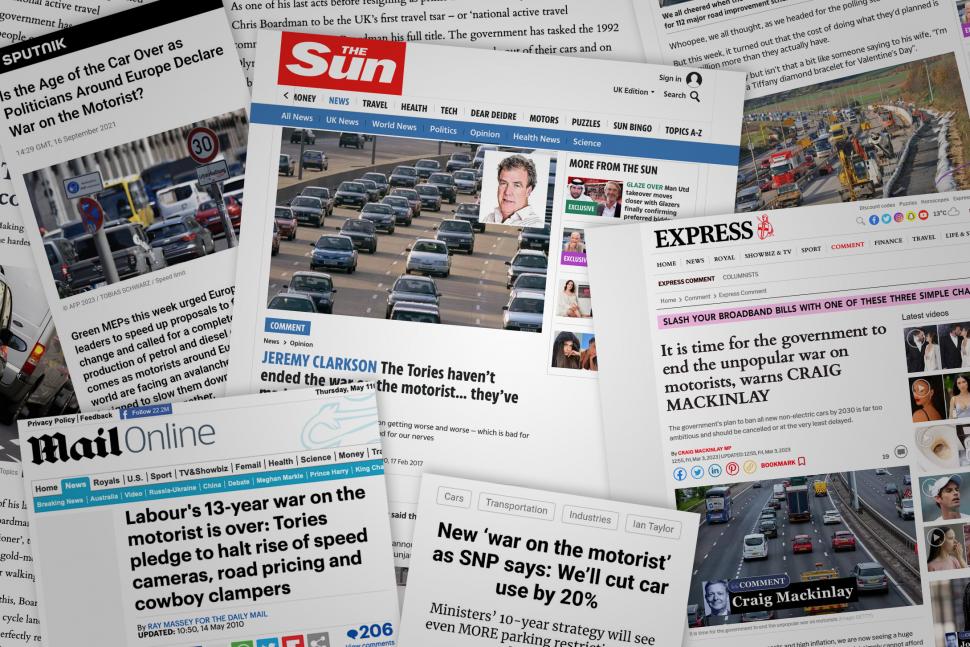
The Telegraph newspaper suggested the policy was “part of Labour’s war on motorists”, while the Daily Mail also said it would “stop drivers overtaking cyclists” as part of the “latest war on motorists”. Likewise, The Sun said plans to “shrink” roads “so cars can no longer overtake cyclists” had prompted “fears of traffic jams and conflict”, while the Daily Express led with the “war on drivers explodes”.
However, a Department for Transport spokesperson called the claims “false” and said they “misrepresent the guidance” from Active Travel England which was published earlier this month and highlighted “critical safety issues” on English roads, described as street layout issues which are associated with an increased risk of collisions for people walking, wheeling or cycling.
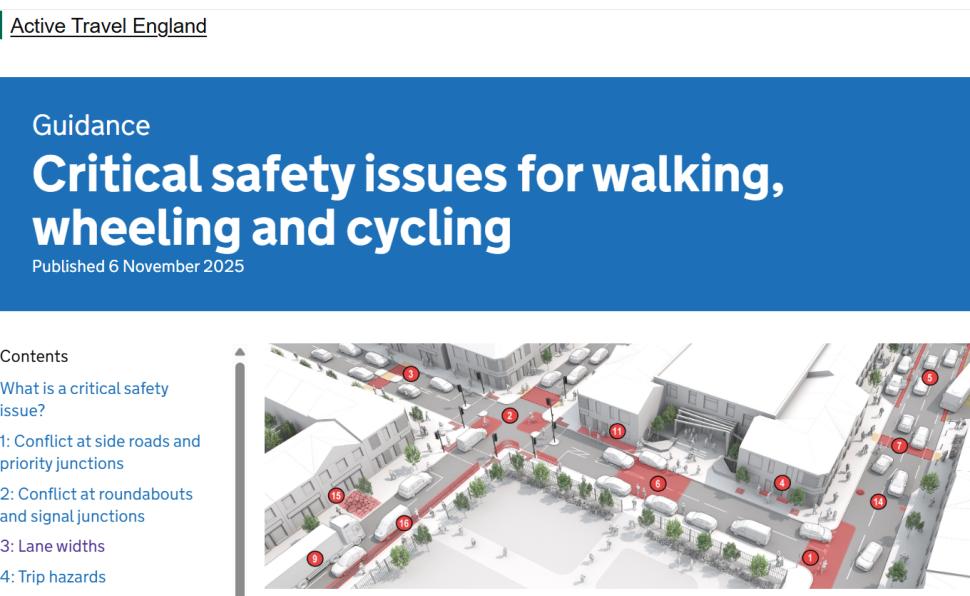
Active Travel England has warned about 16 of these common design features and “explains each of the issues with illustrations and provides links to relevant guidance and key evidence”.
The uproar has stemmed from the third of the 16, titled ‘lane widths’, which points out evidence suggests the width of a lane can have an impact on how motorists overtake cyclists and the risk of collision experienced by those travelling by bike.
Pointing out that when traffic lanes are narrower than 3.25m wide it “is usually clear to motorists that there is not enough space to safely overtake cyclists”, the guidance suggests that lane widths between 3.25m and 3.9m can see motorists trying to overtake “when there is not enough space, therefore increasing the risk of ‘shunt’ or ‘clip’ collisions”.
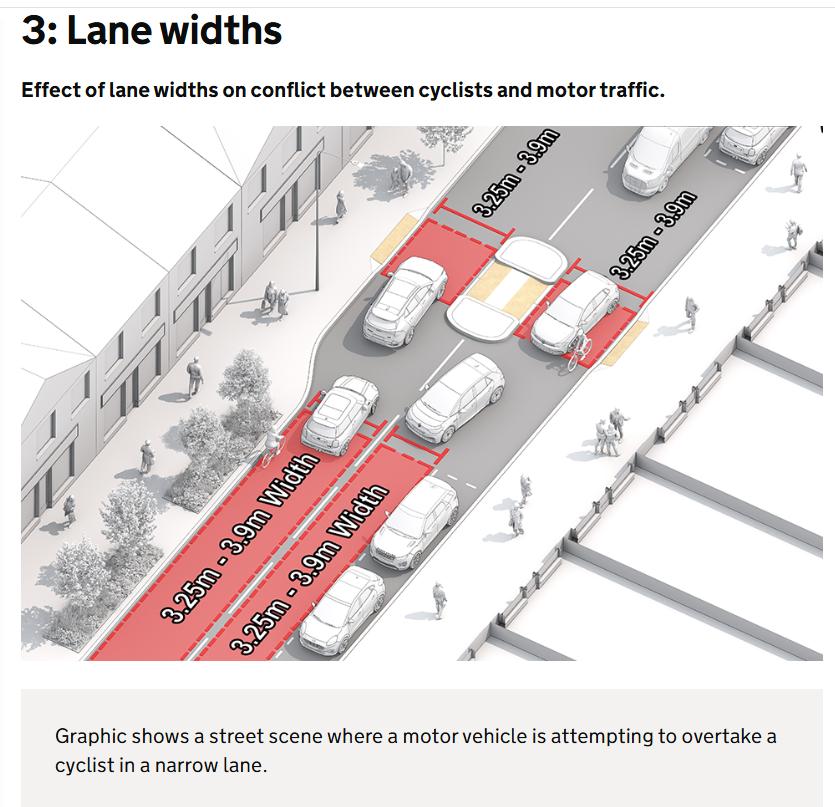
Citing relevant academic research, Active Travel England concluded “to resolve this issue” it would “recommend that lanes between 3.25m and 3.9m are avoided”.
The guidance continues: “Where there are two opposing 3.65m lanes, a 3.25m lane and a 4.05m lane would resolve this issue, as would removing the centre line. This issue is commonly caused by the introduction of pedestrian refuge islands. In this case more formal crossings such as zebras or puffins may resolve the issue as they may not require the island.”
Responding to the outrage in the media and from driving groups, the Department for Transport clarified that “there has never been legally binding standards for road widths – and that remains the case”. They also reiterated the point that the specific dimensions of lanes, where widths are between 3.2m and 3.9m, could cause safety issues for cyclists and drivers due to the lack of space to overtake safely.
“The government is absolutely on the side of drivers, focusing on making journeys safer and smoother, and saving motorists’ money,” a spokesperson added, Transport Secretary Heidi Alexander having also denied claims of a so-called ‘war on motorists’.
> ‘The War on the Motorist’ deconstructed — looking at the truth behind the myths
“Over the past year alone, we invested an extra £500m – enough to fill seven million potholes – to help local authorities maintain their local road networks, committed £1bn to repair bridges, flyovers and tunnels, and given the green light to over 30 road schemes to improve journeys across the country.”
The press coverage this weekend included comments condemning the guidance from various figures from motoring organisations.
Brian Gregory, policy director at the Alliance of British Drivers, claimed to the Daily Mail that “the whole idea is just to make driving unpleasant instead of trying to get everybody to co-operate and work together to use roads safely”.

“It’s all about penalising motorists. It’s completely stupid,” he said.
Likewise, AA president Edmund King suggested it would be “impossible and impractical to change the widths of all our roads, which have evolved since Roman times”, something the Department for Transport has made very clear is not on the agenda and presumably demonstrates the way the guidance has, in the government’s words, been “misrepresented”.
“This is not America where wider modern highways and more space means it would be possible to radically change road layouts,” King said. “UK roads will always require a degree of give and take which can’t just be ironed out by regulations.”
While lane widths have attracted most attention, the Active Travel England guidance also raised concerns with certain roundabout and junction designs, as well as painted cycle lanes installed in ‘dooring’ zones, and poorly maintained surfaces that put cyclists in danger.
“A critical safety issue is defined as a street layout or condition that is associated with an increased risk of collisions for people walking, wheeling or cycling,” Active Travel England stated.
“Active Travel England’s route check tool identifies 16 critical safety issues for walking, wheeling and cycling. This guidance explains each of the issues with illustrations and provides links to relevant guidance and key evidence. You can use this guidance with the route check tool to identify and remove these risks.
“This will help reduce the risks of collisions for people walking, wheeling or cycling. The recommendation to focus on identifying and removing critical issues was introduced nationally in Local Transport Note 1/20 for cycling and regionally through approaches such as London’s Healthy Streets check and Greater Manchester’s Streets for All check.”













40 thoughts on “Government shuts down “false” media claims roads to be narrowed to stop drivers overtaking cyclists, after tabloid “war on motorists” hysteria “misrepresents” latest road safety guidance”
This looks more like evidence
This looks more like evidence of the tabloids’ War on Cycling.
I cannot understand why they
I cannot understand why they do it. Cyclists are about zero danger to motorists, and they make about zero difference to their journey times.
Follow the money of the
Follow the money of the Murdoch press and GB News
They do it because blaming
They do it because blaming somebody else means they don’t have to take responsibility for their actions.
To sell papers, its the same
To sell papers, its the same with all their attacks on minorities 🙁
HLaB wrote:
Could they not just invent a big bike race?
The Tour of Britain was
The Tour of Britain was sponsored by the Daily Express.
There are about 7 million
There are about 7 million cyclists in the UK, so it’s not a minority group.
Wait – I thought the
Wait – I thought the population of the UK was (checks) nearly 70 million? And I’d guess that even the population of middle aged men is more than 7 million (or even middle-aged men who might be able to pedal about, possibly in lycra)?
Actually – what’s the “cyclist” criterion here anyway?
chrisonabike wrote:
Have seen a bicycle in the last seven years.
Aha! I knew those close
Aha! I knew those close-passing drivers were secretly all “avid cyclists”!
“I’m a cyclist myself…”
“I’m a cyclist myself…”
The tabloids and the
The tabloids and the Telegraph have it right, drivers, you will spend the rest of your non-motorway driving career at 14-15 mph behind a cyclist.
For the same speed on the
For the same speed on the road, cyclists are too fast and too slow at the same time.
David9694 wrote:
14mph was fast enough for the Locomotives on Highways Act 1896, so you would think the Telegraph would approve.
Locomotives and foot-poundals
Locomotives and foot-poundals are a bit modern for the Telegraph, who still live in a world of phlogiston.
I’m still struggling to pedal
I’m still struggling to pedal my way through the luminiferous aether…
See also the Downs-Thomson
See also the Downs-Thomson Paradox – keep providing for cars and eventually in urban areas your drive will be no faster than taking the bus.
https://en.wikipedia.org/wiki/Downs%E2%80%93Thomson_paradox
Everybody lives in Town A and
Everybody lives in Town A and works 10 miles away in Factory B.
“Aha! say some of the workers – if I get a car, I can save 20 minutes each way”
“The bus is getting so slow these days, I had better get a car”, say more of the bus passengers”
The bit that no-one remembers is that as this progresses, even the car users are taking longer now than when most people used the bus.
It’s transport iterated
It’s transport- “iterated Prisoner’s Dilemma” – if you defect to the car your life is “better” so why wouldn’t you if you could? But as you say the end result as equilibrium is reached is everyone is worse off.
It’s quite a contrast between
It’s quite a contrast between a well-thought-out technical document, and the hysteria it appears to have generated.
Can I sue the Murdoch press
Can I sue the Murdoch press and GB News for $1 billion for taking an editorial line that is blatantly out of context (in this case invented) to spin a narrative? Will they even apologise or sack editors? Or is this all that “freedom of speech” that Trump and Farage seem to only love when it’s them enacting it.
“The government is absolutely
“The government is absolutely on the side of drivers,”
So there IS a war? & we all know that the Government couldn’t really give two sh!ts about active travel when it comes down to it.
And who/what is the other
And who/what is the other side, the people the govt are, presumably, against?
Nonsense – the government is,
Nonsense – the government is, of course, on everyone’s side, and will deliver on the wishes of all of them, even where those wishes are diametrically opposed.
Ahh you see that would be
Ahh you see that would be “them”
Reduce the width of cars?
Reduce the width of cars?
Could it be that the
Could it be that the perception that road lanes are getting tighter (or being narrowed) is actually due to the average width of a car increasing…?
It is probably worth doing a straw poll to ask cyclists if we are finding it harder to filter swiftly through rush hour gridlock now due to losing some of the available space because of the number of larger cars on our roads.
I think the minds are getting
I think the minds are getting narrower though…
A problem exacerbated (here
A problem exacerbated (here at least) by people parking inconsiderately at best, illegally at worst.
Roads are narrow enough without someone deciding to take up a chunk of pavement and road simultaneously.
Are you quite mad? That is
Are you quite mad? That is not only going against one of the cunning ways (US) car manufacturers found (a fair number of years back now) of exploiting loopholes, forcing an arms race which helped vehicle “upselling” and making tons more money:
but also against the US government ideology (driven particularly hard by the president and pals) of “buy our cars and oil or else”.
But yes – smaller cars please – indeed what about Kei vehicles?
https://en.wikipedia.org/wiki/Kei_car
And microcars?
My feeling is that Kei
My feeling is that Kei Vehicles would not pass NCAP Tests.
European vehicles have grown wider partially to meet NCAP tests – higher bonet lines, thicker pillars to accomodate air bags etc.
So swings and roundabouts – a Kei vehicle may be a lot smaller but it would still hurt if it nipped your ankle coming out of a junction because the sun was in the drivers eyes.
Oh they’re still motor
Oh they’re still motor vehicles – so in “safety to those in the outside” terms not much better * because basics of kinetic energy with zero effort by driver, driver encapsulation etc. *BUT* they might contribute by allowing more space for other modes?
I know – there’s still “but buses” and “but fire engines”. Plus it’s ultimately about a *choice* of what we want. They have those big cars and buses and fire engines in NL but that doesn’t stop them making places more friendly to people who aren’t inside motor vehicles!
* Unless that means smaller a- frame pillars so better visibility and less protection so perhaps focusing the odd driver’s thoughts on careful driving? I have no idea about the validity of “but we have safety standards” here – presumably the Japanese don’t tolerate vehicles which just explode and burn in crashes now? And of course if your vehicle is heavier / going faster / around other bigger vehicles presumably there is more pressure for more safety measures, which in turn…
JNCAP have been testing kei
JNCAP have been testing kei cars for a few years now, you’d be surprised how well they do.
Reduce the width of roads!
Reduce the width of roads! Reduce the width of cars! My top of the range SUV cost me £120 grand. If you cyclists can’t afford such a beast, that isn’t my problem.
If they make roads narrower and I scrape against any bikes as I overtake (and I ain’t slowing – why should I?), I will sue the arse off the cyclist, irrespective of their age – 4 years old or 94 years old. Not my bloody problem.
I’m getting more angry just thinking about it.
Gnurrr, gnuur, it makes me mad!
Gnurr, gnurr! (sounds of expression of incoherent rage resulting from threat of loss of privilege)
The Association of Bad
The Association of Bad Drivers is hysterical … but they have one thing right – we do indeed need to make driving harder and less pleasant. But selectively – not in the “punish drivers” way but to rebalance the system (following over 100 years of throwing money at promoting motoring and making it more convenient and safer). Also to guide people so that they’re incentivised to make choices about whether or where to drive which benefit everyone – and ultimately themselves. (NL had done this pretty thoroughly – it’s possible to drive anywhere, but through traffic in urban areas is discouraged or even prevented – you can go round, but it’s now quicker by eg. bike or public transport. And for the very few who actually have to drive it’s now far better than before!
I usually have some regard
I usually have some regard for the AA president, but I think he’s slightly off the point here:
In fact … America isn’t all wider modern highways (yet). Their urban cores often started out – as many European ones * – before the car and were built to accommodate horse transport. The US does a lot of rebuilding and some have indeed been bulldozed for expressways * but quite a lot is still no wider.
A LOT of the UK was built with roads that are wider than the minimum for a couple of buses to pass. Historic Edinburgh … is mostly suburbs with pretty wide roads and some “football-pitch-sized junctions”. “Narrow streets” often turns out to be “… after we’ve allowed for parking on both sides, and maybe a turn lane”.
Also: wider lanes? Not good for pedestrians to cross. “But we need the space to accommodate pedestrian refuges” begs the question of why we need *them* in the first place. Often because we’ve crammed too much motor traffic going too fast into a *place* where people want to walk freely.
Finally … in NL they have in fact rebuilt their road network in the light of choices to use motor transport more appropriately. They did this when they built new places, or needed to restore or repair old road infra. And … you could see a lot of difference within a decade or so, and after 50 years now there has been quite a transformation. And they haven’t gone broke, or ruined their historic places, quite the reverse!
Anyway – lane widths are also a lower level issue; better than arguing over helmets or priority, but we should be talking about networks first!
* In the same way European cities aren’t static, and have been rebuilt since mediaeval times never mind Roman. And Europe has had more of a kind of event that forces rebuilding – wars destroying its places! Plus plenty of cities have copied those US expressways…
Are there any scientifc
Are there any scientifc papers available to show the the impact of continuous exposure to fossil fuels on the cognitive capabilities of Brian Gregory, Edmund King and editors of the Telegraph, Daily Mail and Daily Express?
GC 66 wrote:
Lots of studies on the effects of leaded petrol on people’s IQ and also stats on a noticeable reduction in crime when lead was being removed in certain countries.
Cars are getting wider, which
Cars are getting wider, which gives less space when overtaking. Take the example of a standard 7.3m carriageway, with parked cars 1.8m wide (1970’s style,) on both sides, at a car passing cyclist situation. If the car stays 0.5m from the parked car on the other side, there’s 1.4m left for the cyclist. The width of later models of Mondeo is 2.1m. With cars that width, there’s 0.5m left for the cyclist.