



A Reform party councillor in Derbyshire has branded cycling and walking routes in the Peak District “tinkering around with pleasantries” and urged the county’s council to prioritise railway infrastructure and journeys.
It comes as councillors at Derbyshire County Council were meeting to discuss funding and responsibilities for public transport, Derbyshire Live reporting Cllr David Harvey had strong words for his colleagues’ approach to transport in the area, arguing Britain needs to “get back to manufacturing” to “make Britain great once again”.
“As a country that is really struggling at the moment, we need to get back to manufacturing,” he argued. “This year is the 200th anniversary of the Stockton to Darlington railway, designed by George Stephenson, who is buried in Chesterfield.
“He was one of the great British engineers and we need to make Britain great once again. We need to be at the forefront of developing, engineering, manufacturing, technology, that is what we are really good at and we must bring this back.
“It is all very well having cycling and walking paths through the Peak District – it is very nice, I have done it myself, but we must have a focus on growing the economy.”
Cllr Harvey did go on to suggest that this does not mean binning off cycling routes entirely, stating you could “integrate cycling and railway tracks side by side and there is an awful lot we can do”.
However, he continued: “Tinkering around with pleasantries like walking and cycling through the Peak District… we have got to realise that what is important is the economy in this country so I am fully supportive of any investment in the railways in the county of Derbyshire.”
The comments were prompted after Conservative councillor Sue Hobson spoke about the value of turning disused former railway routes into cycling and walking routes, such as the White Peak Loop. There was also mention of pressure group lobbying around ideas to reinstate former railway lines such as the Monsal Trail.

Councillors were told building new routes or reinstating old rail tracks would be an expensive endeavour, one that the local press reports “may risk all money for public transport in the region being focused on one project, without the certainty that it would ever be able to be funded”.
The rise of Reform UK has meant new political figures voicing their opinions about cycling at a regional and national level.
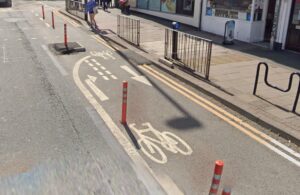
Earlier this month Reform-run Warwickshire County Council announced it is conducting a county-wide review into whether cycle lanes are “actually worth it”. The council said it wouldn’t “crazily put down cycle lanes” because it’s not “best for the residents”, that despite more than 3,000 residents signing a petition for a delayed five-kilometre bike path to be included in the council’s plans.
In April, Nigel Farage told BBC Breakfast that councils on the “verge of bankruptcy” were wasting “tens of millions” on “cycle lanes that no one uses”, accusing them of mismanaging money while basic services such as adult social care were under strain.

Farage has regularly made cycle lanes a political issue. In 2020, he rebranded his Brexit Party as Reform UK and pledged to stand candidates against councillors who backed new bike lanes and road closures. He wrote at the time that “for much of the day these new bike lanes with their endless lines of shiny white posts lie empty while traffic jams block what is left of the roads”, describing the schemes as “madness”.
The following year, he escalated his criticism by sharing a video of an ambulance stuck in gridlock beside a protected cycle lane in London, writing on Twitter: “This is totally insane. These cycle lanes are a joke.”
In May, Reform was labelled “utterly clueless about how to run a council” and accused of “pandering to the terminally online” after the Nigel Farage-led party pledged to remove all low traffic neighbourhoods (LTNs) from the areas it now controls – only for the local authorities themselves to confirm that they do not, in fact, currently have any of the traffic-calming schemes in place.
While cycling infrastructure has remained a relatively quiet topic for Reform and Farage in recent times, it remains to be seen if cycle lanes, LTNs, low-emission zones and other active travel measures will be dragged back into the culture war politics of the past few years. For now, much of the Reform-related cycling stories are coming out of local government.














24 thoughts on ““Stop tinkering with pleasantries”: Reform councillor tells council to swap Peak District cycling and walking routes for major railway investment”
The only reason to put
The only reason to put industry back into the peak district is if we go back to powering it directly from waterwheels, otherwise the hills provide too many problems for transporting goods out of the area. If you really need the power provided by the water then convert it to electricity and transfer that power to a factory built next to an existing railway line!
Sure, I want more railway
Sure, I want more railway lines, but unsurprisingly (given his party affiliation) this guy appears to be a bit of an idiot.
“It is all very well having cycling and walking paths through the Peak District – it is very nice, I have done it myself, but we must have a focus on growing the economy.”
Does he think everyone who visits these walking and cycling routes spend £0?
To invest anything
To invest anything (apparently) requires a clear link to growth in “the economy” then? Hmmm. So leisure activities & wellbeing are out. Apart from the obvious links to productivity & tourism revenue, but we’ll overlook that because that’s lefty woke ideology & just invites fOrRinErS over here.
Reform do sound a bit like a predatory hedge fund rather than a political party when it comes down to it. Line your own pockets bleeding the “investment” (the country) dry – but employ distraction about flags or some sh*t like that – & then asset strip on your way out.
Are they still a company?
Are they still a company?
Probably spend more than the
Probably spend more than the people passing through on a train! And sod the health and happiness of local people, let’s just spend all the budget building railway lines…
I am honestly just tired of
I am honestly just tired of politicians (and the public) who keep harping back to some supposed “golden ages” of Britain that we need to get back to. There is a reason why, even with our glorious history of invention, creativity and innovation, that so many of our major technology companies are owned by companies in other nations, and we are falling so far behind others in developing and implementing new technologies.
it is the same mindset that holds back investment in “green” technologies and sustainable energy production … a particular issue because, even without climate change, we would have to do those things because our current fuels are finite resources that we are using up.
Britain has been lauded through history as a forward-looking nation. That is what we need to get back to.
In a sense they’re going with
In a sense they’re merely going with the flow (on fossil fuels / extractive industries and “down with this renewables” stuff etc). *
What do humans not like? Change! What are humans most concerned about (assuming they’re not being bombed and or starving)? Their position in relation to other humans.
Ergo – it’s sound *political* sense to urge we keep digging out the coal / piping the oil and gas!
It hasn’t run out yet (although in fact in the UK some is already “uneconomic”) – so why change? Also – others may get ahead if we try to do different.
Worry about it tomorrow! (Humans don’t last that long, and political careers are much shorter…)
(* Of course if one follows the money they may well be going with the fuel and power lobby…)
chrisonabike wrote:
FTFY
This generalisation is going
This generalisation is going to the
dogsanimals!chrisonabike wrote:
No maybe about it. Five Garage Farage is heavily funded by the foissil fuel industry.
Comtinuing the let’s play
Comtinuing the let’s play trains theme, it’s as though Reform Cllrs have no idea about anything – and I’m all for more railways and less pothole fixing.
‘Deprioritise’ road repairs to ‘encourage’ more train use in Derbyshire
Reform councillor Cllr Alex Millward made the suggestion in a Derbyshire County Council meeting
https://www.derbytelegraph.co.uk/news/local-news/deprioritise-road-repairs-encourage-more-10527404?int_source=nba
(more on Reform in the Tea Shop)
The issue I have with all UK
The issue I have with all UK political parties is they are all trying to apply 20th century solutions to 21st century problems. Reform is obviously the exception to this, they are hanging on to 19th century solutions…
The Conservatives did a good
The Conservatives did a good job of allowing river pollution and promoting social inequality – also 19th century features.
Come to think of it, Reform
Come to think of it, Reform could go the whole 19th century hog with Andrea Jenkins singing the Gilbert & Sullivan classic “Three Little Maids From School Are We”, at the next party conference, instead of that shit song she wrote when she was in a band.
Or Farage could highlight the lawlessness in Britain by singing “A Policeman’s Lot”.
Manufacturing outside of
Manufacturing outside of China is gone, likely forever. The best approach is managing and marketing what is manufactured or even putting things together to make a finished product to sell locally. Far better to consider that tourism will yield better income opportunities than attempting to reinstate the industrial age in the UK. Tourism requires things like walking and cycling routes. Chinese are very good tourists too.
“Manufacturing outside of
“Manufacturing outside of China is gone, likely forever”. Apologies for the digression from cycling themes but I couldn’t disagree more with this statement. Sure it’s greatly reduced however in the UK we still have a very important manufacturing base. And long may it continue. High tech manufacturing provides many highly paid value jobs. Our economy along with the UK tax intake (paying for things like NHS, social services and dare I say it travel infrastructure) would be greatly reduced without it. If you think that can be replaced by chambermaids and bar staff think again.
“tinkering around with
“tinkering around with pleasantries”
Not something anyone meeting a group of Reform councillors has ever said.
Reform: for when the planet
Reform: for when the planet absolutely, positively has to be destroyed overnight.
Parody of the 1979 Fedex commercial. https://www.youtube.com/watch?v=YboNZ73BJRE
Completely agree with him. I
Completely agree with him. I love the peaks and way beyond, but we need more self sufficiency. If implemented it has to be done in a way that has the minimum impact and damage.
I’ve noticed no one commented on the disaster HS2 is and what a balls up they’ve made of it.
I lost faith in HS2 when they
I lost faith in HS2 when they cut the cycle-paths from the scheme to save money.
That alone shouldn’t worry
That alone shouldn’t worry you – it is virtually a rule that money is cut from active travel infra (if that isn’t dropped completely) when bigger schemes run short (which is also more common than not).
An integrated approach to travel (well, other than “and we must also not reduce motor traffic capacity”) often seems a dream in this country. Other countries show that this is possible though.
lesterama wrote:
Even worse that was predicted to give the biggest economic benefit from the entire scheme whilst being the cheapest aspect of it. So zero money saved because it was an investment, not a cost.
Dave H wrote:
Not sure how “bicycles” are going to *reduce* self-sufficiency? And aside from that being a complex issue to address providing mobility infra has widely been shown to *increase* local resilience. And actually make a positive contribution to the economy unlike mass motoring.
Providing more public transport / rail links is a good idea also – why not both (they can be synergistic)?
Are you taking issue with (as reported) the evaluation that putting rail back in is too expensive / risky? That is a judgement call.
Or you just don’t think the proposed provision for cycling has any benefit?
I can understand “not in x place” – but in my experience when those who say that are quizzed it turns out there is only one place they think *is* appropriate – “elsewhere”!
(Seems odd that Reform would be lobbying for massive government spending on a chancy project – or do they have some private investor lined up? Or could it just be that “bicycles” gets their goat for some reason?)
Apart from folk riding and
Apart from folk riding and walking in the Peaks for leisure having zero relation to how self sufficient the UK is, the biggest economic benefit and the cheapest part of HS2 was going to be the bike path running alongside it.
Nothing Five Garage Farrage or his even dimmer minions says on this [or any subject] makes sense. Active travel and safe bike lanes reduce congestion whilst saving money, making people healthier and reducing pollution. But Five Garages doesn’t care about that, he just wants to sow hate and division as well as do the bidding of the fossil fuel industry who are paying a lot of his wages.