


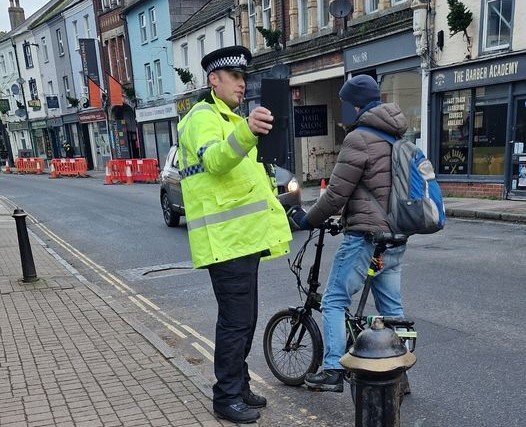

Cyclists in Salisbury have been warned that they could face fines for riding against a new one-way system, after police in the cathedral city say they “almost instantly” stopped a commuter flouting the traffic regulation during a targeted operation earlier this week, while branding the behaviour of both delivery cyclists and the general public “incredibly dangerous”.
However, the crackdown has been criticised by cyclists in Salisbury, with many questioning the police’s claim that using an alternative route would add “less than a minute” to journey times, while one social media user told the officers to “grow up” and questioned whether “cyclists are the most obvious issue” currently facing travel in the city.
Fisherton Street, a key route into Salisbury city centre, was transformed earlier this year into a temporary one-way system, as part of improvement works on Fisherton Gateway that will last until next summer and, Wiltshire Council says, “enhance the public realm and improve pedestrian areas”, making it “easier, safer, and more convenient to travel by foot into the city centre”.
However, Salisbury Police took to social media earlier this week to announce that, despite the ongoing roadworks, people on bikes “are still cycling against the one-way system leaving the city centre” and that an operation was carried out to crack down on such riding.
“This is both delivery cyclists and the general public,” the police said. “This is incredibly dangerous.
“Officers today visited Fisherton Street and almost instantly stopped a commuter cycling the wrong way. If this issue continues, fixed penalty notes will be given out to prevent this practice.
“Cyclists can use Crane Bridge Road; this only adding less than a minute to leave the city.”
While the police’s post and threat of fines was applauded by most Facebook users – with many claiming that cyclists “don’t think the rules of the road apply to them” – others were critical of the force’s actions.
“Yeah, because cyclists are the most obvious current issue facing travel in Salisbury,” one commenter said. “Grow up. There are real crimes unsolved and unpunished.”
“I agree with parts of this post,” another said. “But suggesting that the diversion only adds one minute to a journey is farcical.”
“All the multiple road works make Salisbury impossible, and I don’t actually blame people for wanting to cycle the wrong way! Sometimes I feel like driving the wrong way,” a motorist added, while another claimed that while “rules are rules”, the lack of a cycle lane towards the city centre has made life difficult for people commuting on bikes.
> ‘Vulnerable Road User’ operation sees police fine cyclists for jumping red lights
This type of police operation, targeting rule-breaking cyclists and usually accompanied by a social media post, is of course nothing new.
In September, Police in Scotland carried out a ‘Vulnerable Road User’ initiative which saw four cyclists fined in Edinburgh for riding through red lights.
The operation, which also saw cyclists, pedestrians, and drivers “spoken to and given advice” appeared to take place at a pedestrian crossing in the Scottish capital, with Roads Policing Scotland explaining that four cyclists and one driver were fined for going through red lights.
And in February 2022, police in Hackney said they had caught 18 cyclists jumping red lights in 90 minutes, each getting a £50 fine and a road safety lecture.
A week later questions were asked after another force, this time in Manchester, was keen to highlight its crackdown on people using bicycles riding through reds. Like the action in Salisbury this week, the Manchester post attracted a significant number of responses questioning why the force is “prioritising” less dangerous offences, while others called for a more effective use of police resources.
A campaign group dedicated to making the A56 in the north-west of England safer for all road users also suggested there are “far more serious” dangers on the road that police should be looking to target.



















56 thoughts on ““Grow up”: Police criticised for targeting “incredibly dangerous” cyclists riding against one-way system”
Why is this considered
Why is this considered dangerous on a high street where all traffic is likely travelling at 20mph or less, with good visibility, yet perfectly acceptable when on a country lane, with limited visibility, less space, and drivers potentially barelling along at twice the speed?
TBFit’s rather more than a
TBFit’s rather more than a high street – it looks urban arterial to me.
It’s not even the high street
It’s not even the high street. It’s inside the ringroad, so not for through traffic. Probably most used for access to the Central Carpark.
With two zebra crossings, parked cars & stopped buses, cyclists tend to get held up by motor traffic, rather than the other way round.
cyclists tend to get held up
cyclists tend to get held up by motor traffic
This happens all the time here- the MGIF nutter overtakes and is then immediately stopped behind parked cars because of obvious oncoming traffic whereas I could have just kept going. However, I can illegally by-pass the blockage on the pavement if I can get past the cars right across the pavement outside the school
They could just permit
They could just permit contraflow cycling on this (temporary) one-way street.
https://www.sciencedirect.com/science/article/pii/S000145752200330X?utm_source=pocket_saves
Allowing contraflow cycling
Allowing contraflow cycling is one of the traffic law changes that I think would improve safety and encourage cycling. Personally, I’ll cycle the wrong way up one-way roads if I think it’s quicker/easier and has enough room. What’s annoying is on roads where it isn’t allowed, you sometimes get drivers trying to squeeze you off the road as they don’t like cyclists interpeting the law.
.
.
If only we had you in charge, to decide which laws we could break and which we had to follow. Things would be SO MUCH better then.
.
Yeah?
.
Flintshire Boy wrote:
It would definitely be better as many laws are poorly implemented and designed to further the status quo and protect the land-owners.
As global communication has become easier, we can now easily compare our traffic laws with those in other countries and decide which ones are more suited for the stated aims of reducing short car trips and promoting cycling. Also we have much better access to data and are able to evaluate the impact (or hopefully less impacts) of changing traffic laws. Certainly, I think that our current traffic laws are very much designed with a focus on travelling by car and our road networks are extremely focussed on motor traffic. Traffic lights are another example where we’re now starting to experiment with allowing cyclists to get across junctions before the motor traffic so that there’s less RTCs and less cyclist deaths.
When following laws, good citizens should evaluate who the law serves and whether the law is protecting people or protecting corporations/institutions. Sometimes the greater good is served by not obeying certain laws – there are plenty of historical examples of immoral laws and the UK’s recent law to prevent protests is an example of a dubious law.
I get that pretty often on
I get that pretty often on roads where it IS allowed.
I have read elsewhere (can’t
I have read elsewhere (can’t recall) the “it’s actually fine safety- wise” argument. I’m not sure in general it “encourages cycling” – I don’t always enjoy those interactions and others are more cautious than me!
I think of this a “temporary, occasional hack” for a few locations where it’s currently too difficult to fix or where a short “unpleasant” section makes an entire route much better or even possible. And best where motor traffic is minimal anyway and ideally very slow.
I note in NL they tend to “fix” these over time eg. over the decades the one in article below was one way, parking both sides -> one way for cars with cycling both directions (one contraflow) -> no cars
I pretty much agree.
I pretty much agree.
2 way cycling on one way 20mph streets seems very reasonable for a start, and via a physically protected 2 way track on one way Classified Roads with higher speed limits.
It will take time, however.
Whats next, e-scooters,
Whats next, e-scooters, motorbikes, mobility buggies, as long as they keep a slow speed? One of the fundamental aspects of being a road user in any form is to be predicatble and if this road isnt designted for flow in the other direction (temporarily or permanently) it makes life harder and a little more dangerous for everyone.
argiebarge wrote:
It probably makes sense for e-scooters as they have very similar properties to cyclists – limited speed and weight whilst being very maneouvrable so as to pull in when there’s not enough room to pass. Mobility buggies would suffer from not having that option, so there’s less roads that would be suitable for them to contraflow. I don’t think it’s suitable for full size motorbikes, though I’ve certainly seen pizza delivery scooters going the wrong way.
Well a major issue with our
Well a major issue with our road systems is that *any* change is “bad” due to humans operating on them through memory / autopilot. Plus humans are in general easily overwhelmed. Outside of early childhood / once in a lifetime for the driving test there is no “road training” (for those not driving professionally).
That’s why all road systems – especially the best – aim for predictability via simplicity, regularity and clarity.
So I agree it’s not a great idea. However it may have a (very small, ideally temporary) role in making change *possible*. And IIRC there is some evidence this hasn’t caused carnage where deployed so far.
This is a 2 way road reduced
This is a 2 way road reduced to one way for roadworks.
What has not been done is to consider different modes of travel separately, and how appropriately to allow for them during the road work period.
AKA car brain.
On your other, it seems like a bit of a generic kneejerk. Mobility buggies have 2 way movement here on the footway. Motorbikes are motor vehicles are considered as such.
E-scooters need to be properly regulated, but that will not happened whilst Short Term Rishi and the Shysters are concerned only with saving their cowardly political arses.
I understand the situation
I understand the situation which is why ‘temporary’ is in the wording, I have read the article. As I noted elsewhere in the comments I believe the system could work well as I’ve seen it in use before. But right now it isnt.
Should it be? That could depend on how long the works will actually be up which seems to be “Summer 2024” (so likely Autumn earliest) so it would make sense with such a timescale.
Incidentally the work seem to be pavement widening, street lighting, among other things but the primary goal apears to be pedrestian focused with no specific cycle infra noted other than additional cycling bike racks (source: invest in Salisbury).
Sorry, can’t see the validity
Sorry, can’t see the validity of the protest here at all. Riding the wrong way down a one-way street is silly and dangerous. Perhaps there’s a case for saying there’s enough room for a cyclist contraflow and lobbying for it to be established but in its absence it’s just a stupid thing to do, antagonises non-cyclists and perhaps most importantly from a cyclist’s perspective it puts you completely the wrong side of the law if you hit a pedestrian or get hit by a car, in the former instance you are bound to be in serious legal trouble even if it was a pedestrian stepping out whilst looking at their phone or similar, and in the latter you can forget about any form of compensation for damages or injuries. Just not worth it.
Rendel Harris wrote:
There is some research showing that contraflow cycling can improve cyclists’ safety despite the common perception that it’s dangerous:
https://roadsafetygb.org.uk/news/research-calls-for-legislation-to-allow-contraflow-cycling-on-all-one-way-streets/
Often, the alternative to cycling the wrong way down a one-way street will involve tangling with much busier roads and/or a longer journey – both of which would increase the likelihood of a RTC.
I don’t think your point about hitting pedestrians is that relevant as you want to be avoiding doing that anyway and I’d recommend going safely and carefully when contraflowing so that you can stop whenever necessary.
https://www.cycling-embassy.org.uk/sites/cycling-embassy.org.uk/files/documents/Contraflow%20Cycling%20TAL%206-98.pdf
https://www.cyclinguk.org/briefing/contra-flow-cycling-2-way-cycling-1-way-streets
https://www.edinburgh.gov.uk/downloads/file/24959/c5-contraflow-cycling
In a defined contraflow
In a defined contraflow system sure, which this isnt. We cant make up the rules as we go.
argiebarge wrote:
If it’s safer to ignore the rules, then I’d put personal safety above rule following.
What you actually meant to
What you actually meant to say is if it slows down my trip its better to break the rules, and this is where one of the biggest risks from cars arises.
argiebarge wrote:
There’s always a trade-off between speed/ease of travel and safety. However, I don’t think that using a back-street road the wrong way is anywhere near the danger of a busy road with lots of side roads and junctions – that’s where most RTCs happen with cyclists.
Allowing cyclists to take the most direct and speedy route is a big step towards getting more people travelling by bike. If you’ve got a route along a busy road where you get stopped every 500m by a traffic light, then it’s going to be an arduous journey fraught with danger. If instead there’s a route that allows a steady speed, then cycling along that is going to be much more pleasant and acceptable for more people.
argiebarge wrote:
Motorists Break Law To Save Time, Cyclists Break Law To Save Lives, Finds Study
https://www.forbes.com/sites/carltonreid/2020/09/18/motorists-break-law-to-save-time-cyclists-break-law-to-save-lives-finds-study/?sh=2c6a12e33c54&utm_source=pocket_saves
Some of the “defined”
Some of the “defined” contraflow systems are little more than a sign at the end of the road. They make it legal to cycle in the other direction, but the practical on-the-ground change is often negligible.
For sure, I’d be perfectly
For sure, I’d be perfectly happy for it to be made legal on the majority of one-ways, as it is in Paris for example and works well. I’m just saying I don’t think it’s a good idea whilst it’s not legal as drivers aren’t going to be expecting you and I do think there’s an increased risk of hitting pedestrians because when they’re walking towards the oncoming traffic they’re more likely to step out without looking behind. I guess you can obviate the risk by riding at walking pace, but then why not go a legal way round at normal speed?
Rendel Harris wrote:
It very much depends on the specifics of the roads, but in my experience most one way roads are quieter back roads that do lend themselves to contraflow cycling. There’s busier multi-lane one way roads that aren’t suitable (e.g. round the Triangle in Bristol) so it does require some evaluation of when the alternatives are better.
I have my doubts about pedestrians looking for cyclist traffic even when the road isn’t one way.
hawkinspeter wrote:
I find too many pedestrians look with their ears before crosing roads. Amazing that the introduction of electric cars hasn’t reduced the frequency of this.
Most pedestrians never look
Most pedestrians never look either way when they cross a side road. So you always have to expect them to step out regardless.
There is generally “some
There is generally “some research” to prove most things. Meanwhile abiding by the rules of midst unlikely to see you issued with a fixed penalty notice.
There’s blatantly space for a
There’s blatantly space for a contraflow cycle lane, since the carriageway is around 7m wide. I’m afraid I put this down to car-brain, and alternative modes not being given equal consideration, in the Highway Authority.
It’s all about values and priorities which don’t exist in the HA.
AFAICS, even one of the footways meets the specification for a shared path ie ~3m wide, which is way beyond the width of many shared paths in this country. The one dorectly next to my local 25k AADT bypass is 1.2-1.5m wide for about 2 miles.
Even on the police photo:
I suspect it may not remain
I suspect it may not remain so wide – yes obviously from that picture there’s plenty of space for a contraflow and were it to remain like that they should definitely implement one, but the cones and fences look as if they’ve been put there ready to commence works when presumably much more of the carriageway will be taken away.
Despite the photo, the
Despite the photo, the pavement for much/most of the effected part of the street is hardly wide enough for the number of pedestrians, so no room for shared use pavement.
Services are being identified, updated/replaced for the new road layout, so the barriers are being moved as work progresses, and at times form a chicane. Work vehicles also park there.
Note that Salisbury centre has many one-way streets, so the alternative route isn’t always a simple option. Also note that the high street is open to cycles!
The real issue is that the works are taking far too long (along with those in the Central Carpark).
I love my bike wrote:
I didn’t say it was squire, I think you’re replying to the wrong person!
It is not dangerous on most
It is not dangerous on most roads. The roads are one way because there is not enough space for two cars to pass.
Very often One-Way-Systems
Very often One-Way-Systems are implemented to augment on-street car parking capacity.
Roads like these are extremely off-putting for cyclists.
neilmck wrote:
It would not be dangerous if a contraflow cycle lane were established and that should be done everywhere possible. I would disagree that it is not dangerous to cycle the wrong way up a one-way street where it is not permitted, if drivers and pedestrians are not expecting cyclists to be coming in that direction it seems perfectly obvious to me that will increase the possibility of incidents.
There is a one way road in
There is a one way road in town with herringbone parking and I still see cyclists going the wrong way along it. Even saw a dad with his young lad go the wrong way ! No way can you see people coming the wrong way, no matter how careful you are.
Not really convinced about ignoring the restrictions however safe it might appear.
On my commute to work, there
On my commute to work, there is a one way street I cycle the wrong way down, it is wide enough for cars (or delivery vans) to park down one side and leave enough room for me to cycle one way and a vehicle pass the other with no risk of collision (unless one of us isn’t paying attention). At the time I travel, I almost never pass a vehicle travelling the opposite way, despite it being in Central London.
To travel the legfal way would see me turning right across a main road, which is basically impossible on a bike unless traffic lights further down the road stop traffic. You’re then riding on a really busy road with no cycle lane and for about 200 metres before turning right back to the quiet streets.
Despite outrage from people online claiming that my riding down the one way street is always more dangerous, I can categorically say without any doubt in my mind that it is not.
There are many one-way
There are many one-way streets I can think of that I cycle down occasionally. I do this because despite the outrage, it’s safer for me. One such is here https://maps.app.goo.gl/iJYrL5WDMd9b9ABz6 and no, I don’t use the cycleway parallel to it, because it’s full of broken glass like you wouldn’t believe, and it’s also dark and uninviting.
I think the default position should be that if a one-way system is implemented, contraflow cycling be allowed. Only on dual carriageways, or very narrow urban roads, should this really be questioned.
Everyone from pedestrians to
Everyone from pedestrians to motorists know what a one way street is you cannot be surprised if the police have an issue with it.
pablo wrote:
Maybe not surprised, but if they routinely ignore speeding and distracted driving, then it seems curious that they choose to enforce arguably far less dangerous rule breaking.
I’m surprised.
I’m surprised.
Contraflow cycling on a one-way streets without a painted cycle is normal and not uncommon.
You just put an “except cycles” board below the No Entry signs at one and, and a cycle symbol with an arrow painted on the road at the other end, so drivers are aware. If it is a long street repeating the painted symbols occasionally.
I’m not sure if I’ve seen one without a 20moh limit, mind.
Seeing a no entry sign for a
Seeing a no entry sign for a one way street without the “uitgezonderd” notice and a picture of a bike and brommer is pretty unusual in NL.
People assume that it is
People assume that it is dangerous to cycle the wrong way down a one-way street. However one-way streets tend to be quiet streets often only existing as traffic calming measures. In France, once an area becomes a 20mph zone all one-way streets magically become two-way for cyclists.
Around where we live in Paris
Around where we live in Paris all the one way streets are two way for cycles.
That sounds very interesting,
That sounds very interesting, and I think it makes perfect sense. Do you have any link to it?
It actually became law in
It actually became law in France in 2008 that all 30 km/h roads had to become two-way for cyclists unless circumstances made it impossible: contraflow lanes for cyclists in Paris rose from 40 km to 250 km in a year. I don’t have BIAD’s experience of living there but I go to Paris a lot and cycle every time I do and they work brilliantly, being the default for one-way streets everyone is used to them and they are pretty well respected by car drivers (Parisian drivers, in my experience and contrary to popular myth, being significantly better around bikes than London ones). All the research I’ve seen has shown that there has been a very significant rise in cyclists using those streets without a corresponding rise in incidents.
Thanks for the info, France
Thanks for the info, France really wants to promote cycling and doesn’t fear changes.
I would really like to see similar changes in legislation in more countries.
For having been to Salisbury
For having been to Salisbury not long ago, the place is a total shambles traffic-wise.
If ever a city called for a total closure of its centre to motor traffic, it’s this one
We as cyclists are at times
We as cyclists are at times our own worst enemy, If its a one way system its that for all traffic we are not exempt.
From the photo there are
From the photo there are cones and barriers on the road that are restricting the width, this makes cycling against the traffic doubly dangerous. Any vehicle, even another cyclist won’t be expecting anything to be coming towards them, and they will be focussed on avoiding those obstacles.
Standard selfish ignorant
Standard selfish ignorant responses. If you want to dictate roads policy join the council. If you want to dictate police priorities run for PCC or get involved in the myriad other ways there are. Those people saying police should have different priorities would be the first ones shouting if they or anyone they care about was injured while breaking the law. It’s not the police who need to grow up here.
I love all the comments here.
I love all the comments here. “If the law was different, we wouldn’t be breaking it.” And “the police should turn a blind eye because cyclists can’t cause as much damage as a car”
Guys, the law is the law. If you get caught breaking it, accept your medicine and maybe start posting articles in support of riding within the law rather than being openly critical of people doing their job by upholding it.
You, road.cc, and your readers don’t do yourselves any favours with this sort of article or responses.
The police has had little
The police has had little difficulty publicly refusing to police 20mph zones in the past, and when the vermin redcoats overran my parents village were nowhere to be seen to enforce road traffic laws or the hunting with dogs act.
Hmm… on one hand I’m
Hmm… on one hand I’m sympathetic to the viewpoint “you pays your money and you takes your choice”. Also while I think the danger in this story may be exaggerated (both parties are approaching head on – this should be maximum mutual visibility at least) I also don’t think this is a great idea – even where legal.
I tend to stick to the rules. But the rules are still taking on board the position of vulnerable road users and the rules “as people understand them” (e.g. how a substantial number actually drive) are different again!
“Shooting the messenger” / those actually enforcing the law: as Robert Hardy notes enforcement is … interestingly selective.
Pavement driving? Police have officially said “not interested” (it might change a bit here in Scotland – again enforcement-depended).
Close passes (or even contact)? Police Scotland at least have effectively said “not interested” (see how easy it is to report and the fact that someone accused saying “No, I don’t recall that” effectively ends an investigation).
Cyclists killed on the roads? As we know from reporting here not infrequently the police and / or legal system says “not interested” (“driving to the conditions” is apparently optional / they’re throwing themselves under vehicles).
Of course bikers are going to
Of course bikers are going to object how dare people think they have the right to be kept safe from law breakers on bikes . One way system , well I was only going one way lights well they all mean go ,pavements that’s the fast lane isn’t it . Take that pedestrian to court he bent my wheel when he hit me at speed on the pavement I have rights you know what’s the odd damaged pedestrian or 20