


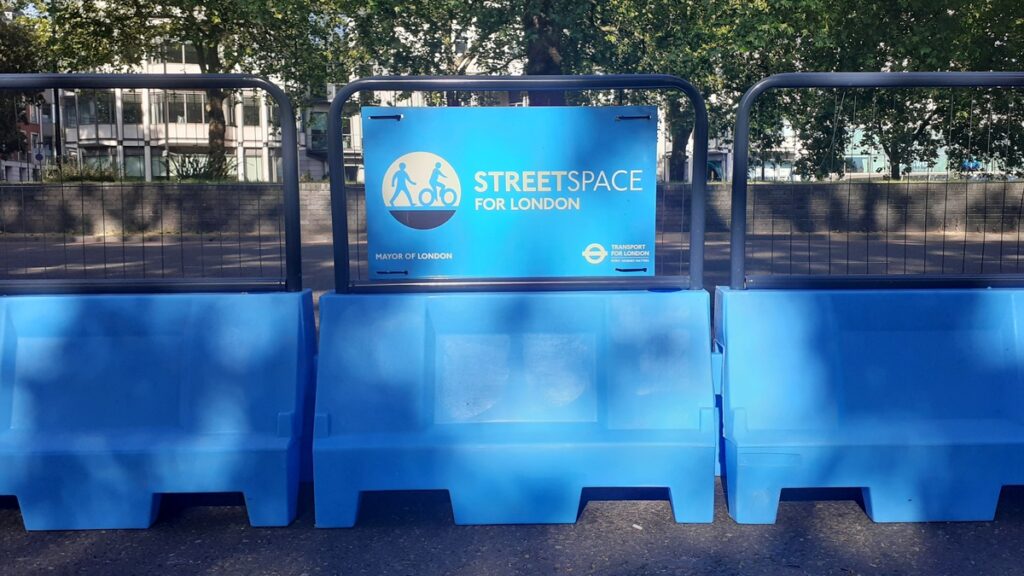

Three Court of Appeal judges have said that a High Court judge’s ruling earlier this year that emergency measures undertaken by Transport for London (TfL) in response to the coronavirus pandemic were “seriously flawed” and “irrational” had no foundation, their criticisms contained in their full decision explaining why they last month upheld TfL’s appeal against the original judgment.
> Transport for London wins appeal over Streetspace active travel programme
In January, Mrs Justice Lang found in favour of The United Trades Action Group (UTAG) and the Licensed Taxi Drivers Association (LTDA), which had sought a judicial review claiming that TfL’s Streetspace for London programme under which increased road space was given to cyclists and pedestrians, TfL guidance to boroughs including on low traffic neighbourhoods, and the closure of Bishopsgate were all unlawful.
In her decision, the judge said that TfL and the Mayor “took advantage of the pandemic” to enforce “radical changes” to London’s streets and that they “failed to distinguish taxis from ‘general traffic’,” disregarding “the distinct status of taxis as a form of public transport, reflected both in law and policy” and “the role played by taxis in facilitating accessible public transport for those with mobility impairments.”
She also said that the changes went “beyond what was reasonably required to meet the temporary challenges created by the pandemic.”
However, the Court of Appeal’s full decision, which has now been published, pulls her ruling apart, with the three judges saying that it was “extraordinary and not right” that the steps taken by TfL and the Mayor be described as “extreme or ill considered,” nor were there grounds to view them as “irrational.”
They said that Mrs Justice Lang “seems to have given no or almost no weight to the fact that the [decisions taken by TfL] were made on or by 15 May 2020 at a time when the duration and future course of the pandemic were wholly unpredictable.”
The judges also pointed out that each of the measures introduced “was in accordance with the policy not only of the Mayor and TfL but also of the Secretary of State for Transport of encouraging walking and cycling rather than other means of travel.
“They were not universally popular, but we think it would be extraordinary and not right for a court to condemn them as extreme or ill-considered, especially during the pandemic,” they said.
UTAG and the LTDA have been refused permission to appeal against the ruling, and have also been ordered to pay TfL’s costs, including paying £50,000 within 14 days.





















47 thoughts on “Court of Appeal pulls apart High Court judge’s rejection of London’s Streetspace programme and other active travel measures”
Ouch!
Ouch!
‘UTAG and the LTDA have been
‘UTAG and the LTDA have been refused permission to appeal against the ruling, and have also been ordered to pay TfL’s costs, including paying £50,000 within 14 days.’
Cue squealing, GB News commentary and lots of outraged cab drivers
Huw Watkins wrote:
Another mistake; don’t read this one either.
Huw Watkins wrote:
I do not consider a black cab to be “public transport”
At least, certainly not the same kind of public transport as, say, a bus or a tram or a train…
brooksby wrote:
I’ve often wondered whether it is in the same sense as “public” schools…..
I would suggest the correct
I would suggest the correct term we should be using is “mass transport”. A private car is only an issue when it is on the road running from Point A to Point B. All things being equal, a taxi will be on the road for the same length of time for the trip – hence no savings in road congestion, in fuel usage, in air pollution (in fact will add to them since they have the overhead of cruising around looking for the next fare). Mass transport (busses, ferries, trains, trams, etc) is a subset of “public transport”. and is to be encouraged.
Taxis provide some savings in garaging and parking space, in car ownership and running costs, but every empty taxi you see driving around is an overhead on the system.
You’re hiring a vehicle and
You’re hiring a vehicle and driver for the exclusive private use of yourself and party. How can that be deemed public transport?
rct wrote:
The vehicle and driver are available to the public as individuals, so not like a private car.
eburtthebike wrote:
So does that mean that chauffeurs and limos are public transport too?
Captain Badger wrote:
No; not unless they are available to the public for hire.
eburtthebike wrote:
Aren’t they all available to the public, or do they require qualifications?
Captain Badger wrote:
Presumably also makes (random example) Amazon a public service, too, since any individual member of the public can order stuff from them.
No because Amazon can refuse
No because Amazon can refuse to sell to you whereas a black cab has to pick you up (even if disabled with a wheelchair).
hirsute wrote:
That’s the crucial distinction, a black cab is public transport because theoretically any driver with his/her light on is obliged to accept your request for any journey within London under 12 miles, whereas an Uber or minicab driver has the option to refuse. However, anyone who’s tried to get a cab from Trafalgar Square to Peckham after midnight knows full well this is an empty promise and a good reason (of several) for removing black cab drivers’ ridiculous privileges in London.
Rendel Harris wrote:
That’s the crucial distinction, a black cab is public transport because theoretically any driver with his/her light on is obliged to accept your request for any journey within London under 12 miles, whereas an Uber or minicab driver has the option to refuse. However, anyone who’s tried to get a cab from Trafalgar Square to Peckham after midnight knows full well this is an empty promise and a good reason (of several) for removing black cab drivers’ ridiculous privileges in London. — hirsute
Clearly I’ve been playing devil’s advocate with Eburt, but as you both have said , there is an obligation for a Hackney carriage licence holder to accept fares, unless there is reasonable cause to refuse.
My understanding is that the reasonable cause is not clearly defined in any legislative sense (obvs I may well be wrong, and someone will no doubt be able to furnish extra details), leading to a great deal of difficulty in holding these “public servants” to account legally, let alone operationally.
hirsute wrote:
Yes – but that wasn’t the explanation I was responding to.
eburtthebike wrote:
But it is certainly debateable* whether Taxis increase or reduce emissions. And if the removal of taxis would lead to an overall reduction in carbon emissions there is no moral justification for the number of privileges they recieve.
* on the one had a taxi with a fare is making the same journey as a private car, and will then spend additional time driving around empty. On the other hand they complete the final miles of journeys predominantly taken by rail, with some rail passengers unlikely to consider using the bus when reaching their final city. So potentially the removal of taxis would decrease rail use.
Apparently LTDA and UTAG are
Apparently LTDA and UTAG are planning to go to the Supreme Court to get leave to appeal. So this isn’t over yet; or they may just be throwing good money after bad.
The judgement specifically
The judgement specifically refuses them the right to appeal…
Might be based on “Steve
Might be based on “Steve McNamara, general secretary of the LTDA, said: “We are currently in the process of reviewing the Court of Appeal’s full judgement with our lawyers and considering next steps. We will keep the trade and other interested parties updated.”
I suppose the question is if the CoA did not follow due process is there a mechanism for reviewing that? A sort of super-judicial review.
True, but you can get
True, but you can get permission to appeal from a higher court.
Zebulebu wrote:
Which is why they are considering going to the Supreme Court, I think. https://www.supremecourt.uk/procedures/how-to-appeal.html
Please will someone in London
Please will someone in London buy those three appeal court judges a drink? Or five?
With such a damning, unanimous verdict against her, surely Mrs Justice Lang should be considering her position; anyone who gets it so wrong has no place deciding other people’s future.
“UTAG and LTDA have been refused permission to appeal against the ruling, and have also been ordered to pay TfL’s costs, including paying £50,000 withing 14 days.”
Cherry, hop on that cake.
eburtthebike wrote:
The language used by Mrs Lang was not the measured language we are used to hearing – it’s almost as if there was some kind of bias in her original judgement….
Hurrah! Judge Lang has been
Hurrah! Judge Lang has been given a real pasting in the measured legalese of the Appeal Court- stating that ‘she made a logical error’ is tantamount to describing her as a thickhead. Are there any consequences for a judge criticised like this?…anyone on here with legal expertise?
Promotion?
Promotion?
Amazing result considering
Amazing result considering how judges are as thick as theives when it comes to sticking together. I would bet that the 3 appeal judges were all men who might not want Judge Lang in their ‘club’.
wtjs wrote:
But it’s also a way of avoiding saying the original judge acted with bias in favour of taxis/against cyclists.
When the appeal court judges agree the decision was very wrong there are only two possibilities – incompetance or corruption. It wouldn’t do to suggest the latter.
The amount of crowing from
The amount of crowing from the LTDA and UTAG after the first judgement makes this all the sweeter.
And therein lies the crux of the whole argument against cycle lanes/LTNs across the country … there appears to be this notion that they should only be introduced if they are “universally popular” rather than being “the right thing to do”.
We cannot deal with the climate crisis without cutting the number of cars on the road, and we can’t cut the number of cars on the road without making it both more convenient and more attractive to people to use alternate forms of transport.
There will inevitably be some short term pain for some people as that adjustment is made, but councils giving up as soon as someone bleats about the slightest inconvenience means we are moving much more slowly than we need to.
The other problem is that as a society we are buying bigger and bigger “cars”, which use up more space, do more damage to the roads, and cause more serious injuries to vulnerable road users in a collision. This is perfectly exemplified by Ford’s decision to discontinue the Mondeo as everyone is apparently now buying SUVs rater than family cars.
Unless we take on board the lessons we could learn from The Netherlands, Denmark and Paris, in how to proceed, we really are doomed.
I agree with all that.
I agree with all that.
To revive an old argument in a totally unnecessary way, I’ll point out that Tao Geoghegan Hart and his colleagues should stop marketing the awful Grenadier 4×4.
Jetmans Dad wrote:
less convenient and less attractive to use motor transport
Not making any detectable progress at all.
My preferred method of travel
My preferred method of travel in London, when working, was taxi; black taxi only as I don’t do private hire (or is that criminal hire). That was until 3 years ago when the LTDA and UTAG campaigns started to target cyclists much more aggressively.
They are an odd bunch. Many of them could not see the irony of them moaning about “immigration” and the “EU” dictatorship; whilst they commuted from their homes in Spain to their/their relatives socially provided housing in London, to work every other week (Cash would be better Sir).
The final nails were the constant assumptions that this “white” 50+ business person (64 actually, you are so kind) would support their tirades about cyclist, imigrants and the EU. I mean how were they to know that I’ve ridden bikes from the age of 5, my wife most definately has a brown hue, and I’m looking for the barstewards who stole my citizenship?
Not all Taxi drivers are bigots; only the ones that have their mouths open! That second sentence is untrue there. I now walk, use the bus or if unavoidable the tube/train. Feck Black Cabs!
Hi Legin,
Hi Legin,
Been that cab many times & have the tee shirt. I, however, am 65 but clearly don’t look it.
B
Legin wrote:
Seems a strange decision to make if you had ever cycled on london streets, at an early age I learned enever to trust cab drivers as they could spot potential fares with eagle eye vision, but the cylists between them and the fare, was much harder to see.
I cycled on London Streets 6
I cycled on London Streets 6 times between 1974 and 2016, so rare I can actually remember them.
This has absolutely made my
This has absolutely made my week:
“UTAG and the LTDA have been refused permission to appeal against the ruling, and have also been ordered to pay TfL’s costs, including paying £50,000 within 14 days.”
Has anybody found a good
Has anybody found a good Twitter thread on this yet? maybe they could share the best bits?
I am left bewildered that
I am left bewildered that there seems to be so little objective truth or agreement about the law amongst those at the very pinnacle of the profession. A layman might be left believing it is an extremely well remunerated cabal of soothsayers.
Sriracha wrote:
That could be one way of looking at it.
The other way is that errant decisions may be appealed, in this case was, and the checks and balances were proved to be effective.
If it was thought that all judgements were correct, there would be no need for an appeals process. Currently, there is one, and whilst not perfect is established and broadly effective.
But it’s not really a system
But it’s not really a system of “checks and balances”. That would imply a separation of powers between different bodies, such that no single body held ultimate power. Whereas the judicial system is a hierarchy, where the top court holds ultimate authority. We just have to accept that they know best.
What stands out in this case is the starkness of the disagreement. If it were just a finessing of an abstruse point of law which swayed the balance of a finely hung decision, well then fine. But for two top tiers of the legal system to hold such opposed understanding strikes me as odd.
Sriracha wrote:
Well, no we don’t have to accept. There was an appeal, and it won.
I agree that the disagreement was staggering. That doesn’t amount to both being wrong though. The fact it was staggering demonstrated in my mind how rare this kind of occurrence is – it’s a standout case. I commented below that they were so opposed, and the summing up so harsh (in legal terms), perhaps indicates some initial favour in the first judgement.
Captain Badger wrote:
Well, no we don’t have to accept. There was an appeal, and it won.
I agree that the disagreement was staggering. That doesn’t amount to both being wrong though. The fact it was staggering demonstrated in my mind how rare this kind of occurrence is – it’s a standout case. I commented below that they were so opposed, and the summing up so harsh (in legal terms), perhaps indicates some initial favour in the first judgement.— Sriracha
but the lower court made a different conclusion, we have to accept the appeal court is correct as their deciion cannot be appealled.
But part of this is that there are 3 judges on the appeal court panel, not a single judge with ultimate power.
Captain Badger wrote:
One of the best books I’ve ever read was “Arthur and George” by Julian Barnes, which deals with the case that caused the court of appeal to be set up, the Arthur being Sir Arthur Conan Doyle of Sherlock Holmes fame. Must read it again soon.
“Half of legal advice given
“Half of legal advice given is wrong” quipped my lecturer on on my unaccredited Law in Society minor, regarding litigation.
Although leave to appeal wasn’t granted, I believe the loser can apply to have that set aside. But I hope they now drop this nonsense.
Cabbie Twitter remains quiet on this AFAIK and is sticking to the occasional “under this crazy rule introduced by Khan, I can’t drop off my one-legged war veteran passenger”, “oh gosh, aren’t there lots of cyclists around” or “there are no cyclists around”.
Still, the LTDA have got its members’ backs should anyone by a weird combination of circumstances find themselves accused of assault..
Wasn’t there another thing
Wasn’t there another thing stating something like a Judge makes their personal decision and then looks for the legal arguments to back it up rather then the reverse? This is especially noticable with the more Political backed systems like in the USA when the politics of the Judge is known in advance (they were nominated by Dems or Republicans).
Sriracha wrote:
Dangerous concept, objective truth; your truth or my truth?
There is no such thing as truth, just proven facts. Nothing Mrs Lang said could be proven true, while everything the appeal court judges is provably true.
Unless you’re a Trump or Boris supporter of course; in which case you’re beyond redemption.