


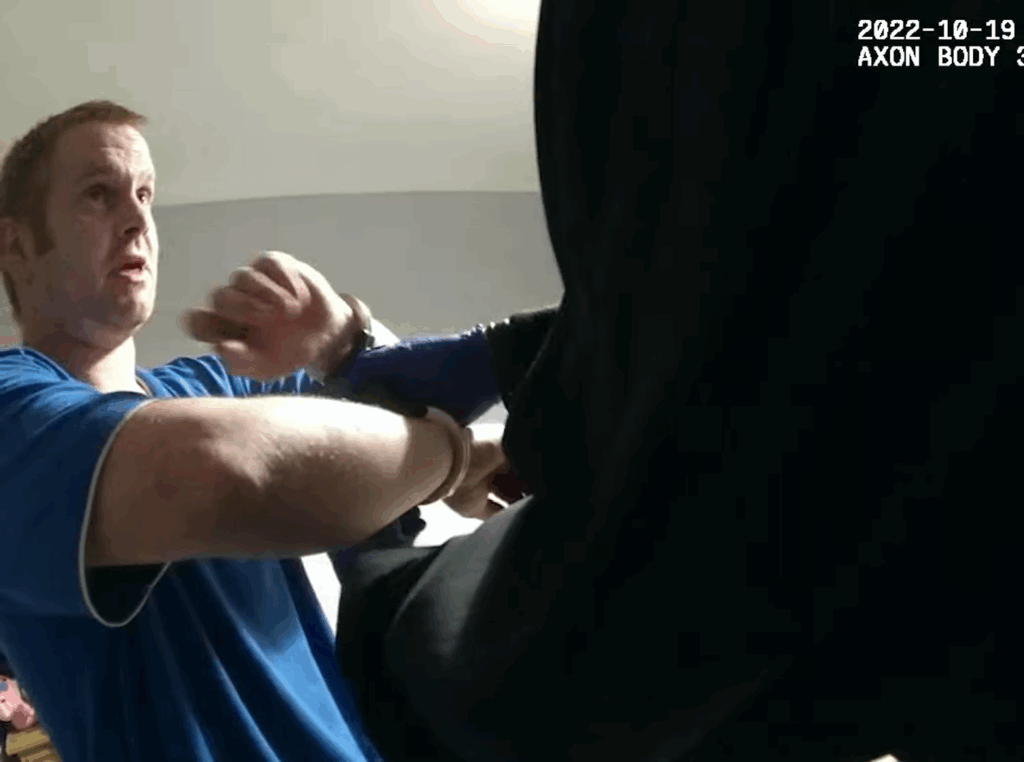

A man who did not hold a driving licence and had been drinking all afternoon took his mother’s car without permission and killed a cyclist in a collision, the drink driver who fled the scene after the fatal crash now jailed for 12 and a half years.
Kent Police reported Danny Gibson was also banned from driving for 20 years, at Maidstone Crown Court on Friday, one of the longest driving bans we can recall reporting on in a sentencing story.
The 38-year-old hit and killed a cyclist on Tuesday 18 October 2022 in Wormshill, Gibson not helping his victim and instead fleeing the scene, abandoning the vehicle in a nearby field and making his escape on foot.
While a witness had heard a loud bang shortly after seeing a cyclist pass at around 5pm, it was not until later in the evening when a friend went searching for the rider when he failed to return home that he was found and pronounced dead by paramedics at 8.45pm.
Gibson had been drinking in Sheerness on the afternoon of the collision before taking his mother’s car without permission, that despite not holding a driving licence or insurance. In fact, when arrested Gibson claimed to officers that it could not have been him as he did not have a licence and a bicycle was his main mode of transport.
However, he was seen leaving the area at the time immediately after the collision but failed to report the incident or seek help for the cyclist. Police officers were called to his address later in the evening following a report of a domestic incident, but still he did not report the incident.
He was later arrested and forensically linked to the vehicle by a piece of broken glass that was found in his hair. Gibson initially denied charges including causing death by careless driving while over the drug-drive limit, and driving while unlicensed and uninsured, but he later admitted the offences and was sentenced at Maidstone Crown Court on Friday almost three years to the day since the fatal collision.
A judge sentenced Gibson to 12 years and six months in prison and banned him from driving for 20 years.
Detective constable Dave Holmes from Kent Police’s Serious Collision Investigation Unit said: “This was a tragic and entirely avoidable incident that has devastated a family and a community. Gibson’s reckless actions and decision to flee the scene showed a complete disregard for human life. We hope this sentence brings some measure of justice to the victim’s loved ones.”


















28 thoughts on “Hit-and-run driver who killed cyclist after afternoon of drinking jailed for 12 and a half years”
More of this justice please,
More of this justice please, it’s refreshing to see a punishment proportional to the crime.
I sadly fear he might appeal on the grounds of overly harsh sentence, but I hope that would get thrown out
Hopefully if he does appeal,
Hopefully if he does appeal, it’ll get bumped up to at least 15 years.
HoarseMann wrote:
If a Magistrate’s Court sentence is appealed to Crown Court it can be either increased or decreased, unfortunately a Crown Court sentence cannot be increased if the guilty party is asking for a reduction, the Court of Appeal can only increase a sentence if a third-party launches an appeal on the grounds of excessive leniency. The only thing they can do in this regard is make a “loss of time” order if they think the appeal was blatantly frivolous or groundless, meaning that time served on remand by the guilty party does not count towards their sentence.
Let’s hope this is a paradigm
Let’s hope this is a paradigm shift in the seriousness attached to dangerous driving, as we’ve seen so many cases dealt with much more leniently despite what might look like higher levels of culpability.
This is another tragic and preventable death for which the perpetrator is entirely to blame, and voluntary intoxication is no defence, but I find it hard to conjure up much anger at a man clearly in the grip of severe addiction. It’s good that he’s no longer putting others at risk, but the same would be true for many who have been let off because “the sun was in their eyes” and who still think there’s nothing wrong with what they did.
Great news and a sentence
Great news and a sentence that fits the crime. Top marks to the prosecution and to the Judge! A great example set for others in the judiciary to follow.
Sorry to go against the “at
Sorry to go against the “at last a fit sentence” feeling, which of course I understand, but why was this not charged as death by dangerous driving, with the availability of a life sentence? It quite clearly falls into the culpability range for the offence and exhibits several of the “aggravating factors” in the Sentencing Council guidelines. If drinking all afternoon then driving without licence or insurance isn’t sufficient to qualify as dangerous rather than careless, what the hell is?
At last, a fit sentence.
At last, a fit sentence. There, I said it.
Death by careless driving
Death by careless driving whilst under the influence does have the potential for a life sentence. It’s on a par with death by dangerous driving in terms of the penalty that could be imposed:
https://www.gov.uk/guidance/the-highway-code/annex-5-penalties
However, a life sentence is apparently very, very, unlikely to be handed out in either case:
https://roadtrafficaccidentlaw.co.uk/road-crime-and-the-life-time-sentence-myth/
Thanks, I didn’t know that.
Thanks, I didn’t know that. Surely yet another reason for the arbitrary distinction between careless and dangerous driving to be removed. The distinction seems more or less at the whim of the CPS and I’m sure it could affect judges in sentencing: shall I give him a life sentence, well he’s “only” been convicted of careless driving, not dangerous, so giving him the same sentence as if it was the worst case of dangerous driving can’t be right…
I would personally argue that
I would personally argue that insurance and a lack of license has absolutely no relevance to whether something is dangerous driving or not. Thats like suggesting that its worse if someone without training in butchery kills someone with a knife vs someone who is trained to use one.
Dangerous driving is dangerous driving. Insurance has no bearing on whether something is dangerous and nor does your lack of training. Thats ignoring the fact that most people on the roads are trained and certified competent despite driving like absolute twats a huge amount of the time.
On the way home from nursery the other day (less than a km) there were 3 people who were doing over 50 on the road I walked down. Its a 30. Its heavily built up with hundreds of school children walking along it as well as a train station with constant foot traffic. Holding a license is absolutely zero proof of care or capability.
I agree with your last
I agree with your last assertion that licence and training are no guarantee of either careful or indeed competent driving.
The law being the law, you could end up being in the right (eg. what the actual driving was a) has to be agreed on and b) if known that, and that alone, is then judged against the standard).
However I’d note that both “careless” and “dangerous” definitions make reference to “what would be expected of a competent and careful driver”.
Not a lawyer but i think *by definition* he can’t be called competent (never having passed a test). Unless … you’re advancing an argument that he *might* actually be a brilliant driver but we simply can’t tell either way (due to him not having been tested – if that is the case) ergo we are disqualified from drawing that inference?
Then – being pissed, drugged up and taking a car without permission. I would say that suggests a lack of care in driving is inevitable. (But again, genuine lawyers might be able to cut that argument to ribbons, chopping the logic being their job).
Finally noting that (rightly or not) one reads court reports where things like cyclists wearing helmets or not crop up (even when eg. said cyclists died by their entire body being disrupted, or not receiving damage to the head at all). Apparently that is being brought in as a proxy for *their* care or recklessness; so why can we not call a drunken, drugged up thief who hasn’t taken any of the usual necessary steps that an actual careful or competent driver would “dangerous”?
A drunk, drugged, unlicenced
A drunk, drugged, unlicenced and uninsured driver could happen to operate a vehicle in a way that doesn’t markedly differ from the way a skilled and careful driver would do it.
I’ve never driven and have no licence, but wouldn’t be amazed if, even loaded with an unlawful quantity of alcohol and drugs, I could keep a car moving in a normal manner along a straight road in broad daylight. At least for a moment, there might be no way to tell my driving from that of someone competent.
The car could then be hit by a meteorite blasting down from above. That would cause an accident that no driver could be expected to avoid. Someone could be killed in the resulting crash. I’d be guilty of a number of offences, but not careless or dangerous driving.
That is different from a situation in which the person operating the vehicle does something that would not fit the standard to be expected of a reasonable driver, resulting in a crash.
DJameson wrote:
Again perhaps that is indeed the law, although invoking the fact that by chance one cannot tell the difference for a short period (and it must be chance as else why note the difference or even invoke care or competence?) doesn’t sound a promising start (but yet again law…)
But that was not the point in question. It’s “could you guarantee you would be able to safely interact with other road users” – and a) with perhaps no knowledge of the rules b) no practical experience of applying them while driving and c) being intoxicated that is much less likely.
My best guess – not being a lawyer – was they’re just going for the lower bar. Someone determined that they could get a “good enough” sentence for DUI and driving without a licence and those were seen as easily provable – and perhaps dangerous driving was not. Sometimes that is so even if their had been witnesses / more facts agreed.
You may recall reading about seeing this fail because “the cyclist suddenly threw themselves under my wheels (as I overtook unsighted round a bend)” – Helen Measures. Or someone just drove over a cyclist from behind that others had reported seeing (Michael Mason case – it was dark at the time and police didn’t even bother paying to CPS). Or drivers simply say “I don’t recall that” (at least one I can recall in Scotland – though that was with the nuance of “Not proven”).
Imagine two untrained,
Imagine two untrained, unlicenced, drunk, and stoned drivers approaching each other. At the last moment, one of them suddenly veers into the other’s lane for no reason, causing a head-on collision that the other could not have avoided even if he were sober and competent.
It makes sense to me that the one who veered was responsible for the crash. It makes sense that both are guilty of driving while intoxicated and without a licence, but the one who caused the crash was also guilty of some further offence like careless or dangerous driving.
That doesn’t change if we separate the two drivers who ought never have been on the road – each crashes into a car driven by someone sober and licenced, one because he veered and the other because the oncoming car veered. The one who drove badly was more culpable than the one whose driving was what you would expect of a good driver at the time of the crash.
So you’re simply saying that
So you’re simply saying that you think there are two completely distinct things in law here – an assessment of the driving on its own merits (bearing in mind that this is usually imperfectly known to the court) as judged by the standard (“careful and competent driver”) and completely ignoring any other factors eg. being sober, knowing the rules and having shown appropriate skill at driving (passing the test)? And then (completely separately) the issue of whether the driver was intoxicated, unlicenced, far too tired etc.
That may legally be so I guess. We know that courts seem very keen not to draw any link between “someone was killed or injured” and any responsibility – of course that could always be an accident and the the legal system is generally strongly for a very high standard of proof.
I think it depends on the
I think it depends on the reason he didn’t have a licence. If he was so incompetent that he was unable to pass the driving test, but still chose to drive, that is surely relevant.
Not having a driving licence
Not having a driving licence and being uninsured reinforce his contempt for the law in addition to his not caring about people harmed by his drunkenness.
That’s the relevance to my mind.
In what sense though? Is
In what sense though? Is being competent and trained in something and still choosing to do something you know is very dangerous better than someone less skilled choosing the same actions. This is my point. I don’t think its relevant. I think that their choices and the outcome are 99% of what should determine the sentence.
mctrials23 wrote:
It’s not “better” in any moral sense, however there is a good case to say it’s more dangerous for the unqualified/unskilled person to do it and therefore should at least push the offence from the careless to the dangerous driving category. Put it this way, if you were absolutely forced to take a plane flight (I don’t know, maybe you’re on a tropical island and the local volcano has just started erupting) and there were only two people available to fly the plane, both of whom were drunk but only one of whom was a qualified pilot, what would be your safer choice?
I disagree with your
I disagree with your viewpoint, as in my my mind I thought at least part of the discinction between careless and dangerous was that for dangerous driving, the driver needed to be undertaking activities that would be clearly and obviously regarded dangerous.
For me, driving without a licence that confirms you can, at least when required to, drive to a competent standard, whilst simultaneously being under the influence, is obviously, and inherently dangerous. If its not the case, why have driving licences or indeed alcohol / drug driving limits at all?
I can see why the CPS went for careless though, if even cyclist are willing to do mental gymnastics to seemingly excuse, trivialise the abhorrent disregard for law and human life displayed by this piece of scum, why take the risk with a jury of 12 drivers?
Nobody’s doubting that these
Nobody’s doubting that these are crimes; it’s a matter of what the crime is. Yes, you could define it as dangerous or careless driving to drive drunk or without a licence, but in fact there already is a crime of driving drunk, and another of driving without a licence.
There’s also the distinction between careless and dangerous (which often seems to be drawn in a way that makes no sense). You could say that there’s a breakdown of logic in the very concept of “causing death by careless driving” as opposed to “by dangerous driving” on the grounds that the driving must have been dangerous if it caused someone to die.
However, it does make sense for the legal system to recognise a distinction based on how bad the driving was. I’m sure I’ve seen it classed as “careless” when someone was drifting into the wrong line while texting. Personally I’d see that as dangerous, but it’s not as dangerous or as deliberate as road racing through a city centre at 100mph.
A piece about the victim:
A piece about the victim: https://www.kentonline.co.uk/sittingbourne/news/bail-extended-after-cyclists-death-277265/
The collision location: https://www.cyclestreets.net/collisions/reports/2022461234902/
One disturbing factor was the
One disturbing factor was the age of Gibson.
From reading the headline and the first section, I was expecting him to be a reckless teenager. He is 38, an age when he should have developed a sense of social responsibility and a full appreciation of how how his actions can affect others.
Should this not have been taking into account during sentencing?
12 years sounds like a fair sentence. But if he ends up serving 6 years, it seems lenient.
Maybe he should have been sentenced to 12 years to serve a minimum of 8 to 10 years.
He may be 38 years old, but
He may be 38 years old, but from hearing him speak I’d say his IQ is no more than double that number.
um… how many Reform voters
um… how many Reform voters have a developed sense of Social Responsibility. How many Tory MP’s for that matter.
Age does not correlate with Social Responsibility. Whereas selfishness and sociopathy has a direct inverse correlation.
Also the discount for a guilty plea is roughly 1/3 less time spent on remand. So its likely he’ll serve more than 6 years and closer to 8 but not near 10.
Today’s golden shoehorn award
Today’s golden shoehorn award goes to…
I don’t agree with your
I don’t agree with your argument on age. A lot of younger people tend to think less about the consequence of their actions. They often think they and others are invincible and death etc is a long way away. Hence more joyriders etc tend to be teenage or early 20s. Most people around middle age will have experienced the death of a close relative and will have some understanding of how it feels.
I would expect a 38 year old to be more likely to consider the consequences of their actions than a 17 year old and think that sentencing should reflect this.
Re your argument about politicians. Many are irregular people and have been that way all of their lives. Although I am appalled by Reform and their policies, many of their voters feel that it is their only chance of seeing change.
Mr Blackbird wrote:
What are they the rest of the time?