



A Nottinghamshire man who drank two pints at a work event then decided to drive home before swerving into and hitting a cyclist, leaving him with a broken back, has avoided prison.
CCTV played at Nottingham Crown Court shows James Barber, 35, drive across the middle line, hitting the cyclist. The father of two, who was cycling home from work, was thrown over the bonnet and left seriously injured. Barber stopped at the scene, and was not speeding according to the recorder.
Barber, of Leveret Way, East Leake, was handed a 22-month suspended prison and disqualified from driving for three years.
Recorder Michelle Heeley KC said: “You had been out at a work event and made a foolish decision to drink two pints. I accept you were not speeding but you were swerving across the road, overtook a parked car and drove into the victim. You simply did not see him.
“This could have been fatal, and you would have had to live with that on your conscience. I accept you are fully aware of that and of the consequences of your actions.”
The victim spent 13 days in hospital, underwent spinal surgery and required weeks of care from his wife, who had to feed him water through a straw and help him wash and dress.
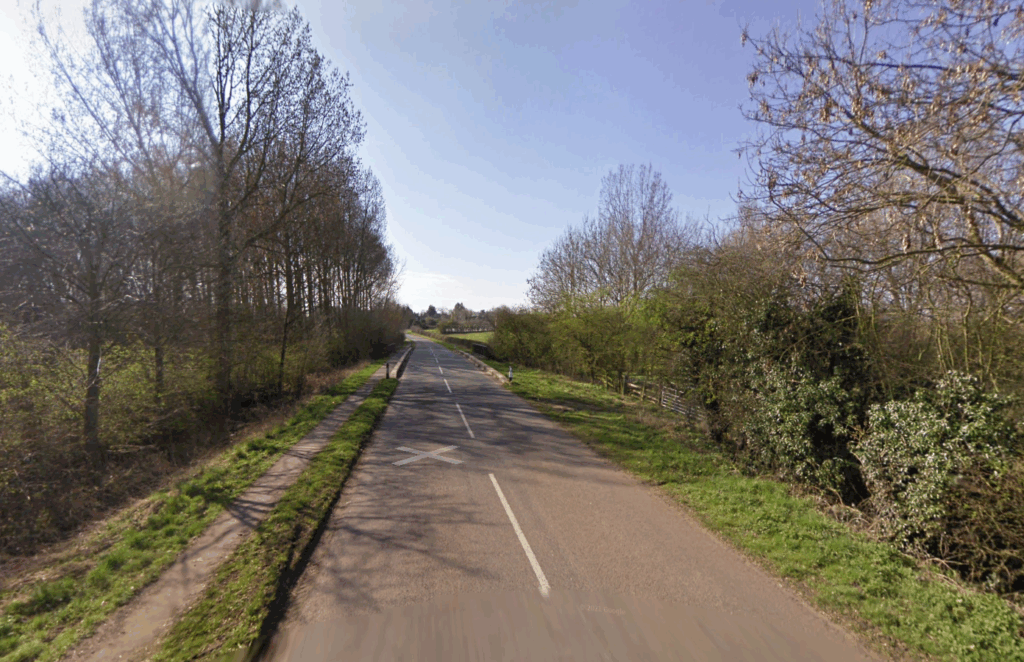
The incident took place in Pithouse Lane, West Leake, at around 5:30pm on March 22 last year.
Denney Lau, prosecuting, said that the victim had just left work and was cycling home when he was struck by the defendant’s BMW.
He said: “He saw the car swerving towards him and then could not remember anything.”
The court heard that Barber failed a roadside breath test. An evidential sample, taken at 6.59pm, gave a reading of 35 micrograms of alcohol in 100ml of breath, which is the legal limit in England and Wales.
Mr Lau read the victim’s impact statement to Nottingham Crown Court, which said: “I can remember my wife feeding me water through a straw, which would sometimes fall out for a long time. I had six weeks in a neck collar, and my wife had to shower me.
“I was a physically active person before this and now I feel like a kid with other people doing everything for me. There were times when I could not hold a cup in my hands.
“My wife and daughters have been brilliant as has my work. I am not thinking about going back to cycling just yet, I am taking baby steps, but I am getting there, but I want to get back on my bike.”
Andrew Thompson, mitigating, said Barber had never been in trouble with the police before, and has a child.
He said: “He was driving home from work and foolishly he’d had a couple of drinks. He knows the journey well, saw a parked car outside the pub and he went far too far across the road and did not see the victim coming towards him on the pedal cycle and that’s very unfortunate.
“The defendant, to his credit, did stop. The police came, he cooperated fully, and he actually admitted the offence to the police.”









39 thoughts on “Driver who drank two pints before swerving across road and crashing head-on into cyclist, leaving him with a broken back, avoids jail”
What was he found guilty of?
What was he found guilty of?
Not sure how I feel about this. I don’t believe in prison time except for the most heinous offences. But people like James Barber need rehabilitating.
lesterama wrote:
According to this article he “pleaded guilty to causing serious injury by dangerous driving”.
35 micrograms of alcohol per 100ml of breath is the legal limit, so you have to be over that to be convicted of drink driving.
I wonder how it was suspended
I wonder how it was suspended given the guidelines https://sentencingcouncil.org.uk/guidelines/causing-serious-injury-by-dangerous-driving/
Or are the prisons still too full ?
Many years ago, two pints was
Many years ago, two pints was deemed as just within the limit and ok for driving.
However many beers are stronger these days and two pints drunk over a shortish time will more often than not take you over the limit.
The consequences for the poor cyclist were dreadful.
And all for the sake of having an extra half pint or pint.
So presumably he got away
So presumably he got away with drink-driving on a technicality? Awful.
Any booze makes for a worse
Any booze makes for a worse driver.
NEVER drink and drive.
Generally, I agree. Given a
Generally, I agree. Given a choice, I usually prefer not to drink at all rather than drink with an imposed limit.
But the maximum I would ever have is 1 1/2 pints.
However, I have driven to work after getting up for an early start after 5-6 hours sleep. While not illegal, is that morally wrong?
I once drove 28 miles home after working a straight 26 hours (not through choice).
What about driving home 70 miles after a particularly tiring time trial?
It isn’t all black and white.
Mr Blackbird wrote:
Yes it is. Any alcohol affects your driving, if you drink a pint and a half and then drive your reaction times will be significantly diminished as will your hazard perception capacity. You are more dangerous to yourself and others when driving if you drink any amount of alcohol, it’s as simple, or black and white, as that. The drink drive limit should be a BAC of zero.
Well if it ever is reduced to
Well if it ever is reduced to zero, then I will already be compliant virtually all of the time and will need to avoid alcohol on other minority oçcasions.
Not sure if I can always guarantee that I will have had at least 8 hours sleep or not taken part in any potentially tiring activity before driving though.
Why add the supercilious bit
Why add the supercilious bit about sleep.
? Driving tired is an offense but that’s not reached by just having 7½ hours instead of 8
E6toSE3 wrote:
Thing is … the acceptance of mass motoring as it currently is makes all kinds of driving in higher risk states (or less competent drivers) inevitable.
As long noted by others, we have drink driving as the one taboo *. But everything else (even drug driving in a substantial minority opinion) gets a pass. And in the mean time we’ve added other risks (mobile devices).
Because mass motoring “I *have to drive*”. Car is just there, social / work expectations, now the alternatives don’t exist because they’ve been replaced by driving etc. So we do when tired to various degrees, distracted, unwell, taking legal medication, as our abilities decline with age or health conditions…
Most of this isn’t illegal, the degree that it affects people is variable etc. All tacitly accepted, until something goes wrong and a victim and/or their relatives is suddenly asking “why is everyone saying ‘sorry, tragic accident’…”
* Mostly… after a real hard slog and serious focus by politicians, police and courts … for a generation or so.
I did similar but only drank
I did similar but only drank beer under 4%. Stopped as research showed all alcohol affects driving. Cycling was my main form of transport from age about 20 in mid 1970s.
I’m not being supercilious.
I’m not being supercilious.
If you read my earlier comment, I pointed out that because of non-routine early work starts (and by early I mean 3am /4am) I have had to drive after 5-6 hours sleep. Or I have often driven home after physically tiring activities.
Although not illegal, these events can in theory impair driving performance.
I am questioning where this stands morally and where it is reasonable to draw the line?
Almost always. But 50 years
Almost always. But 50 years ago, as a student, I knew a few sons of farmers who’d been driving since infancy and fancied themselves as rally drivers. Without alcohol, they drove furiously (I think that’s a legal technical term) as if on their family farm tracks. With alcohol, they slowed right down to drive extremely carefully as they knew they were less in control. Of course, the alcohol didn’t make them good drivers, just less scary dangerous than when sober. I felt safer cycling in London than on country roads
Perhaps you may feel
Perhaps you may feel differently if you were eating your tea through a straw
“2 pints” – right
“2 pints” – right
bloodylazylayabout wrote:
Even if two pints is true, two pints of what, Ruddles Best (3.7%) or Theakston’s Old Peculier (5.6%)? Frequently see drivers complaining on forums about how unfair it is that you can be “done for a couple of pints” with no acknowledgement that “a pint” is pretty meaningless except as a definition of liquid volume.
Rendel Harris wrote:
No deterrent whatsoever to
No deterrent whatsoever to this idiot or others.
Given he did not exceed the
Given he did not exceed the legal limit, in what sense did he fail a breath test ?
It appears he failed the
It appears he failed the initial breath test at the roadside. But the ‘offical’ test taken an hour and a half later was exactly on the limit – ie. not over it.
I’m wondering if the police
I’m wondering if the police apply what may be logival that, being at the limit 1.5 hours later, would be proof that he was definitely over at the time of the incident.
I’m wondering if the police
I’m wondering if the police apply what may be logical that, being at the limit 1.5 hours later, would be proof that he was definitely over at the time of the incident
No use, I’m afraid. The Shyster Defence lawyer would just say to the clearly receptive judge ‘he had a few swigs of spirits from a bottle he keeps in the cab for medicinal purposes’, to steady his nerves immediately after the incident
mitsky wrote:
It seems logical but, as noted below, due to the way alcohol is metabolised and released into the bloodstream (which is dependent on numerous factors such as food eaten, speed of drinking and individual physiology) blood alcohol levels can actually peak anything up to two hours after drinking. If someone’s blood alcohol level is on the legal limit an hour after drinking that may be their peak level, it might well have been lower previously.
Hirsute wrote:
Utterly absurdly, blowing positive at the roadside cannot be used as evidence in court, it can only be used as a good reason to take the offender to a police station for an evidential test. If this takes, as in this case, ninety minutes and the offender is right on the limit at that time it’s perfectly obvious they must have been over the limit at the time of the incident but that has no standing in court. It’s a hangover (sorry for the pun) from the days when “blow in a bag” breath tests weren’t very accurate; modern handheld digital breathalyzers with electrochemical sensors are pretty much as accurate as the machines in police stations and the ridiculous loophole should have been closed long ago.
And yet there is an
And yet there is an established back calculator.
Hirsute wrote:
Yes, the problem with back calculations though is that blood alcohol levels can keep rising for up to two hours after the subject had their last drink as the drink is processed and alcohol released into the bloodstream (rate dependent on numerous factors such as size/weight of subject, food eaten etc), so it’s not guaranteed that someone on the legal limit an hour after a crash was actually over it at the time of the incident. The UKIAFT (UK & Ireland Association of Forensic Toxicologists) recommend that back calculations should not be made using readings taken within an hour of an incident and that caution should be used with those taken within two hours.
Probably the sensible
Probably the sensible approach to this is to drop the limit to the point where it’s not legally possible to drink and drive. Regardless of when you’re tested.
And drivers would need a
And drivers would need a degree of self-awareness to ensure especially careful driving ‘the morning after’ to avoid being suspected and changed with ‘drink driving’- either that or a police force desperate to always be looking the other way when road traffic offences are concerned. I know what option I would expect! Anyway, this suggestion sounds like a good idea, as long as equally severe measures are introduced and enforced against ‘other-drug driving’.
2 slow pints would not put
2 slow pints would not put the normal adult male over the limit. And in fact considering the marginal amount he must have been over by, it’s reasonable to say that alcohol was unlikely to have contributed to the accident. Also how far across the middle of the road was he? Was the cyclist doing the lane hog thing🤔
Biker george wrote:
Any alcohol impairs reaction times (I should know, I’ve put away enough pints), co-ordination and hazard perception. It’s not in the least reasonable to say that because someone was “marginally” over the limit it’s unlikely to have contributed to the crash (he was speeding and at or over the drink-drive limit, that’s not an accident). The driver crossed into the cyclist’s lane and hit him head on, where the cyclist was in his lane (and he is entitled to be in whatever part of his lane he chooses, just as a driver or motorcyclist is) is no mitigation whatsoever. Your post reads like a poor parody of victim blaming and drunk/speeding driver defending.
So that makes it ok then? Ok
So that makes it ok then? Ok he should be still done for the injuries caused
I was querying the storyline
I was querying the storyline but this was explained by john_sm7.
https://www.walesonline.co.uk
https://www.walesonline.co.uk/news/wales-news/cyclist-thrown-air-like-rag-32455861.amp
Yet another example of a court putting maximum effort into getting a driver off after she killed a cyclist- including several of the classics:
In mitigation, Peter Donnison said his client had expressed sincere and genuine remorse and was deeply sorry for the suffering she has caused. He said the defendant has a number of health issues, and will “have to live with collision for the rest of her life.”
The judge added: “No sentence I can pass on you can be a measure of his life’s worth. No court can do that… You cannot have been paying proper attention to the road.”
Parnell was spoken to by police and tested negative for drugs and alcohol. She told officers her eyes had been “blinded by bright lights”.
Parnell, of Heritage Park, Trowbridge, Cardiff, later pleaded guilty to causing death by careless driving. The court heard she has no previous convictions.
“No comment” and “remorse”
“No comment” and “remorse” are not compatible statements.
> expressed sincere and
> expressed sincere and genuine remorse
Aren’t those the bare essentials for any psychologically normal human being? I’m not sure they should count when it comes to mitigation…
Given the clear inadequacy of
Given the clear inadequacy of the criminal law in cases like this, I hope the poor cyclist now uses the civil law to sue this driver and, by getting a substantial payout, making him question whether he can afford to drive in future due to massive insurance premiums.
“The defendant, to his credit
“The defendant, to his credit, did stop” Absolute legal minimum after an accident, so why get credit for that?
What do the two drinks even
What do the two drinks even have to do with it? He illustrated he’s an incompetent driver sober or not, and he ought to have his license taken away for a significant lenght of time and spend time in jail equal to the victim’s recovery time. The latter would give him a chance to think about the consequences of his bad driving.