


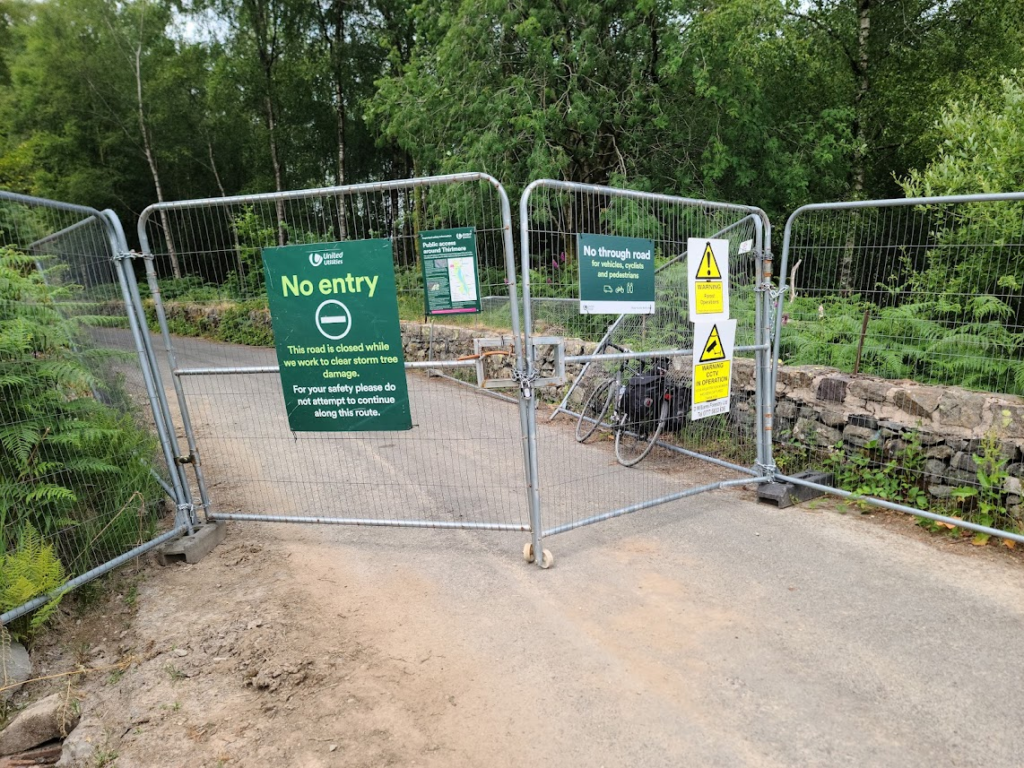

A cyclist who visited the Lake District this summer, riding along a storm-damaged road which the council recently proposed to shut permanently, has spoken out about the “totally unnecessary” delay in repairing the route.
The quiet route alongside Thirlmere reservoir, part of the National Cycling Network and “one of the only safe road cycling routes leading towards Keswick”, was badly damaged during Storm Arwen in 2021. Having been temporarily closed for two years, it now faces permanent closure.
Last week, we reported that Cycling UK had launched a campaign in response to Cumberland Council’s consultation on closing the road, the cycling charity objecting to the proposal that would see cyclists forced to use the A591 instead, “a narrow section of busy A-road, hemmed in by walls with fast traffic and HGVs”.
Furthermore, it was revealed that the council’s diversion route “only stipulates suitability for vehicular traffic; therefore no diversion route is provided for pedestrians and cyclists at this time”, something Cycling UK branded “ridiculous”.
The story prompted road.cc reader Dave to get in touch with his own first-hand experience of riding in the area during a cycle tour in June. With “no knowledge” of the closure and deciding it was “much safer than going back and cycling up a busy main road”, he joined a local rider who told him you could get through, the pair clambering past the gates and fallen trees to slowly and carefully continue along the closed road.
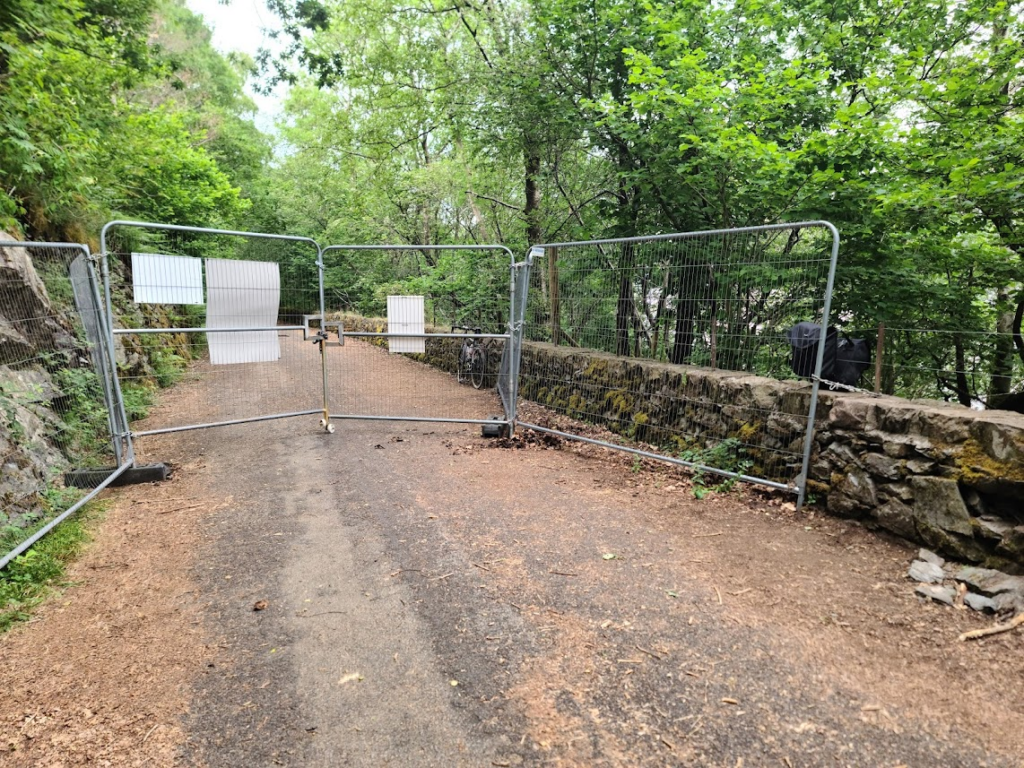
“He also had some fairly critical comments about the council and their indifference to the situation,” Dave recalled. “I am very much a law-abiding citizen and I take responsibility for my own actions and safety. Although I do not like having to do things like this, I consider it was much safer than going back and cycling up a busy main road.
“As you can see by the position of my bike it was possible, with difficulty, to get the bike, the panniers and myself over the wall and the fences. I even climbed back to get the photo. It was fairly obvious that other people had done the same and there was a difficult but manageable route past the fencing.”
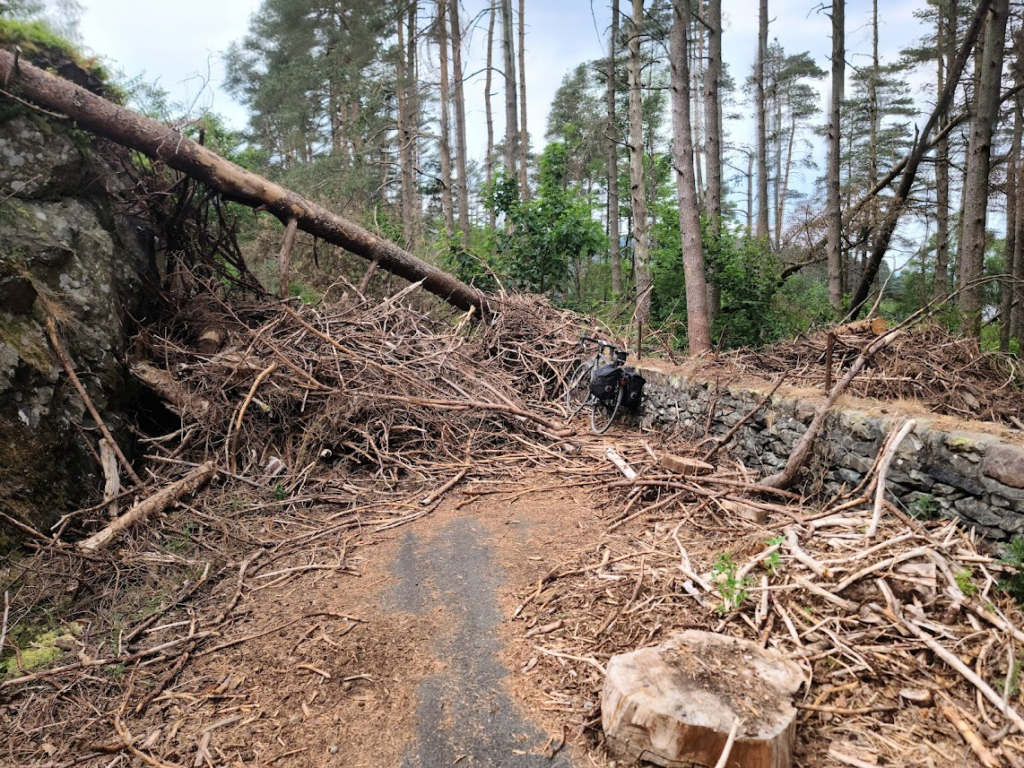
The damage to the road is mainly fallen trees, as seen in one of the photos Dave took, but the council also says there is a risk of falling rocks however, as pointed out by Cycling UK, “there are plenty of roads around the country where falling rocks remain a risk without resulting in the extreme solution of permanent closure”, notably the A591 on the opposite shore.
“Again, there was an obvious route through and evidence of plenty of use,” Dave said of the way through the damaged section. “The final obstacle was the next fence. very similar scenario to the first one with clear evidence of a route past it.
“It seemed clear to me, and the other cyclist I met, that: “There has been a totally unnecessary delay on dealing with this route. If it had been important for motorised traffic it would have been done very quickly.
“The blocked off route appeared to me as being used as a very convenient free and spacious timber yard for getting the trees cut up, out and probably sold for a good price. No time pressure or costs either.
“It is such a good alternative route that I would imagine whatever they do to try and permanently close it, people will find a way through on foot for sure and on bikes for riders who can lift them high enough. Two closed-off, dead-end routes in this quiet location will lead to all sorts of problems.
“It should be obvious, for all the reasons you have pointed out, that this route should be kept open and if not as an open road at least as a restricted byway or bridleway for pedestrians, cyclists and horse riders.”
Cycling UK has urged people to email Cumberland Council before the consultation closes this week (15 September) and has drawn up a template objection listing its criticisms.
“The council is opting to close one of the most enjoyable and atmospheric cycling routes in the Lake District,” the charity and campaign group said.
“Crucially, any risk assessment seems to have been focused solely on the risk of falling rocks on this road, without looking at the bigger picture of cycle safety. Closing this route forces cyclists onto a busy, and arguably much less safe, A-road up the eastern bank of the reservoir.
“We think it’s more than just a local issue: it has a much wider impact. The closure shifts cyclists, horse riders and walkers from a safe, quiet road, to a busy, unsafe A-road, without any comparative safety audit. That disregards the Traffic Regulation Act criteria for making an order, and is a flawed decision-making process.”














7 thoughts on ““If it was important for motorised traffic it would have been done”: Cyclist slams council’s plan to permanently close quiet route and send everyone along busy main road”
I believe windfallen trees
I believe windfallen trees are generally worthless as timber, but apart from that, situation is all very predictable.
1 ton builders bag of split
1 ton builders bag of split logs is worth about £100 as firewood. You be suprised how many 1 ton builders bags you can fill with a single windfallen tree.
My local tree surgeon told be
My local tree surgeon told be one reason for HS2 taking so many trees is that there is a double bonus – get paid for felling then selling the tree for bio-fuel, so although the timber may not be sound as abuilding or woodworking material, there is a lot of value in a tree.
IanMSpencer wrote:
Trees have a lot of value when not being felled as well
IanMSpencer wrote:
They were quite happy to deliver a huge load of logs to me for free when they were chopping a whole load down near us (and still are)
Having made offers in the
Having made offers in the past (just to remove as much as I could use) I’ve sometimes been encouraged and sometimes refused. Probably on the whim of those tasked with doing the job.
Like all these things I guess it’s rate and concentration-dependent (population-density / resource use). Fossil fuels are simply “non-renewable” because we use them far, far too fast after all.
Although I think having to pick your own trees could help limit consumption (or, sadly, often not…) I think restrictions on the use of wood as fuel in our urban environments where most of us live are fair on health grounds at least. (e.g. some in London, the gov’t plan here – cover designed by HP?). Particularly as most people would likely use extremely inefficient and polluting ways of burning over the best-in-class.
Chatted to quite a few people
Chatted to quite a few people while there. Seems cyclists just hoist their bike over.
I am on a heavy ebike so it is not really doable, especially with something like a 50′ drop off that narrow wall shown.
Walkers just choose to do it too, though obviously they have even less choice.There were 2 splightly 80+ years olds clambering along it last time l landed there with the shock of the continued closure.
Utter madness. I sincerely hope no corporate manslaughter ensues from accidents there or even on that main twisty dangerous road. At that same time I did that main road, a couple, probably in shock were gingerly walking the grass verge, I assume too scared to be in that main road.