



A cyclist who was injured after crashing into a cycle lane wand while trying to avoid an oblivious motorist who turned across the cycling infrastructure into his path, has secured compensation from the driver’s insurers – despite a senior police officer claiming the motorist did “nothing wrong”.
Edinburgh-based cyclist Simon was cycling home from work on the A701 in the Scottish capital last September when he was forced to take evasive action thanks to the driver, who avoided punishment for careless driving.
However, the cyclist’s insurers, Cycle Law Scotland, then argued that not only was the police’s decision wrong, but that the driver had contravened the Highway Code’s guidance on vulnerable road users, leading to secure an out-of-court agreement seven months later – after the driver finally admitted to not having seen the cyclist at all while turning across the bike lane.

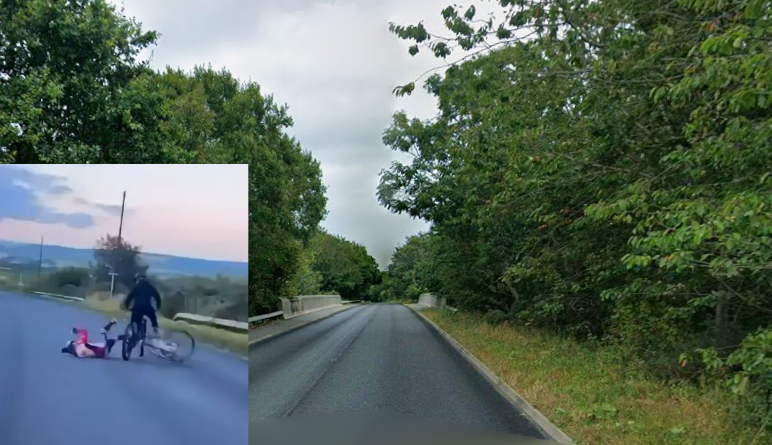
On the day of the incident, captured on his helmet camera, Simon was riding in the A701’s cycle lane, a stretch partially protected by Orca wands and littered with potholes.
He then approached a bus stop, where the row of wands ended, continuing along the briefly unprotected section of the cycle lane.
However, just as he was about to re-enter the protected portion of the lane, Simon was overtaken by a driver, who then immediately indicated before turning left, across the bike lane.
“I’m focused on the cycle lane ahead, watching for potholes. I notice the driver indicating and stop pedalling,” Simon said, reflecting on the incident.
In the footage captured on his helmet camera, the squeal of the cyclist’s brakes can be heard as he attempts to avoid colliding with the motorist by swerving to the right. Simon then turns his head to remonstrate with the driver, shouting “Hello?!”
However, after shouting at the motorist, he turns back straight into the path of the first wand dividing the cycle lane from traffic. He collides with the wand, flying over his handlebars, and crashing heavily onto the road and suffering injuries to his hands, knees, and elbow.
“I see the bollard and try to swerve left, but clip the base,” he said. “Even if I’d not turned to look at the driver, I’m not sure I’d be able to get back in the lane, and it’s too dangerous to go to the right of the bollards – I’ve no idea what’s behind me, could be a HGV.”
Meanwhile, the driver carries on completing his turn onto the side road, seemingly completely oblivious to what had just occurred around him.

Simon reported the incident to Police Scotland, who were initially planning to charge the motorist with careless driving. However, the case was dropped on the instruction of a senior police officer, who held the opinion that because the cycle lane stopped for the bus stop marking, then the driver had “done nothing wrong”.
Faced with this criminal cul-de-sac, Simon then contacted Cycle Law Scotland, who intimated a civil claim for compensation to the car driver’s insurance company, supplying a copy of the footage to “make things easy”.
However, to the law firm’s surprise, the motorist’s insurer denied liability, claiming, among other things, that the cyclist was travelling at 20 to 25mph at the time of the incident, had been distracted looking out for potholes, and had not seen the driver turning in time.
They also claimed that the crash simply took place because he took action to avoid riding into the car and struck the bollard instead – a claim rubbished by Cycle Law Scotland.
“You are missing the fundamental point: your insured failed to give way and drove into the path of our client. Your insured’s actions are in contravention of the Highway Code,” they told the insurer.

Cycle Law Scotland also highlighted that, in their opinion, the police decision to not charge the driver was wrong, arguing that it was the careless actions of the motorist which had forced Simon to take evasive action.
This case was due to proceed to a final court hearing in April, liability remaining disputed in full. However, just six days before the hearing, a first offer was made, with negotiations continuing and a settlement reached two days later.
Eventually, the driver even admitted to not having seen the cyclist at all before he turned left across his path.
“As cyclists, we know how to safely negotiate the many obstacles put in our way,” Cycle Law Scotland said in a statement announcing the settlement.
“However, in this case, the obstacle was a car, whose driver seemed oblivious to Simon’s presence, driving negligently and turning across the path of a vulnerable road user. We never give up and always meticulously prepare our cases so that we secure the right result.”




36 thoughts on “Cyclist who crashed into bollard after oblivious driver turned across cycle lane secures compensation – despite police claiming motorist did “nothing wrong””
Surprise surprise ScotRozzer
Surprise surprise ScotRozzer ignorant of the law and failing cyclists again.
They are even worse than everyone else. (Even WTJS’s force).
institutionally anti-cyclist
institutionally anti-cyclist
“…the driver finally
“…the driver finally admitted to not having seen the cyclist at all while turning across the bike lane.”
Shirley this means the driver’s eyesight isn’t good enough or they didn’t look properly.
Either way they should hand in their licence.
And Police Scotland’s refusal to prosecute is shamefull.
Well yes, in a sensible world
Well yes, in a sensible world saying that you didn’t see something that you should have unless you are a dangerous driver would be considered an admission that you are a dangerous driver. As we know though, thats not how these things work.
Admitting you are a crap and dangerous driver is taken as mitigation rather than admission. Its absolutely bent and until that changes, safety on our roads won’t meaningfully change.
And this is where “blocks” or
And this is where “blocks” or “wands” may be “a start” but if so they need to be one we move on from very quickly.
If we have them at all they need putting in some kind of buffer space between the cycle path and the main lanes. And at that point you’re basically in “yeah we’re building a separate cycle path territory as you then need to handle side roads (continuous cycle way, if minor) and junctions.
Which shouldn’t be a mystery *. But will cost a bit more money and be a harder fight than paint, signs and wands – although “anything” is already a fight, so why not just aim for something worthwhile?
* Thousands of good examples from all kinds of road layouts available. And indeed from cities which are “still developing”. Though as Chris Boardman points out it does require people with a modicum of experience – and probably far more important councillors with the faintest understanding of “why”, what infra is actually too cheap (not worth the money) and what is actually possible (here’s what you could win).
“the crash simply took place
“the crash simply took place because he took action to avoid riding into the car and struck the bollard instead”
Errr… If you had not hit the bollard you’d have hit my client and we’d be suing you.
I know they have to stretch things but who in their right mind would put that forward?
Chapeau to the law firm, I
Chapeau to the law firm, I think he got lucky in several ways there!
I wonder how many other forces wouldn’t have said “look – they’re in front of you, they’ve got the indicators on for several seconds – you could have slowed sooner and anticipated them turning…”
That was my first (and second
That was my first (and second) thought too. But – if this was two lanes of cars and the driver had sliced across the inside lane, perhaps to belatedly exit a two lane carriageway, without regard for vehicles coming up the inside lane?
This sort of cycle lane is always a compromise, and one which assumes cyclists’ pragmatic understanding of the invulnerability of motorists.
I agree, the cyclist’s lawyers were pretty good.
Yes – and there is a “double
Yes – and there is a “double standard” or “pragmatic understanding”. I think that’s unlikely to change much. (“But cyclists are travelling slower / makes more sense to get the motor vehicle out of the way of others”).
Thinking – how it can *ever* work (eg. even with a separate cycle path) though? I think it’s multi-factor, not just “training” and culture. I suspect at the least it involves:
a) fewer motor vehicles and slower speeds. So less “pressure” on the driver to get out of the way of lots of other fast traffic. Where those do apply there should be a “waiting area” for motor vehicles.
In NL this would be massively helped by the “monofunctional road/street” design and planning system. So they have changed it so they don’t have 40mph “distributor” roads with houses and businesses accessed directly from the road.
Here we have an A-road to get people in and out of the city with housing and hotels – it’s a Scottish “stroad”!
b) separate cycle path design (and things like continuous footway) make it clear you are leaving “space for motor vehicles” and entering into some other space. In the “cycle lane” case it is “still the road, just with intermittent barriers / paint”.
c) irrelevant in this case but where cars are turning into side roads the design should slow them (tight corners, narrow access, ramps) AND the side road should also be designed to keep speeds low. Everything should say “don’t fly off the main road” – it should promote “slow, stop, observe, move”.
I think in this instance
I think in this instance where the car is turning into a private driveway there would be merit in extending the orcas so that they are a continuous line that the car has the bump over to get in and out. The vast majority of drivers don’t fail to check because they are deliberately malicious, they are just caught up in the flow of driving and become thoughtless. Anything that breaks up that flow and forces them to slow down before manoeuvring greatly increases the chance that they will make observations.
Yes, the principle is good.
Yes, the principle is good. That’s basically what the ramp does in “continuous footway” (and cycle path) treatments at side roads / other access across the footway.
Although in this case the driver appears to slow right down – do they even stop? – but then turns regardless. Almost certainly without looking, or perhaps just a quick scan of the footway.
I don’t think a “continuous orca” implementation would ever get traction in the UK though. (FWIW those current blocks are more substantial – though ones suited to driving over could be used at entries). They’d get trashed!
And people will ask eg. “what about safety for motorbikes? What about cyclists cycling on the main lanes who need access? Wheelchairs? Pedestrians might trip – especially the old / those with visual impairments …” I think some of those are reasonable questions.
Expecting motorists to stop on this road isn’t an impossible ask. But if you spelled that out it would absolutely get push back. While not an “urban motorway” (Edinburgh has worse, with direct access to properties…) this is sometimes busy, buses run fairly frequently here etc.
Thoughtless is exactly how
Thoughtless is exactly how most people drive and thats dangerous. Thats also at the absolute core of the idea that “accidents happen” and when they do, they weren’t anyone fault and we can’t avoid them.
Thats the biggest change that needs to be made with driving. You can see it on the motorway perfectly. Its the reason you have people sitting in the outside lane doing 65 or in lane 3 out of 4 doing less than the speed limit.
Their brain has turned off and all they are concerned about is their own actions. They aren’t worried about anyone else because how would their lack of action cause any issues. They are driving at a consistent speed so any problems will be someone elses fault and its up to others to react to their presense.
When we start punishing people properly for not being active in their driving then things might change. Currently we only seem to have a passing interest in punishing people who consciously decide to drive dangerously rather than their unconscious dangerous driving.
mctrials23 wrote:
Well yes. But that is exactly “mass motoring” as the current system is designed to provide. Or rather – the “mass” and “keep driving” parts are far more important than the “lack of crashes”, never mind “careful”. What drives things is selling cars, selling fuel, selling the ability to transport stuff everywhere quickly by road, selling mobility to people and selling a mobile workforce/customers to businesses.
What are the odds that fixing it so the vast majority of the adult population get to drive (via passing a once-a-lifetime test, which isn’t terribly rigorous) will deliver consistently skillful, careful drivers? Even less so when we set the expectation that driving will be a commonplace task – one done fairly often, at times of the day where we’re going to be tired / at low mental arousal / distracted, or for tasks where we’re not going to be truly focussed on the driving (“emergencies”, driving children about)?
There’s a dilemma here which is not uncommon in human affairs. From being a difficult and dangerous activity we have (sensibly) made engineering and rule changes so driving is much less so. But doing that means far more people will do it, more often. And it’s harder to persuade them it needs attention, following the rules is important and that it can have very serious consequences.
We can disprove the above every day… Until (for a few of us) one day we are wrong. But at that point the simplest answer is “it’s someone else’s fault” or “it was an accident!”
That’s why I believe that
That’s why I believe that hoping to solve the current crash rates via “better drivers” (through “more police” / “cripple those who have accidents”) is going to be very hard to achieve. The conditions the current system is set up with work against it.
Unless we really do make driving a priveledge by dramatically reducing the franchise and permanently excluding those who err. But what could drive that (apart from dictatorial whim)? And what happens to pick up the transport demand?
I do think we should press for more on the legal side but I think we only get support for that if there is less demand for driving (so smaller “mass” motoring). A very tall ask – how does that happen (aside from dictatorial fiat above)? I guess like any major shift it needs multiple things – but the key is via providing excellent alternatives to driving. (EDIT – and a different key assumption about the goal of transport systems – moving people safely rather than moving motor vehicles).
That way there is a virtuous circle we may be able to access – or break the current one which acts to create ever more driving. That involves pushing (as we did with motoring) public transport and active travel. (The latter needs multiple things to make it attractive relative to driving a journey but definitely involves “not mixing with motor traffic” – except in limited, controlled circumstances).
I’d be embarrassed to show
I’d be embarrassed to show that video if it happened to me 😕
Quote:
Sorry, and yes I feel a heel for saying it, but if he noticed the driver indicating why didn’t he brake as well as stop pedalling? He’s a long way off when the indicator comes on (see screenshot). The driving is awful and no sympathy at all for the driver but the incident looks very avoidable to me. Sorry again…
No need to apologise, I had
No need to apologise, I had the same thoughts. In similar circumstances I have the brakes on and I’m ready to stop short of a car that I assume hasn’t spotted me.
Rule 73 says “Do not ride on the inside of vehicles signalling or slowing down to turn left”
There’s more of course, with obligations for both sides, but my assumption these days is that I’ve not been seen regardless of my rights on the road. Frustrating to have to do that, but better than the alternative.
You must have an old copy of
You must have an old copy of the highway code, as rule 73 does not say that.
bensynnock wrote:
But rule 74 does…
I think (assuming anyone is
I think (assuming anyone is paying attention to rules…) the problem is that cycle lanes are neither fish nor fowl here – especially “advisory” ones which mean nothing. On the one hand, they’re “just another lane” * , on the other motorists are not supposed to enter them then hang about. **
I think the rule you cite applies but there’s also the newer:
Rule H3: You should not cut across cyclists, horse riders or horse drawn vehicles going ahead when you are turning into or out of a junction or changing direction or lane, just as you would not turn across the path of another motor vehicle. This applies whether they are using a cycle lane, a cycle track, or riding ahead on the road and you should give way to them.
Do not turn at a junction if to do so would cause the cyclist, horse rider or horse drawn vehicle going straight ahead to stop or swerve.
You should stop and wait for a safe gap in the flow of cyclists if necessary. This includes when cyclists are: approaching, passing or moving off from a junction, moving past or waiting alongside stationary or slow-moving traffic, travelling around a roundabout.
And the picture shows a very similar situation – albeit it’s a side road, not the entrance to a property.
* So one reason cyclists can filter rather than “undertaking” is via the usual exemption of “the traffic in the outside lane is going slower.”
** I suspect that is why stuff like “separate” – while not necessarily seeming to be physically much different (e.g. an extra foot or two of distance) can help – because it helps work with people’s mental models (“this is my space, that’s their space”)?
Wow, thanks for that. I hadn
Wow, thanks for that. I hadn’t noticed that one.
So we have a situation where the driver should not cut across a cyclist when turning left but the cyclist should not ride up the inside of the driver if the driver is signalling or slowing down (you can’t possibly know if the driver is slowing down to turn left so you would have to assume they were).
What is the cyclist supposed to do? What is the driver supposed to do?
Everyone is supposed not put
Everyone is supposed not put others in danger and not to collide.
I like the Marine “rules of the road” style here (Colregs) – rule 2 spells out where responsibilities lie. Essentially avoiding collision is everyone’s job. And even though there are detailed rules “commonsense” applies – but also to take into account “any special circumstances” of all parties and “which may make a departure from these Rules necessary to avoid immediate danger.”
Sort of “the main point of these is to avoid collision; not lawyering after the fact” – although of course they are also used in cases.
In the case of the rules of road rather than sea I would hope the rules would support the more vulnerable party of course… but that requires more than just the rules (eg. some feedback for drivers).
I agree. But it’s another
I agree. But it’s another nod to “rules don’t help because people sensibly defer to might”. So we create a feedback loop where drivers come to expect others will make way for them / stay out of their way.
So like the “if they don’t step into the crossing we don’t need to stop” situation.
Similarly with the last Highway Code clarifications on allowing cyclists and pedestrians crossing side roads to do so.
FWIW my thoughts on conditions which would make this more likely to work per the rules in my reply to Sriracha.
chrisonabike wrote:
But by going round the car the rider has already done this and without the court case/insurance claim the driver would have carried on his way knowing nothing about this incident.
The issue I have with the cyclist is that he says that is is too dangerous to stay outside the cycle lane because there might be a HGV coming up behind him. He should be aware of traffig coming up behind him with regular shoulder checks and there seemed to be time when he stopped pedalling for another check to be sure if it was safe to leave the cycle lane otherwise he would have been better off ploughing into the near side of the car.
What does seem clear is that
What does seem clear is that the motorist and indeed police don’t consider the driver did anything wrong here (except perhaps the motorist saying they “didn’t see” the cyclist – which could be both an accidental admission of “didn’t look” and application of the Incompetence Defence).
Agreeing that *we* might have been more proactive about guarding against potential motorist actions, the reason that the case occurred was the crash. The blocks are a big factor.
The problem with these blocks is that they can increase danger (as shown here) and restrict movement (eg. overtaking) and require some focus. But in return they don’t properly keep motor vehicles out (indeed this layout is designed to allow buses to pull in, vehicles to turn into and out of properties etc). They do dissuade vehicles entering the cycle path more than paint, but clearly don’t make enough drivers think “stop, then observe, then cross”. They aren’t even “fit and forget” – although these ones seem pretty robust some have been damaged.
Once we’ve accepted protection is needed and committed to create it we shouldn’t stop at this point! It’s “just not good enough” (not really better than paint overall) so ideally we should go further to fully separate mobility paths. I’d say the “US jersey barrier bodge” (concrete barriers all the way, with intermittent gaps just wide enough for a double-buggy / adapted cycle) has merit as “emergency infra” but that a) likely wouldn’t have fixed this scenario and b) won’t be acceptable for access by passengers at bus stops – without effectively building a bus stop bypass anyway.
Agree 100% on the wanding, if
Agree 100% on the wanding, if you’re an experienced, confident cyclist travelling at near to traffic speed then they are unhelpful. They restrict your movement, preventing you from taking primary when you sense you need to and do nothing to prevent you being left-hooked.
No sympathy for the driver, their poor observation skills are clearly illustrated by them driving the wrong Alfa
If that car were a bus I
If that car were a bus I would have been taking primary and moving to the outside of the lane to get ready to overtake so that I didn’t have to slow down or put myself in danger. This is slightly more tricky as the driver stays in the outside of the lane, but I think the same thing applies and I would just have to come to a stop on the offside of the car as the driver approached the turning, which is following the guidance of rule 73.
I have observed many drivers in London pull into the LHS of the lane once they have signalled to claim the space and ensure that they were not going to have to deal with cyclists on the left but I suspect the narrow access road requires the driver to turn in from the centre of the lane observing how so many drivers seem to struggle to turn their steering wheels sufficiently when cornering especially at T-junctions. Perhaps arm strength should be tested at 70 as well?
Pub bike wrote:
Had exactly that yesterday but it went the opposite way. I was In a cycle lane, a bus passed, clearly going to pull in to a bus stop ahead. I slowed slightly and checked behind (to check I could pull out and overtake the bus) – but several cars were approaching fast. I checked in front – and the bus driver slowed, the cars caught up. I guess the bus driver thought to let me past on the inside – which I’m wary of of course. Now everyone has stopped – cars behind bus, I can’t overtake bus because cars, bus driver is waiting for me!
Of course all that would be totally unnecessary with a bus stop bypass…
The cyclist has very slow
The cyclist has very slow reactions; he had plenty of time to stop. In traffic, we must expect other road users to make mistakes and do stupid things.
kingleo wrote:
…. and face no consequences from the police. It’s down to us to anticipate every possible piece of poor driving and deal with it without complaint.
I often wonder what the point of having a highway code is.
Senior police officer
Senior police officer determined no offence. Moronic or Masonic decision?
Safety wrote:
Neither. Blind prejudice. You don’t need moronic/masonic to explain the tolerance of Wayne Cousins in the met, but a culture of misogyny. See also Stephen Lawrence, and institutional racism. It’s down to cultures of institutional anti-cyclist prejudice within police forces.
I would suggest that its not
I would suggest that its not police related at all. Its general opinion. The police are normal people by and large and a large proportion of normal people would gleefully vote to ban bikes on the roads tomorrow given a choice.
Motornormativity.
Motornormativity.
I get why the police wouldn’t
I get why the police wouldn’t prosecute that, however, in most scenarios where a driver switches lane, moving into the braking zone of another road user, and ends up being rear ended then they will be found liable by the insurers.
In this case the driver is far too close to the bus in front. If they know they are going to turn, why? I think that if you’re driving on the brake lights of the vehicle in front you’re going to be less aware of things around you, particularly behind. The HC says 2 secs this, imo, is what the police should have looked at as a contributory factor in the incident. For the police to suggest that the driver did nothing wrong is to normalise poor driving.
Poor driving is normal.
Poor driving is normal.