



A councillor in Shropshire has argued that plans to improve cycling and walking infrastructure in seven market towns across the county, which he claims have prompted over 1,000 comments from residents, are evidence of “what goes wrong when outside consultants are brought in to dream up schemes more at home in large cities than small, historic towns”.
Andy Boddington, a Liberal Democrat councillor who represents Ludlow North in the Conservative-controlled Shropshire Council, says he wants to promote walking and cycling, as well as measures to ease traffic pressures in Ludlow town centre, but insists that some of the council’s proposed active travel schemes are “madness” and “impractical”.
The proposals, which are currently under consultation until 16 June, form part of the long-term Shropshire Local Cycling and Walking Infrastructure Plan, which aims to deliver improved active travel measures over the next decade in seven key market towns across Shropshire, including Shrewsbury, Oswestry and Gobowen, Church Stretton, Market Drayton, Bridgnorth, Ludlow, and Whitchurch.
According to Shropshire Council, by delivering a “high quality” network of cycling and walking routes, the plan will improve access to key destinations, grow local businesses, reduce carbon emissions, and promote healthier and sustainable travel choices.
However, Lib Dem councillor Boddington has called on the council to deliver a scheme “more sensitive” to the needs of the county’s historic towns, and says he has received hundreds of comments from local residents concerning the proposals.
“Not all the comments have been friendly in tone. Please don’t shoot the messenger. Please don’t assume I support the council’s position. I don’t,” he wrote on his blog.
Boddington claimed that the current plans “show what goes wrong when outside consultants are brought in to dream up schemes more at home in large cities than small, historic towns like Ludlow.”
He continued: “There was no consultation with the local community and councillors while the plans were being drawn up. If there had been, then Shropshire Council would have realised that some schemes are madness, some are impractical, and some would meet strong local opposition.
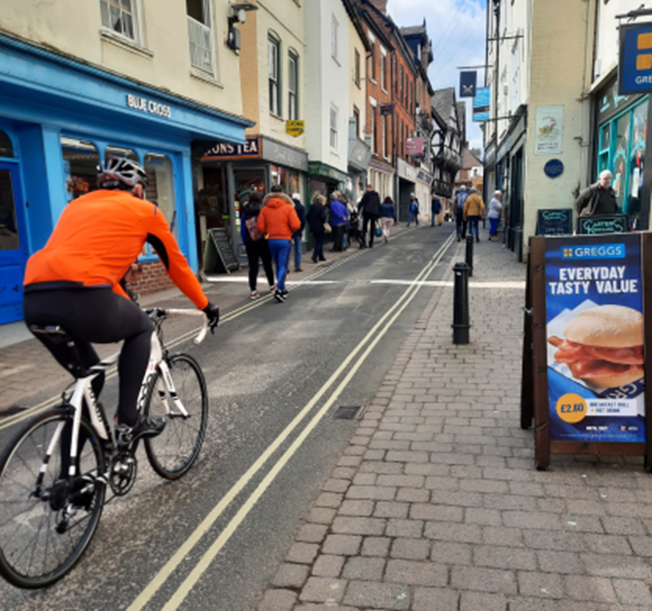
“The strongest opposition has been to proposals to close King Street to traffic. It is very narrow and the pavements more so. If it is closed, along with High Street as the consultants suggest, access to the town centre for buses and deliveries would be blocked. We closed King Street during the pandemic but even with the low traffic volumes then, it led to traffic problems in other areas of the town.
“I would welcome a trial closure of King Street on Saturdays. We should also work to reduce the amount of traffic using the street.”
The councillor also argued that there is “no consideration of disability in the plans”.
“More than one in five people in Ludlow are disabled,” he said. “That rises to one in three for those aged 65 and over. In this day and age, it is wrong to develop and plans for getting around and about without putting disability at the centre.
“Walking and cycling schemes work well in cities and large towns, where there is space to segregate cars and vans from cycles and pedestrians.
“We need to improve walking and cycling proposals in Ludlow and the surrounding area. We need plans that are more practical and more sensitive to the needs of our historic town and its residents.”

















35 thoughts on “Councillor slams active travel consultants who “dream up schemes more at home in large cities than small historic towns””
Just as well these historic
Just as well these historic towns had their street layout created in the Middle Ages, which was famously when peasants drove everywhere and no one walked….
I do not believe that
I do not believe that providing infrastructure to today’s behemoth vanity SUVs is particularly “more sensitive” to the needs of historic towns.
Reducing congestion eases the journeys of our less than able travellers.
But our streets are too
But our streets are too narrow…
But this is a historic town with a medieval layout…
But we have to have driving everywhere because disabled people, or because the elderly…
“More than one in five people
“More than one in five people in Ludlow are disabled”. That sounds like a very high percentage. Can it be correct?
Shortage of surnames there?
Shortage of surnames there?
Or perhaps the driving is really bad?
alchemilla wrote:
It’s not that far off the national average actually, which the 2021 census found to be 17.9%. However, the figure should be treated with caution: the questions on the census were:
And then those who answered yes were asked:
Now I answered yes to both those questions (physical – autoimmune disease, limiting but well-managed) but I don’t really regard myself as disabled and certainly don’t need any concessions or consideration when planning a transport scheme. It’s disingenuous, to say the least, of the councillor to use the figure in a way that implies that everyone who is classed by that metric as disabled will be negatively affected by active travel schemes. Indeed, given that exercise has been proven to have a beneficial effect on numerous physical and mental ill health issues, many of those classified as having a disability would benefit from better and safer walking and cycling routes.
Just here with the usual,
Just here with the usual, because the videos are great!
Perhaps reflecting the UK / US mindset, the Netherlands cycle paths are not mentioned in many travel guides in English (e.g. [1]) for tourists with disabilities (exceptions of course). More evidence of the power of cultural mental limitation? Or just “what you don’t see doesn’t exist”?
I’d say everyone benefits from quality accessible cycling and walking infra.
Great links, thanks, what an
Great links, thanks, what an absolutely fabulous advert for better active travel infra. The Dutch seem to have completely flipped the equation so that it would be the person who opposes active travel infrastructure who is seen as limiting opportunities for the disabled, rather than vice versa as prevails over here.
2.35 million people (4.2% of
2.35 million people (4.2% of the population) has a Blue Badge. That might be a more useful metric.
Tom_77 wrote:
Yes, that sounds more realistic. Even then though, not everyone with a blue badge will be affected by active travel measures: since 2019 new badges have been available for those with psychological health problems as well as physical so you might, for example, have someone who has a psychological disorder which means they can’t use public transport but who wouldn’t object to having to park 100 yards further away from the shops, or indeed cycling there if a safe route was available. Anti-active travel campaigners do tend to have a rather patronising way of talking about the disabled as if every single one of them is only capable of being picked up at their front door and dropped off at the front door of the shop, which is not true in many cases. An anecdotal example is a friend of mine who has MS: she loves cycling on segregated paths, in parks et cetera, but unfortunately her condition makes it difficult for her to start off quickly (she basically has to lift one leg onto the pedal with her hands) and so she doesn’t feel safe riding on the roads. If she had a segregated route to get her to the local supermarket she would love to leave her car at home and take her bike, but people like this councillor would doubtless use her as a statistic amongst the people who must have car access everywhere.
Blue badges are only
Blue badges are only available to a proportion of people with a disability, focused on people with the higher rate Personal Independence Payment and Mobility Impaired.
Hidden disabilities have onlt recently been added to the critera.
So not a very good measure.
mattw wrote:
Respectfully, I think you are mistaken there, yes you can automatically get a blue badge if you get the higher levels of PIP or DLA but many people (including three I know) are eligible for the blue badge on the grounds of mobility issues even if they don’t receive those higher levels of payment, the bar is considerably lower. One of the people I know who has a blue badge because of her MS was issued with it almost as soon as she was diagnosed but it took her three years and a considerable worsening of her condition before she was awarded the higher rate of DLA.
Rendel Harris wrote:
I wonder how many of those people have repiratory issues that are exacerbated by the amount of cars?
In a small town in the middle
In a small town in the middle of the open countryside, I’m sure you know the answer to that.
ITK2012 wrote:
Probably best to check (interactive UK map available). The data granularity is maybe a little large but Ludlow would appear to be similar to some bigger places.
Also maybe worth a read of the literature. (UK overview from 2019). Turns out there may be more to be concerned about than we thought and proximity to roads is pretty important.
If the good councillor is so worried about blocking traffic, perhaps there are more than a couple of horses per day?
ITK2012 wrote:
Approx 12%, then
ITK2012 wrote:
The Bull Ring in the centre of Ludlow has annual average PM5 pollution of 8.70 micrograms per cubic metre (mcg/m3), 74% above the WHO limit, annual average of pollutant PM10 of 15.65 mcg/m3, above the WHO limit of 15 mcg/m3 and N02 levels of 28.20 mcg/m3, almost three times over the WHO limit of 10 mcg/m3.
One suspects that’s not quite the answer you were sure people knew…
Rendel Harris wrote:
Wow! I won’t be drinking in there – is it a drive-in?
Thank you for putting those
Thank you for putting those numbers into a true and logical perspective.
Andy Boddington, a Liberal
Andy Boddington, a Liberal Democrat councillor who represents Ludlow North in the Conservative-controlled Shropshire Council, says he wants to promote walking and cycling, as well as measures to ease traffic pressures in Ludlow town centre, but……
But I hate them, so I’ll find some kind of reason, any kind of reason, to oppose anything that makes walking and cycling easier. And besides, I’d be worried about running them over in my gigantic, totally unsuitable for small market towns, SUV.
Are you sure he’s a LD? He sounds stupid enough to be a tory.
That picture of King Street
That picture of King Street at the head of the article, credited to Councillor Boddington, surely demonstrates exactly why that road should be closed to traffic.
Mungecrundle wrote:
Yes, and the times I’ve used a wheelchair, I’d much prefer to try to navigage that street if there’s no motor vehicles in it than if there are.
It reads to me that whatever
It reads to me that whatever happens motor vehicle users must not be inconvenienced. However narrow the pavement or inaccessible a small town centre is, nothing – but nothing must inconvenience the ability of a car or van to access said centre.
Same old rubbish.
Same old rubbish.
People who want a cycle network in theory but not in practice.
Good article, thanks!
Good article, thanks!
HarrogateSpa wrote:
same old same old.
Reduce car journeys – but not the ones I want to make.
“More than one in five people
“More than one in five people in Ludlow are disabled,”
hmmm…
They probably all got run
They probably all got run over on King street.
peted76 wrote:
that needs to be a gif with the banana coming out of the hand in this context
You have to love the argument
You have to love the argument that ‘the medieval street is too narrow’…
That would be the street originally ‘designed’ for pedestrians and horses, with a footprint about the same as a bicycle…
Yup, the street is so narrow
Yup, the street is in fact [i]so [/i] narrow they have to prioritise the wide vehicles over the narrow ones. I think I’ve got that right?
It’s amazing that people that
It’s amazing that people that claim to care for an area can’t be more critical of ‘where it all went wrong’. Take that picture of King St, bollards advertising blocking the pavement, the horrible slab of tarmac with yellow lines and the corporate modern shop fascias. Nothing historic about any of it.
The trouble is that car brains can’t imagine a street where cars share their space with pedestrians, cyclists etc etc. Where speeds are restricted to 10mph max. Where van deliveries have to be made within certain hours. Where drivers don’t bully their way past other road users.
IanMK wrote:
I saw the blog post by Andy Boddington (a LibDem councillor), who appears generally to be a level-headed character. Although I’d be happy to have an opportunity to take a pop at consultants and their exorbitant fees, the fact is that central government cuts have seen Shropshire Council bled dry of resources, including knowledgeable people in the planning and highways departments. So much work is outsourced, at significant cost and often with unsatisfactory results (you don’t want to know about leisure & Serco or highways & Kier, though you can probably guess).
I fear that the recently published Local Cycling and Walking Infrastructure Plan (LCWIP) is just hot air and the Tory-led Council will once again piss away our money and refuse to do anything significant to help people walk and cycle more or to cut pollution in towns and villages across the county (the attitude re. air pollution is appalling).
Ludlow is on a bank above the river Teme, due to its attractiveness it is an extreme example of ‘a town of haves and have-nots’ (with eye-watering house and restaurant prices). The main shopping and tourism/leisure area is compact and not en route to anywhere. It would be better if some streets were closed to motorised traffic, even if only at weekends or certain hours of the day. King Street [street view] is the most obvious candidate. The LWCIP page for Ludlow states that “24% of residents said they walked to work”. The walking strategy has pretty sensible and quite modest recommendations that do not mean banning cars or forcing elderly people to jog up a 10% gradient to buy a pint of milk.
I don’t know what Andy’s specific objections are but I don’t believe his 1-in-5 claim and I suspect that he’s had a lot of angry feedback from drivers who are too entitled and lazy to walk anywhere (and don’t want to accomodate anyone else doing it either).
Quote:
surely an argument for very narrow vehicles?
What were those people
What were those people thinking when they designed historic streets? No space for cars and no consultation with the public of 2023.