



A driver who hit a cyclist as they cycled along a painted bike lane in Warrington, breaking the rider’s left leg in two places, has been banned from driving for 12 months and ordered to complete 150 hours of unpaid work.
The victim, a 35-year-old woman, suffered a broken tibia and fibula in the incident which happened at around 10.25pm on Thursday 2 November 2023 as the cyclist travelled along Hawleys Lane away from the A49.
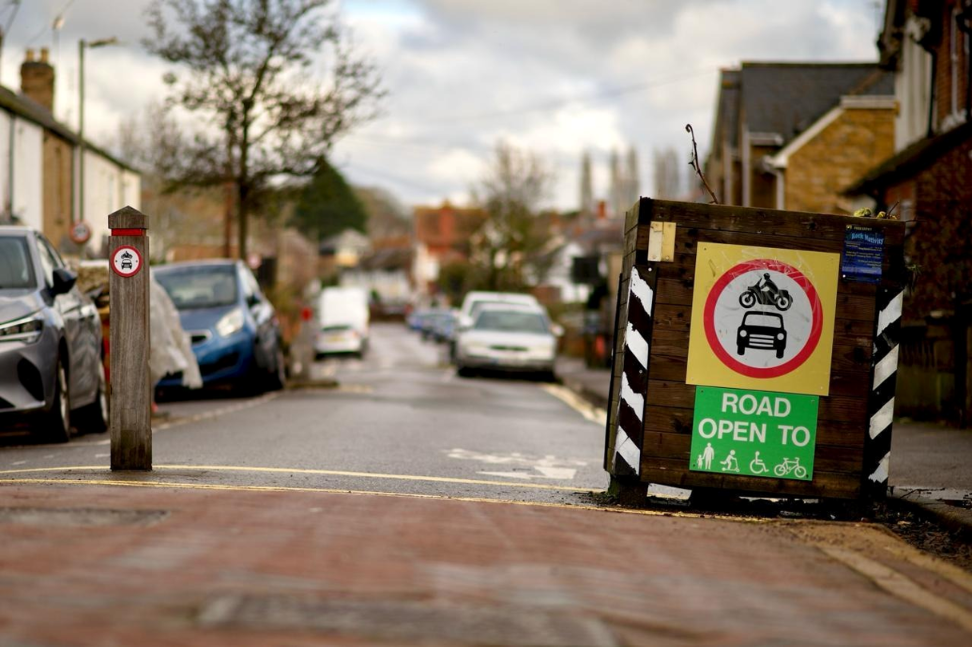
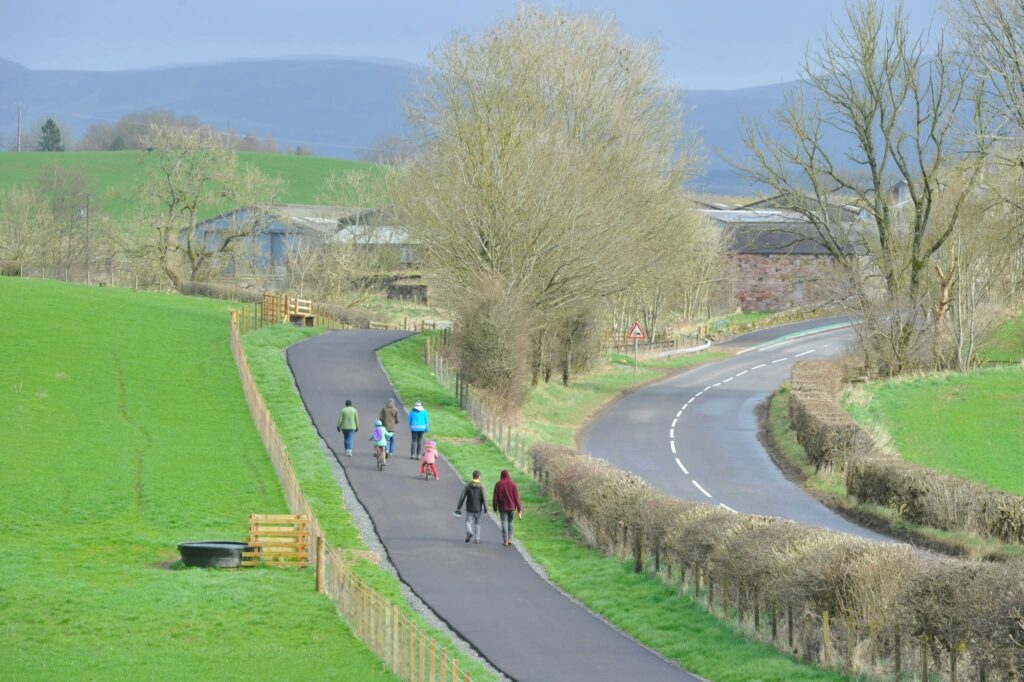
At the junction with Longshaw Lane the rider was using the painted cycle lane [pictured in the photo illustrating this article] which was not protected from traffic and consisted of painted lines and a blue strip marking the infrastructure.
A reporter from the Chester Standard was at Warrington Magistrates’ Court to hear how Laya Koussa pulled out in front of the cyclist, causing the victim to collide with the side of the Nissan Qashqai the 30-year-old was driving. The victim suffered a broken tibia and fibula in her left leg and was treated by paramedics at the scene before being taken to Warrington Hospital for further treatment.
Koussa denied she had caused serious injury by careless or inconsiderate driving. She was ultimately deemed to have been driving without due care and attention, the driver sentenced to a 12-month community order and ordered to carry out 150 hours of unpaid work.
She has been banned from driving for 12 months and ordered to pay court costs of £650 and a victim surcharge of £114. An application was approved for the funds to be deducted from her benefits.
The case serves as a further example of why many cyclists do not feel safe using painted bike lanes, the infrastructure offering no physical protection from traffic.
A 2020 study found that painted advisory cycle lanes actually increase the risk of cyclist casualties, with the authors urging highways authorities to cease installing lanes of that type and to convert existing ones into protected cycle lanes.
Another common complaint is that painted cycle lanes can encourage close passes from other road users, that because people see the infrastructure as permission to overtake regardless of if they have sufficient space.
A 2019 study supported this, finding that painted cycle lanes are likely to result in closer passes from motorists.
The researchers from Melbourne concluded that when a cyclist is in a bike lane, a passing motorist has a clear lane ahead and is therefore less likely to carry out a proper overtaking manoeuvre. Passing events that occurred on a road with a painted bike lane and a parked car had an average passing distance that was 40cm less than on a road without a bike lane or parked car.









16 thoughts on ““Careless” driver banned for a year after breaking cyclist’s leg in bike lane crash”
She had demonstrably caused
She had demonstrably caused serious injury so that’s not up for debate (or shouldn’t be).
But does Laya Koussa really think that pulling out in front of an oncoming road user (causing a broken leg, or creating a situation where that became unavoidable) is not careless or inconsiderate? Hmm…
Think this line of argument *
Think this line of argument * is almost a default and not just for collisions involving cyclists. e.g. “They ran into me ergo it’s their fault”.
Add to that “well if they’re choosing to ride then it’s not my fault if they get hurt falling off their bike or hitting things – it’d only be bumper damage and scratches if they were in a car”.
I’m actually a bit surprised judgement went against the driver (tried to review the article but it wanted subscription or ads).
* Assuming it’s not just the lawyers saying “no – don’t ‘fess up, there’s every chance you’ll get off if they do take it to court”.
Some crazy people might
Some crazy people might suggest that if you drive like that and don’t consider it careless or inconsiderate then you are not fit to be anywhere near our roads in a car. As I say though, crazy thinking because everyone knows that its a right to drive your car however you like once you get your license.
What would the penalty be if
What would the penalty be if someone took a baseball bat and used it to break a strangers leg in two places? More or less than a total of £764? The driving ban seems rather meaningless, given the number of people who just ignore those. https://news.sky.com/story/thousands-of-drivers-brazenly-ignoring-bans-with-one-caught-20-times-while-disqualified-13038937
It was only a cyclist, I don
It was only a cyclist, I don’t know what all the fuss is about.
Motornormativity: if those injuries had happened to a pedestrian and were caused by the driver mounting the pavement, I’m pretty sure they wouldn’t have got just a slapped wrist.
On benefits, but can afford
On benefits, but can afford to own a car…
I live in Warrington and pulling out right in front of an approaching cyclist seems to be the favourite sport of the motorised locals. Along with the overtake, cut up and brake check manoeuvre. I have been getting so many of the former that I have grown accustomed to instinctively slowing down and getting ready to stop entirely each time I am approaching a side road with a car pulling up.
whosatthewheel wrote:
Ah … but of course she has to drive! Perhaps she is disabled (hence benefits), and/or is doing some dire job (in-home care support?) which pays starvation wages (on part-time hours) but requires you have a car to get round people on time / because that is your “staff room”?
As a slight aside it’s interesting that you get push-back to any restrictions on motoring not just from the rich but strongly from the poor. One might naively think that running a car was outside the reach of some folks – or at best a financial trap for them.
But … cars are important. People will find a way to get one and run it. They’re not solely a transport tool – if they ever were. They’re now bound up in our identity / social status / how we want to project ourselves.
Plus … you can sleep in your car – not so much in a bike. If you have to get out of a place fast (with say some of your stuff and a pet and a child or two) a car can make that happen. (Sometimes possible on a bike – but planning and time are required).
And you can generally sell it for a several hundred quid (perhaps even if not actually fully yours…). Entry level bikes you’d struggle to get 50 for.
whosatthewheel wrote:
She may have a disability and have the car through Motability. She may have recently lost her job and the car dates from more prosperous times. For all we know it might not even have been her car, perhaps she had borrowed it from a friend or family member. Judge her for her poor driving and her unwillingness to take responsibility for it, definitely, but don’t just assume, as your comment clearly implies, that somebody on benefits must be fiddling the system.
I cannot see how the type of
I cannot see how the type of cycle lane has any bearing on cars pulling out in front of you.
If anything more protected cycle lane infrastructure (barriered or on pavement bike lanes) seem to encourage this type of behaviour.
IME primary and a directable several hundred lumen helmet mounted front light are the only effective deterrent against someone determined to pull out on you in the dark.
Everyone carrying more /
Everyone carrying more / brighter searchlights will fix things? Perhaps it helps sometimes, but I think this leads to other issues. We’re already in that arms-race so it’s slightly to your advantage to be brighter than everyone else…
I don’t think this is a good plan generally because a) dazzled drivers do not make safer drivers (“sorry, the NightSun was in my eyes”) b) cars have much brighter lights, and drivers still manage to pull out in front of them c) if you are not looking you cannot see, no matter how bright the light.
Effective front lighting
Effective front lighting definitely doesn’t eliminate the pull out/across, though might help. And that’s with me using decent front lights at all times on the road for a couple of decades. Got my first NightSun TriLights 25 years back. Helped a bit back then because I believe that some of the more observant motorists might have thought I was on a motorbike. Incredible lights, aimable beams, but they never went to LEDs, and only had a temporary dalliance with Li-Ion, unlike their major US competitor NiteRider, who are still with us. Still have a couple of sets, they’d be something else converted to LEDs.
anotherflat wrote:
No – drivers not looking because “hardly any cyclists” and very little feedback in general for unsafe driving: that’s what encourages this. Combined with “roads built for driving” everywhere in practice.
We don’t want “bike lanes” anyway, we want separate cycle paths where they’re needed. (Though perhaps by “on pavement bike lanes” you mean this?)
When done properly * these make it really clear that you should yield and check who’s coming. As clear as joining another road.
The problem of course is that drivers don’t even manage to negotiate that correctly all the time and not infrequently pull out in front of other drivers…
* Chicken and egg again – in the UK where we get infra (infrequently) it’s rarely even up to 3rd class standards. And until we have lots of it and lots of cyclists we won’t have anything to keep reminding drivers to drive safely (apart from other cars crashing into them…)
But see picture for a “side road” crossing in NL (from BicycleDutch) – can’t get clearer (though perhaps a street light closer…)? And if the side road is a minor access-only road then it should be really, really clear – see many examples here.
Would the driver have pulled
Would the driver have pulled out in front of a 20 tonne ATV? No. Too many drivers drive on the risk to them, no-one else. When drivers say cyclists are dangerous, they mean the risk to the driver of being blamed for the cyclist’s injury. This, is the ‘risk’ and the ‘danger’. UK driver culture is by far the most toxic I have experienced in my travels around Europe.
Wonderful picture, but don’t
Wonderful picture, but don’t most main battle tanks come in north of 60 tonnes? And if it was the car drivers fault, the tank is quite well camouflaged…
polainm wrote:
I’ve driven around a lot of Europe, and I’d agree that standards are worse here in the UK (errm… maybe Italy too), but that collision in the photo you’ve used happened in Germany. I don’t think running out of talent when driving is a specific national trait.
https://www.theguardian.com/uk-news/2015/jun/03/british-battle-tank-crushes-womans-car-in-germany
I live not far from the Bovington camp and locals tend to have a healthy amount of respect for the tracked armoured vehicles that move around on the roads. When something bad happens, it’s always very bad.
Well, I got my licence back,
Well, I got my licence back, finally! Outrageous denial of my civil liberties for 12 months! That’s nearly a whole year!
How did they imagine I was going to get to my community payback sessions, eh? Lack of joined-up thinking, that’s what it is. Fortunately Dave was able to take me, coz he was nearly at the end of his ban so he was, like, over the hump and due to get back on the road anyway.
So, I had to fill out forms and stuff, just to get my licence back. And I’ve had my insurance quote – well, that’s gone up. It’s just milking innocent offenders – a money-grabbing scheme!
It’s so stupid, I can’t even remember why they robbed my licence off me in the first place. Somebody said I was lucky I didn’t have to re-take my test. Can you imagine that! Doing the driving test again just to get my licence back. I know how to drive. I’ve been driving for, like, over a decade without having to have lessons. I’ve done the test; threw the Highway Code out of the window – because once you’ve read that and passed the test, then you learn how to drive properly. And somebody says I should be taught how to drive again.
And I would’ve had to do the hazard perception test again. Can. You. Imagine. ?! It wasn’t me on a bike that failed to spot the car pulling out in front of them, was it?!
Well, now I can get out there and prove to everybody what a good driver I am.
Anyway, gotta go, mum. There’s some busybody in a police uniform next to me gesturing me to “put the phone down”. Even though it’s clearly on speaker because I’m holding it in front of me… Yeah, I know… somebody should give him driving lessons.