


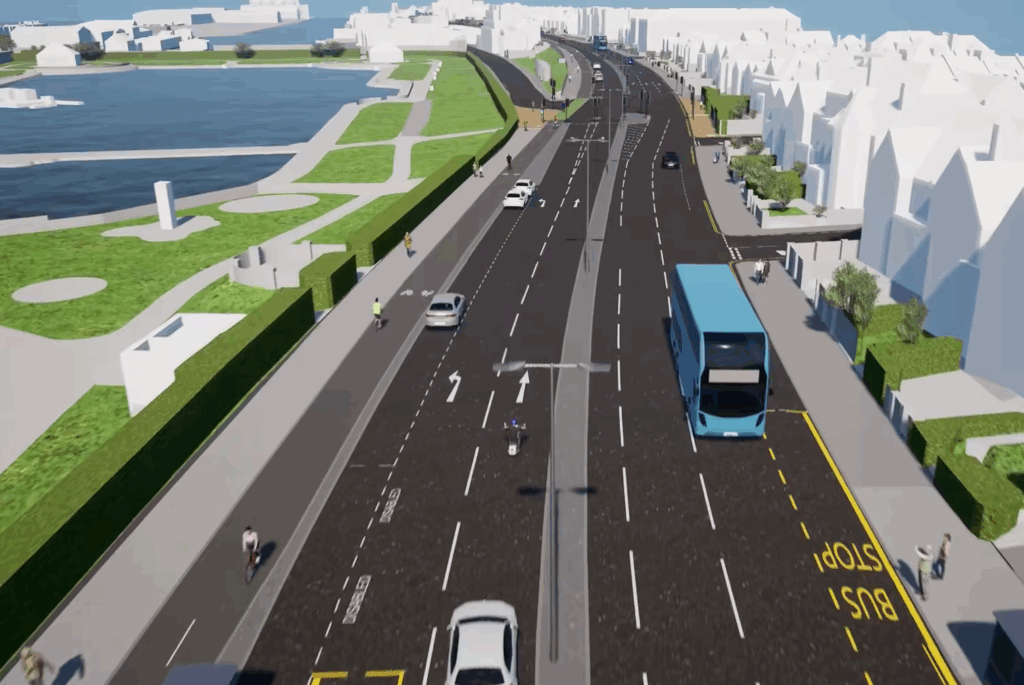

In the latest bike lane row, Brighton & Hove transport chiefs hoping to transform a major A-road with a £3m investment in safe active travel infrastructure have been told their plans put “the city in danger of grinding to a halt”, that according to a Conservative councillor who claims it’s “a significant amount of money continuing to be spent on cyclists who often do not stick to cycle lanes” and “encroach on space given to pedestrians, endangering their safety”.
Brighton & Hove City Council is running a consultation on the A259 active travel scheme between Hove and Portslade, the proposal aiming to improve walking, wheeling and cycling along the seafront from Fourth Avenue to Mill Road. To do this, the local authority wants to install a new two-way cycle lane that is separated from traffic, improve the safety of crossing and junctions, upgrade pavements and crossings, and introduce new loading and disabled parking bays.
One westbound lane of the current four-lane road would need to be removed for a 400m stretch between Fourth Avenue and Hove Street to provide space for the changes above, something the council is confident will not impact traffic flow.
In fact, its research states that even removing the lane, the westbound route would still provide a capacity more than 500 vehicles per hour above what was the highest hourly traffic flow recorded in the past decade.
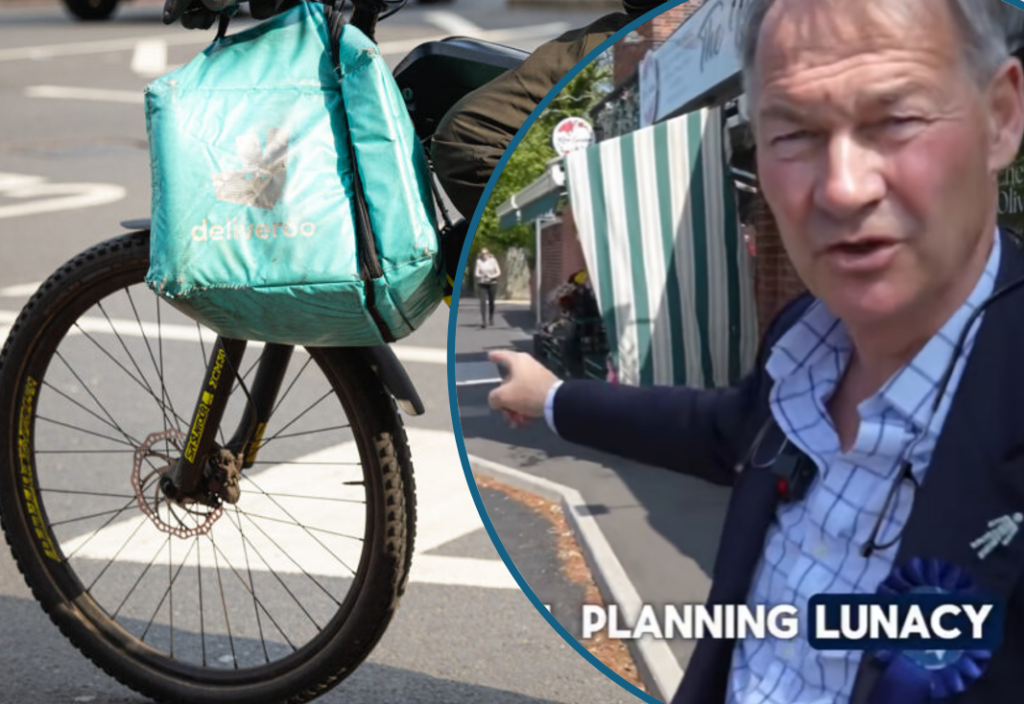
However, speaking to The Argus, Brighton and Hove Conservative Group leader, councillor Alistair McNair, claimed the scheme could see the entire city “grind to a halt”.
“Many residents will see a significant amount of money continuing to be spent on cyclists who often do not stick to the cycle lanes but encroach on space given to pedestrians endangering their safety,” he claimed, adding his belief that the crossings proposed are “not pedestrian-friendly”.
“While the Active Travel England funding can’t be spent on potholes, the council is also spending nearly £3m on this over three years which could have been used in different ways,” he continued. “Labour is always shouting that they are a listening council. With this consultation, they have an opportunity to prove it by ensuring that changes suggested by local residents who will live near the scheme are considered and hopefully adopted, especially shop owners, families and disabled.
“The new cycle lane in Preston Road has also not been well-designed with cyclists writing to me and other councillors describing the accidents they have had. We hope the build quality of this seafront development will be better. Drivers may be dismayed to hear there will be even more roadworks for years to come with little benefit for them. The city will be in danger of grinding to a halt.
“Long term, driving through Brighton and Hove may be impacted with increased congestion and slower journey times. This may put off visitors at a time when our high street is struggling with higher taxation. This development may bring improvements but will inevitably cause a great deal of disruption while being built. We hope the council works closely with the developers to hope disruption is kept to a minimum, the work is finished promptly and the channels of communication for residents to express concerns are clear and easy to access.”
The Green Party praised the council’s work to bring the proposal to the public, saying it “undoubtedly improves the existing road”, but said the “fact that it is being funded by taking £1.2 million from a previously promised active travel scheme on Marine Parade” was “a cloud hanging over this scheme”.
The Green Group’s Steve Davis said: “When you offer people a safe and fast way to cycle more of their usual journeys, it’s no surprise that it results in more people ditching their cars and getting on their bikes, resulting in better health outcomes for them and economic benefits for the area.
“For all Labour’s talk of reducing inequality – giving these health and economic benefits to the west of the city, only by denying them to the east, must leave a sour taste for those in Kemptown and Whitehawk.”
Campaign group Bricycles has been more positive, calling the project “very positive”, even if it “could be even better with a few minor tweaks”. The cycling campaign group pointed out that “there should be benefits for motorists” and said it will mean “drivers are no longer caught behind cyclists when driving in either direction”.
“Overall the scheme is a very positive one and could be even better with a few minor tweaks,” the group said. “The really good news is that the scheme extends beyond Hove lagoon. This was a really pleasant surprise as we thought the funding only covered the first section.
“We’ve seen the detailed drawings and the overall picture is really positive. The scheme achieves a 3m minimum width along much of the route. The junctions are well designed to give cyclist priority — or to at least allow cyclists to legally cross the junction throughout most of the traffic light phase. The plan includes some good improvements to the public realm and improvements for pedestrians, too.”
Bricycles has raised some concerns that it hopes could be addressed post-consultation, such as “the very small 0.6m buffer between parked cars and the cycle lane” which could put riders at risk of doorings. It also suggested the traffic light pedestrian crossings be set up so users do not have to wait in the middle of the road for the lights to change.







37 thoughts on “Cutting road to three lanes for cycling route puts city “in danger of grinding to a halt”, claims politician — but cycling group says drivers should back plan as they’ll “no longer get caught behind cyclists””
What they are forgetting is
What they are forgetting is shrodingers cyclists. We both hold them up for a huge amount of time (when we are on the roads) and aren’t something to even consider for saving time (when they suggest bikes lanes which might take away from cyclists holding them up).
What someone really needs to do is tell drivers that if a journey is too painful to take via car then perhaps they should use another mode of transport. Just to head off the obviously very caring average motorist as well, perhaps remind them that if they didn’t drive their massive car (almost always) with a single occupant, all the elderly and disabled people would be able to get about easier because there would be less traffic.
But they all have to drive!
But they all have to drive! They’re all “meaningful journeys” – nobody just drives in a circle like cyclists do! *
And … it’s always a case of “drivers’ burden” as well. Very few or no journeys are apparently driven because the driver “wants” to drive them – it’s all for other people! So:
Transport: for the kids, older relatives, pets to the vet / dogs for essential exercise…
Cargo: shopping for the family, for those older relatives.
Because of work: for work itself or as part of a job e.g. delivery, transport; to get to clients like a care worker; just to get to work – it’s rare that anyone lives near enough to simply walk or cycle apparently.
* … but instead, people say “I’m just going … er … to the shops / for a coffee” – then drive out, perhaps doing that, perhaps just parking up somewhere (local beach etc.) They really just “wanted some space”. Sure, they drove from point A to point B and stopped, then perhaps another point … but sure enough they ended up back at point A again, just like the cyclists.
But as we know many
But as we know many motorcyclists and cyclist do just go out, for cake, for fish and chips some distance away:
Not a motorcyclist, but isn’t
Not a motorcyclist, but isn’t owning a motorcycle (in the UK) as much “about the ride” as it is getting from A to B? (Unless you’re working a delivery job?)
TBF I enjoy cycling to run my errands more than I would doing them e.g. by bus, and also may decide “oh look, I might run out of washing up liquid in a few weeks, better nip to Sainsbury’s” (but in large part because I can then cycle there on these routes).
(If only I would finally buy that car I was meaning to buy after I moved to Edinburgh all those years ago I might start making some meaningful journeys, and contribute something towards the local economy…)
chrisonabike wrote:
Always and not only in the UK.
Some riders go to local coffee shops. We tend to go for fish and chips at the seaside, Mablethorpe or Hunstanton or WSM all worth a good run out. Just considering Scarborough next week🏍️
Abroad good cycling roads are also good biking roads, the Alps and Pyrenees excellent but I did find coming down the hairpins on Stelvio rather mundane.
BikingBud wrote:
Ah, it’s notoriously banal – so much so that to avoid ennui riders play musical instruments on the way up and down, or ditch the bars and brakes on the descent.
I’m a cyclist, motorcyclist
I’m a cyclist, motorcyclist and driver. I commute either by bicycle and train or by motorbike, depending on the weather. I do ride my bicycles for pleasure a lot and my motorbikes for pleasure occasionally. I tend to drive when I have to and only very, very rarely for pleasure.
That would explain the
That would explain the research finding that buying a motorcycle during your midlife crisis was associated with weight gain.
Quote:
It’s their default position, I expect nothing less.
don simon fbpe wrote:
It’s their default position, I expect nothing less.
But is that all tautology?
Just look at that picture!!
Just look at that picture!! Look at the amount of space between the houses and the sea and what a tiny proportion of it is given to cyclists
I ride that route regularly, the cycle lane is nowhere near sufficient, especially in the summer
What’s with the weird half a
What’s with the weird half a lane next to the median? Dedicated lane for motorbikes (but watch out in case something happens to be turning)?
Someone’s built a monolith
Someone’s built a monolith though (non-traditional colour), so perhaps a time-and-space travel option will be included?
It’s for when the first lane
It’s for when the first lane of motor traffic is having to squeeze by cyclists cycling on that side of the road *, and the second lane of motor traffic has to overtake the first!
* The cyclists will need to be there because they put the bi-directional cycle path on the opposite side to where the houses and side-streets are – that people presumably need to access. They could perhaps even go bi-di on both sides (like some places in NL) … but as usual the lion’s share of the space is dedicated to the motorised modes. (And AFAICS even public transport has to share with the private transport, so if the road is remotely busy buses will be stuck in traffic and drivers will be trying to pull out round stopping buses…)
Conservative Group leader,
One can only hope. Until that point is reached motoring is almost certain to continue increasing. It’s already gridlocked? Adding “one more lane” will merely lead to a short respite before the place is gridlocked again – now with a lot more space devoted to driving and a lot more expensive infra getting trashed and needing replaced. And more dependence on driving.
The fundamental problem: the space-inefficient nature of motoring *. Anything that increases support for that transport mode cannot be a positive contribution to transport issues in urban spaces (or indeed many issues there).
Of course despite what we know about this “more of the same” is a short term win: for some motorists, for the motoring and related trades, for politicians …
* Plus its effect of suppressing other modes, creating a driveogenic environment. This includes changing the political landscape, creating a feedback loop where there are pressures for more of the same: as motoring blights the areas just outside the urban core the better off move to suburbs or dormitory towns / villages. They will wish to drive in to the city to work / to access amenities from there and – as well-connected people will exert a greater political influence.
“…..Brighton and Hove
“…..Brighton and Hove Conservative Group leader, councillor Alistair McNair, claimed the scheme could see the entire city “grind to a halt”.
Is there anything quite so far out of touch as anyone stupid enough to still be in the tory party? There’s a reason the tories are fourth in the polls, and Alistair McNair and dinosaurs like him are it.
Conservative councillor
Conservative councillor bemoans “cyclists who often do not stick to cycle lanes” and “encroach on space given to pedestrians, endangering their safety” but (wilfully?) fails to realise that both of these are in part due to the lack of decent cycle lanes. Shocked.
When will these retards
When will these retards iunderstand that vehicles cause traffic to grind to a halt.
Surreyrider wrote:
Please don’t use the R word. It is extremely offensive.
Congestion occurs at
Congestion occurs at junctions, not between junctions. That’s why junction areas usually contain more lanes than the rest of the road – to stack traffic.
The A56 through Stretford near Manchester has recently had a lane taken for cycleways in each direction, reducing it to 2 lanes in each direction. There has been no increase in congestion. Kingsway, in Stretford, was reduced from 4 lanes to 2 just this year. No congestion.
These idiot boomer drivers need to stick to sipping soup under a blanket.
At Portslade going west the
At Portslade going west the 259 reduces to a single carriageway, single lane each direction. In Brighton beyond the Steine it”s the same. Going north the A23 is the same. The two, three, whatever lanes in the middle is a car park.
Yep it’s like 3 lanes for one
Yep it’s like 3 lanes for one checkout, no one’s getting served any quicker
It’s always a Conservative
It’s always a Conservative politician who moans about cyclists, isn’t it
No (sadly). Folks from all
No (sadly). Folks from all parties are happy to indulge – and will likely continue until walking and cycling are just seen as another perfectly common and logical way for making some trips.
… OTOH if it’s someone speaking up *for* cycling and mobility infra I would be surprised to see that was coming from a Conservative (never mind Reform).
There are some notable exceptions at both Westminster as as mayors (well BJ back in the day) / in councils. I believe the All Party Walking and Cycling Committee had members from all.
But Cycling (and “war on motorist”) is still available as an equal-opportunity wedge issue.
chrisonabike wrote:
“had”?
There isn’t an All Party Walking and Cycling Committee, although there is an All Party Parliamentary Group for Cycling & Walking… and it has a committee.
The group includes 35 MPs (out of 650), comprising:
and 33 peers (out of 859):
The committee has 4 MPs:
Apologies – I know this is
Apologies – I know this is still extant but couldn’t remember the name and was too lazy to look up. I’m pleading the heat…
Are they there generally fewer Conservatories because of the warning that “people in glass houses…” ?
Perhaps this kind of thing is yet more “waste” / “wokery” / “working people aren’t served by this and can’t afford to subsidise it” * that Reform would bin if they could?
“Conservatory”?
“Conservatory”?
No it isn’t. I have heard
No it isn’t. I have heard Labour politicians and even had a conversation outside a polling station with the Green representative who also complained.
Quote:
Ah… So he doesn’t want cyclists on the road, but doesn’t want any money spent on giving them their own space either.
I know it’s been said before, but if you put cycle lanes in place and cyclists aren’t using them then generally there’s something wrong with how or where you’ve put them.
Typical
Agree, and hopefully not just
Agree, and hopefully not just “semantics” but…
If you put cycle *lanes* (rather than separated cycle paths / “mobility tracks”) in place don’t expect cyclists! (Except possibly in the US where even this low-level workaround is an amazing improvement on the usual).
Existing cyclists may give them a miss and they won’t lure many non-cyclists onto the roads.
I think talk about “adding cycle lanes” – even if in favour – is often an indicator of still being stuck in the motoring-provision mindset which won’t lead to much changing. (It’s the *network* and/ or the deciding to put some restrictions on motoring… and “tactically” looking at the junctions).
Unless we “can’t get there from here” and have to work through eg. “add cycle lanes” – cycling maybe stops declining or maybe increases by half a percent, then tweak something else etc.?
Is perhaps the biggest impact of cycle lanes “road-narrowing”? Or maybe reminding people that cycling “is a thing” – even if it’s just a negative because “I never see any cyclists in them”?
I use a shared use cycle lane
I use a shared use cycle lane on a hill, narrow, overgrown, poorly maintained, with a sharp incline near the top. 2 days ago the road was blocked to motor vehicles but I was allowed through. I obviously used the road, usually full of speeding drivers. Much easier to cycle up. The amount spent to make it easy for drivists who essentially are pressing a pedal and minor steering, sweeping bends, but people cycling can go to hell. Anyone complaining about money being spent on cycling and active transport should be told to grow up and fu#k off.
Why do they want to build a
Why do they want to build a cycle route right next to a major road? This seems like the worst of both worlds – I’d far rather have a route for bicycles that avoided main car routes like this entirely. For what it’s worth, Milton Keynes is actually rather easy to get around on a bike.
stulemanski wrote:
Probably because it goes from places where people want to go from to places where people want to go to.
stulemanski wrote:
“Yes”, in that where we can reduce the motor traffic we should and ideally we should be thinking in terms of “what are the best routes for our mobility route network” rather than “how can we squeeze a cycle path next to this road”…
… but also “no”, as mdavidford points out.
Also (not a resident…) Milton Keynes is apparently passable by bike with less interaction with motor traffic than many other UK places … but for some time hasn’t demonstrated what’s recognised as “best practice” *.
And more than that by design it’s great for driving (not that some elements of the design aren’t a good idea)!
* e.g. see here and here and generally here for “what was not good enough” getting fixed.
So it connects two existing
So it connects two existing cycle lanes and drastically improves one of them which was quite dangerous (the other is fine, not great but fine).
The other choices were equally heavily trafficked and have no existing cycle infrastructure. There isn’t really a car free route.
Too many cars in the city is
Too many cars in the city is the problem, not some cycle lanes.
The real test of comments
The real test of comments like this is to substitute the word cyclists with the word motorists and see if the person quoted would likely say it – if not, then they’re probably just anti-cyclist. Let’s see: “it’s a significant amount of money continuing to be spent on
cyclistsmotorists who often do not stick tocycleroad lanes” and “encroach on space given to (cyclists and) pedestrians, endangering their safety”. Hmmm…