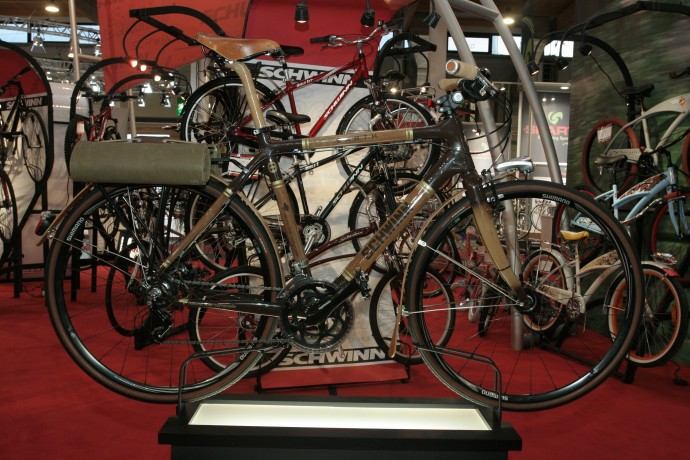
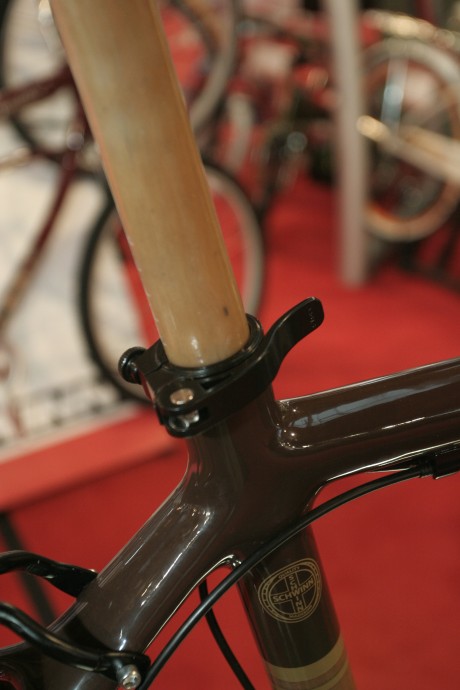
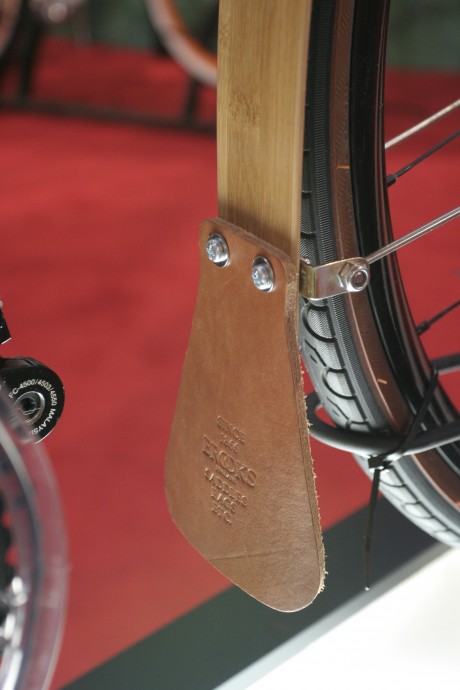
Schwinn’s Earth bike is a concept touring bike made from flax rather than carbon fibre. So it’s greener than your ‘traditional’ carbon fibre, see. Not sure how much greener it is than your even more traditional steel or aluminium – both highly recyclable – but let’s not let that get in the way of an interesting concept… Flax has been used in the motor industry for a few years now as a reinforcing material for plastics. Its avantages are that it is organic, eco friendly, hygienic to work with, oh, and cheap. What makes it particularly attractive from a bike manufacturer’s point of view it has a good strength to weight ratio. It has made an appearance in Formula 1 – outside of the aerospace industry probably the biggest testbed for new composite materials. So far the only bike company to really latch on to flax are Museuw – their MF-1 flax bike uses a combination of 100 per cent carbon tubes with 50 per cent flax tubes. The big claim made for it is that the flax adds vibration damping properties to the ride making it more comfortable to the rider. Maybe, though if it does that would suggest that it would be an ideal material for a touring bike. The Schwinn Earth concept bike takes this a step further using tubes made from 90 per cent flax and 10 per cent glass fibre (one of the claimed advantages of flax is that you can mix it with synthetic materials to tune the performance of the final tube). It’s certainly an interesting bike, and we would really like to find out more about it, and what the likelihood is of it making it onto the streets – the model on show at Eurobike was strictly of the ‘look don’t touch’ variety.
While the claimed ride characteristics of flax would seem to make it an ideal material for tourers, you would probably want to limit your trips to the first world, because if one of these breaks the village blacksmith is not going to be able to help – unless he knows the way to the bus station. Another disadvantage of flax bikes is that so far they haven’t proved particularly cheap. Sceptics also point out that there are many materials that can be incorporated into an epoxy matrix and considered fibre – carrot fibre is ‘the next big thing’, but that none has yet been shown to out-perform carbon particularly when it comes to strength to weight ratios. Carbon is cheaper too.
One advantage something like the Schwinn Earth might have is that in countries with strict policies on the disposal of hazardous substances (that’s all of the EU) an end user certificate won’t be required to prove that the bike has been disposed of responsibly – something that is required for carbon fibre machines. Schwinn Earth gallery
More Schwinn Earth pics
Schwinn Earth: It’s a ‘green’ flax touring concept bike…
Add as a preferred source on Google
Help us to bring you the best cycling content
If you’ve enjoyed this article, then please consider subscribing to road.cc from as little as £1.99. Our mission is to bring you all the news that’s relevant to you as a cyclist, independent reviews, impartial buying advice and more. Your subscription will help us to do more.
3 Comments
Read more...
Read more...
Read more...
Latest Comments
@Smoggysteve "Most would happily ride on the roads and be treated with respect by drivers". But people aren't - and as far as I can see they won't be. Not until there is a lot less driving and it's slower around cyclists, and far more people driving have "skin in the game" eg. they sometimes cycle and their friends and family do also. That's what leads to the model - which is perhaps most advanced in NL - where cycling, walking and driving are all seen as separate normal transport modes. Their needs, vulnerabilities and any dangers to others are considered. And *that* leads to "mix / share when possible, separate when necessary". But "possible" is "where your 10-year old would be safe to cycle unsupervised" - so very few motor vehicles, going slow! And AFAICS everybody - even "existing cyclists" - is happy with the result. (I dunno about a few pro cyclists - but don't they tend to have training camps in different counties anyway?)
@quiff as an Edinburgh resident I can confidently say he's speaking without moving his lips in one sense: - while as I noted in a separate comment there *is* now some real separated cycle infra, all the examples i can think of have *at least as much space* for pedestrians. The rest of the "cycle infra" is essentially similar to the situation in the rest of the UK: eg. bus lanes*, cycle lanes and shared use paths (eg. "build" infra by sticking up a sign). Edinburgh is one of the places with a moderately extensive network of former railways which have been converted to "shared use" paths (completely motor traffic few). However though shared they are not narrow by UK standards. And this is all effectively a "free extra" for all non- motorised users, not like the "sign a cycle path" where pedestrians do lose space. I think this all comes from the "popular understanding" of cycling in which ultimately cyclists are the "other". They don't fit "motor vehicle" or "pedestrian" (including wheelchairs on the very rare occasions people think about that). Thus "cyclists are cheating" in multiple ways! They shouldn't get their own space as "there aren't enough" of them. And "they can just use the road / path". But being able to *choose* "on the road" or "on the footway" (shared use path) is clearly unfair - nobody else gets to do that! BUT of course even if they did pick just one of road OR pedestrian space it's still not fair anyway because they're "too slow" for the road (don't pay "road tax" etc...) and "far too fast" for pedestrians... * Though some existing cyclists may appreciate them when there are few buses, buses and bikes are a very poor mix for several reasons.
Whilst a shame for any employees, their bib shorts had the worst chamois pad I’d ever encountered, utter waste of my money. Even though they were Strava challenge discount purchases, still a waste of money.
Thanks, just going to have to suck it up. Got next week off and will take the easy, if expensive option...
@ktache Just go for the TNT Sports only package, £30.99 for a month. Alternatively have you considered experimenting with a VPN for a few pounds, allowing you to sign up for a free stream abroad, e.g. SBS Australia which streams the Tour live? If I didn't have a kind mate's login that's what I'd do!
So, it's now the month of July and I'm going to have to pay to watch the TdF, for one month only. On a tablet unfortunately, as I didn't manage to get a laptop to rig up to the TV, grrr. Just wondering, what package will I have to fork out for? Not wanting to pay for the wrong one...
Not that it sounds like a dealbreaker given the other faults you've identified, but that cable isn't really a "proprietary" cable, four pin magnetic cables like that are quite common on bone-conducting headphones and other devices (my inexpensive smartwatch uses one) and they can be had for £4.99 on UK Amazon.
There was never really anything to say about le col kit. Most of it was alright. Some of it was poorly designed/made. Trying to position yourself as a Rapha competitor whilst always offering 40% or more off doesn't scream premium though.
Up next in the MucOff product line; for when the cassette won't budge, (chain)whip-it!
3 thoughts on “Schwinn Earth: It’s a ‘green’ flax touring concept bike…”
whats wrong with steel?
Flax or no flax, who’d ride a carbon touring bike? I’ve known a carbon MTB with a dirty big hole worn in the chainstay after one wet day in muddy conditions. What are they thinking? Steel is where it’s at for touring bikes, pure and simple.
Well it is a concept bike…
Agreed, probably not very fixable, once you got off the beaten track. On the other hand maybe there are plenty of plenty of local composite factories out there that’d run you off a quick tube, but where are you going to get the flax?
Now a bike made from carrot cellulose…
some oriental pedantry for you….
aluminium is indeed recyclable, and when all or even most alu bikes are recycled you could just about call it a green material. for the time being, it’s a material whose production generates more carbon emissions weight for weight than it does aluminium.
anyone got CO emissions stats for flax…? 😛
or recycling stats for bikes in general? it can’t be worth the hassle of disassembly….