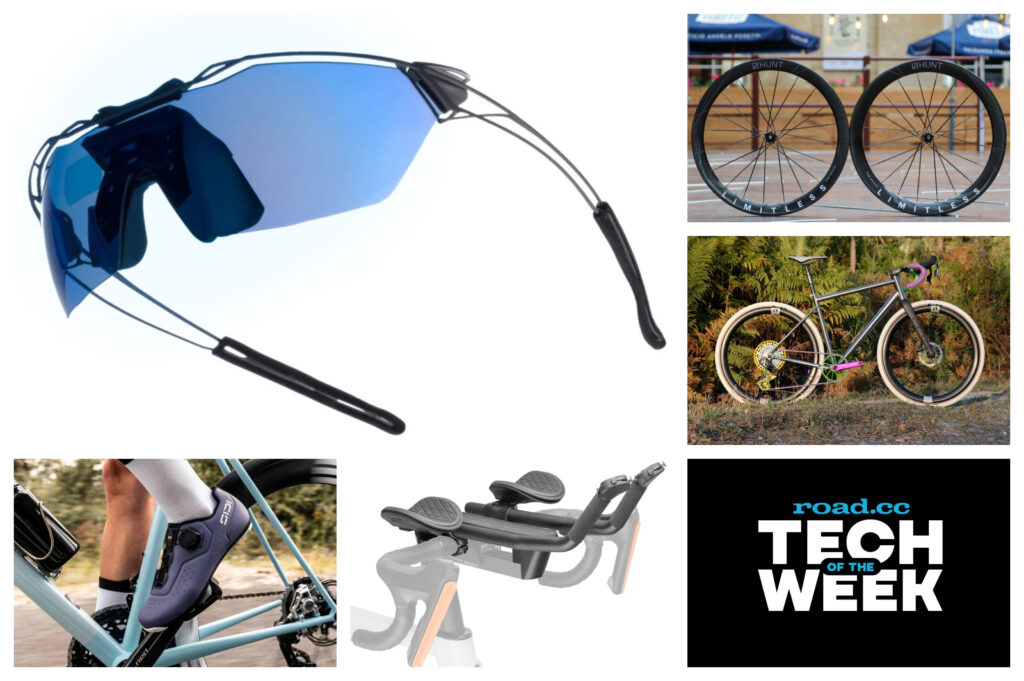
Electric bikes were big again at Eurobike, and every year they seem to get bigger. It’s a trend much more noticeable on, and driven by, continental Europe but we still see its effects filtering through to Blighty. So what’s happening? Electric bikes are getting better No doubt about it, the technology has come a long way from the 40kg behemoths that used to pass for electric bikes five years ago. To see how far technology has come I had a spin on the top-of-the-range (2,800 Euros) Diamant, a Trek sub-brand that’s distributed in Germany and Austria.
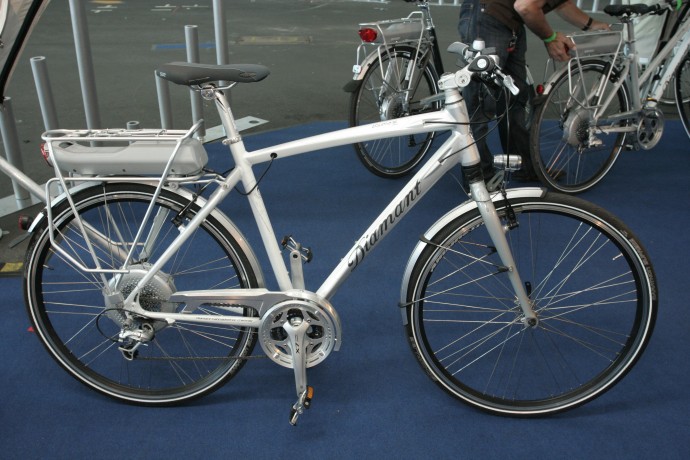
What’s refreshing from the outset about this bike is that it’s obvious that without the battery and associated gubbins it’s a well-thought-out and competent city cruiser. You get a well made Aluminium frame, decent rigid forks with a small headshok-type damper, sensible wheels and new LX running gear. It’s the kind of upright urban steed you might expect to weigh maybe 26-28lb. With the battery, motor and controls the total weight is considerably higher at 46lb, but it’s still a perfectly manageable bike even with the motor turned off.
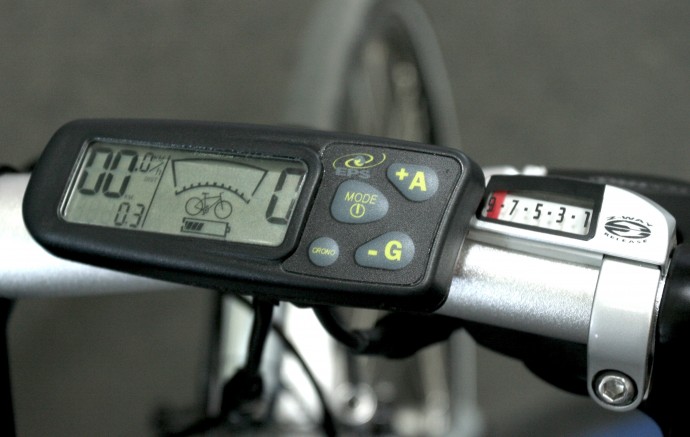
Add some power and it really comes to life. The bike uses the Pedelec system (it adds to your pedal input) and there’s four levels of assistance, from 25% to 200% of pedal power. Braking is regenerative, helping to charge the battery, and there’s also four charge settings for longer downhills, or if you just want to make life difficult for yourself. On the full power setting it was so impressive that I had to stop to confirm with the Diamant guys that it really was just a road legal 250W motor; on the continent electric bikes can be twice as powerful, but need to be licensed.
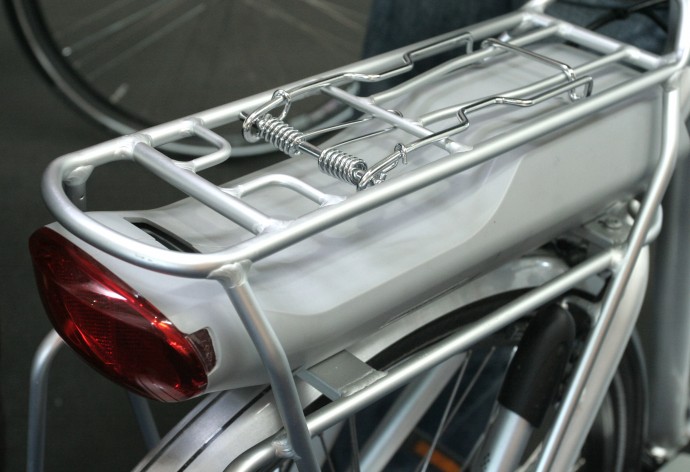
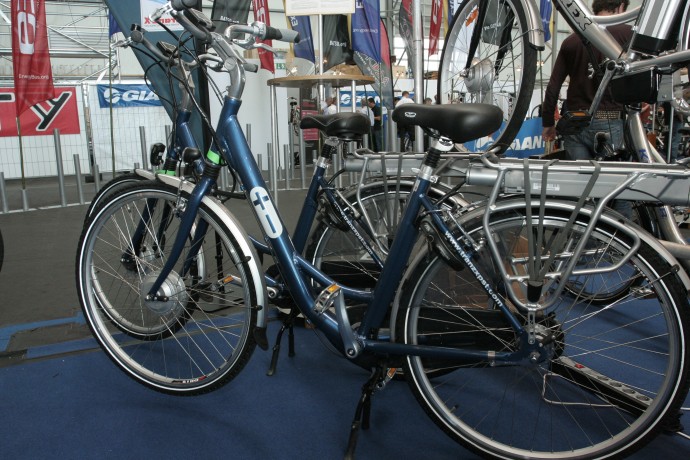
Obviously this is a high-end machine with a price tag to match – the scarcity of Lithium Ion batteries isn’t helping to make these bikes affordable at the moment – but there were plenty of other good-looking bikes on show for a lot less; I also had a spin on a mid-range Trans-X Pedelec bike that was very likeable if not as impressive as the Diamant. Pedelec seems to be the system of choice right across the board now, and twist-shift systems appear to be losing favour.
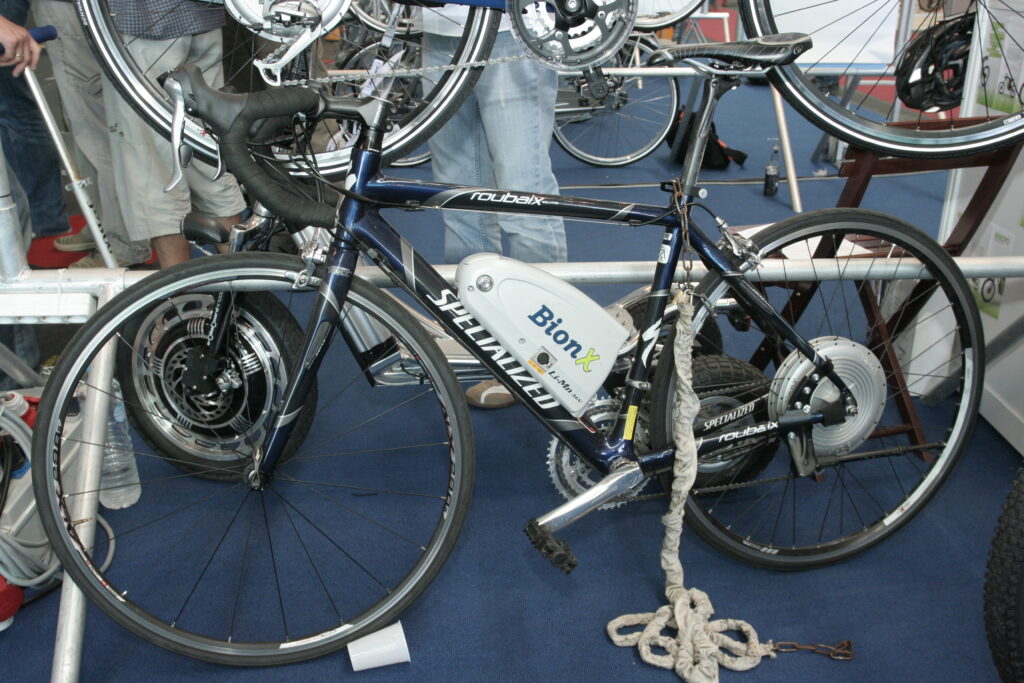
On the retrofitting front the Bionx system was all over the place as well, fitted to all sorts of bikes including the Specialized Roubaix at the top of the page that they wouldn’t let me have a go on. A modified version of Bionx is also the power behind the new electric Birdy – more on that later… And the bad news? Well, mainly that there’s too much faffing around with the actual bike design when all that’s really needed is a light and efficient way of adding power to what we already know are the most sensible bike shapes. We don’t need shaft drives, nor unusual frames; these things just add weight without giving any operational advantage. Similarly there’s a big obsession with front and rear suspension, which is even more unnecessary on a town bike on the continent than it is over here. Just fit some bigger tyres, and do us all a favour: the systems are generally rubbish, and it’s just more mass to push around.
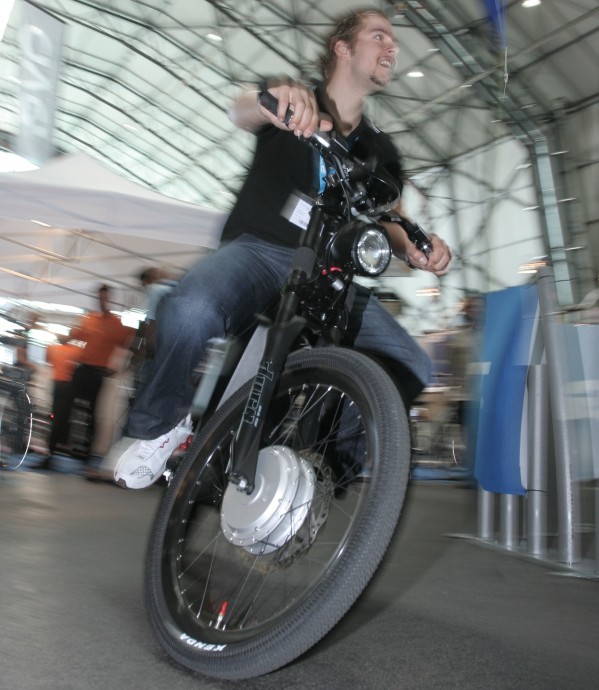
There was plenty of ‘urban utility vehicles’ knocking about too, basically motorbikes of one description or another with their petrol innards replaced by electric ones. I can’t help feeling that this is a hiding to nothing: it’s not as if the world can’t cope with a few 50cc mopeds pootling into town, and I’m yet to be convinced that firing up some manner of power station to supply the energy to charge the battery of said electric moped is better than a tiny petrol engine anyway. Having said, I’ve got a lot of time for the e-Bikeboard scooter, simply because it’s such tremendous fun. Sadly, I think it’s too powerful to be legal in the UK…
- News

Electric Bikes – the future?

Add as a preferred source on Google
Help us to bring you the best cycling content
If you’ve enjoyed this article, then please consider subscribing to road.cc from as little as £1.99. Our mission is to bring you all the news that’s relevant to you as a cyclist, independent reviews, impartial buying advice and more. Your subscription will help us to do more.
No Comments
Read more...
Read more...
Read more...
Latest Comments
Not talking about just bikes shops, but any business that cannot afford to pay its staff a living wage, is not a viable business. Big companies whose staff have to claim benefits despite working full time are exploitative. And yet it's 'benefit scroungers' that get attacked and demonised by the press, not the extremely wealthy, tax dodging companies not paying their staff properly. Oh, like large say newspapers businesses.. Smaller businesses like your LBS, are like poor Vs rich folk, their existence costs them more than big businesses it does due to economies of scale etc, just like rich folk can afford to buy better quality suff that lasts longer or stockpile food when it's on offer whilst poor people have to scrape by.
The problems mentioned in this article are far more wide-ranging than simply affecting the viability of hiring Saturday lads/lasses. Fixing bikes or selling bikes now requires so much more skill and knowledge than it did 10-20 years ago, but the pay is still rubbish, partly because public perception is that the job is easy and is just a hobby. Therefore people with the ability to be good at the job are not encouraged to stick around and they look elsewhere for a career that can earn a decent wage. I don't enjoy the fact that half the bikes that I work on have almost-unique parts that requires odd techniques, tools, or parts to repair and I first have to research what I need for many of them (despite having 20 years of experience). I'm now getting so much work that I could consider hiring someone else, but it would be impossible to find a skilled person who would work for the wage I can offer and it would take far too much of my time to train someone to a level where they can do more than the simplest 10% of the jobs that come in (whereas 10-20 years ago, after a small amount of training they probably could have done 30+% of the jobs). The complexity and uniqueness of modern bikes is apparently necessary to sell them, but soon there are going to be no mechanics left who will work for the wages that people are prepared to pay. At some point, people are going to have to admit that bike mechanics and salespeople are highly skilled and knowledgeable and should be reimbursed accordingly. Or, everyone can just order bikes online and watch YouTube repair videos and end up with a bike that barely works and isn't safe; but that's fine because they're just simple kids' toys, right?
I think the author is trying too hard to "both sides" this one. The basic error is Gove's - he was wandering across a pedestrian crossing on red for him with his head in a cup of coffee, and started well after it was on red. The Highway Code says "should not cross" in these circumstances. He then tried to excuse this by red herrings. Conservatives, including Gove, are supposed to have taking personal responsibility for their actions as a core value. Perhaps having the crooked coward Boris Johnson and Fruit Loop Liz as elected leaders demonstrates that this is merely historical. Gove is permitting a culture war being fought in the pages of his magazine; that is a war where Conservatives are demonising cycling because they hope it will save the rump Conservative Party. One example was their sudden reversal of support for the Welsh 20mph default limit. Should noodles have reacted less sharply - perhaps. A chat with Michael Gove to stop him wandering around the streets like a lobotomised koala may have been beneficial.
@mdavidford Funny, as soon as I saw your comment on the ticker on another article I knew to whom you must be replying.
@mctrials23 People have been suffering for years because they have been unlucky enough to have been hired by bad people, or had the bad luck to become ill. This is just bringing the system more into balance. I don't have a problem with encouraging people to start businesses but I don't agree with doing it by letting them exploit the poor and the desperate, if they need encouragement then offer state benefits for small businesses and use the claims process to make sure that they are doing everything they should to run the business properly including paying and training their employees. If they just want to get rich quick by exploiting others then they should be in the USA.
One may wonder why you've brought up DEI when it has nothing at all to do with anything in what Lappartient said. Or why you care about the state of the women's sport if you're so down on diversity, equity and inclusion. 🤷♂️
Not quite the first time, I rode over it back in the late twentyteens, just happened to see it was jammed nose-to-tail so thought it would be fun to filter along...turned out there was an overturned lorry at the eastern end blocking all carriageways. I honestly didn't know cycling was banned (the signs aren't very prominent), just assumed nobody rode on it because it would be suicidal in normal circumstances. Fortunately the weary copper at the other end who saw me just cut off my apologies and said, "Fuck off over there [a gap in the barrier to a slip road] and don't do it again."
They're not slalom barriers, they're Sheffield stands for parking your bike.
@momove I would think that spending time training someone up, putting the time and effort into that only to have most people move on relatively quickly isn't a great business model. I know there is the argument that "if your business has to take advantage of people to run then its not a viable business" but thats the reality of some of these shops. Up to a point, thats exactly what apprenticeships have always been. A business get cheap labour that might help them a bit and the apprentice learns something.
One may wonder why bureaucrat Lappartient wants to reinvent the wheel with a massive injection of DEI and drastic reduction of money. Let the best cyclists win, period. Meanwhile, women's pro peloton needs means and support to attract new sponsors, increase TV coverage, improve salaries and prize money.