



If you buy a counterfeit bike on an internet site like Alibaba, you not only run the risk of injury or even death, you could also be supporting organised crime like drug trafficking and prostitution, says the World Federation of the Sporting Goods Industry (WFSGI). The problem of counterfeits in the bike industry has become so great that fakes might even be finding their way into local bike shops.
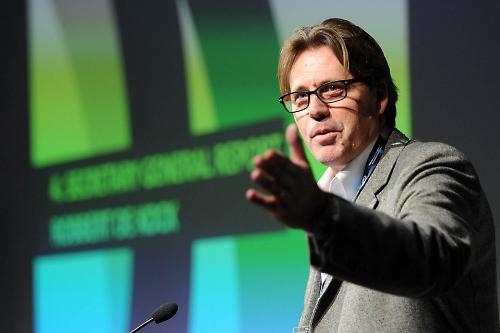
According to Robbert de Kock (above), Secretary General of the WFSGI, “It is since many years the WFSGI’s aim to tackle counterfeits, as it represents both a severe threat to the health and safety of the consumer and a huge loss for the image, the goodwill and the business related to the trademarks and products of our members.”
The counterfeits being spoken about are bikes and other cycling products that are passed off as the creations of big brands like Shimano, FSA, Specialized, Zipp, and so on.
In a presentation by the WFSGI to members of the bike industry at Taipei Cycle last week, Michele Provera (below), Vice President of Internet Brand Protection at Convey, a company that specialises in internet brand protection, said, “We’re not dealing with sweatshop factories, we’re dealing with very sophisticated organisations who launder money they gain from drug dealing, from prostitution, from slavery.

“They invest this money into selling counterfeit products because it gives them huge profit margins. They have no R&D costs, they save everything that was invested by the legitimate brand.
The WFSGI has teamed up with Convey to combat internet-related counterfeits. The objectives of the project include (in the WFSGI's own words):
• To discover and analyse the existing online threats for… brands covering domain name abuses, illegal offerings and counterfeit product sales on third-party operated online platforms.
• To remove counterfeit offerings from the major e-commerce platforms and online marketplaces and to permanently banish the respective operators and sellers.
• To shut down rogue websites and regain control of abusive domain names used and registered by third-party operators.
The WFSGI and Convey believe that the internet provides counterfeiters with the ideal platform to exploit bike brands because they can sell fake goods on e-commerce platforms and create counterfeit online shops with domain names that lead consumers to believe they are legitimate sellers. They can also highjack websites, divert traffic, and post videos, ads and links to counterfeit shops on major social media networks like Facebook, Twitter, YouTube and Pinterest.
Convey says that the problem could be about to get worse with new gTLDs – generic top level domains – giving counterfeiters the opportunity to confuse consumers with legitimate-sounding web addresses like www.shimano.sport, www.giant.store, www.cervelo.bike, and so on. Trademark holders – the brands – get preferential treatment in securing these gTLDs. They can also recover a domain name that is identical or confusingly similar to their trademark or has been registered by somebody with no legitimate interest, but that does take time and money.
Convey says that fakes on Western marketplaces like ebay and Amazon are just the tip of the iceberg. Chinese e-commerce platforms are the main source of counterfeits: sites like Alibaba and AliExpress. That said, we shouldn’t be complacent if we buy from more mainstream sources.
“We are seeing that more and more buyers are not just purchasing one piece for their own bike, they are purchasing hundreds of pieces of the same product,” said Michele Provera.
“This means that they resell them in Western marketplaces or, worse, they can maybe have a local bike shop and – who knows? – start to mix the counterfeits with real ones. If someone buys one of these products and the next day the frame breaks, what could the consequences be? If you’re lucky, the guy will [just] complain on all the forums, and social media… but there could also be liability problems.”
The project is in its early stages but the WFSGI and Convey say that they have attacked hundreds of counterfeiters, removed 21,000 fake products from sale, and blocked 5,000 annual transactions with an estimated value in excess of €1 million.










80 thoughts on “Buy a fake, risk death, support slavery – says bike industry”
This would explain why my
This would explain why my bike is really hard to pedal uphill – it’s a counterfeit.
They certainly can’t fool
They certainly can’t fool you! 8>
We’re back to this again
We’re back to this again aren’t we:
Hey, isn’t the guy in the
That’s it I knew it reminded me of someone.
Counterfeit products massive
Counterfeit products massive problem, says man who gets paid to tackle counterfeit products.
No-one condones counterfeit
No-one condones counterfeit products, but if the “industry” wasn’t so hell bent on making what we’ve just bought obsolete, as quickly as possible, so they can flog us yet more stuff, then maybe the whole counterfeit problem would be reduced substantially. The “industry” must play their part.
Neil753 wrote:No-one condones
What is that phrase that includes, nail head on and hitting?
Neil753 wrote:No-one condones
I went out on a ride Sunday with my friend Nick, whose Dave Lloyd still sports the original Dura Ace STI levers, from what, 1991? They’re 8-speed, and they’re a bit clunky, but hey, they work pretty well.
Thanks to “the industry” being “hell bent on making what we’ve just bought obsolete”, i can now go into a shop and buy a pair of Claris STI shifters, 8-speed, for £79. I dread to think what the original Dura Ace ones cost. For what they did cost, I can probably have electronic shifting now.
the logical extension of your argument is that we should simply stop making new things, so we’re all still riding around on 1991 Dura Ace STIs or whatever other arbitrary point you decide things are fine as they are. I don’t want that, I like new things. Engineers tinker with stuff to make it better. And it does get better, and that’s good. If you don’t want to pay for new stuff because you think the old stuff works fine, then don’t. Nick hasn’t. But if you don’t think an FSA seatpost is worth what they’re asking for whatever reason, just go and buy a different, cheaper seatpost, not some piece of crap knock-off
Dave Atkinson wrote:Neil753
Dave, that’s not the point I’m making. There’s nothing wrong with technological progress, but we’re witnessing carefully orchestrated obsolescence, on a massive scale, through endless changes in what are laughingly called “standards”, reduced component “mileage”, rapid withdrawal of spares availability and irresponsible advertising that markets the bicycle almost as a “disposable” item.
No-one condones counterfeiting, especially when it compromises safety but, as high end components become ever more expensive (and apparently disposable), things are likely to become worse.
Neil753 wrote:Dave, that’s
that’s just the same thing, viewed from different sides. progress will always create obsolescence. the idea that it’s a massive conspiracy makes me chuckle, having met many of the people that are supposed to be orchestrating it 😉
all you’re really saying is, “I don’t agree with the pace of change”, and the logical extension of that argument is the same as it was before.
not really. you will always be, and have always been, able to counterfeit goods cheaper than you can R&D them; what’s changed isn’t the bike industry, but the ease of getting fake goods to the consumer. that’s why there are so many at the moment. selling them direct overseas simply wasn’t possible 10 years ago and regulation hasn’t kept up.
Dave Atkinson wrote:
all
That’s not what I’m saying at all.
To be clear, it’s not the pace of change that’s the problem here, it’s the haste in which support for existing componentry is withdrawn.
Industries that withdraw support for products that would otherwise be expected to last a long time, especially in an era where consumers are not just increasingly adept at circumventing traditional supply chains, but are also concerned about the environmental and ethical issues connected with unnecessary material consumption, are unlikely to win much sympathy over the longer term.
PS – Trek Lady seems to have had to fight her corner on this thread so, to cheer her up, I’ll just say that my American made Trek frame is still going strong, and the DuPont paint still hasn’t got a mark on it. Amazing quality!
It’s more Machiavellian than
It’s more Machiavellian than that. Pinarello, for example, buys all their unfinished frames from China at around 200 bucks a pop, perhaps less with bulk buys. They’re brought into Italy where they are painted and finished (admittedly it’s nice paint), after which they charge over 2,000 bucks for the finished article.
Because less than 10% of the total value of the end product is made outside of Italy, Pinarello can legally say that each from is made in Italy.
Now, while I’ve mentioned Pinarello, the truth is that all these brands are at it. Colnago*, De Rosa, Cipollini, Willier, Cervelo, Specialized*, Trek*… Even Zipp has the parts to their rims made in China (perhaps Taiwan) then the components are bonded in the USA. And they charge 1,000 bucks for doing this (admittedly Zipps are very nice rims).
While I don’t condone piracy, so wouldn’t ride a Chinarello, I have no problem going to the same factories the “manufacturers” do and buying the same product for a fraction of the mark-up they do. And they are the same as the real brand; a local pinarello dealer said they have seen fake Dogmas that handle exactly the same as the genuine article. They say you couldn’t tell the difference.
Perhaps Road could write an investigative article about how much money the European and American manufacturers make by marking up Asian products and pretending it’s home grown. Oh wait, then you wouldn’t get invited to those provate launch parties in exotic locations, would you?
* These guys do make some frames outside of Europe.
Gordy748 wrote:Now, while
As I recall, it stated quite clearly on the box of my Cervélo that the product was made in China. I have no problem with that.
Gordy748 wrote:
Now, while
Sorry, but we don’t bulk buy frames. Yes, we make frames in Asia, but in factories that have Trek employees based there, using Trek manufacturing technology and engineering plans, monitoring the processes used, and testing in local test facilities. We do not buy off the peg frames.
It’s exactly the manufacturing and R&D that makes the bikes more in the first place. The bike industry has to compete with the defense industry for a limited supply of raw material (carbon). It’s therefore very expensive to acquire it in the first place. Also, consider that we have 18 carbon engineers developing new ways of using carbon to make bike frames. And each time we introduce a new carbon product, we have to make the tooling to mold the tubes. These molds cost anywhere between $15k-50k for EACH mold. Different sized bikes require different molds. For a bike like the latest Madone, we had 300 prototype versions of that frame, all of which were molded in Wisconsin before going into production there. Then, we had to share that production technology with the factory we use in Asia (at great risk to intellectual property), and continue to pay local Trek employees in order to ensure product quality for lower price point versions of that Madone. It takes years to develop new products, and it’s very expensive.
This is incredibly concerning. Can I ask, where did you pick up on the idea that components are more valuable than the frame, just out of curiosity?
The frame is the foundation of the bike. It’s what bears your weight. It’s what provides the overall ride quality you experience. It’s the thing that potentially, you never have to buy again.
Components are the moving parts of the bike. Individually, they are cheap and easy to replace. In all likelihood, you’ll have to replace several of those over the years. Chains wear. When you replace chains, you need to replace cassettes and chainrings at the same time. Derailleurs get bent when bikes fall over. Levers get damaged in crashes. These parts have a much shorter lifespan than the frame itself.
Investing in the moving parts is like buying a house based on the quality of the interior design, but ignoring the fact that the foundation is cracking, and the house sits on a sinkhole.
Bikes can be expensive. No one is denying that. But manufacturers, even big brands like Trek, don’t make huge amounts of profit on bikes. It’s profit that keeps any company in business, and allows technology to advance, so we have to make some of it, at the end of the day.
I have a question. When
I have a question. When people were buying Trek bikes when Armstrong was riding them, were those customers unwittingly supporting drug taking, drug smuggling and fraud in pro cycling because some of that money was being directed to Armstrong’s team in the form of sponsorship and endorsements? And if so, how do you distinguish between drug smuggling, organised crime and prostitution? Seems to me there line between buying a legit brand bike or fake brand bike isn’t so clear cut from a moral standpoint.
That’s an entirely apples to
That’s an entirely apples to oranges comparison, and suggests a level of complicity in Armstrong’s actions that didn’t exist.
Organised crime is more than likely what’s sitting behind the production of counterfeit frames. Designs are being stolen (bought from factory employees willing to share them for a price), and there are more kickback layers than pastry layers in filo dough. It’s copycat product that was made using stolen designs, plain and simple.
Organised crime is not sitting behind the production of Trek frames.
People who buy counterfeit products are not intentionally supporting organised crime. Of course not. The purpose of this piece is to try and educate people about where the money goes when they DO buy what they think is just a super cheap version of what they assume is an overpriced bike.
TrekBikesUK wrote:People who
Seriously, when it comes to the quality aspect and the moral aspect of ripping off someone elses work I agree with you entirely.
But as it states in the first paragraph of this article that someone who buys a bike from Alibaba could be supporting drug trafficking. And my question is how is that different from buying a legitimate brand that sponsors someone who is or was involved in drug trafficking? In my mind, and you may disagree, there doesn’t seem to be much difference there.
Like I said, I don’t support or condone fakes. My beef is really with the spin they’re putting on this whole issue. It’s an industry body talking to the end customers like they’re a bunch of idiots who can be easily manipulated.
LinusLarrabee wrote: But as
That’s like saying if you buy a John Terry jersey, you are saying adultery is ok, and that Adidas made that adultery possible. Or if you buy a Kobe Bryant jersey, that you support rape, and Nike and the Lakers made that possible.
The difference is the source. If a bike manufacture was also manufacturing drugs, then your argument would possibly stand. In this case, you are saying that the purchase of a product somehow condones the actions of a person who just happens to be sponsored by that brand. That would make sense if we continued to sponsor Lance after the Reasoned Decision. We didn’t.
Since when is an equipment sponsor directly responsible for the choices that a sponsored athlete makes off the field?
TrekBikesUK wrote:That would
To be honest I wouldn’t be too keen, as Trek, to wave this particular flag. The way Trek got involved in Lance’s attack on LeMond to take some measure of revenge for his (totally accurate) finger pointing is one of the deeply depressing parts of the whole debacle. Along with Oakley staff lying under oath, it shows the depths which a brand will go to in order to support their cash cow.
For what it’s worth I don’t think drug dealing and sponsoring Lance are the same thing (it’s a mental comparison).
TrekBikesUK
I think the nuance in my reasoning is being lost somewhere here. I’m not saying Trek or any other brand condones drug use or is responsible for the actions of the people it sponsors. In a nutshell, the way I see it, you have an industry organisation making some pretty bold accusations about the illegal activities ordinary consumers “could” be supporting if they buy a fake bike. Yet, the very companies this organisation represents have built their brands on the back of, and have financially supported, teams and athletes that have engaged in illegal activities. Something is a little wrong there, is it not? Pot, kettle and black? Added to that, we know for sure that some teams and athletes took part in illegal activities, yet all we have is a bold and unsubstantiated claims from a less than impartial industry body that those dodgy Alibaba sellers are involved in drugs and prostitution. There’s a reasoned report and countless rider confessions to prove what the industry was supporting (even if they claim not to have known), where’s your evidence that these Alibaba sellers are directly involved in drugs and prostitution? I would also ask where your evidence is that these fake frames are dangerous, but I might be accused of supporting them, which I don’t. Besides, everybody knows that official frames have never suffered a random catastrophic failure during a professional race 😉
Since when is an equipment
Since when is an equipment sponsor directly responsible for the choices that a sponsored athlete makes off the field?[/quote]
Here Trek UK gets it wrong. Trek has a crushing responsibility for the doping scandals that infested the sport. Doping was/is a total system that involves the athlete on and off the field in one seamless continuum (I will spare the details). The signs of doping on a massive scale were blatantly obvious to anyone remotely interested in the sport. Riders who refused to play by the rules were ruthlessly expelled from the Congregation. The UCI and the Sponsors, with Trek leading the Choir, officiated at the same Altar of Darkness.
Trek gambled and lost, its reputation in tatters. The only way it might one day be forgiven is by very ACTIVELY, OPENLY and RELENTLESSLY combat drug abuse in sport and make the UCI accountable for its choices. Until this day, Trek does none of that. Shame on Trek.
As a consumer, I have no choice but embargo Trek products and explain my motives to friends who ask for my opinion. After all, I live in the marketplace.
Trek wrote:Trek
I didn’t say that the components were more important than the frame! What I said was that I got an EQUIVALENT frame which allowed me to spend more of my budget on components.
Or do you think that anyone that doesn’t buy a Trek is a dribbling imbecile who should be wearing a canvas blazer with wrap around arms? Trek’s idea of selling you a bike is to sell you a decent frame and then skimp on the components to keep the price down. [You’re not the only ones.]
As I was building the bike from scratch I was able to avoid having to compromise. I could have a good frame and good components. If I had bought a Trek frame I would have had to compromise.
levermonkey wrote:Trek
I didn’t say that the components were more important than the frame! What I said was that I got an EQUIVALENT frame which allowed me to spend more of my budget on components.
Or do you think that anyone that doesn’t buy a Trek is a dribbling imbecile who should be wearing a canvas blazer with wrap around arms? Trek’s idea of selling you a bike is to sell you a decent frame and then skimp on the components to keep the price down. [You’re not the only ones.]
As I was building the bike from scratch I was able to avoid having to compromise. I could have a good frame and good components. If I had bought a Trek frame I would have had to compromise.— levermonkey
Sorry, I was confused by your use of ‘…I was able to spend my budget where it really mattered,’ followed by a list of components. So that makes it sound like there’s more value in the components vs. the frame. A lot of people express this sentiment.
And I don’t believe that I suggested anywhere in my reply that people should only buy Trek, and that anyone who doesn’t is an ‘imbecile’. It’s pretty unfair to suggest that based on me asking you a question that wasn’t incendiary, or insulting.
You are absolutely right that we are more interested in selling high quality frames, even if it means we down spec the components. We do this because we spend a huge wad of cash, and devote an enormous amount of time guaranteeing the quality we build into the frames. And to us, that is way more important than parts that need to be replaced over time. Making cheap frames so that we can sell Di2 bikes for 2 grand, when the gruppo itself costs that much at retail is the compromise, not the other way around.
TrekBikesUK wrote:
It’s
Sorry. It is not. There are more and more carbon fiber manufacturers coming online throughout the world. The supply of commodity small tow carbon fiber, commonly referred to as T700 and T800 whether they are made by Toray or not, is ample. This is what is used for the vast majority of all carbon fiber frames, branded or not.
In addition, aerospace also uses large tow carbon fiber which are not used by sporting goods manufacturers.
Lastly, if you are talking about the “space” part of the aerospace, yes those fibers (pitch based carbon fibers) are hugely expensive, but even then their supply is not limited as the quantities needed by sporting goods manufacturers is tiny.
No. The front triangle of the Madone for example would have cost you $7k max. The rear triangle parts are shared (chain stays for example) so the total cost per size is approx $10k.
Your very nice Speed Concept frame indeed costs a lot for tooling, but that frame is very highly differentiated and its value is not in doubt for anyone that knows something about bikes and aerodynamics. There are no generic frames that come close to it in terms of performance.
Again sorry, the factory knows very well how to make your frames. They are the manufacturing experts. All that you can do is communicate the design intent and give suggestions. The factory’s engineers are the ones that figure out how to make your frames since after all you are using their equipment and staff so whatever design you make has to be able to be executed using their technology. Giant and their contractors will not go for massive retooling and staff training just to accommodate your models.
Besides, it is disingenuous to imply that your second tier frames are given so much attention by Trek.
The main problem with counterfeits is that they impinge/steal the brand equity from the brand owner. It is not about technology or necessarily safety.
This is why it is wrong and why nobody should ever buy fakes. It is theft, plain and simple.
However the problem with the generic frames displacing the original design frames is the fault of the industry. There is too much nonsense in marketing.
For example, again Madone. You claim and proudly write “Kamm Tail” on the Madone and thus imply aerodynamic performance by borrowing the halo and the “Kamm Tail” application by your Speed Concept frame. The problem is that the Madone “Kamm Tail” is not a Kamm tail and it is not aerodynamic and that you have no data whatsoever to support your aerodynamics claim, implied or direct. You are using it as a marketing device to steer the consumer choice. You are using… unthruth, to generate profit. While this is not as bad as making and selling fakes, it is far from fair or ethical. This is what is driving the generic frame problem. Your customers are feeling confused and misled and are refusing to believe the brand’s claims so they (wrongly) start believing that “all frames are the same”.
Also I am not singling you out, all brands are guilty of this. Unsubstantiated claims, innuendo, outright lies (for example country of origin, claims of R&D for a rebranded generic frame, etc.), incorrect features are used by all brands to sell their products.
Bicycle media is also complicit (road.cc too) by often just paraphrasing a brand’s press release without checking anything. Any claim of stiffness, aerodynamics, comfort, you name it, gets repeated ad-nauseum by all the bike press (mainly English speaking) without a single meaningful independent verification of any of it, except perhaps weight as all you need is a scale.
Neither the bike manufacturers, not the vast majority of bike media are objective. Thus expecting the customers to be any different is naive.
Lastly, bike industry is a consumer goods industry. It is largely unregulated (besides CEN/ASTM/etc. for basic safety). There are no ethical codes of conduct when it comes to advertising, there is no government nor industry based regulation about who says what, nor are there any consequences for lying to the consumer. Thus the brands and press do and say whatever they want, so we consumers do what we are doing.
Blaming us for the industry’s problems is galling.
TrekBikesUK wrote: It’s
This is the thing I don’t understand, why does Trek, an American firm who invests so much in R&D, risk its intellectual property by shipping production off to China or Taiwan? I know employing Chinese/Taiwanese labour is cheaper but is it really worth the risk? If intellectual theft is such a problem why not start manufacturing frames back in the USA? I’m sure having “made in the USA” stamped on your bikes again would make them more attractive to American buyers and perhaps better justify the high prices you ask of them.
Also there is an issue with you training a Chinese/Taiwanese workforce in your advanced production techniques and then that knowledge being turned against you by a homegrown concern like the Japanese motor industry did to the UK and American motor industries after WW2. I know the Austin Motor Company offered a lot of help, training and advice to what would become Honda (I seem to recall) in the 1950s, now Austin no longer exists and Honda is a market leader.
Neil753 wrote:No-one condones
That’s exactly why I have no interest in disc brakes or disc ready frames… I will only look at them 3rd 4th gen down the line when the frame is a disc frame and the brakes that are now top dollar become standard on the bikes. I jumped on the disc brake craze when I raced MTB dot years ago and I have had an horrendous injury from a rotor on single track when two of us crashed his rear rotor straight through my calve, good luck with that in the first week of the TdF in a cpl years.
Fakes are supporting organised crime and it’s not a joke, kids chained to radiators putting the stickers on your fakes… So go on, press pay!! Just the same when your mrs buys that fake handbag on holiday..is it worth a few quid in the short term, just save a of couple months longer.
I know a lot of cyclists. I’m
I know a lot of cyclists. I’m sure we all do, collectively.
Quick show if hands, has anyone ever seen one of these fake bikes in real life? Can’t say I have, personally.
Nick T wrote:I know a lot of
I haven’t but I know a man that bought a Dogma 65.1 Think 2 Frameset for around $600. Now I’m just guessing but would have to conclude the frame was either stolen or fake. I personally wouldn’t want to risk my safety on the unknown quality of the carbon in such a frame.
Not the quite the same level
Not the quite the same level of concern as for the fake Boeing and Airbus parts…
I think if these guys had
I think if these guys had their way it wouldn’t only be counterfeits that were illegal, but also cheap, unbranded carbon frames & components made by essentially the same companies that churn out gear for the big names
Hyperbole, spin and protectionism all!
I wonder if they took a
I wonder if they took a stroll round the Taipei show floor and questioned the provenance and copyright-skimming status of the various looky-very-likey products road.cc highlighted on the article posted yesterday.
Anyone for a Trak Medone or a Specialazed Illez?
I think (I’m pretty sure) I
I think (I’m pretty sure) I read that many pros buy cheap, unbranded, Chinese carbon frames to build virtually disposable winter/trainer bikes. I’m guessing the general consensus is that they are at least safe enough for the rigour they’re likely to go through. if they add brand decals to these frames, they obviously become counterfeit, but it doesn’t mean they’re any less safe.
dafyddp wrote:I think (I’m
Really? I doubt that is happening at all. What with them getting given bikes by their teams.
It also does mean it’s ‘less safe’ http://cyclingtips.com.au/2011/08/are-all-carbon-bikes-created-equal/ read this as a starting pont.
dafyddp wrote:I think (I’m
Why would they do that when they’ve access to an endless supply of free bikes? Fernando Alonso doesn’t have to mess about with a P reg GTI in the winter, does he?
I heard that the only way to
I heard that the only way to prove you have a real frame is to saw the downtube in half and retrieve a small piece of paper which either says “congratulations on having purchased a genuine product!” or “you are an idiot” – basically much like a really expensive fortune cookie.
I went to a prs (music
I went to a prs (music royalties collection agency) talk where they blithely mentioned music piracy being linked to paedophilia and terrorism. They got booed to a stop and quite right too.
The radio supposedly used in the Lockerbie bomb came from a market trader stall that had counterfeit handbags. That quickly turned into “Don’t Buy Fake Gucci Or You Help Terrorism”. It’s quite shameful. Or shameless. Both, I suppose.
It’s really scary that
It’s really scary that innocent bikers are being lured by organised criminals
with all their prostitutes and narcotics.
Popped in to Halfords before
Popped in to Halfords before they closed. Couldn’t see any prostitutes.
I think the higher end bike
I think the higher end bike products are massively over priced when you consider the manufactring and R & D cost. Just my opinion no evidence. But with cycling being “trendy” some rider want to show there wealth by buying very expensive gear that they will never get near to using to its potential. Bit like the shit golfer with the £1000 clubs who will never use the clubs potential.
Thing is manufacturers are taking full advantage of this (true capitalism) and they are charging as much as people will pay.
I really like Casstelli it’s good quality and looks nice too but £130 for what are nylon tights come on? But I pay it because I’m a knob like all the other sheep. As for Rapha pricing well…..
But as true up and coming capitalist some companies apparently in the Far East (who I suspect make the legitimate gear too), have seen a gap in the market.
Some of it is very poor quality but some appears very good. I am aware of a rider I met on a sportive last year who had a Dogma which he bought as a frame set for £300 a chinerelo he called it if memory is right, it was identicle in every way to a friends genuine dogma. Ok I couldn’t X-ray it to check integrity of the carbon ect but felt the right weight and he had ridden a few thousand miles.
Now in not saying copy right infringement is ok but then neither is profiteering and I can see why a person who could only dream of spending what they may see is a fortune on a bike would want to look as good as the bloke who can spend £5000plus on a bike. But that is our society isn’t it?
Now I suppose you might say get a better job and buy a better bike AKA Clarkson argument for cars. Or the bike companies could stop taking the piss with the pricing.
As for organised crime, it could be argued that by over pricing the posh bike manufacturers are creating a market for counterfeits. IMO I cant see Colombian drug Barrons investing in fake bikes. The only crime I can see is if the buyer is not told its a fake. Is it criminal to charge £4000 for so thing that cost £300 to manufacture.
I’m very happy with my Ribble not posh but rides great.
Beefy wrote: I pay it because
well, you said it. 😉
Straight away I can tell you
Straight away I can tell you that pros do not have an endless supply of free bikes. The bikes are very reluctantly handed out and are closely monitored… nothing goes to waste, and no one gets freebies… OK, not many get freebies.
In the same way as Alonso doesn’t have a Ferrari F1 car in his garage I guess.
However, I doubt there are many buying cheap knock-offs, when they’ll be issued with a genuine training bike that they are contracted to ride.
I find the whole industry a bit weird when it comes to carbon frame manufacture. The reality is, for all the mystique surrounding carbon frames, they are not so magical as we are made to believe. Its simply clever plastic. Therefore its not hard or expensive to make a good frame. We are all being taken for mugs and the only way to make it stop is to stop buying these super expensive framesets. What is not the right way forward is to buy a knock-off.
Jimmy Ray Will wrote:Straight
Ok, so if Richie Porte crashes his Dogma on a Mallorcan hillside in December, the team won’t give him another to train on? Get your head out of the clouds guy, he needs to train like everyone else, on the same bike he’ll be racing on or his seasons a write off.
Counterfeiting will exist
Counterfeiting will exist for as long as people are prepared to pay extra for a name [ NO THIS IS NOT A DIG AT RAPHA BUYERS!].
A few years ago when I built my ‘Weekend special’ I decided that I wanted a carbon frame. After much searching I settled on a b’Twin composit 700 frame. Why?
1. It’s geometry was perfect.
2. As it was a fraction of the price of an equivalent from Trek, Cannondale, Scott, etc I was able to spend my budget where it really mattered (Seat, wheels, brakes, drive-chain, bearings).
3. Any thief is going to walk straight past my ‘budget bike’ and steal yours. 👿
Yes I know it’s not as pretty as yours, but pretty is not going to get you up that hill any quicker.
Where counterfeiting is a real problem is where safety is compromised. If something looks too good to be true then it tends to be too good to be true. If you think something is counterfeit then don’t buy it. Simple.
I’ve seen some very high-end,
I’ve seen some very high-end, or top-end, branded bike parts + frames made officially in the same building as what I’d call a fake or pass-off big-brand part. Wasn’t logo-d up as the big brands but could have been elsewhere. Wasn’t a sweatshop and I’d be suprised if there was any more dodgy dealings linked to that place than any other large business. I didn’t see any mafioso/cartel types playing cards with rolled up Yuans on the table. The ‘pass-off’ parts didn’t do my impression of the factory a lot of good but there’s no denying the quality of the kit they can make there.
cyclingDMlondon wrote:Why not
Same could be said about buying anything second hand.
We used to have a similar problem with computer power supplies, they’d be labelled as 800W units but would burn out, shut down after a couple or three hours of load testing with a 5-600W load. Our testing solved this problem, reduced our return rate and cut the ‘mislabelled’ units out of our supply chain. It’s a bit like how Toys’R’us have to label their cheap kids and mountain bikes as ‘not for competitive use’, because their frames would break if used in anger. No problem with cheap carbon but sell through supermarkets etc… and label it as ‘not for competitive use’ or ‘do not exceed 15mph on this frame”. Moral of this anecdote for the LBS: test your product before you sell it on to the end user.
It suits the brands to try
It suits the brands to try and discredit genuine, generic product from the fakes – they’ll be telling us next that unless our bikes are serviced but ‘official’ dealers, then warranties are no longer valid – not that they’re barely worth the paper they’re written on.
I’ve worked in the trade and I’m tired of the BS – I order my own custom frames from China because they’re a quarter to a third of the price the similar product that’s made by the same people in the same factory. There’s nothing ‘fakery’ about it, I’m just cutting out 2 sets of box-shifters who double the price every time. This is the same heavy-handedness of expensive lawyers protecting their clients IPR for selling “Roubaix” bicycle wheels.
monty dog wrote:It suits the
You ain’t wrong, dog
I think people are looking
I think people are looking through rose tinted glasses, no one is talking about genuine generic stuff…. FFS. Ask yourself this would you put your child on a fake, or give them a copied toy with poor stitching just to save a couple of quid? You should answer yes, as you seem happy with your products. Have you seen all the fake ugg boots, they always have clapsed heels, imagine if that’s your fork at 40mph downhill, night night.
I have worked against child slavery in fake sweatshops from electronics to soft toys, but like many people, what you don’t see doesn’t bother you.
And no I have never used ebay or any other auction site so no I have not purchased a cheap version of anything… I don’t even use amazon now I know how they treat their staff on the ground floor.
if the bike is made in the
if the bike is made in the same factory by the same factory worker in china to the same spec but not sold through the same supplier as mentioned above, by some one with years in the trade, what is the problem except that the big corporate company is not getting there cut. If you don’t buy product which aren’t fair trade then fair enough but I’m afraid the majority do buy goods from china and I only see that market expanding.
Personally I’m not too driven by brand but I would buy a “replica” high end frame with out the high price stickers. I guess that wouldn’t be fake?
As for comparing buying a bike which was someone’s pride and joy which has been stolen to stealing a corporate brand seems a little bizarre though I guess its about the value you give to individuals compared to corporate companies.
I think you will find genuine UGG boots collapse at the heal too because there expensive crap.
I don’t condone or support
I don’t condone or support the idea of ripping off any company or purchasing fake products, but the fact that these companies treat their customers like mugs with their inflated prices and this kind of BS scaremongering really diminishes any sympathy I might have for them. It also doesn’t help that the press fail to question the assertions made by these industry bodies because they don’t want to bite the hands that feed them.
… and I don’t for one second
… and I don’t for one second believe that the fabled “R&D” is quite what people think it is. I’ve long suspected that what we hear about “research and development” is little more than marketing spin.
LinusLarrabee wrote:I don’t
At the risk of sounding derisive (apologies), doesn’t that mean you DO condone the idea of purchasing fake products?
You are right that a lot of talk about R&D isn’t what people think it is. But, what most people think it is, is marketing hype. While this is true in a lot of cases, it’s also not hard to see fact versus fiction.
TrekBikesUK
To be clear: I would NOT ride a fake bike or recommend it to someone else.
Can you tell me the gross
Can you tell me the gross profit trek made internationally last year?
Can you tell me the gross
Can you tell me the gross profit trek made internationally last year?
“lance took drugs so buying a
“lance took drugs so buying a chinarello is fine” is a bit of a leap, no?
Dave Atkinson wrote:”lance
I agree. But I clearly said I don’t condone fakes or ripping off companies, so that wasn’t what I was claiming.
I look at all the eye candy
I look at all the eye candy and dream / drool over it. I wonder how much better it would make me go?
Then I get on my Ribble I bought throught the cycle to work scheme, true I’ve invested in better wheels (Kysrium Elite) and saddle (Fizik or however they spell it), and think WOW this bike really suits me, shifts well enough, and decends down the Lake District passes with supreme confidence. Do I need a £4000 super bike….. no not really. If I won the lottery would I buy one anyway….. definately.
Ribbles in the shop for a drive chain upgrade this year. It’ll be fantastic, if we get some good weather again.
banzicyclist2 wrote:I look at
[quote=banzicyclist2]I look at all the eye candy and dream / drool over it. I wonder how much better it would make me go?
Then I get on my Ribble I bought throught the cycle to work scheme, true I’ve invested in better wheels (Kysrium Elite) and saddle (Fizik or however they spell it), and think WOW this bike really suits me, shifts well enough, and decends down the Lake District passes with supreme confidence. Do I need a £4000 super bike….. no not really. If I won the lottery would I buy one anyway….. definately.
Have to agree, got a Ribble Sportive Bianco, upgraded the wheels and g/s to Ultegra. Fantastic bike but begs the question if a small company in preston can supply great carbon bikes at good price why can’t the big boys?
If I won lotto could get a colnago c59 disc. Would I ride any better? No but it is nice bit of bling! 8>
A lot of opinions in here
A lot of opinions in here would be very different if the poster had ever had a half decent idea to sell once upon a time and made some money out of it. How dare bike companies make a profit, indeed…
Nick T wrote:A lot of
B-)
Nothing wrong with a profit but profiteering will encourage other people to sell a comparable item for less. Capitalism works look at the USA health care system
Nick T wrote:A lot of
B-)
Nothing wrong with a profit but profiteering will encourage other people to sell a comparable item for less. Capitalism works look at the USA health care system
And can someone tell me what
And can someone tell me what a drive chain is? Heard this a few times today.
The front and rear cogs and
The front and rear cogs and chain.
I don’t care that my frame
I don’t care that my frame was built in a smoky hell hole of a sweat shop, with appalling conditions, zero health and safety, and for slave wages of pennies an hour.
Because in 1953, that’s the way all bikes were made in Glasgow!
Like the a Trek man says, potentially a frame lasts a lifetime, even the most confident rider must occasionally worry that their chervelo, chinarello or whatever might not be up to that big descent…….especially after that pothole….was that a creak or did I imagine that……
Flying Scot wrote:Like the a
Or Trek woman. 😉
TrekBikesUK wrote:Flying Scot
trek person then! B-)
All the comments posted lead
All the comments posted lead to the same conclusion: the marketplace works pretty well, everyone seems to be able to purchase a product that fits his/her needs/lust at his/her price point. In fact, the choice available in bikes, components and clothing is bewildering and so are the materials used. I personally ride a titanium bike: make bikes, not bombs!
Counterfeit destroys the marketplace: gone is the choice, gone is the development, GONE IS THE SAFETY, GONE IS THE VALUE FOR MONEY.
Counterfeit is a lose lose situation: consumers lose out, counterfeiters lose out (there is always a cheaper one).
The marketplace ensures continuing development, 99% to the advantage of the consumer. I still ride my 1980’s steel Giant bike, completely original, a magnificently comfortable ride, but I cannot get it up the mountains…
The marketplace funds athletes and the grand spectacle of sports inspires millions of people (I keep my distance because of the secret race).
The marketplace is flexible, adaptable, responds to changing perceptions, corrects excesses over time.
And above all the marketplace, through amazingly complex mechanisms, improves products by making them lighter, stronger and cheaper, in one word: safer.
The marketplace, complete with its forest of regulations and legal protection of brands and but also brand liabilities, is the place I want to be.
Counterfeit has no place in it, because counterfeit destroys it from within.
ah, I misread the title. I
ah, I misread the title. I thought he was asking us to buy a fake bike and support slavery. got it. my bad.
Well said mythbuster and
Well said mythbuster and LinusLarrabee, nothing worse than industry groups treating the public like morons.
On a more positive note look at the effect counterfeiting had on the price of DVDs.
Yea sorry as someone that
Yea sorry as someone that works in the bike trade, people that buy fakes and everything online aren’t helping the trade or my job.
Seems a bit harsh but if you knowingly buy a fake and it has a fault, you won’t get any sympathy from me, in fact you won’t get any of my time either.
We are in a society nowadays that what’s the best of everything and we don’t want to pay for it. If you want the £5000 dream bike but you only have £2000 don’t buy a fake just be more realistic and buy what you can afford from someone that loves bikes and who will look after you in the future
Buying fakes and buying
Buying fakes and buying legitimate gear online are very different things regardless of how they might affect your job security. The pros and cons of online shopping are a completely different argument.
How did this turn from an
How did this turn from an advisory article to an attack on a particular brand that once sponsored one of many hundreds (if not thousands) of cheaters…Oh that’s right we are on the internet ~X( . (as a side note, I have a particularly high level of hate for Armstrong for personal reasons)
I have to agree with the Trek Lady, and I suggest some of you need to listen to what she said on Velo Cast (I think it was velo cast) first before making further digs. Furthermore if we stopped buying products from companies that sponsored cheats the whole industry would collapse and we would be getting around on roller skates.
I have been a victim of counterfeit products, and I tell you its heart wrenching when your item arrives after months of saving and scraping only to find its a cheap knock off.
jason.timothy.jones wrote:How
Sorry, it wasn’t meant to be an attack on a particular brand. As I tried to stress, I was pointing out the hypocrisy of an industry body claiming consumers might be supporting organised crime if they don’t buy from an industry that has previously supported teams and athletes that have been involved in illegal activities. That’s the long and short of it. As I also stressed several times, I don’t support or condone counterfeit goods and would never buy them myself.
Same thing happened to
Same thing happened to Schwinn with Giant.
It’s worth reminding people
It’s worth reminding people occasionally that cheap knock off goods subscribe to the rule of ‘theres no such thing as a free lunch’ – someone ends up paying, be it the employees in crap conditions, the intellectual property owners, or the end consumers.
Ironically, we are conditioned to want want want by the very companies that are complaining about people buying the counterfeit versions of their goods.
It doesn’t make it right to buy those knock-off goods, but as a society we want everything now, and the big brands add their weight to that.
Carbon frame manufacture is
Carbon frame manufacture is not a cottage industry. Even under sweatshop conditions, it would be more expensive to make counterfeit frames than to buy mass produced frames at the factory gate. The vast majority of branded frames come out of a small number of factories in the Far East and are re-badged by the suppliers. The ‘counterfeiters’ simply rip-off the branding. If you buy an un-branded frame, or a lesser known brand, it will have come from the same factories but you are not paying for a name. Perhaps the answer is to buy your frame and components separately and build your own bike from scratch.
There are two sides to this
There are two sides to this whole question – one is about the actual technologies that may be found in fake frames and the economics of their manufacture – that’s the area in which I have some knowledge.
The other is the legal and quasi-legal question about how buying products branded to a company but which have no provenance from that company – these are also moral questions – and in these areas I can only comment that I abhor fakes as they are theft, for all of the reasons outlined in many of the posts above.
On the materials side of life, though …This an old, old debate when it comes to composites.
The plain fact of the matter is, until it fails, the only guy or guys who knows what was under the pretty composite skin and the paintwork, is the dude or dudes who put it there. It’s extremely difficult to determine the exact composition of these types of product post-manufacture. Of course, if the design and manufacturing are done correctly and useage is within the specified purpose & limits of the item, only a fraction of a percentage of the production are ever likely to fail … and then, it is yet more unlikely that the failure will be catastrophic, as correct design addresses this.
The bigger producers, making under contract to the Treks, Specializeds and Pinarellos of this world will have QC staff from within those companies looking over their shoulders with great attention to ensure that their design and manufacturing criteria are followed. The shop floor will actively feed back in these areas, too. These QC and compliance guys will also do their best to prevent knock-offs appearing from out-of-life or otherwise unsatisfactory moulds or through any other source / route.
These guys are not omniscient however, so we do see, from time to time, fakes of many very good products (and it’s not just frames), made with very questionable lay-up schedules, from material that may and may not have been correctly stored for indeterminate periods of time … and the processing in terms of exactly how the product has then been autoclaved, purged of excess resin etc may and may not have followed the original designer’s schedules.
With the advent of 3D printing, there are even ways, now, in which access to a mould can be drastically cut cost-wise BUT … the structural integrity of a composite product is a function of shape, material and lay-up … so failures in copies, as they may be deficient in one or more of these areas, are, relatively-speaking, common.
How do I know this? I’ve seen frames fail and sawn them up and looked at the jointing techniques – these were definitely NOT out of any credible factory, certainly not the one that they purported to come from. I have seen others where a simple volume and displacement test (never mind the evidence of my own eyes) showed to have very high percentages of glass fibre and I have seen catastrophic failure that could not happen were the lay-up schedules as prescribed by the frame’s original designer followed.
Yes, all manufacturers will test the envelope with retail price – but understand this – they are businesses and it is their job to make as much money for their shareholders as they can, whilst holding onto their intellectual property, reputation and customer base in the process.
Frame manufacture if it is done correctly, no matter what the material, is no licence to print money – the bigger brands know this and manage their profitability to give an acceptable overall ROI whilst creating, through sponsorship and other marketing channels, the aspiration to own their product. What the knock-offs do is to undermine this as well as potentially (and that is one thing that has to be stressed) endangering life and limb.
If your “Brand Whatever” frame fails due to manufacturing or material defect and puts you in a wheelchair, you may have some comeback. Good luck to you if it’s a copy …
This article presupposes
This article presupposes several premises but fails to state them explicitly.
1. That the products refer to the High-End bike/frame/wheel market. Typically carbon products.
2. That the buyer is looking for value (a deal perhaps) and opting to spend the least amount possible.
OK, fair enough. It’s possible to have a good bike with moderate modification by simple and effective adaption of an Entry-Level platform. The utmost High-End market is a newly “invented phenomenon” which has seen unreasonable price escalations.
Equipment failure is a possibility across an entire spectrum of products regardless of the back-end reputation of the fabricator. Once goods pass into third-party hands, discorded from history or maintenance logs/schedules/procedures or mere unwitting abuse, the reliability of the product becomes a toss-up.
Bold claim though to link Alibaba to Money Laundering et al.
Basically, get a cheap bike and be happy with it.
Great to see that at least
Great to see that at least some people supply good bicycles at a reasonable price.
About the only “R&D” the labelled manufacturers have done in the last fifteen years is to work out how to get more people to buy sub-standard, cheaply made, expensively sold, short lasting, throw away crap full of so called “developments” that do nothing at all for ride quality or enjoyment – or indeed racing times (check out the non-improvement in Tdf times from 1960 to the present).