



For most of the pro cycling world, June is all about altitude camps, warm-up races, and fine-tuning that all-important preparation ahead of the big one: the Tour de France. But here at road.cc, it really means only one thing: our annual tech-spotting pilgrimage to the Critérium du Dauphiné! (Or whatever it’s going to be called next year…)
Listen to the road.cc Podcast on Apple Podcasts
Listen to the road.cc Podcast on Spotify
Listen to the road.cc Podcast on Amazon Music
This year’s edition of the traditional pre-Tour tune-up race saw Tadej Pogačar strike a huge psychological blow with less than three weeks to go until the Grand Départ in Lille, overcoming a relative bump in the road (by the Slovenian’s lofty standards) in the mid-week time trial to blow away his biggest rivals for yellow, Jonas Vingegaard and Remco Evenepoel, in the Alps and secure a dominant victory.
And while all eyes were on the rampant world champion and his mind-boggling power numbers, road.cc’s editor Jack and news editor Dan were busy skulking around rural French car parks in search of the next big thing in bike tech.
And it’s fair to say they weren’t disappointed, with a new Cervélo S5 aero bike and Campagnolo’s overhauled 13-speed Super Record groupset making their WorldTour debuts, alongside, of course, that mad, track-inspired, super wide fork-sporting Factor, which helped propel British sprinter Jake Stewart to his first career WorldTour win on stage five.
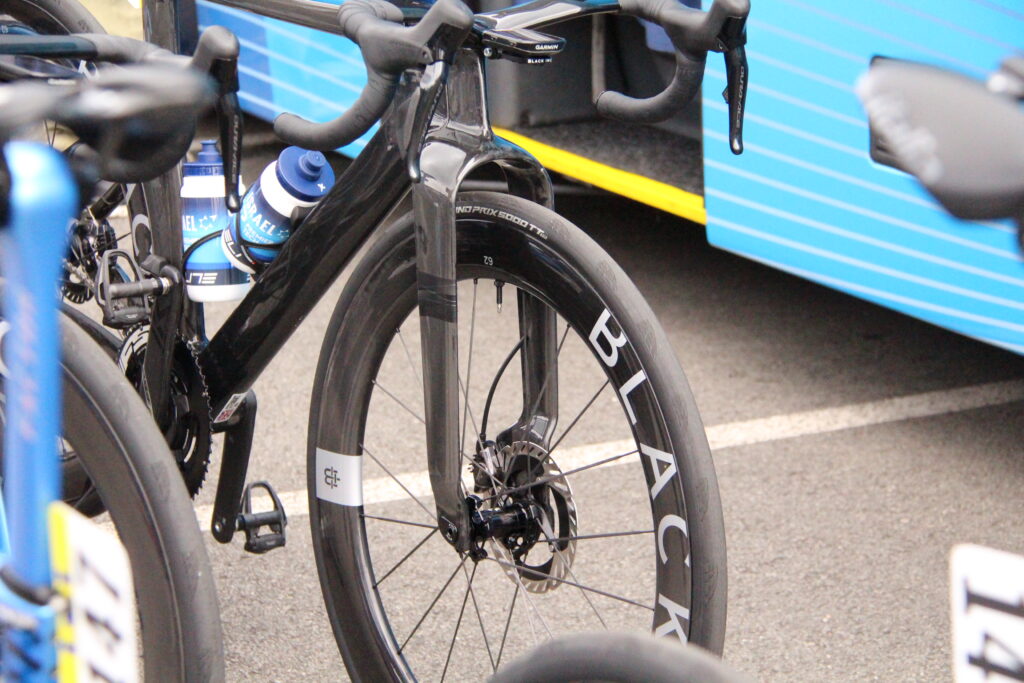
On this week’s episode, Jack and Dan sat down, over a beer (no French wine available, lads?) to discuss the big pre-Tour tech trends of the week, their experience traipsing around La France Profonde in search of cycling team buses, and – despite there being no repeat of last year’s infamous run-in with Ineos – why some squads and manufacturers insist on “playing the game” when it comes to new tech reveals.
Of course, Jack and Dan weren’t long home when the UCI dropped its latest regulatory bombshell, the governing body introducing a string of new tech rules covering everything from helmet designs and rim height to handlebar and fork width.
The new rules could put the skids on Factor’s new bike before it’s even been scratched and have also provoked a backlash from pros and bike fitters, who branded the UCI’s decision to limit riders’ handlebar width to 40cm, apparently in the name of safety, as discriminatory and potentially dangerous itself.
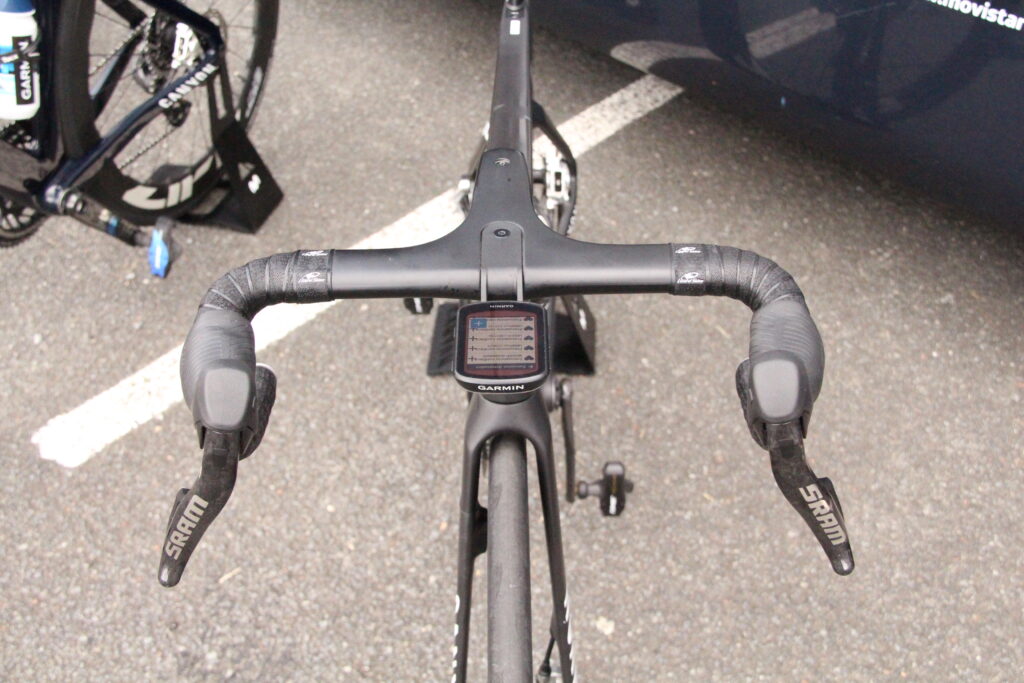
So, faced with these new changes, which are set to be implemented next year, we got together to assess their potential impact on riders, teams, and manufacturers – and how they could affect us lowly amateurs in the future.
Meanwhile, in part two, we turned our attentions away from the WorldTour and the suits in Aigle, and back to your daily commute, to discuss the past, present, and future of the Cycle to Work scheme with the chairperson of the Cycle to Work Alliance, Steve Edgell.
The Cycle to Work scheme has been around in the UK for 26 years now, helping around 180,000 people a year buy a bike through tax-friendly salary sacrifice.
However, it has come in for some criticism recently due to its apparent lack of inclusivity for people who are unemployed or on low incomes, as well as pensioners and freelance workers, who are all ineligible for the initiative as it currently stands.

Its impact on retailers has also been criticised, with bike shop owners arguing that they are currently bearing the cost of the scheme, which they reckon is “sucking the lifeblood out of cycle shops” and is in need of “systematic change”.
And earlier this year, shortly after the Telegraph ran one of its typical anti-cycling articles claiming that Cycle to Work is the preserve of “middle-aged men in Lycra earning six figures”, the All-Party Parliamentary Group for Cycling and Walking (APPGCW) called for a major overhaul of the scheme to help tackle inequality and access to active travel, even proposing the initiative be rebranded as ‘Cycle to Health’.
In this week’s episode, Steve, whose Cycle to Work Alliance is currently campaigning to open up the scheme to millions more workers, chats about these issues, the success of Cycle to Work in enabling people to, well, cycle to work, and what modernising the scheme actually means in practice.
The road.cc Podcast is available on Apple Podcasts, Spotify, and Amazon Music, and if you have an Alexa you can just tell it to play the road.cc Podcast. It’s also embedded further up the page, so you can just press play.
At the time of broadcast, our listeners can also get a free Hammerhead Heart Rate Monitor with the purchase of a Hammerhead Karoo 2. Visit hammerhead.io right now and use promo code ROADCC at checkout to get yours.




















8 thoughts on ““Get that bike back in the van!” Tour de France tech tales from the Dauphiné, Factor’s radical bike, and the backlash to new UCI rules + Does Cycle to Work still… work?”
Ryan Mallon wrote:
To be extra clear about the Cycle to Work scheme…
Cycle to Work is primarily (in practice) a tax efficient means of getting a bike through salary sacrifice. But it is really two adjoined schemes. Cycle to Work is a DfT responsibility. Salary sacrifice belongs to HMRC.
The guidance to employers has changed, but in principle it is supposed to be available to all employees. Where the criticism applies is that the dominant method of acquiring a bike – salary sacrifice – disproportionately favours high earners against low earners. However, employers are not prevented from using other means to deliver Cycle to Work:
Why hired? Because, as anybody who has read the T&Cs of their scheme should realise, most schemes are actually rentals, with a big nod and a wink about the bike being available to buy at the end of the rental period for its residual value plus BIC tax.
Why are lower paid employees disproportionately affected? Because deductions under salary sacrifice for rental must not leave the employee with less than national minimum wage. If you only earn that, the amount you are allowed to have deducted is zero. Since people with disabilities are more likely to be lower paid, it could be said that limiting that opportunity disproportionately affects those with disabilities. The same might be said for sex bias against women. Whether lower pay itself constitutes unlawful discrimination within workplace will depend on the circumstances, but it’s not hard to see how life’s missed opportunities might indirectly discriminate against them, therefore making the salary sacrifice rules discriminatory.
Not only does the scheme disproportionately limit lower paid employees at one end, it doubles up on the unfairness by awarding higher rate tax paying employees the chance to gear the buying power within an additional 20% saving. Standard rate taxpayers effectively have their 20% tax removed from the cost of the bike; higher or additional rate tax payers have 40% removed. So better-paid employees get a better advantage.
A lot of employers use scheme operator to run their scheme. There are overheads for those. Operators’ fees (variable, but typically around 10%) usually come out of the bike shop’s take. So your LBS loses out (especially if they already have to discount bikes at their own expense to shift them). The employer has to liaise with the operator to pay the up-front cost of the bike to the operator, then recoups the equivalent from your salary. If an employee leaves during the term of the scheme, there are calculations to be done to ensure the remaining balance is paid (usually net of tax, so you lose the tax efficiency at that point). Each step is modest and payroll systems may autmoate most of that, but it has to be done and checked.
Instead, noting that basic rate tax equates to the level of VAT, it would be easier to rate bicycles and qualifying items as 0% for VAT terms.
Benefits:
There is ( or was at the time
There is ( or was at the time I bought my last bike ) also an expectation that the bike was used principally for work.
But I agree that the scheme providers are an unnecessary complication & overhead; but would you expect anything less from the kids at Westminster ably assisted by the cybil service.
ChrisA wrote:
More an expectation that you pretend that the bike will be used principally for work, I think.
mdavidford wrote:
It’s this.
HMRC specifically spells out that cycles are supposed to be used for riding to or from work or between places of work. It also says that employers are not required to gather that information, and that employees are not required to record it. This is a big nod and a wink from an organisation not noted for its dependence on non-formal communication.
The tax efficiency of salary sacrifice was always a bearly-workable artifice to create a purchasing advantage where other means were seen as unworkable. Some will argue that we could only rate cycles as zero now we have let slip the mooring ropes to Europe. I’m not convinced that we didn’t have the means to persuade the Commission that zero-rated VAT on cycles was a benefit that could be universally applied with benefits for all. In fact I’m not even sure we couldn’t just have done it anyway.
In any case, nobody’s asking for your mileage…
Unless you do ride for work, and you can claim your 20p/mile (which you can still do on your cycle to work bike, because you are the one funding, maintaining and fuelling it).
GBBasix wrote:
There’s a couple of major flaws with your argument…
The discount given by salary sacrifice for a basic rate tax payer does not equate to the rate of VAT.
The VAT element on a bike charged at standard rate is 16.67%, therefore making bikes zero-rated or exempt would reduce the price by 16.67%. The reduction in price for a basic rate tax payer is 28% if you include NI contributions (41% for a higher rate tax payer). The employer also benefits from a small reduction in NI contributions too.
I would also think that if bikes were made zero-rated, it would take less than a year for manufacturers, distributors, retailers or a combination of all of them in increase the already compressed margins upwards so that in short order, the RRP of bikes would find its way back to the VAT inclusive level.
Keeping VAT on bikes prevents this and also offsets the slight loss of revenue from PAYE & NI.
I think the idea was; a bike
I think the idea was; a bike for work was zero rated, but generally 20% VAT still applies. In the same way as RADAR keys (for disabled toilets) are zero rated, if you have a medical need. I don’t so it cost me an extra 20%.
So far as NI is concerned, my employer added these (employee & employer NI) to the total figure, rather than benefitting from the saving. Not sure how common this is, but the boss was a keen cyclist!
So the saving would be less, even for basic rate tax payer, but it would cut down on all the other extraneous costs.
I guess that makes more sense
I guess that makes more sense; changing the VAT classification for active travel bikes only, but my other point was that there’s a common misconception that removing the VAT from a 20% standard rate item reduces the price by 20%, it doesn’t, it reduces it by 16.667%.
They’re not major flaws that
They’re not major flaws that aren’t already there.
In fact, most operators charge a final purchase price after the rental or extended rental period has finished. That is around 5% of the original purchase price at full value, and not from gross salary. so the headline savings are not really possible. negating the residual value fee is not quite as much as the benefit of NI savings, (although it should be noted the employer benefits from that too), but it makes the differences more marginal.
Individuals should consider their own position on the current scheme wrt salary-related pension contributions, too. Arrangements vary, depending on your pension.
And the price-adjustment is already there. Until recently, the ceiling on the scheme was £1,000. And, incredibly, there was a whole raft of £999 bikes available for a long time. The price point acts as a subliminal threshold, for obvious reasons, but it was exaggerated by Cycle to Work. Manufacturers will always find the best fit for them, whatever the market looks like.