



If you’ve ever suffered from a speed wobble you’ll know that it can be scary – very scary – and it can sometimes lead to a crash. So what can you do to control it?
Essentially, what happens in a speed wobble – sometimes called a shimmy – is that the front end of the bike oscillates, moving quickly one way and then the other, several times per second (the video above is from a YouTube user called Dean Magnusons). Your instinct in this situation is probably to grip the handlebar tighter to regain control, but the harder you grip the bar the worse it gets. Sometimes the movement is so bad that you’ll end up coming off the bike and that’s always bad news.
What is a speed wobble?
There’s a lot of debate out there about what exactly is happening when you experience a speed wobble.
“Bicycle shimmy is the lateral oscillation of the head tube about the road contact point of the front wheel and depends largely on frame geometry and the elasticity of the top and down tubes,” according to the late US mechanical engineer Jobst Brandt.
“Shimmy is caused by the gyroscopic force of the front wheel whose tilt is roughly at right angles to the steering axis, making the wheel steer to the left when it leans to the left. This steering action twists the top tube and down tube, storing energy that both limits travel and causes a return swing. Trail of the fork acts on the wheel to limit these excursions and return them toward centre.”
Fellow bicycle expert John Allen doesn’t completely agree with Brandt’s views.
“Gyroscopic forces may play a part, but the mechanism is the inverse of how a fish propels itself through the water,” says Allen. “The sideways motion of the fish’s tail at the back end of the fish propels the fish. In shimmy, the forward motion of the bicycle propels the sideways motion of the front wheel and fork blades.
“As Brandt says, the flex of the frame in torsion brings the contact back to centre – but at the same time also causing it to oversteer to the other side. If you hold a bicycle over your shoulder and swing the front and from side to side, you can see how the wheel steers the opposite way. That occurs because the center of mass of the front-end assembly is ahead of the steering axis.”
The video above shows someone purposely inducing speed wobble (don’t try this at home, kids!).
And here’s a typical example (below) of it happening spontaneously out on road. Notice how it starts at the handlebar and then affects the whole bike.
What causes it?
In our experience, a speed wobble is most likely to occur when:
• You’re travelling fast.
• You’re tense and/or cold, when a shiver might initiate it.
• You’re not pedalling.
• You’re riding no handed.
• The saddle is set high.
• The frame is long.
However, a shimmy can strike without all of these conditions being met; you can be pedalling along with both hands on the bars, for example.
Some people say that speed wobbles are related to loose headset bearings or poor frame alignment, but we’ve seen no evidence to suggest that either are involved.
How to stop a speed wobble
If you feel a speed wobble coming on, we suggest the following:
• Try to stay calm; tensing up exacerbates the problem. Deep breaths. You can deal with this!
• Grip the top tube with your knees (if you’re pedalling, this obviously means you need to stop).
• Or lift your weight from the saddle very slightly, but don’t stand up.
• At the same time, although it may seem counterintuitive, reduce the strength of your grip on the handlebar. Keep your arms bent.
• Slow down. If you’re going downhill and this requires braking, gently squeeze the levers, don’t lock up the front wheel.
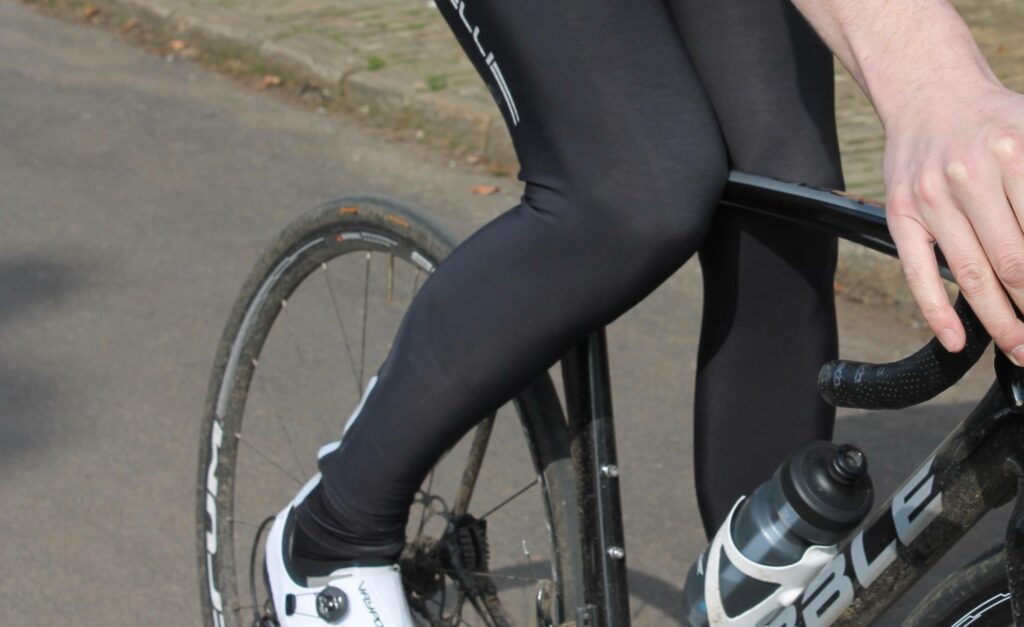
These tips have worked for members of the road.cc team. Some people have success by just laying one leg against the top tube rather than gripping it between their knees.
If you and/or your bike seem particularly prone to speed wobbles, you need to change something about the system (the bike or you). That might mean something as major as swapping the frame, but altering your own response in line with what we’ve suggested above when you feel a shimmy start is the logical first step.












55 thoughts on “Speed wobbles: try these 5 easy ways to stop shimmy”
The knee thing is very
The knee thing is very effective indeed
it seems that certain set-ups
it seems that certain set-ups get the death wobble at certain speeds on certain road surfaces – something to do with vibrational frequencies getting reinforced – coming down the pyrenees I was on an aluminium frame that did it at about 54kph every time – so speeding up was just as good as slowing down 🙂
beezus fufoon wrote:
Did you buy my Litespeed from me 🙂 Death machine
beezus fufoon wrote:
The first time I experienced this was on an aluminium frame as well. Everytime I got right arround 48-50kph it would start. If I could get the nerve to get up to about 56 it would start to calm down. After drifting into the oposite lane of travel on a descent durring a wobble it gave me such a stigma about going down hill I still get nervous going over 55kph. This is over 10 years and 3 bikes later and none of my last 3 bikes have had the issue.
The one thing I have noticed, as I have bought progressively stiffer frames, going from that old Trek 1200, to an 05 Tarmac, to a Giant Propel and now an Allez Sprint, the bikes have fealt progressively more comfortable at speed. It makes me wonder if more compliant frames are more prone to the issue.
Do not lift your weight from
Do not lift your weight from the saddle. That is very dangerous advice. It significantly reduces the damping of the frame (which is what knees on the top tube increases).
Clamp the top tube with your knees, as far forward on the top tube as possible and as tight as possible, and slow down.
Do not lift your weight from
Jobst Brandt: “Unloading the saddle (without standing up) will stop shimmy.”
Mat Brett wrote:
Jobst Brandt is wrong.
Read how he did his research – initiated shimmy on a bike which tends to shimmy (how he created an environment to test his methods) is not the same as a normally stable bike entering a violent oscillation.
Many years ago I had a road bike for which, when riding no-hands, a slap on the side of the stem would cause shimmy. Fun and games, oooh look at me, then hands back on the handlebars and it would stop – a simple solution to an soft oscillation. A few years ago, after installing new wheels on a different, faithful, road bike, I experienced very hard shimmy twice within a few weeks on mountain descents. Unweighting the saddle caused the amplitude to increase dramatically (the frequency remained the same), the shaking bike almost throwing me off.
Both bikes had shimmy, but the two situations and their solutions are not comparable. Brandt’s methods were flawed, his advice bad.
A few years ago, after
Yr experience is the opposite of what is reported by people in many places. http://www.slowtwitch.com/Tech/Speed_Wobble_5033.html https://cyclingtips.com/2011/03/speed-wobble-when-the-bike-shakes-its-head/ http://forum.slowtwitch.com/forum/Slowtwitch_Forums_C1/Triathlon_Forum_F1/Preventing_High_Speed_Wobble_P5102989
‘Unweighting the saddle a bit makes the system more flexible, decreasing the natural frequency to one that’s lower than your current speed. The shimmy stops’ – Damon Rinard, Engineering Manager, CSG Road Engineering Department, Cannondale & GT Bicycles (ex-Cervelo, ex-Trek, ex-Velomax, ex-Kestrel)
Spacer wrote:
Honestly, a lot of what is written about bicycle shimmy is rubbish. Many people talk about headset adjustment (the difference in resistance and damping between a loose, tight or properly adjusted headset is miniscule, really, with no change in bike geometry), frame construction and stiffness (why didn’t many/most steel bikes shimmy on every descent?), and some write articles as if a frame can be designed and built which favours or resists shimmy predictably. There was one company which even announced a “cure” some years ago, an assymetrical fork — this has obviously not taken the cycling world by storm.
The occurance of shimmy is a result of the total system, the complete build of the bike and the rider. This is why I was able to ride a high-end, stiff racing bike for several years in mountainous terrain and never have the slightest problem, and then with a change of wheels it immediately became an unstable monster.
As for unweighting the saddle, if it works for some people and doesn’t work for others, then it is not a reliable solution to be recommended as the first course of action in what really is an emergency situation.
Mat Brett wrote:
I suspect that it’s not reducing the load on the saddle that stops speed wobbles but rather that reducing the load on the saddle causes you to put weight on the front wheel, and it’s that that stops the wobble.
Only had it once. I shifted
Only had it once. I shifted my weight back and it started. Not sure if it was the lifting of my rear end, the shifting of weight rearward, or the extra weight I put on the bars as I moved that triggered it.
Almost shitting my pants seemed to sort it.
Podc wrote:
so erm, is it “unloading the saddle” or unloading in the saddle?
beezus fufoon wrote:
Try the first one first, then move onto the second one.
It’s sounds very similar to
It’s sounds very similar to natural resonance.
That perfect storm of all variables that will vibrate your bike at such a frequency that it will become uncontrollable. If it is this then changing those variables will generally stop it. I remember watching a video of a bridge swaying madly over a ravine in high wind. The answer to stop it was to add weight by loading it with trucks to change the bridges point of natural resonance. Although if you saw the vid any driver would’ve been mental to drive onto it!
However back to cycling terms, if it is this, and I openly admit I am no expert (just adding my twopenneth) then any change in the state of the bike will change the point of natural resonance. Beit changing the weight or speed or changing the amount of flex in the frame (gripping the top tube with your knees) should make a difference.
All that being said if you’re calm enough to do any of this whilst travelling a high speed then more kudos to you!
fullers1979 wrote:
Yeah, the engineer in me agrees with the natural resonance. Putting your knee on it on the top tube damps the oscillation, similarly, I imagine reducing grip on the bars decreases the rigidity of the system and prevents the “over steering”.
Scary stuff though, I managed to get a bit of a front end shimmy the other day when I went into a corner too fast and pulled on the anchors just as I entered the corner (which drops quite sharply)!
wellsprop wrote:
In my previous work as an engineer I did a lot of work on resonance. I was basically having to design components so that they would be able to function at very high rpm without resonating in such a way as to cause them to be damaged. A shimmy on a bicycle is a form of resonance. It’s as simple as that. Anyone who tells you about gyroscopic forces does, quite frankly, not know what they are talking about. There are many, many variables that can cause shimmy in a bike. The rider’s weight and weight distribution are two key factors, but also included are the frame design, frame stiffness, headset stiffness, tyre type (and tyre combination), wheel type, fork design… and so on. A bike that may shimmy badly at speed with one rider may not with another, basically because the two have different weights or riding positions. And two bikes of the same type from the same manufacturer may have different resonant frequencies depending on the types of tyre, wheel or headset stiffness, not to mention the riders of course.
Predicting what bikes will shimmy (or when) is really, really hard. If it happens, good luck. I’ve had a high speed fishtail on my bike when touring in the Picos in Spain as I made a very long descent. But it was a comparatively slow resonance and was fairly easy to control. A high speed headslap, now that’s another thing altogether. Gripping with the knees should help. Shifting your weight might help, but might also make things even worse!
The whole thing with speed
The whole thing with speed wobbles is not clear to me.
One thing I have noted is that, for me, confidence is a factor. I have watched nervous descenders get a ‘speed’ wobble at crazily low speeds just because it is downhill. I have assumed this is because they are very tense with tight shoulders and gripping the handlebars. (I’ve tried it and it can be scary!
If you keep your shoulders soft and elbows bent and hold lightly on to the handle bars – all is good the when not pedalling getting your weight balanced on the pedals off the saddle. Then a bike will hold line. I find keeping the saddle touching thighs and if nervous a knee touching top tube is best.
I know from my own experience it is when I have been nervous descending that I have had speed wobbles. Basically had a bad fall (not off a bike!) and was riding mountains with barely healed ribs, verterbrae etc. Once I had given myself a good talking to and relaxed I returned to fast (50mph) and enjoyable descending!
Oh and I find the knee touching the top bar is a great tip for stability which you can do whenever you feel a little nervous.
Look at the pros – bring both knees in; getting your head in front of and below the bars; hands each side of stem; flat back; feet flat and cranks horizontal can attain some mean speeds! yes it is not the safest with your hands and head in that position but it is fun.
Anyway the point I wanted to make is the main issue seems to be nerves – if you think it could happen then you automatically tense adn trouble starts…
Had a bicycle that I could
Had a bicycle that I could induce wobble on which allowed me to experiment. Knees clamping the top tube was of modest benefit. Best result was to unweight the saddle move my bottom as far behind the saddle as possible – shimmy stopped immediately. I presume that the change in centre of gravity changed the natural harmonic out of the self reinforcing shimmy range.
one of mine used to be the
one of mine used to be the otherway around to Freddy’s fix … pull myself
forward a little and the shake went away !
therevokid wrote:
I would agree, moving the weight forward is the best option but I guess there are many reasons for the wobble so the solution will most likely be different each time.
I had a bike which would
I had a bike which would consistently speed wobble if a sharp gust of side wind caught the front wheel and I was also out of the saddle descending (which I tend to do automatically on bumpy descents from all the years on a mountain bike). It scared the shit out of me. I completely agree with those saying it’s a function of the total system. On that bike remaining seated stopped the wobble.
Another cause is poorly
Another cause is poorly aligned brakes. I once had a speed wobble while descending at about 80kph. Turned out that the rear brakle caliper was slightly out of line so that when I touched the (rear) brake, it threw the rear wheel out of line and caused an horrendous wobble. Because it was caused by the brakes, it stayed until I eventually stopped. Before then, I could comfortably descend (I think 96kph was my top speed on one ride), but after that my confidence was shattered.
Avoid this simply by not
Avoid this simply by not shopping at Halfords
As above, my Litespeed Mira
As above, my Litespeed Mira alu frame was prone to going into a wobble at plus 40mph speeds. First time was in the Pyrenees, pumped the tyres up and it didn’t misbehave again. Because it was a compact frame, with a sloping top tube I couldn’t do the knee thing.
Last time was descending Ventoux, hit a bump (same place as Guy Martin crashed in the gocart) and it went into the biggest shimmy I’d ever had, nothing would stop it, feathering the brakes, skimming off the speed slowly, bit of front brake, a bit of rear, shifting my weight, it carried on regardless.
I was preparing to bail out & I took my foot out of the left pedal & it stopped there and then. I must have been as white as a sheet.
The final solution, I got rid of it!
It had paper thin tubing and thin bladed forks, all of which I think contributed to having a front end that would go into a headshaking wobble. I read a few posts about this & other Litespeeds doing this.
This article saved me this
This article saved me this afternoon. Descending quickly, hit by a gust from the side. Over the space of ten seconds went from steady descent to full on wobble.
Gripping the top tube with my knees instant fix. Thanks..
Had my first one today
Had my first one today coasting into a bend at 52mph. Should have known better – first time on upgrade wheels that are definitely twitchier and I think I tensed up and shifted my weight, unsettling the bike as I went into the corner. I somehow managed to save it without hitting the hedge but it lasted for about 50 metres.
Instict told me to just ease up without breaking and I just rode it out. I was really lucky. The mountain biker I overtook on the way down said it looked well scary from behind. I can confirm it definitely was!
I’ve read and considered this
I’ve read and considered this thread carefully. Death Wobbles seem to be the ghost in the machine. There are no specific causes or complete fixes.
At 53 years old I had my first real experience with this event on a hill I had ridden before. I did everything wrong. I tensed up, held a death grip on the bars, and grabbed my brakes. I thought I was about to become hamburger going down this roughly surfaced road at around 30 or 35 mph.
I’ve lost more than a little confidence just weeks before a 580 mile trip around Lake Ontario.
I wonder if the limited flexibility in my lower back contributed to the opportunity for the wobble to arise? I sit a little tall in the saddle. Add to it my undersized Fuji frame a trunk on the back end and I’ll bet I might expect more of the same.
Any ideas on back flexibility would be appreciated (yoga is against physician’s suggestion). I took care of frame size and now ride a Trek 720.
JClark63 wrote:
Presumably there’s logic to your physician’s suggestion, so there could be an underlying condition that you haven’t mentioned, so I’d go back to them and say ‘OK, if not yoga, what?’. Personally I’ve found a bastardised version of yoga (the book ‘yoga for cyclists’) a useful source of a few stretches that I would never have tried.
But if something prohibits yoga, or stretching in general, the other thing to focus on is core strength. I’m a triathlete who doesn’t swim much (or maybe bikes/runs too much), so that means I tend to binge my swim training and have frequent breaks away from it. It’s great for nice and easy core strengthening – I always feel more stable on the bike during and after a swim binge.
Don’t go too fast and
Don’t go too fast and periodically apply brakes to shave of acceleration
I have seen this caused on a
I have seen this caused on a few occasions by wheels, in particular the placement of a speed sensor magnet on a wheel. This is probably less common now, as many people are using GPS computers without the need for a wheel magnet but still, here is my experience.
It often happened with new wheels, which had a magnet installed by the rider. The natural instinct it seems, is to place the magnet opposite the valve stem, thinking it would balance the wheel.
In truth, most rims are pinned and welded at the opposite side to the valve hole, so is actually the heaviest part, adding the magnet puts a really out-of-balance point to the wheel.
I cured this issue on at least three occasions by moving the magnet round the wheel to the lightest part (found by letting the wheel settle after several spins in a jig, and finding the most favoured place to stop; lightest part will be at the top, or at least heaviest is at the bottom!).
My bikes occasionally do it,
My bikes occasionally do it, but infreqently. My Plan A is relax grip on handlebars and shift your seat back a bit and grip with both knees on top tube, to calm the whole thing down and lighten the weight on the front (which is one of the things that is whipping the wheel back the other way). If that doesn’t work straightaway, Plan B is shift forward slightly and apply weight more on one pedal and brace other knee on frame – that changes the loading on the frame – more weight on the front, a twisting load from one side and a damper from the other – that stops it pretty much instantly if Plan A didn’t work – ie two strategies – dampen and lighten the front, or load, twist and dampen. The latter is scary, because you’ve got to try and change a position on a bike that has a different agenda and has already told you to eff off once.
My impression is that 99% of
My impression is that 99% of the time it is rider. Maybe even higher proportion than that. I help a lot of beginner riders. Some get speed wobbles down a hill at 25 mph. They insist it’s the bike. I get on the bike and ride it a t 25, 30, 35 mph down the same hill, go no hands…. no speed wobble. If someone says “some of my bikes do it” I’m sorry, it’s inevitably the rider. I’ve been riding competitively for 30 years. I’ve ridden dozens and dozens of bikes, frequently over 50 mph. I have never had a bike give me speed wobbles since I was on a sit up and beg when I was 10 years old, except in one circumstance. If you want speed wobbles, simply unload the front wheel at speed down a hill. Sit far back on the saddle and lean back so there is little weight on the front wheel. You will get speed wobbles every time which will disappear as soon as you put load back on the front wheel. If you hold the handlebars with a death grip you may get speed wobbles on some bikes. Unclasping your hands from around the handle bars, leaning over the handlebars and placing your hands lightly on the tops will cure it, in my experience, 100% of the time.
I think there are different reasons for the dreaded wobble therefore a different fix for each…
I get wobbles and I know they’re selfinflicted – it happens when I go down a steep hill and I need to apply the brakes, I find myself tensing and I need to take a deep breath and tell myself to relax. This always works for me. It isn’t speed related as if I’m descending a lower gradient and pedalling I can easily go faster without getting any wobble.
I recently bought a CAAD12 and it is an EPIC machine (Ultegra, rim brake) it is light and it is fast. Since it is still quite new to me I have to go into descents slower so I can build my confidence on it and it’s working!
Had this a couple of times on
Had this a couple of times on the same bit of downhill on my road bike. Found that moving my weight forwards slightly on the saddle stopped it. Anyone else tried that?
bike.brain wrote:
Makes sense to me as you’ll have more weight over the front wheel, which is what you want for control when descending
I had a speed wobble on a
I had a speed wobble on a moulton APB while using a Tri Bar. (Scott AT4) Irrecoverable, woke in ambulance…
I attributed it to the damping being unevenly applied, but perhaps it was just me…
I’ve always found that
I’ve always found that shaving off some descent speed helps – it’s never happened to me below 65 mph.
I’ve had it I think twice on
I’ve had it I think twice on TT’s I think. Typically in the past I’ve stupidly saved too much for the finish and found sprinting on the tri bars wasn’t a good idea. First time I managed to power through it but the second time on another frame I wasn’t as lucky. Subsequently I googled it and would try the knee techique if it occurred again but touch wood it doesn’t as i pace my self better on TT’s :-/
Surprised you didnn’t mention
Surprised you didnn’t mention cross winds as a possible cause.
I have experienced shimmy on a couple of bikes.
A steel tourer, which is very prone to it on any sort of fast descent. But my best (Ti) bike only once, coming off the Pennines and getting hit by a sudden crosswind gust started it off.
I find single knee application – hard – against the top tube deals with it and feels more stable than trying to grip with both knees.
If you have excluded other
If you have excluded other possibilities, try replacing your fork. I experienced a pretty serious shimmy on my Lynskey Ti (and at lower speed similar though less aggressive symptoms) some months after a collision whcih superficially did not appear to have caused any damage. On replacing the fork, I have not had this problem –
However, unpredicatble and strong sidewinds at high speeds on straight descents can always cause problems, esp if you are not pedalling – so I try to keep my speed down in these situations now 🙂
Have experienced this on 3
Have experienced this on 3 different bikes all of which were good bikes. Definitely me and not the bike. Each time it has been because I have tensed up. Happened yesterday coming of a steep hill at 30mph and started to get nervous and tensed up because I could feel a cross wind pulling at me. As the video above shows this is very scary and I have came close to losing control which at speed is going to be nasty. Later descended another hill at 40 mph without incident but main difference was I stayed relaxed. If this ever happens again I will try gripping the top tube with my knees as recommended above but key thing is to stay relaxed and avoid it entirely.
it’s probably a consequence
it’s probably a consequence of steeper head angles for lively steering. Get a bike/frame with longer wheelbase and slacker head angle.
I think I’ve had it twice
I think I’ve had it twice two different bikes but the same thing stupidly sprinting on tt bars. First time I sprinted through it but the 2nd time I wasn’t so lucky and lost a bit of skin (fortunately the bike didn’t even get a scratch. I resist the urge now to sprint in the tt bars and touchwood it won’t happen again :-/
Nothing to add really, except
Nothing to add really, except loosen your grip and slow down.
On a related note, I rode the RideLondon last Sunday. Following the hour and a half walk to the start line, during which I got colder and wetter, I eventually set off shivering. The first downward section into a tunnel had the bike wobbling like crazy because of my shivering. Miserable ride.
“Your instinct in this
“Your instinct in this situation is probably to grip the handlebar tighter to regain control, but the harder you grip the bar the worse it gets.”
I’ve done a fair bit of gliding and this sounds similar to a phenomenon called “pilot-induced oscillation” (PIO). This is where you overcorrect and then overcorrect the overcorrection the other way, building-up an oscillation. (This can particularly affect trainee pilots while being aerotowed by a powered airplane.) The solution is to relax your hold on the control column and let the glider naturally stabilize.
Glad I’ve never had a speed
Glad I’ve never had a speed wobble – it sounds proper scary.
That’s over 6+ road bikes, high/low profile wheels and a lot of descending at speed, which I love.
I’m usually relaxed descending, pinning the top tube with my knees like a jockey with a light grip on the bars, just letting the bike find its way … or maybe just lucky so far 🙂
“Or lift your weight from the
a
I’ve found releasing my
I’ve found releasing my fingers but keeping my thumbs braced helped ie stopping the natural push/pull effect of the deathgrip.
.
Had a shimmy at 45mph going
Had a shimmy at 45mph going down Ballingdon Hill into Sudbury on the Dunwich Dynamo at about half past midnight. The bike had one of those big bikepacking saddlebags, which had made the front feel a bit light. Anyway, braking lightly and pressing knees on the top tube sorted it. Only ever had one shimmy before, in 54 years of cycling. The knee trick seems to work.
Funny this has popped back up
Funny this has popped back up, read this article the other year and it saved me when this happened to me coming down the Iseran at about 70kph this July. Took a couple of seconds to realise what was happening then what felt like an eternity to remember what to do. Weight off the seat and gripped the top tube with my knees and thankfully that worked. Was seriously shitting myself and thought I was definitely coming off. Don’t want to go through that again.
Had the misfortune of a 1980s
Had the misfortune of a 1980s light weight lugged steel frame racing bicycle that would speed wobble going downhill at about 70 kph. Frightened the daylights out of me but l clamped my knees on to the top tube and very slowly recovered stability. Thereafter I started experimenting. I found (1) weight on top of my rear rack made it easier to develop a wobble (2) the quickest way to reduce wobble was to lift by bottom off the seat, stand on the pedals at 3 and 9 o’clock and get low as possible to the top tube. Please note in my case that weighting the handlebar did not work and some studies have also cast doubt on this. Since then I have had no problems with a Surly LHT and a Specialized Carbon Comp Diverge which both have much stiffer frames than the lightweight steel bicycle which was otherwise a pleasure to ride.
Hi, I had my DWD on the
Hi, I had my DWD on the Lautaret (88km)! Survived, tried all those things! Headed to my “local” bike in Valouise, where, he calmed down, made me a coffee and explained what had happened!
Something is wrong he said. He hung my bike from a large strap in the ceiling and then spun it up! It jumped around like someone had shot it! It was amazing! He put another bike on the strap, it hummed like a gyro! He put my bike on a stand and began to check, frame, wheels etc and finally the tyres! There was the smallest of deviations in the rear tyre. There is always something he said!
I was amazed by how much he knew about the problem and how simple it was to him to solve. I often check my bike to see if it “Hums”, after all, far better it hums than hoping knees, seat etc will bring a satisfactory end to your DWD!
I never had a bike, out of
I never had a bike, out of the 9 or 10 that I’ve had over the years, and most I still own from steel to titanium, that never wobbled, even at speeds approaching 60 mph coming down steep mountain roads. Even my former 1985 Schwinn Le Tour Luxe when loaded never wobbled.
Enter the newest touring bike I bought in 2019, a Masi Giromondo 700c, when loaded it wobbles at speeds above 14 mph, and I can see the whole frame moving back and forth. I tried all the stuff mentioned in the article, and comments here and it will not stop other than slowing down, which is highly undesirable when coming down a steep grade loaded. I tried balancing the weight 50/50 front and rear, I tried 75r/25f, and then 25r/75f, and other combinations, nothing works. I only carry about 50 pounds of gear, and I only weigh 175 pounds. I find it very odd that the old Schwinn with smaller diameter tubing and fork diameter, with 27″ wheels with 40 spokes each, never once even slightly wobbled when loaded 70r/30f even when approaching 25 mph loaded, and the Masi has larger diameter tubing and fork, but the wheels are cheap Brev M. 23mm internal Tubeless Ready, Double Wall, with just 32 spokes. I tried moving the seat all the way forward, then all the way back, put on a shorter stem, nothing.
I tried different psi in the original Kenda Drumlins 45c tires, I then switched over to Schwalbe Amotion 38c tires, and played with the psi on those as well; then I tried adding more spoke tension, nothing.
So does anyone here think it could be the wheels causing the whole bike to wobble? Or is the fork, or head tube? The fork and head tube would surpise me since it is larger diameter tubing used over the Schwinn, and the Masi weighs about 5 pounds more than the Schwinn did which I can only assume is due to the larger tubing and heavier wheels. When riding unloaded it rides great even at speeds excess of 30 mph, but add on the 50 pounds of gear and things take a turn for the worse.
I wrote an email to Haro bikes 2 weeks ago about the problem since the frame has a lifetime warranty, but so far no response.
Any ideas would be appreciated.
froze wrote:
do you mean “ever” (or even “”)?