Rear lights guide Nov 2026
Rear lights guide Nov 2026 (Image Credit: Farrelly Atkinson)

Best rear bike lights 2027 — increase your visibility at night and in the daytime with a bright beam at the back

Using one of the best rear bike lights with plenty of lumens ensures you’re visible to drivers both day and night, keeping you noticed from a good distance
contributions from Jack Sexty
UPDATED Wed, Nov 18, 2026 12:19

First Published: Nov 18, 2026

0
This article contains links to retailers. Purchases made after clicking on those links may help support road.cc by earning us a commission but all of our reviews are fully independent. Find out more about road.cc buyer’s guides.
Google icon
Add as a preferred source on Google

Over the years we’ve racked up thousands of cold, dark winter road miles to test hundreds of rear lights. From brilliant budget beamers to retina-ripping radiants that command the attention of even the most inattentive drivers. Here are some of the best rear bike lights available, with quick links to our top picks just below, along with more highly recommended options from road.cc further down the page.
Lezyne Strip Pro Ai Alert 400+ Rear Light
Best rear light overall: Lezyne Strip Pro Ai Alert 400+ Rear Light
Oxford Ultratorch Slimline R50 Rear LED
Best value rear light: Oxford Ultratorch Slimline R50 Rear LED
Exposure Boost-R with ReAKT and Peloton
Best money-no-object rear bike light: Exposure Boost-R with ReAKT and Peloton
Garmin Varia Rearvue 820
Best rear light with radar: Garmin Varia Rearvue 820
Cycliq Fly6 Pro Bundle
Best rear light with a camera: Cycliq Fly6 Pro Bundle
Coospo TR70 Smart Radar Tail Light
Best value rear radar light: Coospo TR70 Smart Radar Tail Light
Brightside Bright, Amber and Sideways
Best sidelight for extra visibility: Brightside Bright, Amber and Sideways

A rear light is a legal requirement when cycling at night in the UK and many other places, and using one that’s brighter than the legal minimum seems like a sensible way of helping drivers see you — or at least defanging ‘but I didn’t see them’ excuses. The best rear bike lights have long run-times, can be seen from a good distance, and are sufficiently tough and waterproof to fend off day-to-day abuse.

Rear lights for cycling universally use one or more red light-emitting diodes (LEDs) to generate their light. LEDs are very efficient, putting out lots of light for modest electrical power, which makes them cheap to run but effective at boosting visibility. Most rear bike lights are now rechargeable, taking power from a USB source like a standalone charger or your office computer. Battery-powered lights are still available, and have their adherents who appreciate being able to revive a dead light at any filling station or corner shop – but with rechargeable lights now so affordable, the vast majority go for them now.

USB-C is now pretty ubiquitous in the device-charging world, and pretty much all new rechargeable lights are USB-C. Most we’ve recommended here are charged via USB-C, or have been updated to that standard since we first reviewed the unit.

A flashing red light says ‘bike’ to most drivers; we recommend using a constant light as well so your position can be easily followed. It can be hard to track the position of a flasher on an otherwise unlit minor road. Rear bike lights are increasingly intended as day-time safety lights too, with super-bright flash or pulse modes designed to be impossible for drivers to ignore. They can be very annoying to other riders though; please use them only when necessary.

While we don’t deploy the famous road.cc Beam Comparison Engine to test rear lights, the procedure for reviewing rear lights is much the same as front beams round these parts. Our reviewers, with centuries of riding experience between them, use products for at least a month before writing up their findings and coming up with final verdicts. For more information on how road.cc does product reviews and how we compile our buyer’s guides, head over to this article. 

If you want to see our top picks of back, front and combined lights all in one place, you can also check out our overall guide to the best bike lights. Just looking for a front beam? Head on over to our guide to the best front bike lights instead.

The best rear bike lights: our top picks

Lezyne Strip Pro Ai Alert 400+ Rear Light
Lezyne Strip Pro Ai Alert 400+ Rear Light (Image Credit: Farrelly Atkinson)

Lezyne Strip Pro Ai Alert 400+ Rear Light

Best rear light overall

Bright

Easy to mount

Excellent run times

Great waterproofing

AI? Kind of, I guess

Brake sensing quite angle-specific

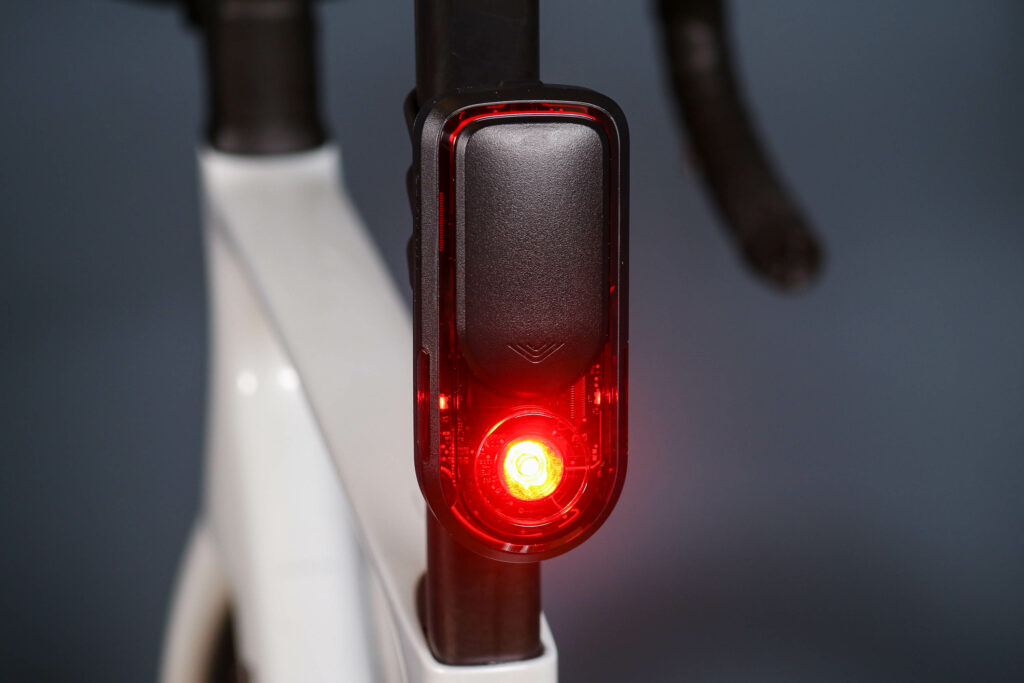
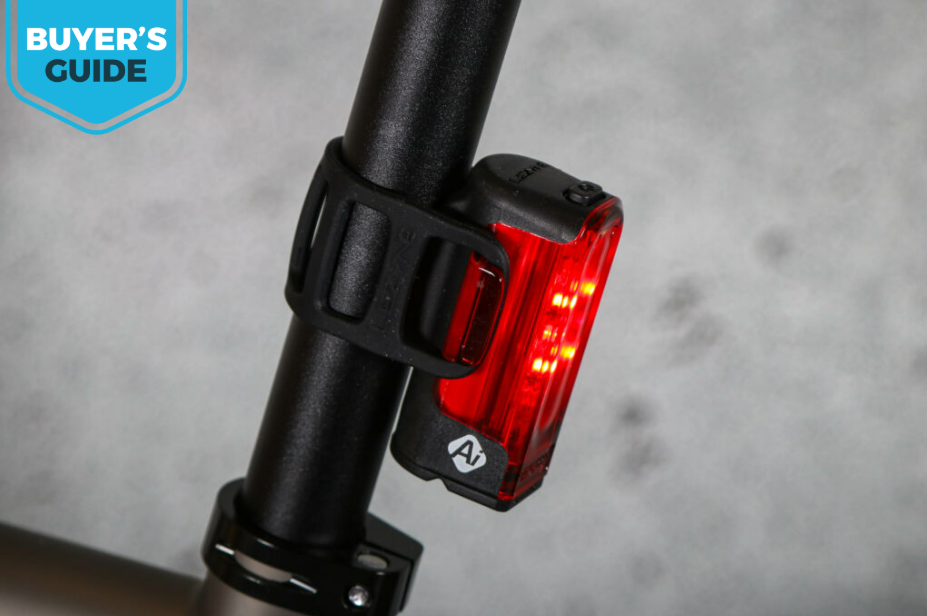
“The Lezyne Strip Pro AI Alert 400 is a very nice rear light that’s easy to fit and pushes out some serious lumens for a long time, as well as packing a decent braking function”, says our reviewer Dave. It’s so good that it’s currently in top spot in our rear lights guide factoring in brightness, design, features, and value.

This light is really easy to use, and mounting couldn’t be easier view the solid rubber strap. The ‘AI’ bit of the name may be stretching it, but it does have a brake detection function based off ‘over 1,000 hours of riding data’ that was fed into a machine learning algorithm to determine when it should activate, so it’s not called that completely for the sake of it.

Elsewhere, the high beam setting is incredibly bright, there’s a wide 270° field of visibility, and run time is huge at up to 80 hours in Femto mode.

We’ve also rated the Lezyne AI Alert 250 very highly if you want something more compact with some really premium features; but the 400 makes it in our guide for being brighter and more versatile for a bit less money.

Oxford Ultratorch Slimline R50 Rear LED
Oxford Ultratorch Slimline R50 Rear LED (Image Credit: Farrelly Atkinson)

Oxford Ultratorch Slimline R50 Rear LED

Best value rear light

Easy fitting

Decent performance

Great value

Not as bright as some

If it’s simplicity you want and you want a good deal, look no further than the Oxford Ultratorch Slimline R50. This design has been around for years; it’s easy to fit, great value and offers decent performance for the money.

The bracket is a simple rubber wedge that fits to the back of the unit, held on by a rubber band. It won’t fit aero seatposts, but for the rest of us it’ll work just fine. 50 lumens is quite a lot for a rear light, and plenty to use it as your main rear light. The weight is just 27g, and battery life is from two hours on the highest steady setting up to 23 hours on the lowest pulse mode.

This simple rear light does the job of making sure you’re seen, with ample light output, good mode choices and easy operation.

Exposure Boost-R with ReAKT and Peloton
Exposure Boost-R with ReAKT and Peloton (Image Credit: Farrelly Atkinson)

Exposure Boost-R with ReAKT and Peloton

Best money-no-object rear bike light

Great build quality

Good runtimes

Several modes

Bright

Pricey

Exposure’s TraceR with ReAKT and Peloton rear light impressed us previously and in creating the Boost-R, Exposure has taken the highly regarded Trace-R and doubled the runtimes while adding just 10g in weight. We reviewed a previous iteration, but it’s now on version 3 with USB-C charging, and the upgraded battery now provides up to 70 hours of run time.

The max output has now been upgraded to a huge 200 lumens, and there are six modes that dictate how much burn time you have, from six hours in the brightest static mode to 48 hours on the lowest flash mode, plus DayBright pulse mode.

ReAKT is probably the best feature of the lot, adapting to the light conditions at the time, and flaring up when it senses that the rider is braking. Additionally, the Peloton feature recognises when there is a front bike light behind you and dims itself to save dazzling the following rider.

Garmin Varia Rearvue 820
Garmin Varia Rearvue 820 (Image Credit: Farrelly Atkinson)

Garmin Varia Rearvue 820

Best rear light with radar

Gives accurate and timely information

Works optimally with a modern Garmin head unit or app

Well made

Very customisable

Relatively expensive

Certain audible alerts absent when using other brands of head unit (via ANT+)

The Garmin Varia RearVue 820 is a fantastic radar and rear light that is highly customisable to your preferences and setup. It proves that Garmin’s radar lights are still the benchmark.

Okay, the Varia RearVue 820 is quite expensive, and it’s best paired with a compatible Garmin head unit to make the most of its rich feature set, but it shows more useful detail than before, while retaining the right amount of audible alerts to let you know what’s going on behind.

It improves situational awareness significantly and is now more customisable than ever. Add in an excellent light and a fast recharge time, and it’s pretty much unbeatable.

Cycliq Fly6 Pro Bundle
Cycliq Fly6 Pro Bundle (Image Credit: Farrelly Atkinson)

Cycliq Fly6 Pro Bundle

Best rear light with a camera

Excellent quality footage

USB-C charging

Easy to use

Weatherproof

Good rear light

Price

It’s a big unit

Buttons are flat and hard to find

The Cycliq Fly6 Pro combines a rear-facing camera and bike light, offering video recording in 4K and 100-lumen output. The video resolution is excellent for capturing details in case of an incident, and the device is easy to use with Wi-Fi transfer simplifying footage viewing.

The bundled package being reviewed here includes the Fly6 Pro unit with a 64GB microSD card, a USB-C cable for charging and transferring files, a safety tether, mounting bracket, two mounting straps, and four bracket adapters. The Fly6 Pro unit is also available to purchase on its own, currently priced at £329.

Coospo TR70 Smart Radar Tail Light
Coospo TR70 Smart Radar Tail Light (Image Credit: Farrelly Atkinson)

Coospo TR70 Smart Radar Tail Light

Best value rear radar light

Accurate radar

Excellent battery life

Superb in-app customisation

USB-C

Garmin quarter turn standard attachment

Minimal info about remaining charge on the unit itself

The Coospo TR70 Smart Radar Tail Light is an excellent device at an excellent price – and that’s a strong combination. Reviewer Paul Grele struggled to find any weaknesses.

As a radar detecting traffic behind you, the TR70 is reliable, accurate and dependable. As a light, it provides various solid and flashing modes – including a Day Flash mode – and the battery life is long – 14 hours for the High Solid light through to 30 hours for the Day and Night Flash settings, with the Radar-only mode capable of 40hrs.

This is a really impressive offering that functions well in all areas.

Brightside Bright, Amber and Sideways
Brightside Bright, Amber and Sideways (Image Credit: Farrelly Atkinson)

Brightside Bright, Amber and Sideways

Best sidelight for extra visibility

Well-made

Extra dimension of visibility

While it’s not actually a rear light, Brightside’s eponymous light deserves a mention for the clever way it provides extra visibility on top of your front and rear beams.

Essentially, it’s a well-built double-ended side light at a good price that attaches easily to your frame, and gives you an extra dimension of visibility to other road users approaching you from the side. Bright 15-lumen Cree LEDs at each end attract attention.

The Brightside has filled a gap in the market (a quick internet search only unearthed the Brightside and the Cateye Orbit Spoke lightset) in a bid to reduce the instances of SMIDSY (sorry mate I didn’t see you) incidents. With too many accidents happening at junctions and roundabouts, the light is designed to give you all-round visibility to motorists approaching from your side – Brightside, not broadside.

More great rear bike lights

Bryton Gardia R300L Rear View Bike Radar Tail Light
Bryton Gardia R300L Rear View Bike Radar Tail Light (Image Credit: Farrelly Atkinson)

Bryton Gardia R300L Rear View Bike Radar Tail Light

Smart light functions

Simple to operate

Easy pairing with head units

Effective radar coverage

‘Loses’ vehicles when they’re moving at your speed

Not 100% on picking up motorbikes

The obvious comparison to the Gardia R300L would be the Garmin Varia system, and for quite a lot less money the Bryton does an impressive job of detecting cars from an impressive distance away. The beam is pretty good too.

There are also some bonus extras, like the easy-to-use smartphone app and smart light capabilities. The unit pairs with most head units (not just Bryton) and Bryton says it can detect vehicles up to 150m away. Our reviewer found it could pick up from even further away than that, about 180-200m on long, straight roads.

As a light it is also very effective, with five settings and just a quick press to flick between them. The light also detects changes in speed and can deploy a brake light, and a flashing light pattern that changes when a car is approaching to increase the chances of you being seen.

There are some small quirks like patchy pick-up of motorbikes and losing vehicles when they’re moving at your speed, but overall this is a decent light and radar system in one.

Moon Helix Sense (150lm)
Moon Helix Sense (150lm) (Image Credit: Farrelly Atkinson)

Moon Helix Sense (150lm)

1.5 hours eco mode when battery reaches critical limit

270 degree visiblity

Lightweight

Responsive and effective braking sensor

Potential for 130 hours run time

Two handed job to remove from bracket

Solid light modes could be longer

The Moon Heliz Sense has exceptional run time for such a small unit, and packs a punch with 150 lumens of brightness on its full beam.

There are braking and sense modes, and the latter auto adjusts for daylight and night-time operations, which means the flash option got our reviewer up to 14 hours in optimal conditions, with slightly less on colder days.

Whether you’re riding on trails or in the city, this is a great compact option with some useful additional mounts if you prefer to attach it to saddle rails rather than your seatpost.

Knog Plus Rear Light, Black
Knog Plus Rear Light, Black (Image Credit: Farrelly Atkinson)

Knog Plus Rear Light, Black

Cable-free charging

Highly visible

Easy to detach

Light and slim

A bit wobbly on aero posts

If you’re a time triallist or hill climber, or just want some brightness without adding weight to your bike set-up, then this very affordable beam from Knog is well worth a look. As well as being light on the wallet, it’s also light in weight, coming in at a diddy 18g.

Our reviewer described it as “an impressively simple light that weighs almost nothing”. Pumping out 20 lumens, it’s bright enough for a useful visibility boost. The mount is magnetic, and there’s a USB port built into it so you don’t need a cable for charging.

Burn time is two hours in steady mode which isn’t huge, but on eco flash you can get 40 hours out of it according to Knog. There are five modes to choose from, and you can’t really go wrong for this price.

Magicshine SeeMee 300 Smart Tail Light
Magicshine SeeMee 300 Smart Tail Light (Image Credit: Farrelly Atkinson)

Magicshine SeeMee 300 Smart Tail Light

Mount fits all shapes of seatpost

Good run-times

Downward-pointing OptiTracing light gives added illumination

Light sensor isn’t very reactive

The Magicshine SeeMee 300 is cleverly designed and has a lot going for it, all without being very expensive.

The smart mode allows the sensor on the light to monitor ambient lighting levels and adjust the light’s brightness accordingly – it’s optional, and there are also low, high, flash and group ride modes if you’d prefer to set it manually. The Smart Mode really is quite smart, flashing 300 lumens during the day and switching to a 100/20-lumen flash plus the OptiTracing light on a static 60 lumens.

The mount should fit all seatposts, and our reviewer used it in all weathers and found this light very rugged and weatherproof.

Best rear bike lights: how to choose and what you need to know

Are flashing bike lights legal in the UK?

Yes, flashing bike lights are legal in the UK and tlaw requires flashing modes to be between 1Hz and 4Hz (one to four flashes per second). However, actual modes vary considerably and some fall well outside that. Pulsing constant modes are a grey area.

Ask a rider why they have their light flashing and they’ll often argue that it makes them visible from further away. Ask another rider why they have a constant light and you’ll often hear that it makes distance easier to judge for following vehicles.

There’s not a lot of scientific research to hang your choice on. Most people who run two lights will have one of them flashing. One thing to bear in mind is that if you’re riding in a close group – be that a club run, sportive, Audax or anything else – having a bright light flashing in your eyes at close range is pretty annoying. Many lights have low-power steady modes for group riding.

Are bike lights a legal requirement?

In the United Kingdom, it is a legal requirement for bikes to have a white front light and a red rear light illuminated when ridden on public roads during the hours of darkness.

In terms of the law, it’s up to you whether your rear light is flashing or not.

How many lumens should a rear bike light have?

A rear bike light doesn’t need to be as powerful as a front light, as its primary aim is for you to be seen rather than to see.

We’d look for lights with lumen levels between 50-100, but as low as 20 lumens can be sufficient if you also have reflectors or a secondary rear light – it depends on the type of riding you plan to do.

If you’re mostly just pootling to the shops and back then something basic will probably do the job. Nowadays, it’s probably worth going straight for a USB-rechargeable light and skipping lights that take replaceable batteries, because you can pick up an acceptable one for under 20 quid now anyway.

If your commute is on busier roads, or you plan to do longer rides at night, you’ll probably want something brighter. There’s a wealth of rear lights about that will catch a driver’s attention from further afield. Many riders who spend a lot of time on the road after dark fit more than one rear light to increase their chances of being seen.

How long do bike light batteries last before needing a recharge?

This can vary massively and depends on whether the rear bike like is rechargeable or battery-powered.

Most rear lights will cope easily with the longest ride you’re likely to throw at them, though not all USB-rechargeable ones can be fully trusted to last a whole night, especially on steady beam. If you’re planning some big forays into the dark unknown – or if you’re just a bit crap at remembering to charge your lights – pick something that has a long run time.

A lot of rechargeable lights will have some sort of system for warning you if you’re about to run out of juice. Multiple lights we’ve tested have a small green light to indicate they’re full or close to fully charged, moving to amber and finally red to tell you the charge is low.

When it comes to rechargeable lights, beware of the highest advertised run times vs mode. Flashing modes will usually last much longer than steady settings, simply because less light is being omitted overall. As an example, the Giant Recon TL 200 recommended in this guide has a max advertised run time of ten hours on its smart night mode, but this goes down to 2.5 hours on the 100 lumen high setting.

Let’s say you have a one hour commute each way, and you prefer to use the higher setting, that means you really need to be charging the light every night. A mid-setting will probably be best for most commutes though, so if your journey is half an hour or less each way you could get at least a week’s worth of use out of most mid-range rechargeable lights.

Where is the best position for the rear bike light?

The best place to mount a rear light on a bike is typically on the seatpost or seat tube, facing directly backwards as this provides a clear and unobstructed view of the light from behind. Some bike lights will also fit under the saddle.

Depending on your bike’s design, you might also consider additional mounts such as a rear rack or saddlebag, providing alternative locations for mounting lights.

Emily is our track and road racing specialist, having represented Great Britain at the World and European Track Championships. With a National Title up her sleeve, Emily has just completed her Master’s in Sports Psychology at Loughborough University where she raced for Elite Development Team, Loughborough Lightning. Emily is our go-to for all things training and when not riding or racing bikes, you can find her online shopping or booking flights…the rest of the office is now considering painting their nails to see if that’s the secret to going fast…  

No Comments

Leave a Comment


Read more...

Read more...

Read more...