


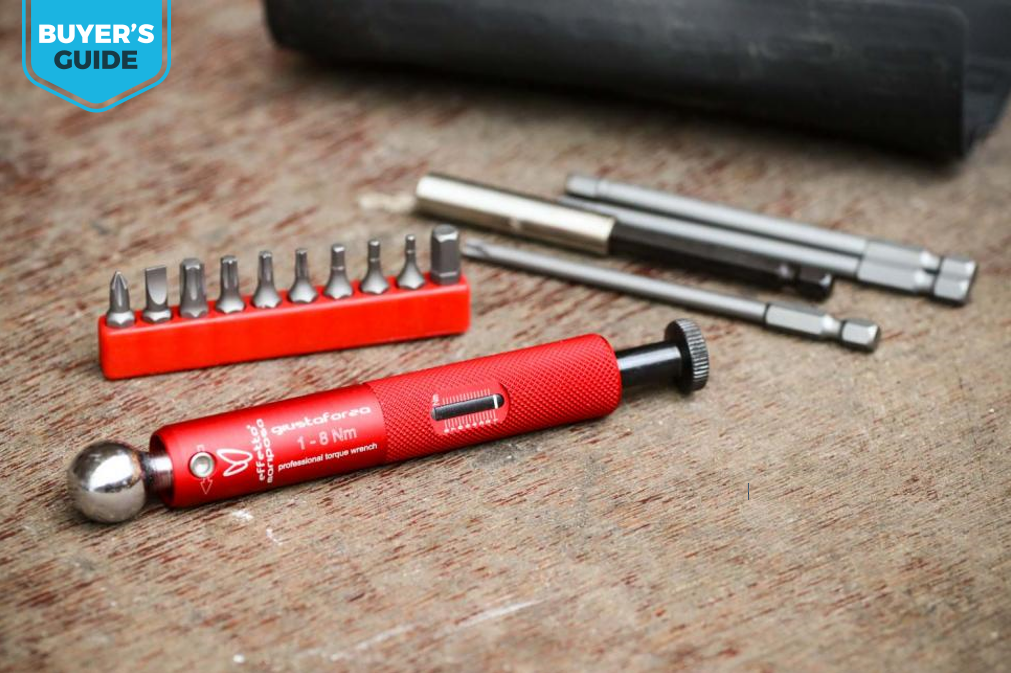
With a torque wrench you can get the bolts on your bike as tight as they need to be and — importantly — no tighter. They cover the relatively low tightness requirements of bikes and are easy to use. These are the best torque wrenches you can buy.
- Best torque wrench overall: Effetto Mariposa Giustaforza II Pro — Buy Now for £148.99 from ProBikeKit | Find out more
- Best portable torque tool: Silca T-Ratchet Kit + Ti-Torque Kit — Buy Now for £112.50 from Chain Reaction Cycles | Find out more
- Best compact torque wrench: Park Tool ATD-1.2 — Buy Now for £80.74 from Triton Cycles | Find out more
- Best budget torque wrench: Merida Adjustable Torque Wrench — Buy Now for ~£22.00 from R2-Bike | Find out more
- Best torque screwdriver: Norbar 13702 Torque Screwdriver — Buy Now for £125.95 from FFX | Find out more
- Best beam-type torque wrench: Park Tool TW-1.2 — Buy Now for £44.99 from Chain Reaction Cycles | Find out more
Why is using a torque wrench to get the tightness of your bike’s bolts right important? Too loose and you run the risk of a bolt coming undone, too tight and there’s the danger of causing serious damage to your bike and, as a result, to yourself. Over-tighten a seat clamp, for example, and you could ruin a carbon-fibre frame.
Bike-specific torque wrenches provide just the range of tightness most commonly found on easily-damaged parts like seat post and handlebar clamps.
Click-type torque wrenches are the most common kind, alerting you with a click when you’ve reached the set tightness.
The best torque wrenches come with factory certification and can be returned or recalibration so you know they’re doing the job perfectly.
The best torque wrenches for bike use
Best overall Torque wrench: Effetto Mariposa Giustaforza II Pro
Buy Now for £148.99 from ProBikeKit
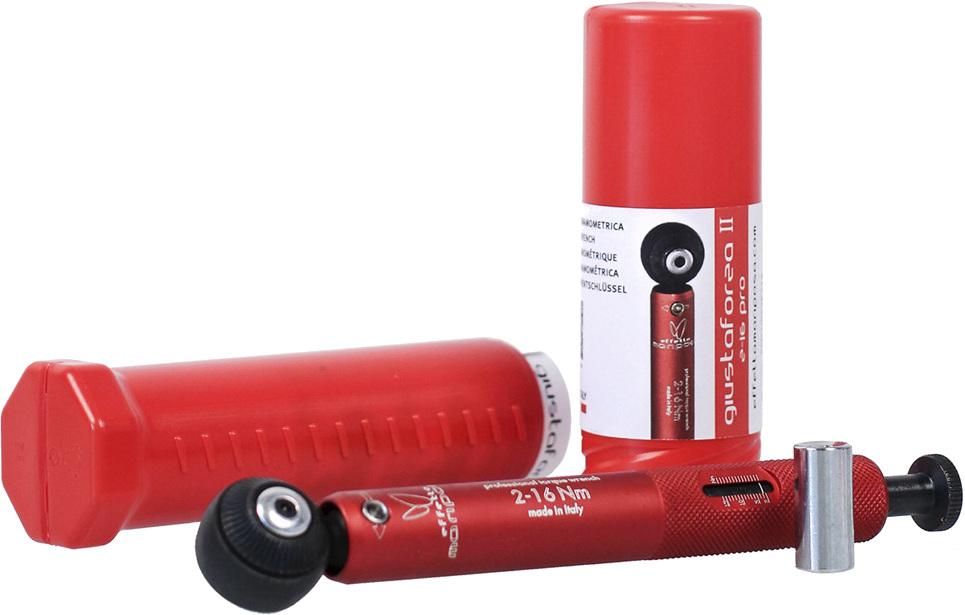
Effetto Mariposa was one of the first brands to offer a high-quality, high-precision torque wrench specifically for bike use. This Pro version has a two-way ratcheting head for speedy tightening, a handy addition to the original’s fixed head. It’s not cheap, but it has a very useful 2-16 N·m range, it’s very accurate and it oozes class.
If you can live without the ratchet, or you need to get at bolts in very confined locations, the standard Effetto Mariposa Giustaforza in 1-8N·m version is about £110.
Find an Effeto Mariposa dealer
Read our review of the original Effetto Mariposa Giustaforza
Read our review of the Effetto Mariposa Giustaforza 1-8 Deluxe torque wrench
Best portable torque tool: Silca T-Ratchet Kit + Ti-Torque Kit
Buy Now for £112.50 from Chain Reaction Cycles
The Silca T-Ratchet and Ti-Torque kit is a beautifully made, superlight, and multi-functional set of tools, made to the highest quality. The set comprises a ratchet handle; a couple of extenders to tailor the reach and leverage; six hex bits ranging from 2mm to 6mm in size; T10, T20 and T25 Torx bits; a Philips #2 bit; and the important part for our purposes, a torque-measuring arm based around a titanium spring.
Rather than setting the torque and hearing a click when you reach it (the method by which many torque wrenches work), you read the N·m indicator printed on the barrel of the tool. There is a risk of over-tightening a bolt, but with due care and attention, and slowly and gently applying torque, you should be fine. The wrench will measure between 2N·m and 8N·m, which covers all the areas of the bike that you are likely to need to tweak in the field, such as handlebar faceplates, stems and seatposts.
Best compact Torque wrench: Park Tool ATD-1.2
Buy Now for £80.74 from Triton Cycles
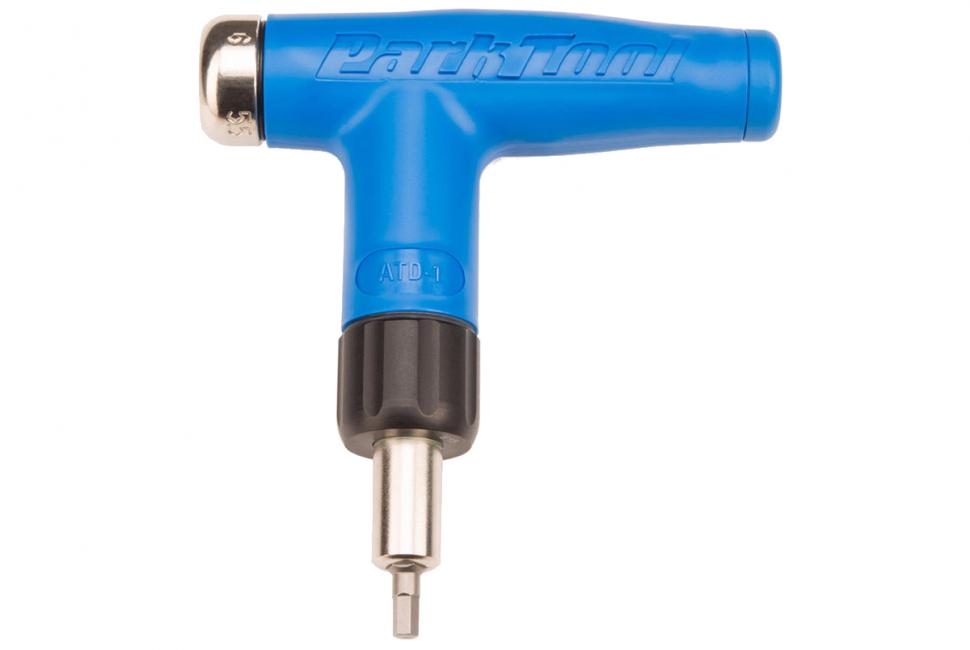
Most bike-fettling jobs that really call for a torque wrench require fairly low torque values, like the 4-6 N·m range of the Park Tool ATD-1.2. It’s quite expensive for a limited-function tool, but does what it does so well that it’s very highly regarded.
Best budget torque wrench: Merida Adjustable Torque Wrench
Buy Now for ~£22.00 from R2-Bike
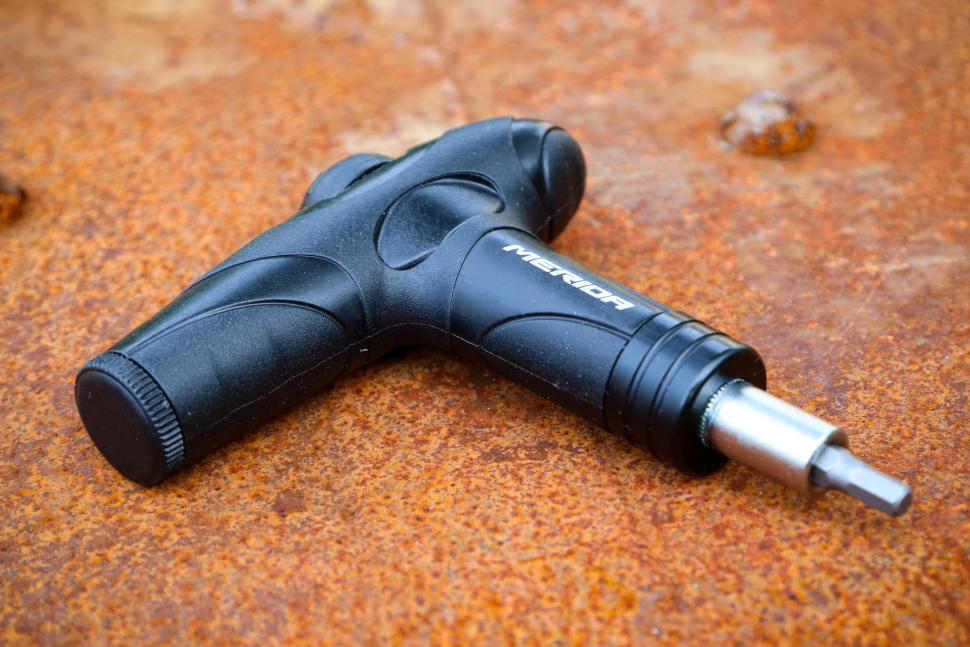
A no-frills T-shape handle design, Merida’s Adjustable Torque Wrench is the perfect tool for quick and easy bolt tightening. It has three torque settings – 4, 5 and 6N·m – and with the 3, 4 and 5mm Allen keys, as well as a T25 Torx key, it’ll cater for most common bolts on a bike. Neatly, all keys bar one are hidden inside the case. It’s a good price too.
The chunky T-shape handle makes it easy to hold the torque wrench firmly, and its relatively stubby nature means you can tighten bolts easily without worrying about the key slipping inside a bolt head.
Adjusting the level of torque is easy – a dial on the top allows you to do this on the fly – although I found it slightly ironic that you need a separate 6mm hex key to adjust it, which sort of spoils the ease of having everything you need in the one unit.
Read our review of the Merida Adjustable Torque Wrench
Find a Merida dealer
Best torque screwdriver: Norbar 13702 Torque Screwdriver
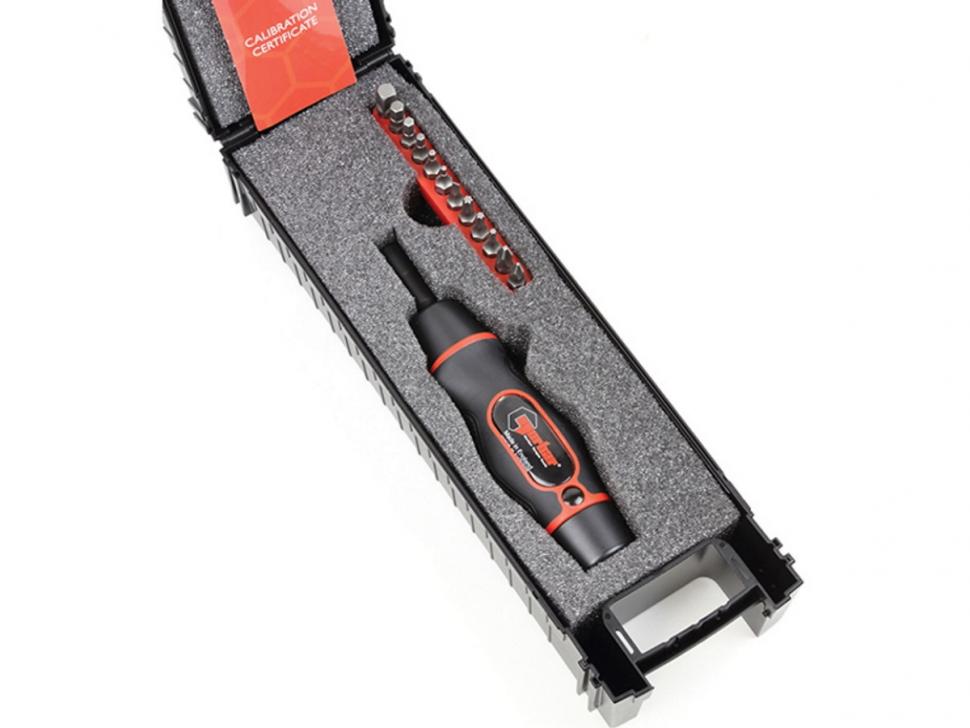
Your classic torque wrench is, in effect, a sophisticated spanner handle. But a lot of bike parts don’t need the high torque you can reach with a spanner, and for those applications the easy turning of a screwdriver handle is more convenient. The 13702 screwdriver has a range of 1.2 to 6 N·m, and can be adjusted in 0.1 N·m increments.
Norbar is a British company that specialises in torque measurement. The 13702 screwdriver comes with a calibration certificate, and if you suspect the device has drifted off, you can get it recalibrated.
If you don’t need the bits (and let’s face it you can get a set of good quality bits for £10-£20) you can get the screwdriver on its own for £88.79.
Best beam-type torque wrench: Park Tool TW-1.2
Buy Now for £44.99 from Chain Reaction Cycles
Park Tool TW-2.2
Buy Now for £49.99 from Freewheel
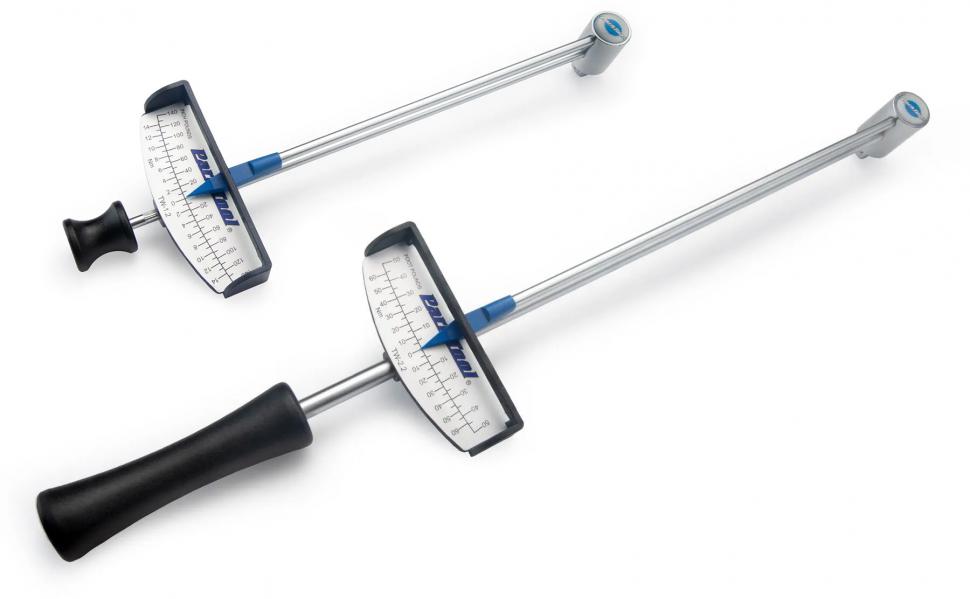
It’s a big welcome back to a couple of old friends. Park Tool’s brace of beam-type torque wrenches are easy to use and reliable, and if they get knocked out of calibration you can just bend them back.
The scale on a lot of beam-type wrenches is marked in both metric and Imperial units in such a way that the thick part of the pointer obscures the metric scale. Clearly realising that bike mechanics think in Newton metres, Park Tool have avoided this blunder by putting the metric scale at the tip of the indicator.
The TW-1.2 has a range from zero to 14 N·m, making it suitable for low-torque jobs like handlebar, seatpost and stem clamps. It has a 3/8-inch square drive so if your tool kit’s anything like mine you’ll need a 3/8-inch-to-1/4-inch adapter as well.
With a range of zero to 60 N·m, the TW-2.2 is suitable for bigger jobs: cranks bolts, sprocket lockrings, bottom brackets and the like. It also has a 3/8-inch drive.
Find a Park Tool dealer
Topeak Torq Stick
Buy Now for £80.77 from Amazon
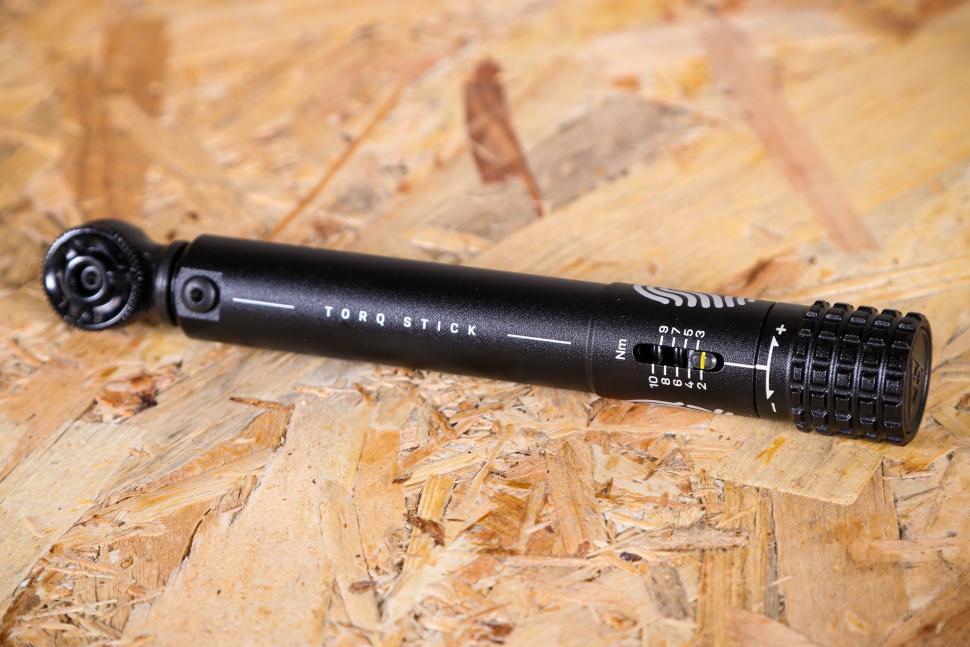
The Topeak Torq Stick is compact, very nicely made and easy to adapt to most fastener types with its magnetic 1/4in drive. Running from 2-10N·m, it’s a great way to ensure important bolts are tight but not dangerously so – especially important if you run a carbon bar or seatpost. The five supplied bits are basic and disappointing, though, and if portability isn’t important you can get much cheaper wrenches.
The Torq Stick adjusts from 2-10N·m in 0.25N·m steps, and is certainly accurate enough for bicycle use. It’s also enough torque for most components, such as bars, stems, brake and shifter clamps, drivetrain parts and most bits of disc and rim brakes. It’s not enough for cranks, bottom brackets or pedals, though.
The scale is etched clearly alongside a physical indicator, so it’s easy to read and should stay that way. The aluminium casing has a slightly satin anodised finish that’s pleasing – and comfy at maximum torque – while the adjuster is grippy and impossible to twist accidentally once set.
Read our review of the Topeak Torq Stick
Find a Topeak dealer
Feedback Sports Range Torque and Ratchet
Buy Now for £45.49 from ProBikeKit
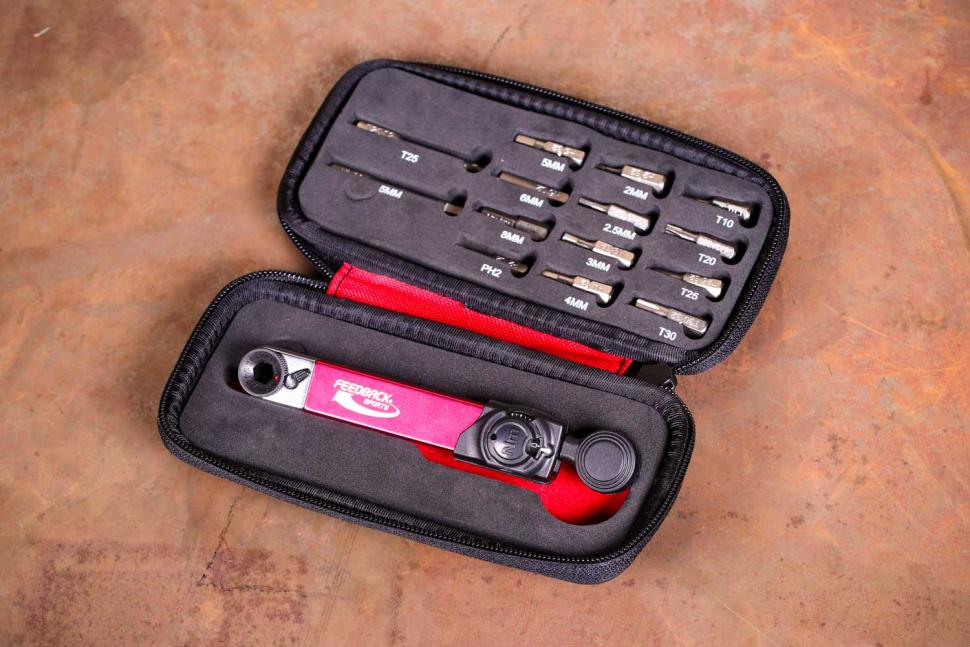
The Feedback Sports Range Torque Ratchet is a lightweight, compact tool for working on your bike while adhering to ever-more-critical torque settings. Made from premium materials with a price tag to match, this may be the perfect Significant Event Present for the cyclist in your life.
It has a wide 2-10N·m range and includes every bit you’re likely to ever need. It’s intuitive to use, and multi-functional for undoing and tightening without removing. The fine ratchet and compact clearance makes it ideal for bolts in awkward places.
Read our review of the Feedback Sports Range Torque and Ratchet
BBB TorqueFix BTL-73
Buy Now for £48.71 from Winstanleys Bikes
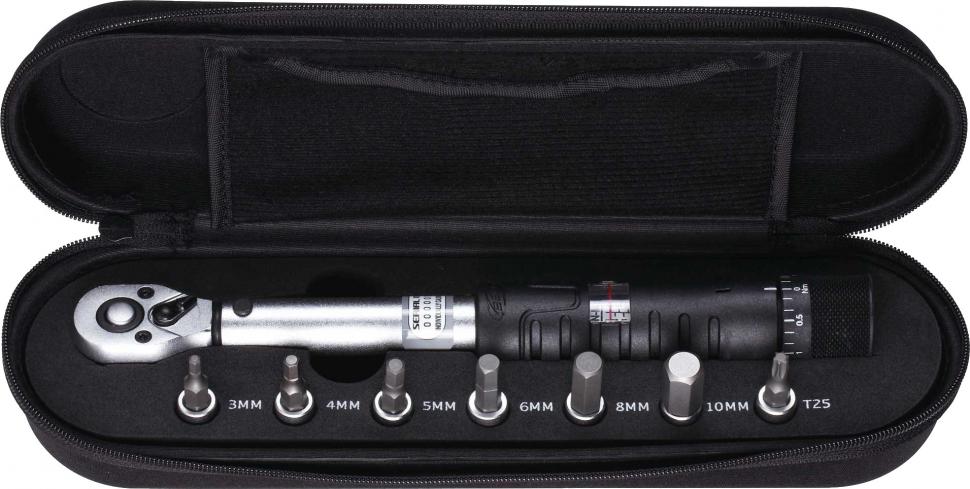
Not as sophisticated as the Giustaforza, but much, much cheaper, this is a decent generic torque wrench at a very reasonable price. There are several very similar tools available: the X-Tools Pro Torque Wrench and Pro Bike Gear torque wrench are almost identical. Buy whichever you can find cheapest.
Topeak D-Torq
Buy Now for £183.99 from Wiggle
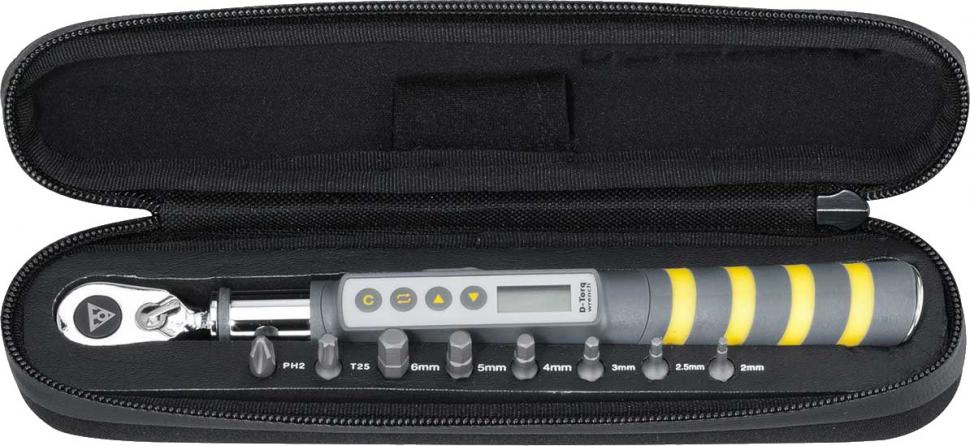
The Birzman digital wrench we mentioned earlier is no longer available, but this Topeak torque wrench with a digital display is very similar. It has a ratcheting head, a range of 1-20 N·m and can be set in 0.01N·m increments. To be honest, that’s a tiny bit silly. It’s hard to imagine needing more than 0.5N·m precision, but it’s amusing for geek points.
If you need more oomph, the £168.53 D-Torq DX has a range of 4-80N·m.
Ritchey Torque Mini Tool Key Set – 4N·m or 5N·m
Buy Now for £21.98 – £30.20 from Amazon
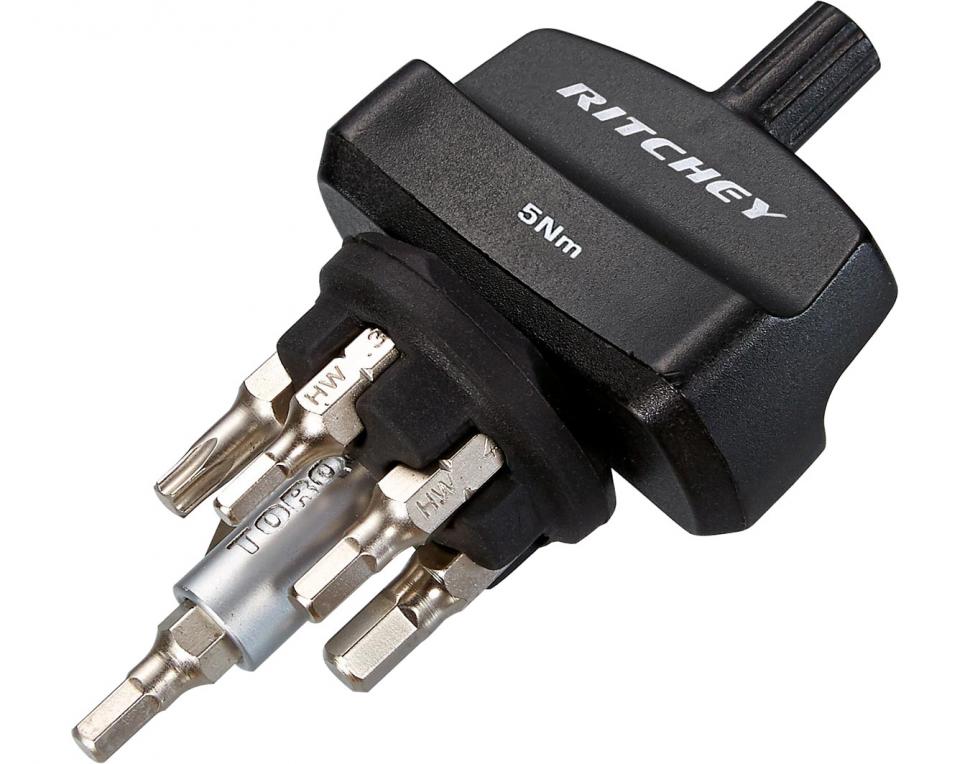
Ritchey popularised the idea of a single-setting torque wrench with its first Torqkeys, but they were also supplied with just one hex size, which was fine if it was the one you needed, but a bit limiting if not. The latest version bundles a selection of useful bits with either a 4N·m or 5N·m body. Moulding a driver for a Shimano Hollowtech crank cap into the handle is a nice touch.
Things to know about torque wrenches
Reckon you’re too smart to trash a component by over-tightening it? It’s easily done. The mechanics at your local bike shop will tell you about people who’ve cost themselves a lot of money by getting it wrong. Torque wrenches aren’t exactly cheap, but buying one could save you a lot of cash in the long run.
You’ll also need a torque wrench to install some power meters so they provide accurate measurements, though this is less common than a few years ago.
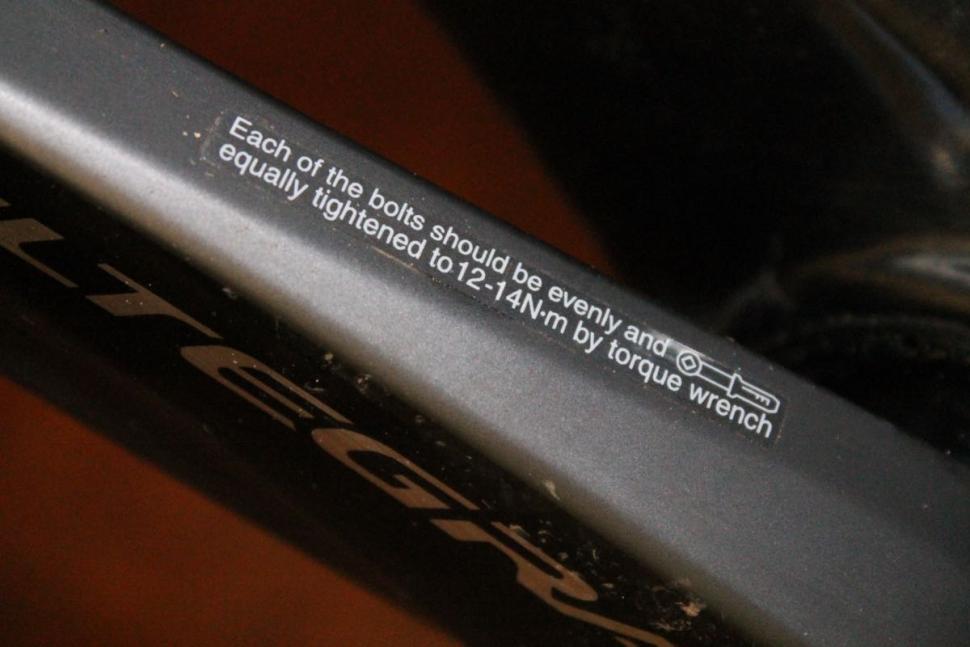
The amount that you should tighten a bolt varies between components, so always check manufacturers’ recommendations.
This Shimano Ultegra crank, for instance, comes with the instruction: “Each of the bolts should be evenly and equally tightened to 12-14N·m by torque wrench”. The N·m stands for Newton metre.
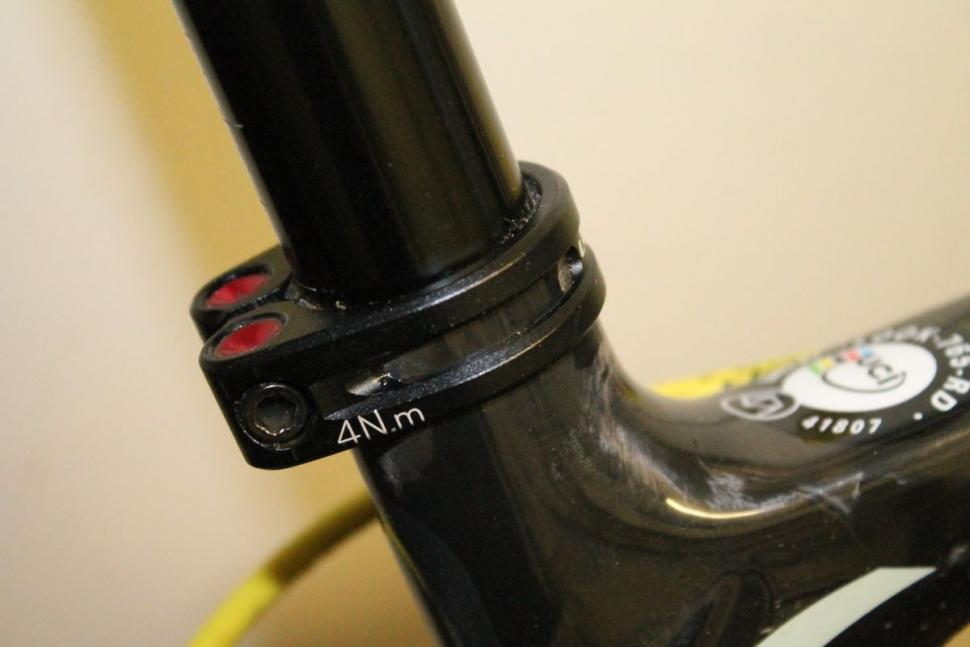
If you’re wondering what a Newton metre is, it comes from the definition of torque. A torque is a rotational force. Force is measured in Newtons, as you’ll recall from GCSE physics. Torque is the force multiplied by the distance between the point where it’s applied and the centre of the bolt. You get a torque of 4 N·m by applying 4N to the end of a spanner a metre long, or — if you don’t happen to have a set of stupendously large spanners — a 40N force on a 10cm spanner.
The right torque for a particular bolt depends on what it’s made from, what the parts it fits into are made from and — if it’s part of a clamp — what the thing it’s clamping is made from, among other things.
Torque wrenches have become a must-have in the last few years because there’s so much carbon fibre and very light aluminium in modern bikes. Clamps around carbon components can easily do damage if over-tightened, so a torque wrench is essential if you’re handling such gear.
A torque wrench is also useful for big jobs, when you may not realise just how tight something needs to be. Square taper cranks, for example, typically need around 40 N·m, which is surprisingly hard to achieve without a long spanner.
Torque wrench types
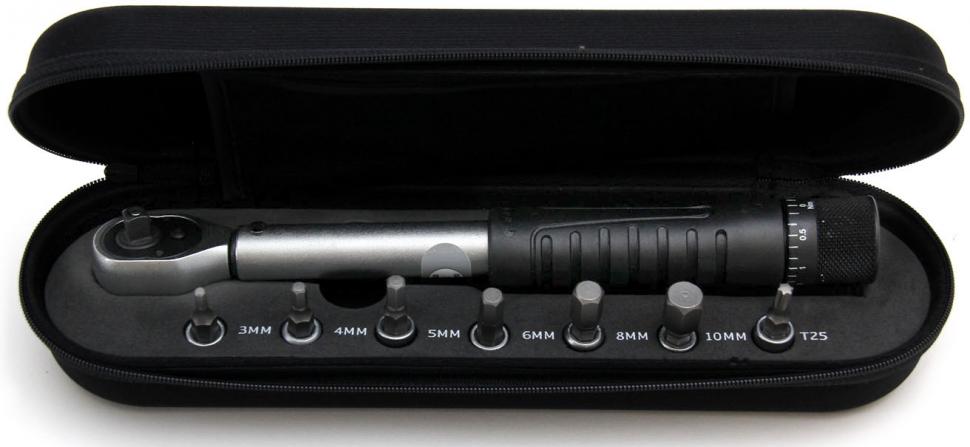
Different torque wrenches work in different ways, but one common type allows you to set your required torque by turning a knob at the end of the handle. You fit the appropriate head, then turn the wrench until a distinct ‘clunk’ tells you that you’ve reached the correct torque.
To maintain accuracy, manufacturers of adjustable click-type torque wrenches usually recommend you send the tool back to the factory to be calibrated after a certain amount of use: check the manual for your tool’s particular requirement.
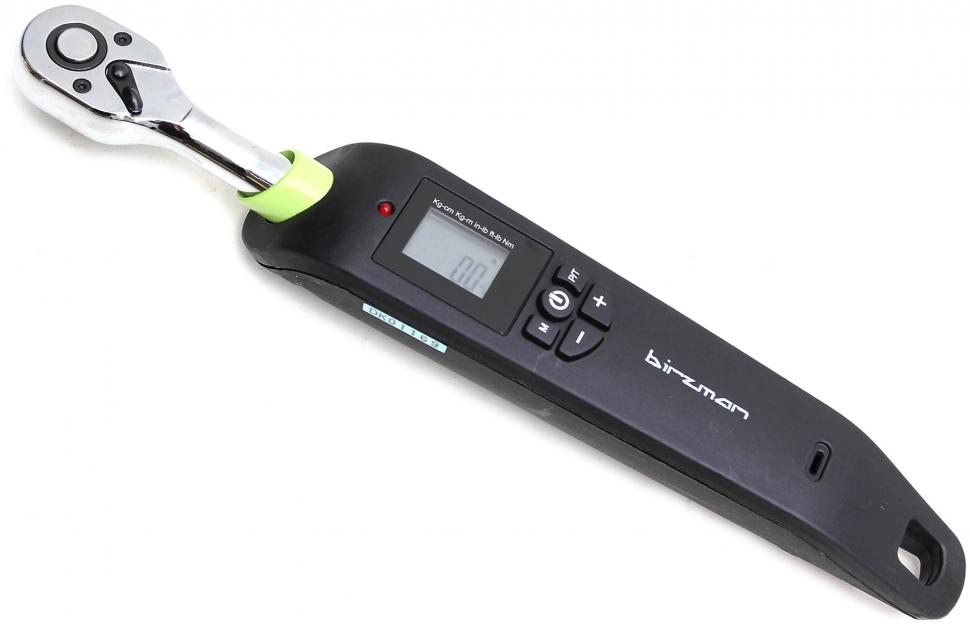
If you can’t live without an LCD display, then there are torque wrenches that’ll feed your desire for digits. You can either read the torque from the display as you tighten the bolt, or set a target torque and it’ll buzz and flash a light when you reach it.
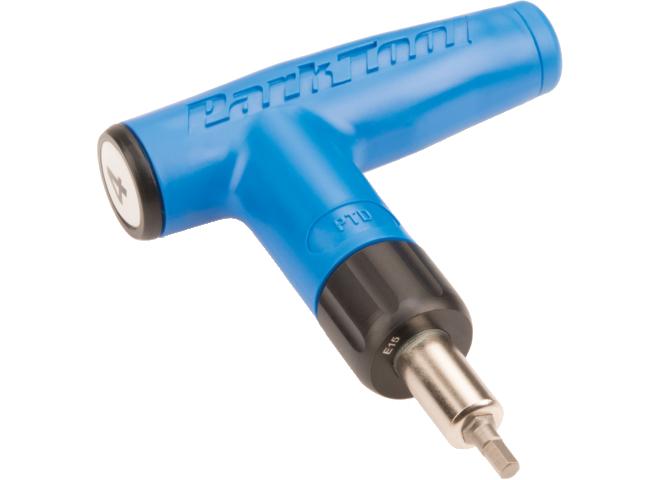
One other option is to use something like this Preset Torque Driver from Park Tool. This one allows you to tighten 3, 4, 5mm and T25 bolts accurately to 6N·m, clicking when you’ve reached the required torque. Drivers set to other torques are available.
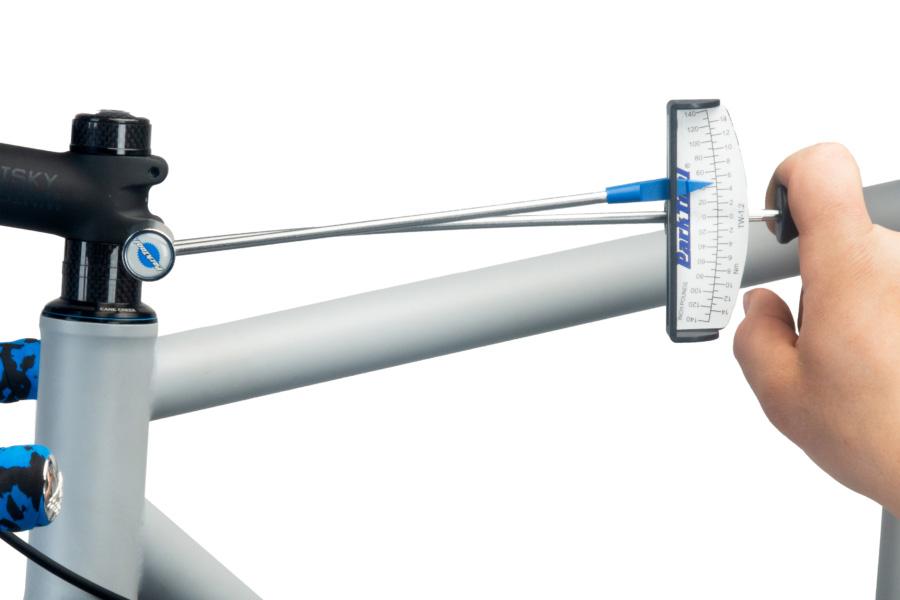
You might also run across a beam type torque wrench like the Park Tool TW-1.2, above. This indicates torque with a pointer that simply indicates how much the tool’s main arm has deflected as you turn the bolt. Beam wrenches are incredibly simple, very tough and don’t have to be sent back to the factory to be recalibrated. If the pointer isn’t on zero when the wrench is at rest, you just bend it until it is.
However, you can’t set the torque in advance and get a satisfying click when you reach it, so beam-type wrenches are now less common. That said, Park Tool have just reintroduced theirs.
Explore the complete archive of reviews of workshop tools on road.cc











20 thoughts on “Best torque wrenches 2026 — get your bolts to just the right tightness”
All torque wrenches need to
All torque wrenches need to be regularly recallibrated to acurate, and therefore useful. The clicky types are the worst for going out of callibration and so I would highly recommend getting a beam type torque wrench. I bought a cheap one from Decathlon for £7 and have checked the callibration and it is spot on. Why would I spend more on a clicky one that, to be honest, I wouldn’t trust. I speak here as someone who has worked as a proffessional mechanic on both bicycles and motorcycles where the use of an acurate torque wrench is essential.
iandusud wrote:
That £7 Decathlon torque wrench is probably the best value tool I’ve ever had. Enough heads for all finishing kit bolts and will do 1 to 12 Nm. The cheapest tool on this list is >3x the price, only does one torque setting and is not calibrateable…
Beam type torque wrenches
Beam type torque wrenches have another overwhelming advantage… you can monitor the torque as you approach the target value to get a feel for the torque-tension relationship and a more consistent result. Bought a cheap little one on E-Bay that will easily fit into a jersey pocket or saddlebag. (And I have a big one for tightening car hub nuts to 150 lb-ft..)
I’ve found the Topeak Combo
I’ve found the Topeak Combo torque wrech with its bright yellow dial to be very useful and easy to use, costs a fraction of the ones in this article and, as rh2059 says yoy can see when you are approaching the required torque figure.
What do You think about
What do You think about TOPEAK Nano Torqbox X 2-6 Nm?
Lukasz 3City wrote:
2-6 Nm (my mistake)
Lukasz 3City wrote:
I’ve got the 5Nm Topeak Nano torque thingy and I think it’s great – probably the smallest and lightest way of having a torque wrench with you. I team it up with a small ratchet driver and the relevant hex bits to make a very small yet capable toolkit.
Looks like Topeak do a new model: https://www.topeak.com/global/de/products/mini-tools/1158-ratchet-rocket–lite-ntx+
I’ve got a Topeak Nano 5Nm in
I’ve got a Topeak Nano 5Nm in my saddlebag and the X Tools ratchet torque wrench from Wiggle for use at home. The Nano is a brilliant idea as you can carry the bits inside the handle.
https://youtu.be/FU-tuY0Z7nQ
https://youtu.be/FU-tuY0Z7nQ
Not the nine o’clock news.
I bought an x tools torque
I bought an x tools torque wrench from Wiggle for £30+ a few years ago. The same torque wrench is widely available under different brands names and widely get 4 stars or so in the reviews.
After the 4th stripped thread/broken bolt followed by blind panic I’d f**led something real bad on my carbon bike I did some research and bought the effeto one for £120.
Best money I’ve ever spent. Brilliant bit of kit, it just works and you can send it back to get calibrated after a set amount of use.
I’d never trust a cheap torque wrench again, they are not the same. Maybe I got unlucky with my one but honestly, I’d rather spend a but extra on this then take a gamble. It’s one if those lessons you have to learn though, most people would still go for the cheap option tbh until they have my experience.
Was it this model that you
Was it this model that you got?
https://www.probikekit.co.uk/bicycle-tools-and-maintenance-nc/effetto-mariposa-giustaforza-ii-2-16nm-torque-wrench-black/10772542.html
And, does anyone have any experience of the Wera A5?
If you can afford that Wera,
If you can afford that Wera, dare I say you may as well stretch to the Effetto Mariposa? ProBikeKit has the non-ratcheting version for 100 quid, and usually stocks the ratcheting Pro version for 145 or so (out of stock on the day I typed this).
The range of the Effetto (2-16NM) is perfect. Oh, and at 5000 actuations between services, you’ll probably be fine! 🙂
Well, the non-ratchet Effetto
Well, the non-ratchet Effetto is actually cheaper than the Wera anyway. But is it better? I see that you can have it recalibrated for €35 +pp, which is a comfort. But how does it work sans ratchet – is it just a fixed 1/4 inch square drive? How do you get along then in tight spots where you might only have a few degrees of arc through which to turn the tool?
The one I bought was this
The one I bought was this (with a decent discount):
https://www.probikekit.co.uk/bicycle-tools-and-maintenance-nc/effetto-mariposa-giustaforza-ii-2-16-pro-deluxe-torque-wrench-red-includes-bits/10772539.html
I know, late to the party but
I know, late to the party but I got the Wera torque wrench back in late 2018 (after the cheapo, alright at a pinch, Brand X stopped working). Back in 80/90s classic motorcycles and their maintenance – engine rebuilds etc – was my hobby; I do similar now with my bicycles now.
Fwiw the Wera torque wrench seems like a really nice bit of kit. Standouts, adjusting the torque setting is the quickest and most pleasant experience I’ve come across on a non-digitial tool. Drive reverse and socket release works well. Ratchet mechanism is fine grained enough to be useful with a small arc of movement. Still works lovely and add on the affordable recalibration facility from a German company that’s been going since 1936 – If I lost it I’d definitely buy another.
Let just leave this one here:
I’ll just leave this one here:
https://www.tredz.co.uk/.Ice-Toolz-Ocarina-Torque-Wrench_117901.htm
Can you use it to turn back
Can you use it to turn back time?
mdavidford wrote:
If I could find a way…
No idea why these bike
No idea why these bike specific ones are so bloody expensive?? I got a Sealey one for around £25 and has been nothing but brilliant. I looked around a lot at the time and all the no bike specific ones, that looked just like the bike specific ones, we’re so much cheaper.
“Force is measured in Newtons
“Force is measured in Newtons, as you’ll recall from GCSE physics…”
Ooh, this web site is sooooo ageist