


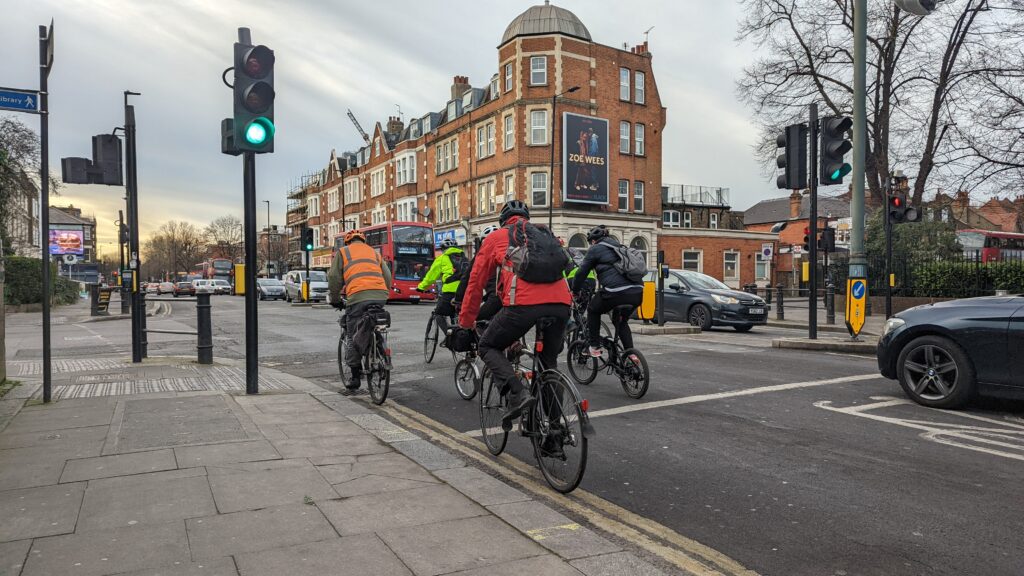

A study looking into the mechanisms behind why cognitive performance improves in response to exercise has revealed that forced electrical muscle stimulation does not have the same effect as cycling at a moderate intensity.
Researchers from the University of Portsmouth’s School of Psychology, Sport and Health Sciences had their paper published in the European Journal of Applied Physiology. The new study asked 24 young, healthy male participants to complete cognitive tasks at rest and while cycling, with the same tasks completed while Electrical Muscle Stimulation (EMS) was applied to the leg muscles.

Participants completed the tasks quicker when moderate-intensity exercise was done, low-intensity exercise and only forced electrical stimulation not having the same effect.
> Cycling your commute can lower risk of death by 47%, as long as you aren’t hit by a driver
EMS is a practice often used in physiotherapy and rehabilitation to loosen tight muscles and it works by triggering nerves that make muscles contract.
“Our results suggest that the relationship between exercise and brain activity is crucial for faster reaction time,” Dr Joe Costello, one of the paper’s co-authors said. “Forcing the muscles to move using an electrical current takes away this connection, and as a result participants didn’t experience an increase in cognitive performance like they did while cycling.
“Not everyone is able to reap the benefits of physical activity — like faster reaction times — because of injury or disability. If we figure out exactly what it is that causes cardiovascular exercise to improve cognitive performance then we can potentially replicate this and remove the need to do moderate-intensity exercise.”
The University of Portsmouth noted the findings support previous research by the team which suggested dopamine has a significant role in the relationship between exercise and cognitive function, while the team had also previously demonstrated that 20 minutes of exercise can boost brain function after a poor night’s sleep.
Soichi Ando, Associate Professor in the Health & Sports Science Laboratory at the University of Electro-Communications in Japan, said: “These latest findings suggest that standard central neural activity — which happens during low-intensity and forced movement — isn’t enough to cause improved reaction time.

“Instead it may be — at least in part — the result of enhanced sympathetic nervous system activity, which happens during moderate-intensity exercise. Your sympathetic nervous system is best known for its role in responding to dangerous or stressful situations, where it activates to speed up your heart rate and deliver more blood to areas of your body to help you get out of danger.”
The researchers did acknowledge the study would have benefited from using a larger sample size, additionally one that is more diverse and included women and older participants.





















12 thoughts on “Researchers find cycling better for boosting cognitive function than electrical muscle stimulation”
Best make it compulsory for
Best make it compulsory for all elected politicians then.
Quote:
Because, of course, cognitive benefits aside, doing exercise is a terrible thing to be avoided at all costs.
Presumably because it’s:
Presumably because it’s:
a) harder to patent, brand, package – and thus create large potential gravy gradients (which in turn attract interest and more moolah).
b) Most people apparently have an aversion to most exercise. So that would be “change!” for anyone interested in promoting it. That’s why despite lots of advertising campaigns and even money put in people appear to be doing less. *
Luckily some places have found that there is a way to get more of this – provide for active travel and (gently) discourage driving. This increases the amount of “incidental exercise” – perhaps not by very much but it does. Cycling is particularly good as it’s “easier than walking” BUT the intensity of exercise is easy to vary – indeed continuously variable – just go faster. And people who have problems walking can join in also!
* Of course there are lots of reasons. We live in a “driveogenic environment” and “work” is increasingly a sedentary activity. As indeed “socialising” and “shopping” can be via our devices.
mdavidford wrote:
Because, of course, cognitive benefits aside, doing exercise is a terrible thing to be avoided at all costs.
Perhaps if you’d been doing moderate excercise while reading the article you’d have not have missed this phrase that precedes your quote:
“Not everyone is able to reap the benefits of physical activity — like faster reaction times — because of injury or disability. “
Not entirely convinced that
Not entirely convinced that was there when I read it.
But in any case
mdavidford wrote:
That’s standard research methodology for virtually all early phase, small scale medical trials. They want to limit potential variables as much as possible, so don’t want any pre-existing medical conditions, and for trials where there’s a risk of an adverse reaction, they want them to start off as healthy as possible so they will (hopefully) have more resilience to anything that goes wrong. They prefer men because their hormone levels are typically more steady.
The former makes sense for early trials, but the latter is a source of contention that virtually all medical treatments have been honed based on data collected from studies on men.
If you had only people capable of cycling to moderate intensity in the cycling group, and only people who are not capable of cycling to moderate intensity in the non-cycling group – how do you know if the difference in observed results are due to the different actions during the trial, and not the inevitable differences in lifestyle the rest of the time?
FionaJJ wrote:
Right, but it means that it’s a bit of a leap for them, at this point, to then claim / speculate that they’ll be able to apply this to people who are not young, fit and healthy (or indeed, male). Whatever’s going on with this group may not work the same way in others.
But then, sadly, I guess your press release doesn’t get so much attention when you just say “we found this thing – it’s interesting, but we don’t really know what it means yet – we need to do some more work on it”.
mdavidford wrote:
Seems like a reasonable assumption to me as most things apply similarly to both men and women and where there are differences, it’s usually in the size of the response. Obviously there are some medicines/behaviours which only benefit men or women, but they’re in the minority – I don’t see why the response to exercise would be much different between men and women.
I think it’s safe to say that
I think it’s safe to say that if moderate exercise improves cognitive function for men then it will improve it for women. How drugs are absorbed, extreted, and interact with everything else going on in the body is more complicated. But so long as the regulator doesn’t require it, then drug companies won’t bother.
I’m not saying it is super
I’m not saying it is super-rigorous work and can be extrapolated to eveyrone. I’m saying that you can’t claim they are advocating everyone can avoid the chore of exercise because they used fit young people as a control group against a technology they say they hope will benefit people not able to do exercise.
They say themselves they don’t have enough data to leap to conclusions, but in this case chosing fit young men will be about limiting variability within the two groups. Regardless of exercise or gadgets, take a group of men in their twenties and their basic cognitive function will be more closely grouped than the same sized group of men if they were all in their sixties, or a group that ranged from twenties to sixties. They need to limit that intra group variability so any differences between the groups carry more weight.
I don’t know why people are quite so quick to assume the worst of those doing the study. The findings, while admittedly limited, don’t advocate for replacing cycling with a gadget. That might be bad news for people who are unable to cycle, but it is good news for those advocating the benefits of cycling.
Personally, Im just there to
Personally, Im just there to race all the other people on bikes and in cars sitting in traffic.
Cycing to work and home is like an 8mile mini-crit to me. I always lose regardless as I’ll stop at every red trafficlight while all the people who I did leave behind, sail right past me even though the lights havent changed.
Unfortunately it is what it is.
Handy, I was just trying to
Handy, I was just trying to decide which of the two to do today