


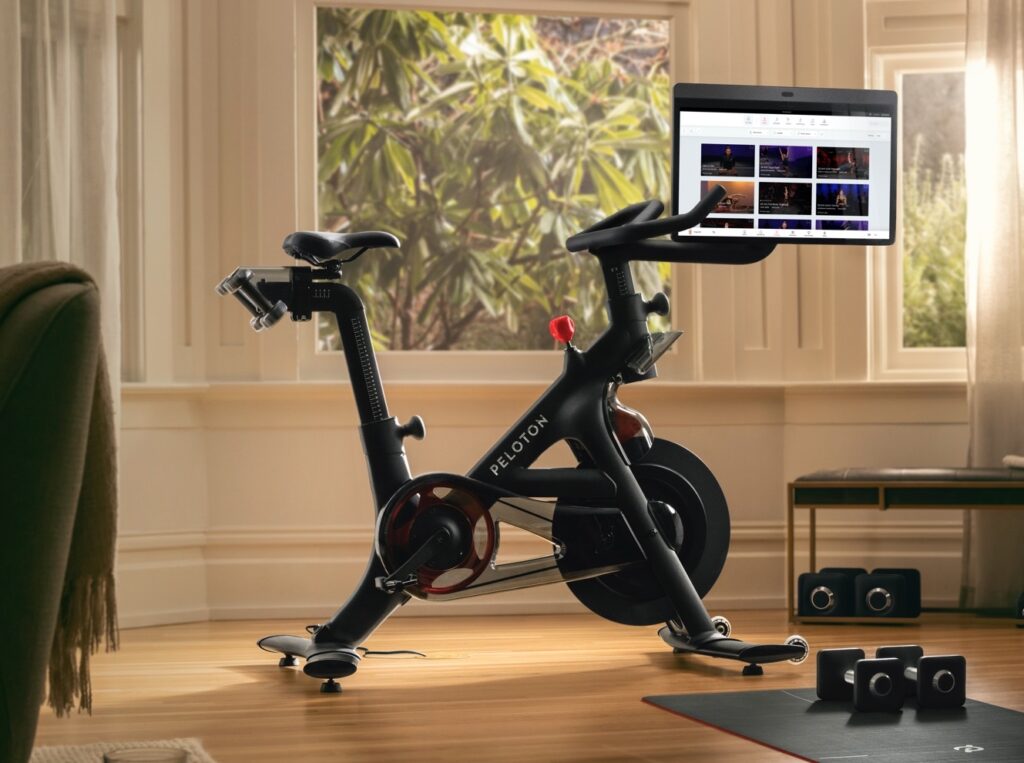

After a turbulent period characterised by restructuring, a curtailed retailed presence, and a series of layoffs, Peloton has reported its first sales increase in nine quarters, beating analysts’ estimates and sending shares surging as much as 41 per cent.
This rare bit of positive news comes as the American fitness company confirmed that it will start charging customers a £72 “activation fee” when they buy one of their exercise bikes second-hand.
In May, at the same time CEO Barry McCarthy stepped down, 15 per cent of Peloton’s workforce (around 400 people) was made redundant in another round of cuts, a cull which McCarthy claimed was necessary to bring the New York-based brand’s spending in line with its revenue, following three years of continuous losses thanks to sales of connected indoor fitness equipment plummeting as Covid-era restrictions eased.
McCarthy, a former Netflix and Spotify executive who joined Peloton in February 2022, replacing co-founder John Foley, was responsible – almost immediately – for making 2,800 staff (20 per cent of the total workforce) redundant that same month.
His other tactics for halting the company’s falling sales and revamping its business model included cutting back its own retail presence due to weak demand, ending its app’s free membership option, expanding into corporate wellness, and creating a rental bike programme.
McCarthy also outsourced Peloton’s manufacturing process from the US to Taiwan, and secured deals with Lululemon, Hyatt hotels, and Amazon, the first time Peloton had partnered with a third-party retailer to reach consumers.
These changes and restructuring now appear to finally be paying off, with the American fitness company reporting a 0.2 per cent rise in sales for the fourth quarter, Peloton’s first year-on-year growth since 2021, as the brand’s shares experienced their best day in 18 months.
Peloton delivered an adjusted core profit and free cashflow for the second consecutive quarter, while its fourth-quarter revenue of $643.6m (£488m) – which was $13m above analysts’ predictions – resulted in an overall loss of $30.5m (£23m), down from $241.8m (£183m) over the same period last year, prior to the latest large-scale cuts and restructuring.
Peloton also revealed that it is has refinanced its debt to avoid a liquidity crunch, giving the company more time to continue its plans to turn things around, which include continuing to search for a new CEO.
“From Q3 to Q4, the narrative has changed from Peloton needing a life jacket immediately to being able to tread water for a bit longer,” Paul Cerro, chief investment officer at Cedar Grove Capital Management, said in response to the figures.
> Peloton’s parting gift to 2,800 employees it just fired? A year’s free membership…
Meanwhile, in another bid to turn the tide on Peloton’s post-pandemic slump, the company today confirmed that it will begin charging customers a $95 (£72) “activation fee” when they buy one of its £1,345 exercise bikes from the secondary market.
Customers who buy a used bike through Peloton’s official resale channels – which charge around double for refurbished, second-hand bikes compared to eBay, for instance, where they can be found for roughly £500 – will avoid the added cost, which will initially only apply in the US and Canada.
Peloton’s customers already pay a monthly subscription fee of £39 to use the brand’s bikes and treadmills, which connect them to online fitness classes and personal trainers.
According to the company, the fee would allow buyers to “receive the same high-quality onboarding experience Peloton is known for”.





















12 thoughts on “Peloton set to charge customers £70 for using second-hand bikes, as brand’s sales finally rise by 0.2%, prompting shares to surge months after large-scale redundancies and restructuring”
Quote:
Just when one thought one couldn’t have more contempt for Peleton (ridiculously high prices, vastly irritating screaming instructors, that appalling sexist Christmas advertisement et cetera) they up their game by describing “charging $75 to let you join our overpriced nonsense” as a “high-quality onboarding experience”, throwing in some ugly grammar for good measure (“for which Peloton is known” please). Excellent work.
So is that “onboarding fee” (
So is that “onboarding fee” (?) in addition to the monthly subscription that you’d be paying in order to use their service (even on a second-hand machine)? So they’re charging you £75 for the pleasure of filling in an online registration form? alrighty then…
From what I can see, it’s $92
From what I can see, it’s $92 if you buy a secondhand bike that’s not sold through their own sales channel (which the article says charges about double the price).
The Peloton story is almost like a sitcom script that outlines a series of stupid ways to either screw your customer or shoot the company in the foot. The fact that it even exists shows what a mess our so-called ‘developed’ societies are in.
Simon E wrote:
It’s just late stage Capitalism. Companies are moving on from merely exploiting their workers to now attempting to exploit their customers
Here’s a prophetic novella from Cory Doctorow, titled “Unauthorized Bread”:
https://arstechnica.com/gaming/2020/01/unauthorized-bread-a-near-future-tale-of-refugees-and-sinister-iot-appliances/
Thanks for the link to the
Thanks for the link to the short story – it was good read!
Capitalists: It doesn’t
Capitalists: It doesn’t matter what a product costs to manufacture, the price is determined by what people are prepared to pay for it. Market forces rule all, they cannot be denied, praise be the market.
Also capitalists: Oh no, people are selling our product for too little, and we’ve run out of rich and stupid people willing to buy at our price. We need to artificially inflate it. Market forces, sharmarket forces. Fuck the market.
You sound nice. If I were you
You sound nice. If I were you I’d stop buying things on “the market”. Hit them where it hurts. Show them who’s boss.
I’m getting the impression
I’m getting the impression that Peloton isn’t the best brand for caring for their customers
On the other hand, and in
On the other hand, and in deference to those comments below referring to ‘the market’, there is at least an element of ‘anyone who voluntarily chooses to be motivated by an annoying pushy American accent deserves all they get’.
Given this demonstration of
Given this demonstration of stunning incompetence and inability to read the room, I wonder if this is the same guy who made the decision to structure Spotify’s architecture in such a way as to render lossless streaming impossible?
Peter Principle springs to mind here.
What’s this got to do with
What’s this got to do with cycling?
The effect of this will be to
The effect of this will be to depressing the second hand value of Peloton bikes. Having shafted their customers on the way in with overpriced hardware, shafting them on an ongoing basis with their overpriced subscription, they’re now shafting them on the way out too.