


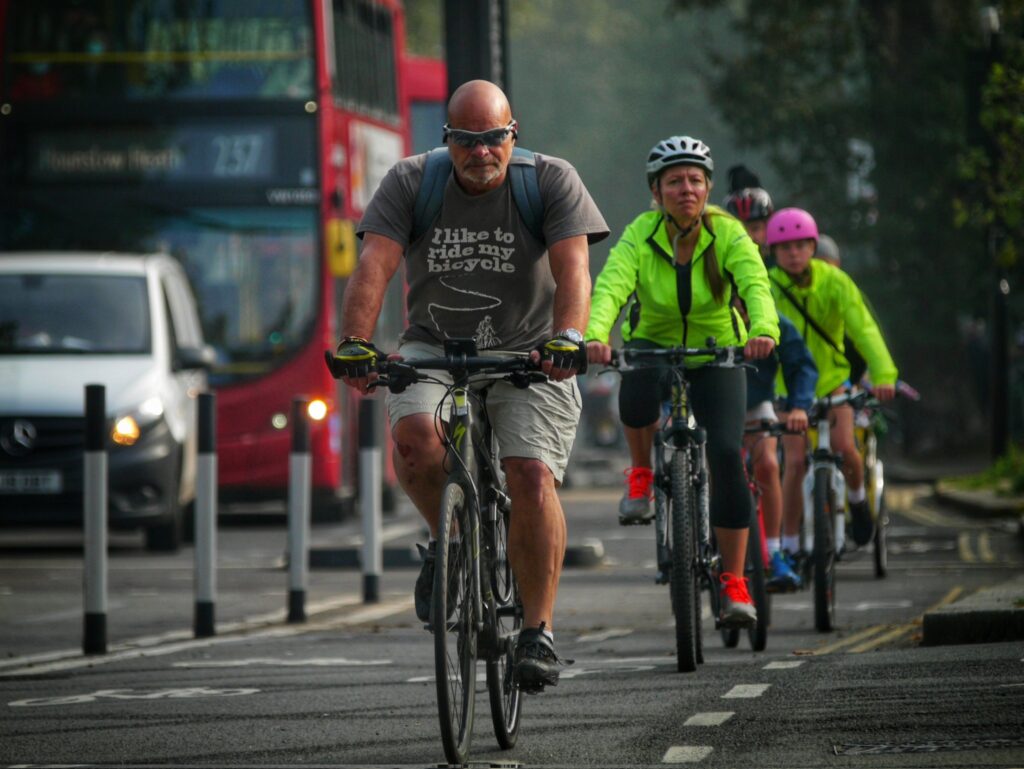

A new study has found that cyclists are more caring than drivers, with the authors saying that the findings suggest that “the benefits of cycling over driving are more profound and sustainable than previously thought.”
Published in the November 2023 edition of the Journal of Environmental Psychology under the title Orientation towards the common good in cities: The role of individual urban mobility behavior, the study was based on annual surveys of the general population in Germany between 2014 and 2019.
It aimed to explore they relationship between cycling and driving in urban environments and disposition towards the “common good” – a concept linked to social cohesion that has been the subject of increased focus in recent years, particularly since the onset of the COVID-19 pandemic.
Within the study, orientation towards the common good was ranked according to four separate measures – “political participation, social participation in organisations, neighbourhood solidarity, and neighbourly helpfulness.”
According to the authors, led by Harald Schuster of the Faculty of Psychology at the FernUniversität in Hagen, North Rhine-Westphalia, “cycling rather than driving was positively associated with orientation towards the common good in all models.
“Cycling was the only variable that was a significant positive predictor for all four facets of orientation towards the common good after controlling for possibly confounding variables (homeownership, personal income, education, sex).”
The authors said that the findings were explained by the different experience of the surrounding environment, and the opportunity for interactions with other people, that drivers or car passengers have compared to those who cycle for everyday trips.
Noting that the private motor car “dominates public space and has become the dominant norm for urban mobility,” they said that “because of the design of cars, the interactions car passengers have with their direct environment are significantly reduced,” chiefly because the vehicle insulates them from the outside world.
“It is likely that the different ways in which people use and interact with their environment lead to differences in the perception of orientation towards the common good,” the study suggested.
“We assume that the frequency and directness of interaction with the neighbourhood environment influences the extent of perceived orientation towards the common good. For instance, when neighbours have the opportunity to talk to each other or have the opportunity to see positive changes in the neighbourhood directly this might positively affect perceived orientation towards the common good.
“People’s mobility behaviour might increase these opportunities in a way that people who walk or cycle through the neighbourhood have more opportunities to meet, talk and interact with their environment. This may increase their experience of orientation towards the common good.”
In conclusion, the authors said that “this research demonstrated that mobility behaviour is associated with the orientation towards the common good.
“These findings are significant for policy and planning because the benefits of cycling over driving are more profound and sustainable than previously thought,” they added.
As we often mention on this site, it’s worth bearing in mind that many cyclists also drive, and choose to use a car or bike depending on the journey being undertaken – indeed, market research consistently shows that in the UK at least, adult cyclists are slightly more likely than the population as a whole to hold a driving licence.
And while that underlines that very often, drivers and cyclists are one and the same person, differentiiated only by the mode of transport they happen to be using at the time, that certainly doesn’t mean that their experience of the world while using a car or a bike is identical.
If you ride a bike and also drive, ask yourself this question – how often do you spot something in your local area that you haven’t noticed before when cycling compared to when you’re driving? And when was the last time you had a friendly chat with a fellow motorist while waiting for the traffic lights to change?



20 thoughts on “Cyclists are more caring over range of issues affecting their communities than drivers, study finds”
I personally think that
I personally think that riding a bike is more enjoyable and more focused than driving, and you can truly appreciate the scenery along the way!
Probably won’t see it next
Probably won’t see it next week as the darkness will arrive earlier, but the yellows in the woods off the gravel road as I approached the ranges on my way home on Friday, in the glorious golden light of autumn was just spectacular.
Not had much of the dew covered spiders webs glinting in the sunlight on the gorse yet in the mornings, got that to come…
I notice how on my commute
I notice how on my commute (and other rides) I can interact with people, see and hear the wildlife and feel a connection with the landscape I’m moving through. You can never get that feeling in a car, not even a convertible.
Yes – you’re *in* a car, so
Yes – you’re *in* a car, so it’s your own private bubble, possibly with a couple of others. (Insulated from your own road noise, maybe with your music, radio, scented furry dice, phone…)
Cycling – you’re in the environment, with everyone else outside of vehicles.
Something something situational awareness? 😉
Having tried a range of riding positions from nearly on my back to TT I’d say that the roadster / Dutch bike “bolt upright” position in particular has the effect of connecting you with other road users, particularly pedestrians. Perhaps something to do with looking straight at people?
OTOH could be just where I’ve ridden that type of bike – more likely to be low traffic urban environments than doing a century.
Well colour me shocked. In
Well colour me shocked. In the voluntary orgs with which I’m involved the preponderance of cyclists is far higher than in the general population, obviously we’re all a frightful bunch of tofu-eating wokerati but it’s not really a surprise…
They left out the bit that
They left out the bit that explains such surveys conclude with apparently clear differentiations between a made-up class “cyclists” and another “drivers”. In reality, the averaging of the observations involved hide the fact that all sorts of people react in many different ways to all sorts of environmental factors, including riding a bike and driving a car ….. but that there are a thousand other environmental factors impinging on individuals that also have effects on their generalised behaviours.
I know many awful and uncaring people who ride a bike; and many habitual drivers who are good and caring folk. And the converse.
*******
Personally I feel that a certain kind of driving experience and also a certain kind of personality amplified by the power of the car, are observable factors in having large and malign influences on behaviours. I know few, if any, who seem to be “better and more caring” only because they ride a bike.
In short: cycling doesn’t seem to be a big factor in determining behaviours but driving a lot in certain environments does, especially in pushing already uncaring people to the extreme of that attitude.
Christ on a bike, what
Christ on a bike, what bullshit next!
Adam Sutton wrote:
Who knows, what have you got?
Nothing, I am not a muppet
Nothing, I am not a muppet who thinks being a “cyclist” makes me special, or needs my ego massged for riding my bike.
Edit: straight in there with the Ad Hominen, a new record!
Adam Sutton wrote:
I think you’re approaching this from the wrong angle.
It’s probably not so much that only the caring people take up cycling, but that cycling gives people a different perspective than just driving a car and certainly cyclists feel far more vulnerable and exposed than drivers do. It wouldn’t surprise me if there’s a similar effect with motorcyclists too.
(No subject)
Adam Sutton wrote:
Wuz that how Jesas got his rep as a nice fellow worth a listen – riding his bike? I pored over the Roman history books I have (not many, admittedly) but despite their fine ballistas and aquaducts I could find no mention of the bicycle ….. .
But perhaps it was the Israelites who invented them? No luck there either in finding a bike inventor of the times, though.
Now, this BS you mention. Although a messy thing, it can prove a fine fertiliser. On the other hand, it’ll grow nettles and docks as well as plums and strawberries. Which do you yourself consume habitually? I suspect … nettle soup, with the stings still in it. 🙂
It sounds feasible and I
It sounds feasible and I suspect that it is due to people’s connection to their surroundings. When you’re in a car, you just view the world through a pane of glass – a bit like watching TV.
hawkinspeter wrote:
I see to recall that Robert Pirsig wrote a couple of pages on that, in Zen & the Art of Motorcycle Maintenance (admittedly, his character was riding a motorcycle, but the same principle applies).
I suspect that in countries
I suspect that in countries where cycling is normal (i.e. the Netherlands), shithousery amongst cyclists might approach the levels of the general population.
…and the result is that the
…and the result is that the average hufter* at large is more likely to damage themself (e.g. on a bike) now as opposed to others. Of course they haven’t gone away and some of them still drive. I think you read about fewer of them driving into shops and houses though **. Or having head-on collisions with other motorists having screwed up an overtake ***.
* https://directdutch.com/2013/03/word-of-the-day-hufter-ill-mannered-person/
** https://www.youtube.com/watch?v=Ra_0DgnJ1uQ
*** https://en.m.wikipedia.org/wiki/Overtaking#Nationwide_ban_on_overtaking_as_road_safety_measure
It’s a similar phenomenon to
It’s a similar phenomenon to community severance: residents on a street interact much less with their neighbours on both sides of the street if that street carries a lot of traffic than if the street is quieter.
“”Grimm, a keen cyclist,
“”Grimm, a keen cyclist, arrived to answer bail last week in Chipping Sodbury. He told a reporter from the Mirror: “Let them bring it on. I’m 49 now, so how could I serve that long?
“These are just allegations, so I don’t want to say anything.” In Florida, over 4,000 miles away from the Cotswolds, prosecutors say he masterminded a synthetic drugs racket which netted more than £5million.””
https://www.gloucestershirelive.co.uk/news/gloucester-news/el-chapo-cotswolds-faces-extradition-8868444
He was doing it in a “caring”
He was doing it in a “caring” fashion though.
This isn’t news. The private
This isn’t news. The private motor car is a means to transport on average 1.2 people in a 1,500kg machine, taking up 2 x 4m of public road and pavement, at speed.
It exudes a significant level of entitlement reinforced by media and government.
Rounded off by a classist culture that can’t move on from workers leaving the factories on push bikes while the toffs drive an automobile.
Passed down through generations, this motor myopia is all too pervasive in culture, policing, policy and law.
Those who do ride face the brunt of all this, and this in turn begins a cycle of questions about ‘what is fair?’
This is why police, judges and highway planners should ride bicycles often, in dense urban spaces and on fast B roads.