


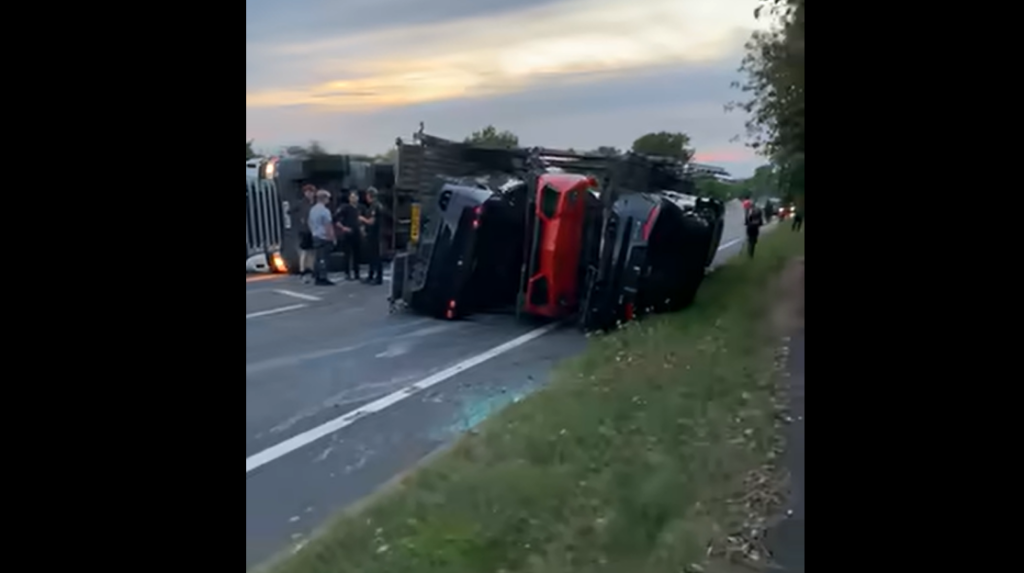

The driver of a car transporter deliberately crashed his vehicle in order to avoid a potentially fatal collision with a group of cyclists, after the large lorry carrying nine supercars began to fishtail in crosswinds on a steep hill.
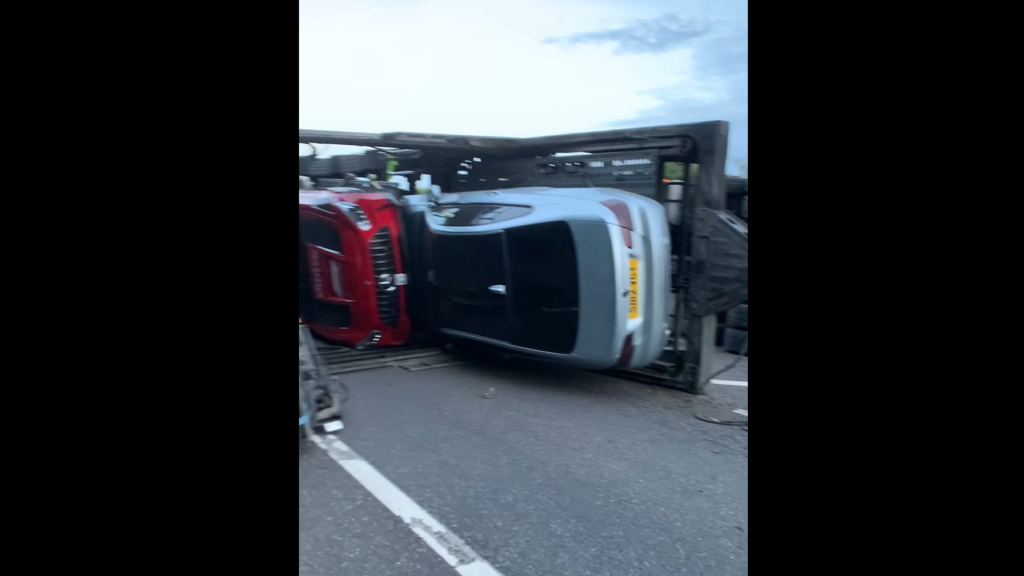
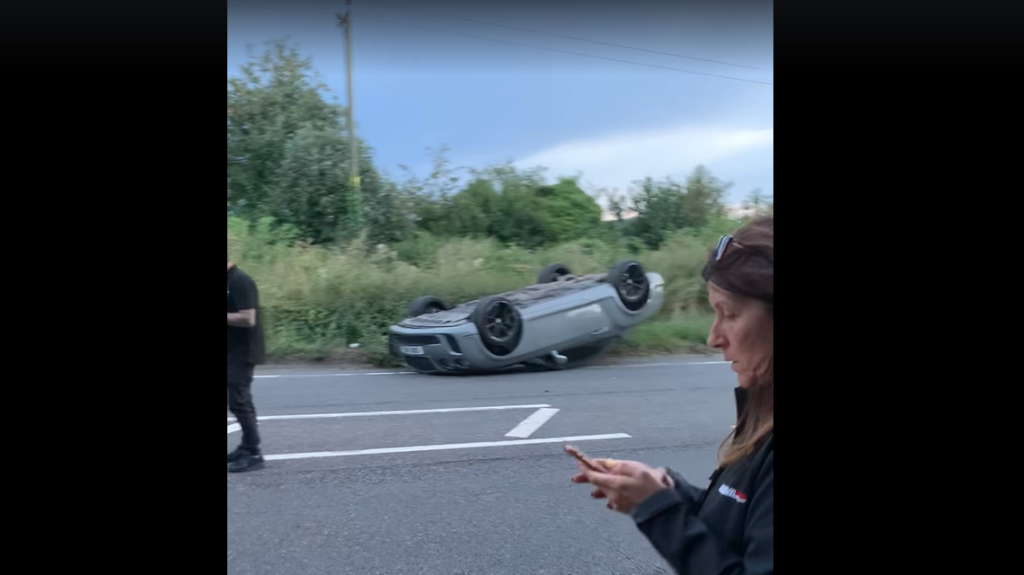
Richard Kilburn’s almost £2 million cargo was written off in the incident on the A20 near Farningham on Wednesday, a video posted on Facebook by Ben Slipper showing the nine supercars smashed and the transporter overturned.
The 61-year-old has been called a hero for his quick thinking to avoid a worse crash as he was taking the cars from Brands Hatch race track in Kent to Goodwood in Sussex.
“It’s a hill and because of the weight the transporter picks up a bit of speed, so I just touch the brakes and try and keep it to 35mph as I go down,” he told MailOnline. “But it began to sway and veer and that’s when I saw the cyclists on the and thought I need to stop now and just jack-knifed.
“Obviously because of the manoeuvre all the cars came off but thankfully no one was hurt and it could have been a lot worse. It was more than 40 tonnes in weight so it would caused a load of damage but the only person hurt was myself with some slight bruising but I’m ok and already back at work.
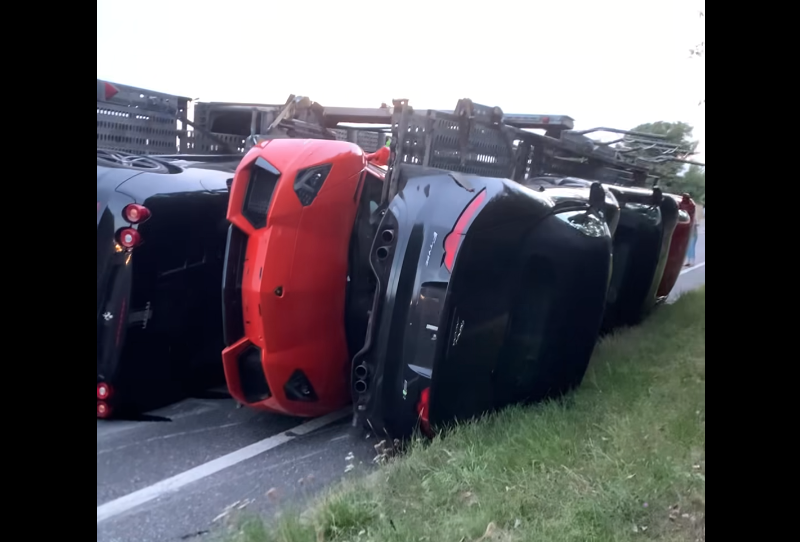
“The whole thing looks worse than it is because of the value of the cars involved and it did cross my mind what the boss would say but the insurance will cover it. The most important thing is that no one was hurt.”
When police officers attended the scene, the driver was breathalysed (testing negative) and was treated for minor injuries.
A source at the driving experience company, Everyman, for whom Mr Kilburn was working told the Mail their employee is “very much the hero in all this”.
“He is a solid driver with years of experience behind the wheel and his quick thinking avoided something which could have ended very differently and very badly,” they explained.
“These things happen but the most important thing is no one was badly hurt – the only damage was to the cars which is nothing compared to someone being hurt or killed.
“Richard has been with the firm for three years and he’s held a licence for 12 years so he is very dependable and knows what he is doing behind the wheel. He tested negative and apart from some bruising from the seatbelt he was fine. The police investigated but there is no suggestion he did anything wrong.
“When you are driving those transporters and there is a crosswind they can sway a bit because of the weight and that’s what happened to him. It got to a point where he reached the tipping point, and it went over but he went over on the side of the road to avoid the cyclists in front.
“If he had miscalculated it he would have ended up squashing them instead of scratching a few cars which will now have to be written off. The insurance teams are looking at it now but it will easily be more than a million to replace them probably more.”
Kent Police confirmed they had attended an incident at 7.57pm on Wednesday 23 August. Among the damaged vehicles were a £271,000 Lamborghini Aventador, a £181,000 Aston Martin DB11, a £170,000 Mercedes AMG, two Ferrari models, and a BMW.
“Officers attended the scene where the driver reported a minor injury. The road was closed while arrangements were made to recover the vehicles,” a police spokesperson said.







105 thoughts on ““Hero” driver deliberately jack-knifed vehicle to avoid hitting cyclists, writing off £2 million supercar cargo”
When I tweeted a sarcastic
When I tweeted a sarcastic “Ah bless, losing control of a 40 tonne lorry just happens.”
I got a couple of nasty kickbacks from presumably lorry drivers.
Just consider this article: lorry drivers and the police think that losing control of a 40 tonne lorry due to a gust of wind is apparently acceptable.
I’d suggest that the lorry was incorrectly loaded, overloaded or being driven too fast for the road conditions.
Could anyone suggest a sane reason for it being acceptable to lose control of a 40 tonne vehicle?
Imagine a train driver detailing or a plane crashing? Why are these things exceedingly rare? Imagine being on a building site where accidents with heavy machinery were just shrugged off?
You weren’t there, you’re
You weren’t there, you’re just assuming.
Why don’t you try thinking better of people rather than the worst and maybe your life might be a bit more fulfilling. Putting people down to make yourself feel better is pretty pathetic
I think the driver was
I think the driver was talking bullshit.
https://twitter.com/ormondroyd/status/1695479793867755807
“Crosswinds? The wind in Farningham on Wednesday peaked at 5mph”
If the vehicle was so susceptible to cross winds, why was he driving it ?
All vehicles are susceptible
All vehicles are susceptible to cross winds.
Here’s an idea … get your provisional HGV, and spend £250 on a half day session with a 15ft 3″ curtainsider.
Go experience it, and then come back and ask the question.
Or are you suggesting that the driver trashed his vehicle and load out of some kind of hero complex?
I questioning his explanation
I questioning his explanation* when the weather doesn’t support it.
What was he going to do if there were other vehicles right next and in front of him ?
Edit * or the mail’s presentation of his interview. The mail and cyclists is normally a bad combo.
You don’t think that he might be stretching the wind factor given the 1M damage?
You actually believe the
You actually believe the weather apps? I have three on my phone, none of them are ever accurate. Mostly the BBC app is completely wrtong, the Met Office can be vague and the Apple weather is the most reliable, but never 100% or near.
Its a record of what happened
Its a record of what happened.
What are you claiming the wind speeds were ?
Biker Phil wrote:
Don’t confuse forecasts with records of past situations
This weather station should
This weather station should show those interested the actual weather at the time:
https://www.wunderground.com/dashboard/pws/IDARTF18/graph/2023-08-23/2023-08-23/daily
For most of the day, the average wind speed was less than 10kmh, with one gust around 4pm maxing out at around 15Kmh.
More likely telling porkies
More likely telling porkies about speed, or was on his phone and had to react to someting he missed.
Farningham that day had wind speeds of up to 8m/s, not enough to significantly affect a properly loaded car transporter.
Porkies about speed is very
Porkies about speed is very easy to prove.
If speed was an issue, then his tacho would be sent away for analysis. Guess the plod were happy with the speed.
Late reaction ….doesn’t have to have been on his phone… could have been mirror checking and saw the group late.
Who knows … unless there is evidence released from an internal camera, the drivers word is all we have to go on.
Oldfatgit wrote:
Well said their are some right smart backsides on here who talk through it.
Hirsute wrote:
Its called his job and winds vary this site has some of the most cynical, unpleasant people. Im sure you never do anything without checking the wind, weather and road conditions for your whole journey before you go out anywhere.
Well done the lorry driver from a cyclist/motorist/ human being.
You assumed that what was
You assumed that what was claimed *and* reported was what actually happened.
Old fat git has described in depth the problems of wind. So we’re left with the driver over egging the wind problem after a 2M damage problem or the industry accepting a degree of inevitable accident as IanM Spencer has argued.
I’ve already stated I do check the wind before cycle trips. Funnily enough I’m very cynical about what the mail publishes. That would be a rational position to take.
What was the actual wind speed ?
I live in the next town. It
I live in the next town. It was clear and dry with only light winds at most.
Sadly there was only scant reporting of the fatal crash further along the A20 earlier that very same day.
Seems to be a lot of nonsense
Seems to be a lot of nonsense being spoken about the weather etc. the UK get on average 40-50 tornados a year. These are extreme and short lived weather events.
now I’m not for one second suggesting there was one that day. I’m pointing out, weather – by its very nature – is unpredictable. Even on an otherwise calm day you can get the occasional strong gust. The sort that picks up kids trampolines from gardens for example. They just come from nowhere then vanish like a fart in the erm…. wind!
it could have been 5mph or 50mph. Usually vehicles are pretty stable. Even car transporters, but add in many variables and line up enough unexpected conditions, anything can happen. Why such a big push to say the driver was talking BS based on what an app might of said. As I mentioned at the start. Those tornados often don’t make it into the records never mine just a strong gust at the wrong time.
didsthewinegeek wrote:
I agree i always look for the best in people and will always help a person. The world is full of moaning whiners who wouldn’t help a soul.
Stephankernow wrote:
and
Alexa, what’s cognitive dissonance?
How to say you have never
How to say you have never driven a high-sided vehicle in your life without actually saying it…
So, let’s put it in to terms you can relate to.
You are cycling along quite happily, and you catch a strong gust of wind from the side.
You will be blown the direction the wind is heading … how far depends on how strong the wind is. If its a strong wind, you will be severely blown off course.
Is that because your are incorrectly loaded on your bike?
No.
It’s because the sail area that you provide is adequate for the wind to over-ride your weight and velocity and push you sideways.
Now … picture a sail 10ft in height and 45ft long … but on a base thats only 8ft wide.
It does not take much of a crosswind before that surface area – 450ft – has captured enough wind to override the weight and velocity.. and before you know it – boom, you are on your side covered in every loose object in the cab.
I’ve been blown over – vehicle weight was 39tonnes of railway sleepers.
Load was secure and low to the bed of the trailer.
However, it was not sufficient to overcome the 450ft of sail area caused by the curtains, and over I went.
Result … M6 between Carlise and Penrith blocked overnight.
I’ve driven almost every single type of trailer out there – from trombones to King; curtainside to fridges, skeleton to separate bogies.
And I hated every single second I was towing a car transporter trailer.
They are fecking horrible to tow as their sail area is unpredictable.
BTw … trains and planes are normally stopped when winds exceed their operational safety limits.
And this accident was investigated – driver was breathalysed and was negative.
If I’m thinking of cycling, I
If I’m thinking of cycling, I check the wind forecast as I’m aware of the risks and consequences. You say “trains and planes are normally stopped when winds exceed their operational safety limits.” What is the equivalent then for drivers of these types of loads?
Depends tbh.
Depends tbh.
Unlike regulated transport, movement of freight by road (except STGO) is mainly at the drivers discretion.
Scotland has recently brought in movement orders that effectively prevented HGVs from moving during high winds – although these had to be severe and it proved to be somewhat counter productive as we ended up with trucks on their sides on the moors as not everywhere has places of safety big enough for an artic to shelter.
Remember that there is only 2 motorway service stations in the entire central belt of Scotland – on in Stirling on the M9 and one at Harthill on the M8.
This had significant cost to the economy as the winds lasted several days and goods couldn’t get delivered.
Edit: not sure if Lesmahagow on the M74 is still there or not.
There is services further South on the M74, but they are Borders and not Central
How does it affect your pay
How does it affect your pay if you refuse a trip? Is not the typical response to find someone who will take it?
P45 was the normal response.
P45 was the normal response.
However, and with all due
However, and with all due respect to your experience, it is also possible for jackknifing to be caused by poor braking, steering, lack of concentration and/or excessive speed for the road and/or conditions, is it not? Given that the weather reports shared above appear to demonstrate that there was nowhere near enough wind at the time to cause jackknifing, isn’t it a bit odd that the police and the driver appear to agree that it’s just one of those things?
I wasn’t there.
I wasn’t there.
I don’t know know what vehicle he was driving.
I do not know how his load was configured.
I’ve never driven his vehicle so I don’t k know the little quirks that it may have.
What I do know is that jacknives are caused by multiple scenarios, including loss of control caused by runaway tipping trailers, as well as hard breaking and turning the steering wheel too hard.
They can also be caused by uneven road surfaces, uneven brake wear, uneven tyre depth.
They can also happen when maneuvering at slow speeds.
They can also be done deliberately – I’ve had 2 x TEUs on a skeleton loaded back to back. The front TEU had to be unloaded by jacknifing the tractor so they could open the doors as the trailer would have been too unstable.
And again, with the caveat of
And again, with the caveat of I wasn’t there, the police would have checked the tacho head which will have showed speed and how hard the brakes were being applied. Many modern lorries also have telemetric measuring devices to show harshness of braking, poor accelaration patterns etc, and also cameras which, if available, the police would also review.
The positive from this was no one was injured badly.
tigersnapper wrote:
If there are no injuries, then their investigation is usually “brief” shall we say.
Not always. VOSA can
Not always. VOSA can investigate too.
Depends on the age of the
Depends on the age of the vehicle as to what the tacho recorded.
I came out just as digital graphs were installed, and given that the paper chart was there to record speed, distance, driving hours /work type, I’d have thought that it’s highly unlikely that the haulage industry has become more prosperous… g-force sensors would be an added extra that would do little to pay for themselves.
Correct. The tacho would be
Correct. The tacho would be the first thing to be checked, as you state, if it was a modern truck it would have had the latest digital tacho installed, which shows all the telemetrics. It can all be checked very quickly, the police, and VOSA have devices that they can point at the sensor and read the data.
Well oddly, my bus route to
Well oddly, my bus route to work, along the seafront clifftops on a dual carriageway, in a double decker, regularly experiences sidewind gusts up to 50mph in winter (much more than that and they close the road) and they all seem to be able to keep it in their lane.
Just saying.
Double decker buses are
Double decker buses are tested differently to HGV as they are passenger vehicles.
“…be capable of leaning, fully laden on top, at an angle of 28 deg without toppling over before they are allowed on the road.”
Feel free to Google UK double decker tilt test.
If however his trailer was
If however his trailer was fishtailing, and they then blame low winds of 8m/s for tipping it, I smell someone not telling the entire truth.
Wind may be a minor factor but I suspect speed and poor loading of the trailer (too much weight behind trailer axles)
And if poor load distribution
And if poor load distribution was an issue, plod would have done the driver for it.
Let’s not forget … traffic police hate trucks more than most car drivers.
I’ve had traffic officers rubbing their hands in glee as they have approached me on routine stops, expecting to be able to get an infringement or two … and then coming away disappointed because I always – absofeckingloutley – drove legal and would refuse to drive anything that I could see had a problem.
I appreciate your in depth
I appreciate your in depth replies from experience.
If the source hadn’t been the mail, I’d be less sceptical.
I think if I’d been involved in something that resulted in 1m damage, I’d be emphasising the bits I couldn’t control and be downplaying the bits I could.
I hate that it’s in the Mail
I hate that it’s in the Mail … means that I can’t go and read the article (refuse to give them the click revenue and don’t trust their cookie refusal).
Trucks don’t fall over *all* the time. It is rare, and when they do, there is normally a trigger.
Personally, having driven car transporters and hated it, and having been blown over, I’d rather hope that this is the case, than the driver was distracted and did a full lock stop that went wrong.
There was times that I’d fecked up – I once had a 50 gallon drum of trichoclorinethanate (sorry if spelt wrong) fall over because a forklift driver wouldn’t move it, and I couldn’t fully restrain it. Did my best, and was almost back to the yard when my red Susie failed and the trailer brakes came on*.
Luckily, the lid held or it would have been a major chemical incident.
* this is a very, very, very good reason *not* to tailgate an artic.
The red Susie is the emergency airline. If this is interrupted, the trailer brakes fail to safe – as in come on.
There is no brake lights, just a rapidly decelerating trailer in a big cloud of black rubber smoke.
Normally results in new underwear for anyone in the area when it happens, and a blocked road until a mechanic get get there.
Red Susies were not part of the vehicle brakedown kit.
You might not know this, but
You might not know this, but you can only get 2 cars after the rear axels on a UK spec articulated car transporter trailer.
There were at least 5 cars on the trailer, so there would have been more weight before the rear axles than after it.
Personally, I would doubt snaking caused by weight distribution.
But … as none of us were there… we don’t know and we’re all pissing in the breeze.
Read the replies regarding
Read the replies regarding digital tacho readings. If he had done something wrong, do not fear, it would have been reported on given the load which was written off.
oldfatgit wrote:
I do wonder whether mobile phone distraction has overtaken alcohol as a likely companion to RTAs. Of course it is right that drivers should be breathalysed as standard procedure, but I think it’s time they were likewise phonealysed too, every time.
I don’t disagree there.
I don’t disagree there.
However… when driving a large vehicle, there is so much more going on that can take your attention from the windscreen.
You spend an awful lot of time looking in the mirrors so you can plan ahead for overtakes, make sure you’ve not caught anything, load is secure etc…
The actual act of driving the vehicle can be a distraction itself.
Lorry transport doesn’t sound
Lorry transport doesn’t sound like a safe means of doing things from all that you’re saying.
Try googling the number of
Try googling the number of HGV movements a day against the number of accidents where the HGV has been the cause.
I drove around 100,000 miles a year for 15 years.
The number of accidents I had – that I had a direct input in to – was 1.
The number of times blown over – 2
Insecure load – 1 partial.
Lost load – 0
Bridges bashed – 0
Pedestrians I hit – 0
Pedestrians who hit me – 1 (central London, zombie walking. Walked in to my trailer when I was turning right)
Cyclists I hit – 0
Cyclists who hit me – 1 (outside King’s Cross. I was static, chap rode in to the back of me)
Cars I hit – 1 (hit a speeding taxi while pulling off from the kerb, World’s End, Fulham)
Cars who hit me – 5. Including a Metro who drove in to the side of my 75ft long trailer, loaded with sectional steel)
Transporting goods by road is safe enough.
The 4-5 people killed on the
The 4-5 people killed on the roads yesterday, today and tomorrow might not see it that way.
Having needed CPR 6 times
Having needed CPR 6 times following being hit by a badly driven mondeo while cycling home from work one August evening 2018 and being left with life changing injuries the road safety preach to me wasn’t *really* required.
[Feel free to go back through my post history, I’ve mentioned it enough, pictures and all].
However … this driver attempted to avoid causing fatalities.
Seems he got that wrong too …
Oh, I’ve got enough
Oh, I’ve got enough experience on the roads to understand that lorries can be a handful in the wrong conditions and there are circumstances where events cause unavoidable crashes through no fault, but here we have a driver suggesting there were no unexpected and exceptional external events and under gentle braking to control his speed he fishtailed which he blamed on a wind – if we accept the lorry driver’s version of events, then he is saying he was driving an unstable vehicle.
I think the only exception I would allow for is high sided vehicles with unexpected very strong winds, but only unexpected, because anyone can recognise that they are exposed to the experience you had. Thinking about that experience: what was it that led you to be driving a vehicle where the weather conditions exceeded the design capabilities of the vehicle? Clearly, the windage of a vehicle is calculable, and therefore the maximum safe wind speed can be estimated. Were winds higher than forecast, were you given a safe wind speed for the configuration, were you able to check forecasts before comencing the journey. Was it a consideration?
As you say, car transporters are difficult – they need careful configuring for weight distribution, but more likely they are loaded for best fit, with modern cars weighing neigh on 3 tonnes each, with a determination to fit as many cars on as possible. The cars are sprung and move independently. Whose responsibility is it to ensure that the lorry can be safely driven on the roads? To argue that it is wrong to criticise the incident because you haven’t experienced how hard it is to drive, is to suggest that it is acceptable to have unstable vehicles on the road. The driver may well just have been following orders, but in the end, someone decided to load the trailer in a way that was unstable in normal driving conditions. What do hauliers use to calculate the weight distribution and safe towing distribution? Or do they just test for fit? Do they leave it to the driver? Given that they are inherently unstable, doesn’t this imply that the hauliers and lorry designers are putting inappropriate vehicles on the road – trying to fit too many cars onto one (or more) trailers, for the sake of cost over safety?
Cycling in strong wind, yes we expect to be moved about, and generally, where winds are exceptional, it is quite predictable how you will be blown about, mainly by gates. I would not ride in very strong winds, and also I never ride with deep rims – just not appropriate for social riding – so I ameliorate the risks.
So, with your experience as a lorry driver, when is it acceptable to despatch a vehicle that can crash in normal conditions due to no fault of the driver? That’s my fundamental point.
Put another way, to be clear, my point is that it is bizarre to accept that it is OK for lorries to be sent out where crashes can occur with an apparently experienced and careful lorry driver. My point is that it is ridiculous to have vehicles on the road which are inherently unstable by design and or by operational requirements.
In part, my experience of Health and Safety comes from being around steel works in the 1980s. Like down the mines, there was an attitude that deaths and serious injuries were part of the job, and it required a zero tolerance mindset to accidents to change to not killing people being the norm. All I am saying is that attitude clearly does not exist in the trasnport industry, much as it does not exist in the motoring population in general – as evinced by the fact that we have 2,000,000 settled claims for damage a year and numerous deaths yet attempts to change the status quo is resisted as somehow unnecessary.
In the road haulage world …
In the road haulage world … you are given the keys.
That’s it.
I’m sure performance curves exist for various trailer configurations … but you don’t get them, and be highly surprised if the company that owns the trailer has them.
As far as employers are concerned – you are the driver.
You are legally responsible for the vehicle and its load.
You are responsible for ensuring it has VED, MoT and that everything works the way it should do.
The driver has very large shoulders, wears many hats and is the biggest legal scapegoat you will ever find
That was the attitude in the early 90s and I daresay it is the same now.
Sorry if loads unanswered … on a mobile and cooking dinner
Let’s go with that assumption
Let’s go with that assumption.
We can agree that loading a car transporter is a skilled task. I would assume that the main contractors for JLR and the like have loading plans to account for weight and size
This sounds like a mixed load being transported for an experience day company. What are the chances nobody planned the load? What are the chances that the loader (not necessarily the driver) had the skills to load appropriately? Does the trailer have the tools to assess the load – e.g. weight sensors on axles and tractor?
My point is that it seems the industry is set up to fail and aside from a few gripes I’ve seen from the police about overloaded transporters in Twitter, it’s just happening, made worse with autobesity. (Presumably transporters have also got taller due to cars being bigger – a double whammy).
Is it even appropriate to allow a car transporter to carry 40 tonnes – should they be limited to a lower level given the various issues?
Neither lorry drivers nor the public should be put in the position of accepting this.
AFAIK … the only trailers
AFAIK … the only trailers with load sensors are tippers.
That’s because you need to weight the body independently from the rest of the vehicle and the only way you can do that is by a sensor on the hydraulic system.
For everything else, there are weighbridges.
I used to plan my load.
I would direct the forklift / crane operator to where I wanted the load placed based on the paperweight of each pallet.
It’s a very rare occurance for a company to have scales and weigh pallets so drivers have exact weights ..
Plus the guys loading the truck don’t give a fouck; they also don’t have time to feck around. They either load you, put you back in the queue for 6 hours or or send you away empty. [Tescos at Crick were bustards for this].
If you have concerns, you go to the weighbridge, pay your fiver and get weighed.
If you are over weight, it’s back to the yard and have the extra unloaded … if they will do it.
Most of the time it’s a case of “you left with it, it’s your responsibility” to the driver.
I don’t have the time or the words to express just how messed up the general haulage industry is.
Special jobs – like this was – the driver would have planned the load depending on drop order / weight distribution if all going to the same place.
*assumptions based on experience as I wasn’t there*
The driver would have driven the cars on to the trailer as he would have been the only person insured to be on it; the driver would have secured the cars by either load point straps or wheel straps or both depending on the type of car being secured.
Load weight, security and distribution are not being challenging in this case by the police.
If you consider that that road haulage is placing the public at avoidable risk, contact your MP, the Fleet Operators Association and the Road Haulage Association.
Don’t bother with the the HSE as they aren’t interested as they class it as a police/ VOSPA problem, not theirs.
(Unless it’s an occurance that is RIDDORable and even then, as I found out .. they ain’t interested)
Completely echo this. My Dad
Completely echo this. My Dad and uncle drove HGVs for decades between them. Only incidents they ever had were a blow over on a curtain-sider. Dad’s blew over onto a road sign which pierced the cab, fortunately missing him. I did a few trips with them over the years and it’s a collossly tricky job with a huge amount of responsibility.
Cross winds are like going past a farm gate riding deep section wheels but just magnified with 400x the mass.
Oldfatgit wrote:
Ah so car trailers are unsafe and those who operate them don’t do anything to mitigate this?
Farningham on the 23rd Aug
Farningham on the 23rd Aug 2023, recorded winds of 8m/s . . not enough of a wind to blow over a truck like that.
Someone’s telling porkiepies I think
8m/s is 17.9mph.
8m/s is 17.9mph.
What was the recorded gust speed?
Most weather reports only give the constant wind speed and not the gust speed – unless you look for it.
Currently, where I am, the wind speed is 9mph (4m/s), gusting to 17mph (7.6m/s).
Gust speed can be significantly greater, and more of a risk.
Oldfatgit wrote:
Stu’s misread the figures there, the wind speed for Farningham that day was max 9mph, not metres per second. All respect OFG but don’t you think your natural sympathy for a fellow HGV driver is leading you to make a few too many allowances here? The guy has jackknifed his truck at (allegedly) 35 mph in a light breeze, isn’t there at least grounds for suspicionthat driver error is in play here? When you say the police must have been happy with the speed or they would have had his tachometer examined, why were they happy with the speed? Did they just take the driver’s word for it?
I’m not a HGV driver any more
I’m not a HGV driver any more.
Too many reasons, so little time and frustration at this phones keypad …
It’s not that I am overly sympathetic to the driver … I just refuse to make shit up about a person to suit an agenda.
Especially when that person is not able to defend himself.
There is a mantra on this site that truck drivers should ride bikes to see what it’s like – many do.
However … boulders are being thrown here by people with absolutely no experience of driving a vehicle that large.
Maybe cyclists should spend time driving trucks – might make some of us better cyclists (not aspersions on anyone on this thread as you could be my neighbour for all I know about you).
Was the tachograph examined – I would be highly surprised if it wasn’t.
In the old days, it had to go back to the cop shop and be enlarged on a photocopier… now if a paper chart the officer could just do that using their phone, or if digital read the device.
*pedant mode*
Tachograph, not tachometer.
*end pedant mode*
In the absence of any contradictory information such as in cab video (which would have been reviewed at the scene by plod, and certainly back at the office) or 3rd party evidence, we only have the drivers story and the rest of this thread is just speculation and bollocks ?
All fair points and I’m sure
All fair points and I’m sure it could be the case that the driver is not at fault at all – but to an outsider it does feel as though he’s been given a free pass for his explanation to be taken as fact without challenge. Maybe that’s just the DM’s desire to play up the “hero saves cyclists” angle and not actually try any proper journalism.
Tachograph, noted!
I’m not really bothered about
I’m not really bothered about how it happened, clearly the vehicle was less than stable, and it ended up out of control in the hands of a competent driver by all accounts.
That it should be discussed in a form of “these things happen” rather than “what can we do to stop these situations in future?” is my gripe.
It’s not so different from little old lady getting a free pass for driving through cyclist because the sun was in her eyes – shrug, these things happen.
High winds can make a tractor
High winds can make a tractor unit and trailer unstable. Once the wind starts to sway the trailer, inertia takes over and the effect multiplies, hence why you see so many jacknifed trucks on the motorways over high routes in strong winds, and also why large exposed bridges close to high sided vehicles in high winds.
Just thought I would put your assumptions to bed.
You’re welcome.
I am not making assumptions –
I am not making assumptions – I am saying it is bizarre to accept unstable vehicles on the road.
The choice is either driver incompetence or vehicle not fit for purpose. Neither is acceptable.
Is the HSE to be involved? I doubt it.
IanMSpencer wrote:
will there be any critical investigation at all by any statutory agency? I doubt it – our roads are a massive blind spot. The episode is being framed as and written-off as a lucky escape.
David9694 wrote:
Still waiting for the Road Safety Investigation Branch to take up their duty, like the MAIB, RAIB, AAIB …
Perhaps we’ll get that right after the review of road law? If Labour gets in next look forward to their potential replacements harranging them about it as they come towards the end of their time in government (actually don’t; clearly this is last on any party’s priority list).
HSE have no involvement in
HSE have no involvement in this kind of accident.
It falls to the police and VOSA as they have the remit for the roads.
I think Ian’s point is that
I think Ian’s point is that in Industry, the HSE will investigate and then push for changes that mitigate it being a reccurring event, just like would happen if it was an Aircraft incident. The Police and VOSA may investigate and come to a conclusion but nothing is put in place to stop a reoccurrance
Over the years, many things
Over the years, many things have been put in to place to help prevent and reduce accidents – from automatic tachographs to load sensing tag axels; from being able to sleep in day cabs to needing sleeper cabs to over weekending in hotels /b&b as opposed to cabs; to reduction in drivers hours.
Vehicle design has changed; most modern curtain or box vehicles now have a sloping front roof section to assist with aerodynamics; long gone are the days of the Eton Twin Splitter and the need for double-declutching … in fact most modern trucks are either semi or fully auto (many new drivers wouldn’t have a clue with a four over four hi-low split).
However … there is only so much you can do.
A typical curtainsider is 15ft tall and 45 ft long and will carry 24 double stacked standard 1 tonne pallets.
The actual freight space is around 10ft x 45ft, meaning the curtains have an area of 450ft2.
It’s mounted on bed 8.7ft wide.
This width is dictated by the Construction and Use Regulations.
Much time, money and effort has been spent over the last 40 years trying to reduce sail effect … but its not possible to do.
Steps are already taken to reduce risk of blow over … High bridges get closed. Exposed Sections of roadway get closed.
But only when it is perceived to be a risk to the general public.
There is nothing that can be done about sudden storms / localised high wind burst..
Ask Micheal Fish ?
Do you really think that drivers enjoy the fact that they can be blown over?
Very succinctly put.
Very succinctly put.
Imagine working in a B&Q where it was expected that every now and again the shelves would collapse, risking injuring customers, and it was quite likely that stock fell off the shelves on a regular basis. It would be closed down, but our roads are that B&Q. “But our shelves don’t break any government regulations.”
I have a heavy combination
I have a heavy combination licence, Australian equivalent of articulated lorry and a former traffic policeman; losing control of a heavy vehicle going down a steep hill should be investigated as driver error, unless there was a vehicle fault like a tyre blowout and then the vehicle should be checked for roadworthy condition. As most heavy vehicles have dash cams and telematics, it makes it much easier to investigate truck accidents than back in the day where police had to rely on driver and witness evidence.
That’s what insurance is for.
That’s what insurance is for. Well done sir.
I shudder to think what the
I shudder to think what the comments on non-cycling websites’ coverage of this story would be.
The Daily Heil is full of
The Daily Heil is full of praise for the driver managing to throw his wagon in it’s side…..
That pleasantly surprises me
That pleasantly surprises me – although that likely says more about my preconceptions.
Join us over on Drivers and
Join us over on Drivers and their Problems for an update.
Two level car transporters
Two level car transporters are quite a common sight on the motorway. Usually going 60mph +, they don’t seem to fall over? Just saying…..
Usually going at 56mph +/-1
Usually going at 56mph +/-1 due to their limiters in fairness, but not falling over.
The fishtailing the driver describes indicates the trailer was poorly loaded with more weight behing the axles than in front. Negative noseweight will do that to a trailer. (Search youtube for trailer weight for a perfect example with a model car)
Oddly it’s only in the Daily Heil that these cyclists are mentioned, also the stretch of the A20 between the B2173 and M25 that was closed does not, as far as Streetview shows, have any steep inclines.
It’s a hill – Streetview isn
It’s a hill – Streetview isn’t very good at depicting these. You’re dropping 350 feet in about 2.5 miles (100 meters in about 4.5 km) from Brands Hatch (note the 150m trig point) to the first roundabout at Farningham, crossing the River Darent as you go.
There is in fact quite a long
There is in fact quite a long hill from brands hatch to farningham and it is fairly steep at the top. It is also dead straight with a clear view for about a mile . I find it difficult to believe the driver deliberately jack knifed the load to save anyone.
Everyman wrote:
Do they? Do these things happen to cars transported by rail; or as a society have we made the poor decisions that led to incidents like this happening?
Cars transported by rail do
Cars transported by rail do not have a vehicle height of 15ft. Railway carriages tend to be less than 10ft.
Road Bridges in the UK must have minimum height of 16ft 6in or be signed.
ScotRail has just spend a fortune replacing bridges because electric trains wouldn’t fit under them.
Rail car trailers are constructed differently than road trailers and their load distribution is totally different.
Height-wise – you can get a rail car transporter in a road trailer … but you can’t get a road car transporter trailer on a rail carriage
Ah so road trailers have a
Ah so road trailers have a far higher center of weight and are intrinsically less safe?
Yes.
Yes.
Look at the diameter difference between a railway wheel and a truck wheel and tyre.
Car transporters normally have a low level bed that is between the width of the wheels as a car can fit in that gap … its why when you see vans being carried, the bottom deck is over the wheel arches as they are too wide to fit.
Most other trailers, the load bed starts over the top of the wheels.
Thank you, Mr Kilburn. Cars
Thank you, Mr Kilburn. Cars can be repaired or replaced. Cyclists cannot.
Now why isn’t rcc covering the lead ULEZ article in today’s gruniad?
Khan for mayor?
But statistically, cyclists
But statistically, cyclists are a renewable resource whilst supercars are much rarer! 😀
speculatrix wrote:
Dick.
That is all.
My 3 friends who were killed
@speculatrix. My 3 friends who were killed by cars aren’t replaceable. The worst thing about it they were responsible riders and comments like yours don’t have a place on this site. Totally disrespectful and immature!
The point of the article is
The point of the article is that the HGV driver, aware that his vehicle was swaying out of control, made a quick decision to ‘topple’ it rather than risk the lives of a group of vulnerable road users.
How he found himself in that position is (i) a matter for the authorities and (ii) secondary (in the article) to the subsequent actions he took. Oh, and it seems (iii) worthy of a good couple of pages-worth of speculation.
On the other hand it is in
On the other hand it is in the Mail, so we have the unproven claims of an interested party plus the spin of an unreliable reporting source. But also that is not what he claims even in the article:
“‘But it began to sway and veer and that’s when I saw the cyclists on the and[sic] thought I need to stop now and just jack-knifed.'” so in other words, he lost control and jammed on the brakes and crashed – there was no deliberate toppling in some James Bond fashion – he himself is saying that he knew it was out of control, just stuck the brakes on and was in the lap of the Gods as to what happened. The hero bit comes from the source at he driver experience company who was not a witness says “‘If he had miscalculated it he would have ended up squashing them instead of scratching a few cars which will now have to be written off.” but the driver himself doesn’t suggest he made some brilliant assessment – the spokesperson just made something up and the Mail ran with it.
The article itself is speculative, it doesn’t get a free pass of being fact. It is a fact that the public should not be exposed to incidents like this, however caused.
A dude literally deliberately
A dude literally deliberately crashed his HGV carrying millions of pounds worth of cargo to avoid hitting cyclists, and all the road.cc members can do is froth and come up with ridiculous claims that have all been disproven (thanks oldfatgit) about the driver and the lorry.
Why not just be grateful that the cyclists were not injured or even killed.
Daily Mail reader checking-in
Daily Mail reader checking-in. Shall we go with “Truck driver avoids others having to pay with their lives for his mistake”?
David9694 wrote:
There was no mistake as far as we know.
If you’re going with that,
If you’re going with that, then the entire system of road freight transportation is unsafe.
David9694 wrote:
Correct
Jeremy Corbyn for PM wrote:
With the only evidence being the driver’s word – no dashcam footage and where are these cyclists he heroically saved? Haven’t any of the ungrateful bastards come forward to say thank you?
I’m just being cynical of course, what possible motive could a driver who will be asking his insurance company to pay out for £2 million worth of supercars have for claiming it wasn’t his fault?
Rendel Harris wrote:
That’s why I said “as far as we know”
Besides, if the truck was behind, they may not have even stopped – assuming that the driver had a separate incident. If a car crashed behind me, I wouldn’t automatically assume that it was because it was saving me.
Stop clutching at straws and misconstruing my words. Thanks
“ridiculous claims that have
“ridiculous claims that have all been disproven (thanks oldfatgit) ”
I’ve not disproven anything.
In order to do that, I would have needed to have been there, and have driven his vehicle in exactly the same circumstances.
I’ve merely presented a view that it *may* have happened the way the driver has reported… and not that it *did*
Without specific reference to
Without specific reference to this accident (to keep Nigel happy), I was intrigued enough to go down the rabbit hole where the driver alluded to the vehicle being a 44 tonner.
What are the extra requirements of a 44 tonner – basically it will be 6 axle, has to have more even weight distribution and it has to have “road friendly suspension”, RFS, which typically means it has air suspension which does not transmit as much vibration into the road (unlike say a chunky tipper truck on leaf springs we often see) and generally makes it easy to load balance across axles. This made me then wonder what systems articulated lorries have for stability control (thinking about how RFS might actually introduce sway and instability but there seemed to be no literature on stability and suspension at all which I find surprising).
Stability control has been required on all new cars since 2011 so we have all got used to driving cars that get us out of most of our driving errors (and of course, when drivers try and test the limits they often will get a nasty suprise when stability control gives up, much as supercar drivers often find it is a bit silly to switch of stability control on a public road and then “see what it will do.”).
Stability control does exist on HGVs (DAF promote their system for example and Mercedes reference there system from years ago). I found some references to the Government wishing to mandate this back in 2009 but nothing seems to have happened. These systems are designed to influence sway, trailer jackknife and tractor jacknife, basically detecting when the tractor and trailor movements don’t match the steering input, and then reducing engine power and applying wheel braking to control and reduce the chance of a crash, much as with a car, but trickier as it is articulated.
It seems to me that there is a technical solution to reduce the risk of unstable vehicles. It seems wrong that stability control is mandated for cars yet not for lorries. (Would it be cynical to assume the RHA might have had an influence?). RoSPA suggest that lorries are as likely to be involved in accidents as other vehicles per mile travelled, but of course they are more likely to cause KSIs where a collision occurs, so this is not a trivial problem. There are about half a million HGVs on the road. 90% of lorry accidents happen off the motorway.
Of course, the other solution is that if you cannot safely load a lorry to 44 tonnes without there being risk of loss of control, then they should not be loaded to the weight limit in the first place.
I would have thought that
I would have thought that cost and compatability would be an issue to introducing stability control.
You would have to get each truck manufacturer and every trailer manufacturer to agree a format and connections to ensure maximum compatibility so it wont matter if its a Scania, DAF, ERF or Seddon Atkinson hooking up.
It would need to be introduced to both tractor units and trailers, and do you then make it a legal requirement to be retrofitted to existing vehicles?
There may be half a million HGV on the road … but you can bet there is a significantly greater amount of trailers.
One small hauler I worked for had 10 tractor units, 15 curtainsides, 8 40ft flat bed, 13 45ft flat bed, 3 flat bed trombones (extendable to 75ft for non-divisable sectional steel), and 2 King low-loaders.
Each driver had their ‘own’ tractor, and the trailers were either in the yard, coupled up or at customers getting loaded (a large portion of general haulage operate on a drop and swap basis as its cheaper and more time effective for the haulier. Means though that the driver has no control over load placement, only load security).
A national distribution company – like Eddie, or Haynes, or Wincanton will have thousands of trailers and hundreds of tractor units.
if stability control had to be fitted to each of those vehicles and trailers, the cost to the haulier would be astronomical.
Road haulage is not a buisness to get rich in – unless you are highly specialised.
For an example, see https://www.roadhaulageservices.com/haulage-rates/
What price safety? … well … how much more do you want to see the cost of food and goods go up?
Who do you think will have to pay for the fitting of all this kit … us.
Hauliers will recover their costs by increasing the rates; their customers will recover the increase by charging their customers more … and this is the only time that Trickle Down Economy works – we’ll end up footing the bill.
All changes in industry boil down to the same thing … cost.
While so few people are killed / seriously injured by HGV in the UK, it may be cheaper to pay the insurance and the Next of Kin than fit the kit.
When the change goes the other way – when the changes are cheaper than life, that’s when the change will happen.
What was interesting in my
What was interesting in my Googling was that I read something from Goverment talking about mandating this back in 2009. If Government had followed through, the majority of vehicles would have been upgraded/renewed by now. I would have mandated it in the introduction of 44 tonners, because these would have been new stock anyway, though I accept that technology has moved on quite a bit and what is commodity product now might then have been a bit more cutting edge. If car transporters are so infamously iffy to handle, surely any sensible car transporter haulier would be wanting to protect their fleet and reputation by using stability systems? Surely there must be an insurance benefit to offset any cost?
One of my mates was an accountant at British Rail, and they costed a fatality (at least a decade ago) at £1,000,000, so any safety developement that could be shown to save lives had a criteria of cost benefit. While insured, what’s the cost of not having this system for the motor experience company?
Of course, people on the receiving end of life threatening or ending events probably have a different cost criteria!
I think that these days, on cars, the stability control systems are designed around industry standard comms networks using industry standard components. The likes of Merc abandoned proprietory systems a long time ago. Likewise, I would assume that lorry and trailer manufacturers work with the braking providers, so it would not be a massive effort to standardise a compatible trailer system. There aren’t that many tractor manufacturers so it would be a fairly easy task to standardise. Then there are likely to be other benefits to ESC.
A bit more Can Do wouldn’t go amiss.
Stability control systems on
Stability control systems on a car are designed to help the driver mitigate a skid. The truck driver in this case experienced an oscillation between articulated elements. Much like a “snake” when towing a caravan or trailer with a car. ESP systems are often disabled on a car when towing (they are on my Passat) because the last thing you want if you experience an oscillation is for the vehicle to be applying braking or restrictions to throttle. You need to drive out of it. The truck driver was unable to do this due to the road users ahead, so he stacked it. Good choice, but the driver is always responsible for the outcome so perhaps it would have been better to avoid getting into an oscillation in the first place.
I did some Googling and the
I did some Googling and the DAF system definitely claimed to deal with the sway. Driving out is about trying to pull the trailer straight, but if you have independent trailer braking, it seems logical you can have the trailer drag itself back into line, and with stability control this could be more effective, using the trickery of knowing where to apply braking to tame the beast.
Did the cyclists help the
Did the cyclists help the driver, they must’ve heard the almight crash occuring?
Muddy Ford wrote:
No, they didn’t help. There was an article on the DM slating the ungrateful cyclists, with the driver saying “I wasn’t expecting an Amazon voucher or bottle of wine, but they could have at least said thanks”. Weirdly, this article has vanished from the site.
Just before the incident location there is a speed camera and a set of ANPR cameras. It’s possible there’s cctv footage of the incident.
A bit of me did wonder if jabbing the brakes on noticing a speed camera could also cause such a loss of control. I see a lot of drivers do this, even when they’re not actually speeding.
HoarseMann wrote:
That was a bit I made up on the drivers thread as what the typical DM response would be, it wasn’t actually a quote! Sorry, thought made it clear (below)
Rendel Harris wrote:
Lol! you got me there. Have you considered writing for the DM? You’re quite good at it!
HoarseMann wrote:
I do often wonder if the Daily Mail writers are just people making things up for a laugh, if they actually believe in the stuff they write that’s quite frightening!
Rendel Harris wrote:
That question amounts to an ourageous slur!… DM writers are paid. They just don’t do it for a laugh!
(The fact that they laugh anyway and some of them must believe what they write is both coincidental and frightening.)
Rendel Harris wrote:
Isn’t that a description of journalism in general? (Or maybe more pedentically “finding” stories and telling them in a way that makes your editor laugh, or at least not call you a c***ing c***).
Andrew Marr’s look at the surprisingly long history of the industry is quite interesting although I suspect you have enough reading already…
In a statement the owners
In a statement the owners added:’ Just another day in the fabric of Everyman Racing life.’
Just revisited the Mail article – I thought Rendel had made up the bit about Amazon vouchers/wine from what would now be an edition this week – I made up some reader comments in response.
Anyway, it’s all knockabout, throwaway in this world, isn’t it? (In contrast to the more usual “did you scratch my car / look at my bird / spill my pint?”)