


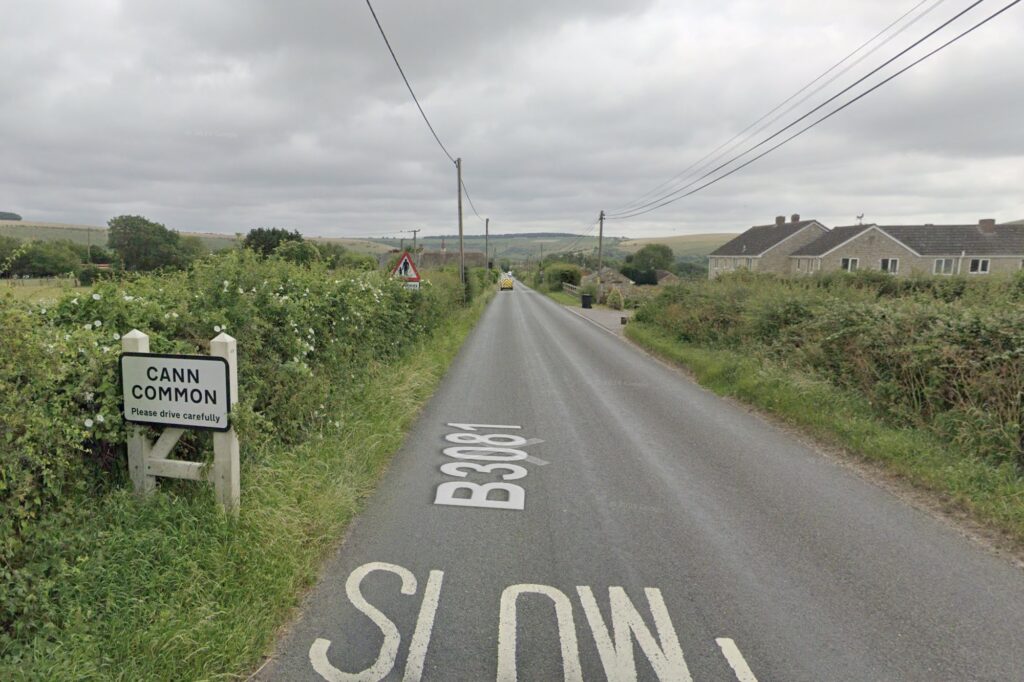

A 75-year-old motorist who struck and killed a cyclist while speeding on a rural road near Shaftesbury has been sentenced to 10 months in jail and disqualified from driving for 29 months, besides being required to pass an extended driving test to regain his licence.
Mary Emerson-Reed, a 63-year-old local cyclist, was riding with a friend along the B3081 between Tollard Royal and Shaftesbury just after 11pm on 23 June 2023, when she was struck from behind by a Vauxhall Insignia driven by Alan Morris.
Both cyclists had their lights illuminated and were wearing high-visibility tabards. Morris, of Budbury Circle in Bradford on Avon, initially told police he had been unable to see Emerson-Reed due to the glare of an oncoming vehicle’s headlights. However, forensic enquiries later confirmed that the cyclists would have been visible from at least 200 metres.
Morris was also found to be driving at 69mph — nine miles per hour above the national speed limit for that stretch of road.
He pleaded guilty to causing death by careless driving and was sentenced at Salisbury Crown Court on 9 May. In addition to the custodial sentence and driving disqualification, he was ordered to pay a £187 surcharge and must pass an extended driving test should he ever wish to regain his licence.
Detective Constable Alex Collins from Wiltshire Police’s Serious Collision Investigation Team said: “This is a tragic incident and our thoughts remain with Mary’s family during this undoubtedly traumatic time for them. There can be no excuse for Morris’s driving. Mary and her friend had their bicycle lights illuminated and they were correctly wearing high visibility, reflective clothing given the late hour.
“Morris had ample opportunity to see Mary and failed to do so, colliding with her and sadly causing fatal injuries. Careless driving is one of the fatal five driving offences – the five offences most likely to lead to serious injury or death.”
The case follows a number of other recent prosecutions involving elderly or inattentive drivers injuring or killing cyclists.
In 2022, 82-year-old Peter Gardner was sentenced to six months in prison for hitting and killing 70-year-old cyclist Jim Tassell, despite being unable to read a number plate beyond three metres. The judge described Gardner’s decision to continue driving with severely impaired eyesight as “reckless” and said his actions had “torn a hole” in the family of the victim.
The victim’s daughter, Emma Damen, has since campaigned for mandatory eyesight tests for older drivers. “You’re literally playing with somebody’s life,” she said.
And just last month, a 70-year-old driver avoided jail despite crashing into a cyclist from behind and causing a fractured vertebra. The victim required a back brace for months and had to rely on family members for daily support.
The court heard that the driver had safely overtaken one group of cyclists but failed to notice the second cluster, with the judge noting: “You just did not see him. You were just not concentrating on the road ahead.”
In another case from April, a driver in Scotland who injured a cyclist and blamed the setting sun was fined £520 and banned for 12 months. The court noted that the cyclist had been directly in front of the motorist and was clearly visible to other road users.
> Do we need mandatory retesting for older drivers?
Currently, motorists aged 70 and above must reapply for their licence every three years, but there is no requirement to retake a driving test or prove fitness to drive.
In a statement released after an 80-year-old driver was handed a suspended jail sentence and banned from driving for life after causing the death of a cyclist by careless driving in 2016, the charity Cycling UK called for a review of the licensing system for older drivers.
“Cycling UK recognises that sentencing elderly and otherwise law-abiding citizens for driving offences, when they have a long and largely unblemished driving record, is an unenviable task for judges more accustomed to punishing offenders they perceive the prisons were designed for,” the organisation said.
“This case however, not for the first time, raises the increasingly important issue of how, with an ageing population where people want to maintain independence and continue driving as long as possible, the DVLA regulates and tests the fitness to drive of those whose reactions, sight and road confidence are declining,” it added.









49 thoughts on “Speeding elderly motorist who killed cyclist sentenced to 10 months in jail and disqualified from driving for 29 months for careless driving”
Quote:
I’d say mandatory eyesight tests for all drivers to have an eyesight test every two years.
There is no excuse for driving with bad eyesight. There are several medical reasons why we should all be having regular eyesight tests, not just for driving. This is not a hardship: it’s just good healthcare.
When we are obliged to provide our driving licence, we should also be required to show a separate card that shows a valid eyesight test result to cover the period of driving in question.
That said, there is no indication in the article that poor eyesight contributed to this collision: it appears to be a lack of attention.
It should be mandatory
It should be mandatory eyesight tests with an obligation on the optician to report the results to the DVLA so that a licence can be revoked in the case of a fail. Failure to attend the optician appointment would also result in revokation of the licence. Its just like an MOT for the driver rather than the car.
If you renew your passport,
If you renew your passport, you need a digital photo.
Before starting your application, get a digital passport photo from a photo booth or shop. Choose the option to get a code with your photos.
You’ll be asked to enter the photo code during your passport application and your digital photo will be added to your application.
Can’t be very hard then to do the equivalent for an eyetest linked to licence application required every 10 years. (assuming you don’t have a paper licence).
Going way too fast for the
Going way too fast for the conditions. At least there is some jail-time, but it’s extremely short IMO.
According to the collision data available online, they were heading NW at this location: https://maps.app.goo.gl/XZ6rNX2mTZSoLvNd6
It’s a very open road, but with a slight blind crest and sweeping bend. The collision occurred just after this blind crest.
I would think this is a case of a driver just assuming the road around the corner/over the hill is clear of obstructions. Then making up some story about being ‘blinded by the lights’. Just straight-up reckless driving, which unfortunately is very difficult to mitigate against as a cyclist – especially with that sort of approach speed .
.
HoarseMann wrote:
A lot of people appear to drive like that in their local area. And especially on smaller (-ish) country roads.
Two things I remember from
Two things I remember from driving lessons (a long time ago)…first was never to assume the road beyond a bend is clear; second was most collisions occur very close to home where complacency ramps up. I had a very good instructor I think. He was really into classics and his Westfield, and wanted to teach people how to drive safely and well…not just good enough to pass the test.
People always say they were
People always say they were taught these things and people make the suggestion that the driving test isn’t fit for purpose because certain things aren’t but come on, its really really simple. If you cannot be sure something is safe to do, don’t do it. You don’t need to be taught specifics.
As to the UKs utterly stupid national speed limit on roads that should probably be 30 at most, the mind still boggles. I assume it would be another “war on motorists” situation if they tried to change it.
I can turn off a reasonably wide 2 lane road with a 40 limit and suddenly I can go 60 despite the new road being thin enough to fit 1.5 cars and full of blind corners. I can’t count the number of times I have come around a corner and been faced with a car going far far too fast for the conditions, smack bang in the middle of the road and had to swerve out of their way.
I think the approach some
I think the approach some places in Europe have taken * is the way. Have much of the language about “making it safer, clearer and more pleasant for everyone (but drivers, we’re concerned about you)”.
So you can still go very fast – but only on roads specially engineered to make it safe (motorways). No “cyclists in my way” and no danger to cyclists ** and pedestrians because they’re not there. (Because not allowed – but mostly because they simply don’t need or want to be there. I can’t recall even the hardiest “avid cyclist” types clamouring for their “right to ride” down the M1).
Then – what about the A-roads? Well again make them “better” for drivers – why wouldn’t they want that? So junctions are improved (for safety), overtaking into an oncoming lane is banned (for safety), cyclists and pedestrians are given their own pleasant well-separated space where this is a “route” for them (for safety).
Similar for B-roads – oh – but if in fact people are going to be walking and cycling there you’ll either have to cough up for separate high-quality infra for them, or accept that 20mph is the limit (safety again).
Urban spaces and streets? Limited or no through traffic, and various traffic calming measures, and 20mph or lower speed limits – and often no overtaking cyclists (there should be no reason to…). (Safety again – but actually also about “nicer places” and the few motorist who do need access here not being blocked by through traffic).
* Perhaps even avoiding getting caught in the rhetoric of “but war on the motorist” … ? Who am I kidding.
** Deliveroo satnav fails excepted.
I wonder if radar would have
I wonder if radar would have made a difference? Might have given that extra second to hug the kerb.
Not that anyone should need radar or even a hi viz tabard.
It’s possible, this is quite
It’s possible, this is quite a sweeping bend, so the radar might have a chance of picking up a vehicle. Generally, the radar needs line-of-sight, but I’ve had some detections around bends – particularly where there’s a big chevron ‘tight bend’ sign, which seems to act as a mirror and reflect the radio waves.
I don’t think radar would
I don’t think radar would have made a difference. I don’t have one, but (AFAIK), the use case isn’t to dive off the road every time there is a vehicle behind you in case they haven’t seen you and are about to plough into the back of you. If anything, I would be more likely to adopt primary position and discourage an overtake until there was no oncoming traffic. If you act as if you are completely invisible to drivers, I don’t think you would ever go outside on a bike – you simply wouldn’t get anywhere.
Plus, based on the google street view, with an oncoming vehicle approaching, I can’t imagine there would have been much, if any, safe space at the side of road.
Radar can tell you if they
Radar can tell you if they are not reducing speed or if the approach speed is higher than you’d like.
It’s only in those edge cases, I’d check my mirror and hug the kerb.
People have posted on here about bunny hopping on the pavement and even jumping off the bike in extremis.
I generally glance down at the mirror to see the position of the car where it’s more hazardous eg blind bends.
Radar improves visibility by changing rear light pattern.
I’m just more risk adverse at my age.
OnYerBike wrote:
That’s _nearly_ my use case. I would dive off the road if a vehicle was about to plough into me. But this is only possible by also using a decent mirror to keep an eye on the approaching vehicle.
Yet again killing a cyclist
Yet again killing a cyclist is regarded as merely careless instead of dangerous. How can you possibly justify that hitting cyclists riding 2 abreast with lights and high vis is not FAR below the standard expected of a competent and careful driver, it’s just attrocious. Happy with the jail time, not happy with the length of the ban.
As for eyesight tests, pensioners get a free test every 2 years, there really is no excuse for not having them and listening to the recommendations. I doubt this was an eyesight issue however.
As he was driving 9mph above
As he was driving 9mph above the speed limit, this should be classed as dangerous driving in my opinion.
And that would be almost
And that would be almost 75mph speedo. Far too fast for a road like that.
Hirsute wrote:
Why?
In what conditions?
A blanket statement that needs qualification.
There is no blind corner, there is a limit point! It seems to be a reasonable distance ahead.
In the conditions as seen on the googlemap link, the limit point may support a safe speed of 80-90 MPH.
On the other hand at night with lights from oncoming traffic reducing/impairing forward visibility a safe speed may only be 20-30 MPH.
Or in reference to another thread where it was deemed speed was not a factor in the collsion despite it being mentioned, in freezing fog where one might expect to encounter black ice, a safe speed might be 10-15 MPH or even lower!
Safe speed and speed limit are wholly separate!
A safe speed on any road at
A safe speed on any road at any time has to be no faster than the speed limit. There are no exceptions, speeding is always dangerous driving.
Whilst it might readily be
Whilst it might readily be called “Dangerous Driving” is it always dangerous?
Wherase people often do not equate not speeding, even being well under the speed limit as being dangerous.
The point I was trying to make before again being lambasted by personal insults is that “speed kills” is an oversimplication. As is merely stating that 75mph for a road like that is far too fast.
I even offered my assessment that gven 3 different sets of conditions, one of which might have been encountered by the driver in this collision, that different speeds will provide a different threshold speed for safety.
No one made personal insults.
No one made personal insults. You made that up.
Hirsute wrote:
🙋🏼♂️
The statement was ludicrous
The statement was ludicrous is a comment on what was written not a comment on the writer.
BikingBud wrote:
🙋🏼♂️
— Hirsute
Is that you, Nige? Your constant reinventions of your username can’t disguise just how thin-skinned you are.
No, I think they’re over on
No, I think they’re over on other threads setting shouting and bad language against careless driving and asking how we should tackle speeding * cyclists / hypothetical non-speeding ones who kill people.
* Faster than the speed limit for motor vehicles.
Eton Rifle wrote:
🙋🏼♂️
— BikingBud Is that you, Nige? Your constant reinventions of your username can’t disguise just how thin-skinned you are.— Hirsute🤣
Excellent well done. That is some assumption but hey if it keeps you happy.
You want room 12.
You want room 12.
Thanks for the enlightening
Thanks for the enlightening comment.
Always good to see objective reasoning.
BikingBud wrote:
Agree to the point about “speed limit is not a target”. (Although that does appear to be the standard UK view).
Higher speeds though … safe for whom, doing what?
This idea has come around here before. AFAICS it boils down either to “I ( think I ) can do X safely, ergo it shouldn’t be restricted for anyone”. Or alternatively: “any number will be arbitrary and ‘wrong’ at some point – so we shouldn’t pick any”.
These ideas may or may not come with some suggestions as to some kind of control measure. Either that there is a “natural” speed e.g. “design speed” for a road *. Or “we have to trust people and anyway they’ll act in their own self-interest”.
The latter would appear to be sketchy at best for drivers. It’s clear that a significant number of us don’t behave in a way where our self-interest appears to coincides with sufficient safety or “consideration” for others, especially vulnerable road users.
* Because – if one ever existed – it has probably changed over time with changing vehicles and driving patterns. And the proposers seem a bit light on how drivers somehow always get the right one in their view… However the idea that people do react to implicit environmental cues (wide straight road, drive fast) and that we can and should positively engineer roads to provide cues / direct feedback for what’s the appropriate behaviour? Those are valid (and in fact not new).
I’d argue that if you hit and
I’d argue that if you hit and kill a highly visible cyclist from behind, your speed is excessive for the conditions.
I would not disagree.
I would not disagree.
BikingBud wrote:
Why?
In what conditions?— Hirsute
On the speedo point, vehicle regulations allow for speedo readings to be within 10% of actual speed, as long as they are over-reading. In practice, most manufacturers have an over-read of around 8%.
My car over reads by about 10
My car over reads by about 10%. I know it does which means that I know if my speedo reads 70 I have a bit of leeway.
The problem arises when people think that they have leeway of 10% + 3 mph and always drive up to that maximum, and so the defacto speed limit in a 30 zone is in fact 36, or 80 on the motorway.
The most obvious rebuttal to
The most obvious rebuttal to your ludicrous statement as to what constitutes a “safe speed” is that this cvnt killed someone.
Thanks another enlightened
Thanks another enlightened comment.
The prevalent conditions at the time of the collision would indicate that the driver in question was not driving at a safe speed but that was not my question.
The observation that the speed was too fast for a road like that without qualification of the conditions is meaningless.
If everybody drives at just below the speed limit but are leaving the road on bends due to cow shit on the road as farmer giles has just been out with his sileage trailer those drivers were driving too fast.
Rule 125
The speed limit is the absolute maximum and does not mean it is safe to drive at that speed irrespective of conditions….
And Rule 126
Stopping Distances. Drive at a speed that will allow you to stop well within the distance you can see to be clear.
BikingBud wrote:
Thanks for the interaction it
Thanks for the interaction it doesnt actually say that in Highway Code Rule 126 but is captured in Motorcycle Roadcraft and I assume the driving equivalent.
The discussion about instructing to pass the L test and advanced driving/riding is relevent here as that very basic addition you have added would not appear to be required before being let loose!
BikingBud wrote:
In the conditions as seen on the googlemap link, the limit point may support a safe speed of 80-90 MPH.
On the other hand at night with lights from oncoming traffic reducing/impairing forward visibility a safe speed may only be 20-30 MPH.
Or in reference to another thread where it was deemed speed was not a factor in the collsion despite it being mentioned, in freezing fog where one might expect to encounter black ice, a safe speed might be 10-15 MPH or even lower!
Safe speed and speed limit are wholly separate!— BikingBud
While I agree, most drivers don’t know about the Limit Point because the L-test fails to mention it. Matching speed to available vision is an essential driving skill, yet the L-test fails to teach Limit Point Analysis.
Similarly, we all suffer from close passes in large part because learner drivers aren’t taught how to overtake. What could possibly go wrong with leaving drivers to learn how to overtake by making it up as they go along?
Yup
Yup
Yesterday I overtook a police car that was following two cars and was being followed by another two cars.
The first pair had slowed to a 45-50 on a national speed limit road, the police car in the middle was caught in the dawdle.
I eased past the rear 2 cars and took up following position behind the police car.
Coming off a roundabout the police car held over to the near side and I eased past him and then opened the throttle a little to get past both cars in front as they were still at 50 ish.
Observation, planning, appropriate use of throttle to execute the overtake swiftly and effortlessly.
Cars drivers unaware and actually signalling to the police that they are unaware by failing to make progress.
A potential closing speed of
A potential closing speed of 180 mph on a road with a width barely greater than twice the width of two largish suvs? It might be safe enough as a closed road rally section, but its frankly absurd to suggest such speeds are ever safe on a narrow two way public road. What happens when you hit a deer or a shaded pot hole at that speed!
Probably less than the width
Probably less than the width of two larger suvs.
Robert Hardy wrote:
Pick what you want or address the whole comment where I have offered a fuller discussion of how a safe speed might be deduced for the particular stretch of road.:
In the conditions as seen on the googlemap link, the limit point may support a safe speed of 80-90 MPH.
On the other hand at night with lights from oncoming traffic reducing/impairing forward visibility a safe speed may only be 20-30 MPH.
Or in reference to another thread where it was deemed speed was not a factor in the collsion despite it being mentioned, in freezing fog where one might expect to encounter black ice, a safe speed might be 10-15 MPH or even lower!
Safe speed and speed limit are wholly separate!— BikingBud
Where is the deer coming from? Out of the clear blue sky? It’s OK they are going to the east away from the road.
What is the pothole shaded by? The deer falling out of the clear blue sky?
Oh and I can see the cyclists in the distance climbing the hill, expect to be behind them shortly so will use acceleration sense as I approach and not pressure them.
If you understood advanced driving you would understand that these are part of continous observation (Information) and the effect (Position, Speed) that an opposing vehicle has on a driving plan.
Hence in the same manner, as the cyclist being observed and planned around, if there was a 2 tonne wankpanzer coming down the hill I would see it and adjust as required
Stop being horrified and over-reactionary and consider the whole discussion point.
Did you spend a whole week
Did you spend a whole week making that picture?
Yea I was trying to find one
Yea I was trying to find one with Santa behind the reindeers but I cleared out all my old Christmas cards and had to improv.
You like it?
I think i’ve found my niche.
Long past time to reduce the
Long past time to reduce the national speed limit to 50 mph on non dual carriage way roads and and 60 mph on non motorway standard junction dual carriageways such as the A1 north of Peterborough.
Robert Hardy wrote:
Since we always love “local choice” I think that could be modified to allow some discretion, but in return we:
1) Provide measurable criteria for requiring lower speeds e.g. visibility: bends, foliage, height changes, road widths etc.
2) Ban overtaking on non-dualled roads above a certain speed limit (perhaps 30mph?). That is for safety to prevent drivers driving into oncoming traffic – we know that people just can’t help themselves, no matter the signage or markings or training.
Of course that would be “impossible / completely unworkable” on UK roads! Whatabout cyclists / horsists / slower (agricultural) vehicles blocking the traffic!?
Leaving aside that a crash is an excellent way to completely block traffic and for some time… How on earth could this work elsewhere?
Well … first separated cycle paths for cyclists / pedestrians (horsists?) – these have to be good, but can then mandatory (in return drivers don’t have them “in the road”). If there is likely to be a LOT of farm traffic a) why is this a “route” for “people who need to get places”? b) If we still need both then we can provide some pull-in spots for the slower vehicles.
Again this is miles from the UK notion of “if it’s not in a built-up area I’m just going to expect NSL speed and I’ll overtake at the first sign of a ‘blockage’ “.
Quote:
As I’m sure the officer meant to say, “Mary and her friend correctly had their bicycle lights illuminated and had even chosen to use additional high viz clothing.” Not arguing that high viz clothing isn’t a good idea at night but calling it “correct” implies that a cyclist who doesn’t wear high viz is “incorrect” and more likely to be at fault if someone hits them.
RIP Mary.
What would the sentence have
What would the sentence have been if he’d run into the back of another car and killed the driver?
Unfortunately, I think part
Unfortunately, I think part of the problem is that the outcome would have been very similar.
It’s hard to follow the statistics between injuries and convictions – whilst there is good reporting on collisions via STATS19, trying to get statstics out of the court system seems to be a bit like getting blood from a rock, and that’s before trying to relate specific collisions to specific convictions (the majority of which do not get reported in the media).
But, as a rough attempt, I’ve found this FOI answer which gives some statistics for Scotland. In short, it’s roughly 50/50 whether a conviction for causing death by careless driving leads to a custodial sentence or not. NB – it’s unclear whether the numbers in the table relate to the offence of causing death by careless driving, causing death by dangerous driving, or both combined (the FOI Request specified careless driving; the table header says “driving dangerously”)
The other thing to note is that there are <30 convictions per year, whilst there are roughly 150-200 deaths on Scottish roads each year (source). This would appear to suggest that across all fatal incidents, there is <20% chance of anyone being convicted at all. I find it very hard to imagine a fatal collision occuring without at least one person acting carelessly/dangerously – although I suppose in some cases, that person could have been the casualty.
The other part of the equation is of course that if he had hit another vehicle, the occupants of that vehicles would have been much less likely to be killed anyway.
agree, speeding while being
agree, speeding while being blinded is a very flimsy excuse. I’d say this is voluntary manslaughter as everybody is aware of the dangers of a speeding car. Being blinded is a reason to slow down, not a mitigating circumstance for why killing somebody is okay.
That being said, adding separate cycle paths will certainly resolve these kinds of conflicts out on the open road…AND I also want to see blinding headlights fixed. I am a cyclist and a driver and they annoy me in both instances.