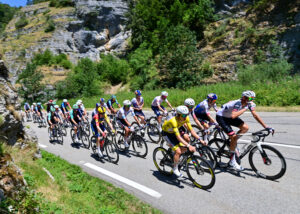
It’s that time of year when all the best riders in the world are testing their legs and fine-tuning their form ahead of the Tour de France. For many this means racing the
Critérium du Dauphiné, a week-long dress rehearsal for the big one next month.
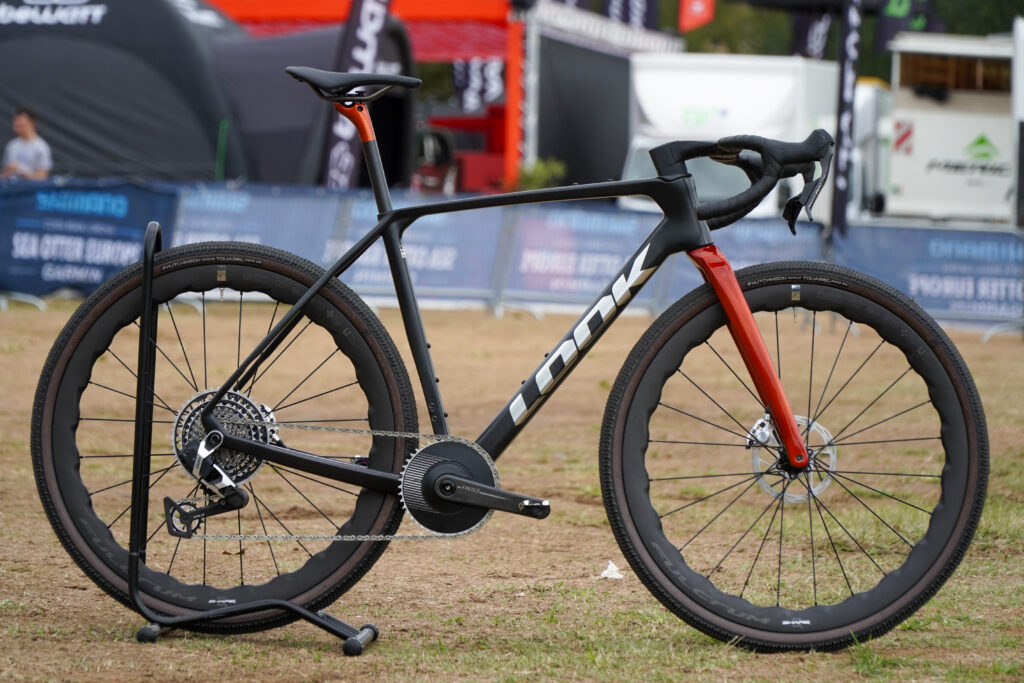
Most importantly for us is that it’s not just the form that’s being tested, many teams, riders and brands using the race as the perfect trial run for unreleased bikes, tech and kit in a race environment. That means it’s a great opportunity for tech nerds like ourselves to head over the Channel to lurk in obscure hotel car parks and do the rounds at the stage start, snapping pictures of new tech and eye-catching set-ups, all to report back to you guys reading now.
While last year we spotted that Trek Madone with it’s radical seat tube design, a new Pinarello Dogma, and the then-unreleased updated Canyon Aeroad, it’s fair to say expectation was lower this time around, with our prediction being that there perhaps might just be a new Cervélo S5 to be sighted. That was until Israel–Premier Tech rolled up with a bonkers prototype aero bike, that has since been ridden to stage victory by Jake Stewart on Thursday (more on that later).

By now you’ve probably read all about the new Factor aero bike and Cervélo’s S5, so we’re not going to spend too much time on them here, instead digging a bit deeper into the wider tech choices of the peloton at the Dauphiné, from monster chainrings and super-aero cockpits, to a bizarre saddle angle, Remco’s not-so-secret time trial weapon, tyre widths, short cranks and more.
Is this the most extreme front end in pro cycling?

Intermarché–Wanty’s Dries De Pooter has taken things pretty far in his search for speed. The Belgian has clearly learnt a thing or two from teammate and breakaway specialist Taco van der Hoorn, deploying 34cm bars slammed all the way down.

It doesn’t look much comfier from the front, although something tells us Mr De Pooter isn’t very concerned by things so trivial as comfort.

Elsewhere on his bike, De Pooter was one of the riders we spotted with a beefy chainring, in his case a 58t one for Sunday’s opener. Not quite Victor Campenaerts’ 62t set-up from a couple of years ago, but still very much part of the current pro trend for larger chainrings.

Most riders we saw were using a 54t, to keep the chain in the middle of the block and that chainline efficient. That was, of course, at the start of the week when the stages featured rolling hills rather than major climbs.
More aero front ends — what can us amateurs learn from them?

It wasn’t just De Pooter chasing aero gains, UNO-X rider Markus Hoelgaard and Movistar’s GC man Enric Mas favoured the narrow set-ups too. While you might not want to copy the trend to the extent De Pooter has, working on your position on the bike is almost certainly one of the easiest ways to go faster. It also comes with the added bonus of being completely free (or at least one of the cheaper upgrades if you want to swap to narrower bars).

Many smaller-sized bikes still come with 40cm bars, so dropping to 38cm or even 36cm can make you faster and more comfortable. Monster chainrings? We’d leave them to the pros…
150mm cranks?! Jonas Vingegaard and plenty of others are opting for shorter cranks

With stars of the sport Tadej Pogačar and Jonas Vingegaard opting for shorter cranks, it’s become one of the hottest tech trends in the pro peloton. Back in February, the Dane was even spotted using 150mm cranks at the Volta Algarve, something he again used this week during the time trial stage. On that new Cervélo, however, he’s using 160mm cranks (above) for the road stages.
Plenty of other GC riders and climbers have followed suit, Guillaume Martin and Mas also opting for 165mm cranks.


Not everyone is following the trends. Check out XDS Astana rider Harold Tejada’s shorter stem. He also uses good old 170mm cranks too, the Colombian clearly not held back when finishing second on the breakaway stage earlier in the week.

Who needs a front derailleur? Lidl-Trek continue to favour 1x

Lidl-Trek made headlines during the classics when opting for SRAM’s 1x Red XPLR AXS gravel drivetrain. It makes sense in cobbled one-day races where mechanical issues can easily end your chances early, the team saying the set-up “reduces risk” and there’s less to go wrong. There was no weight penalty either and the 13-speed 10-46 cassette meant the riders had access to the same gear range that they would have on a 2x set-up.

You’ve probably noticed by now that Lidl-Trek weren’t using that 13-speed gravel groupset during the Dauphiné, Edward Theuns’ bike pictured here with a regular 12-speed SRAM Red cassette. However, the 1x remains and appears to be the team’s standard set-up for flatter stages now. Lidl-Trek’s technical support manager Glen Leven has even said some riders “will never go back to 2x”.

Are you sitting comfortably? Esteban Chaves is… (apparently)

Just look at Esteban Chaves’s saddle angle. It undoubtedly looks more extreme due to the EF Education-EasyPost Cannondales having been placed on stands that raise the rear wheel off the ground, but still, it looks like you’d slide straight off.
The days of 25mm tyres being wide are long gone

Like Eddie Dunbar of Jayco AlUla, most of the Dauphiné peloton was racing on 30mm tyres, Continental’s GP5000 TT TRs a favourite of many teams. One notable exception on the tyre width front was world time trial champ Remco Evenepoel whose blinged-out SL8 featured 26mm rubber.

Again, the TT version of Specialized’s Turbo Cotton tyre.

Remco’s not-so-secret time trial weapon
Remco stormed to TT victory on Wednesday, landing an impressive win over his GC rivals Vingegaard and Pogačar. Plenty of people noticed that cutaway visor he was sporting. It apparently allows him to get his head into his arms without bumping the visor against them. Nifty.
Will this be the fastest bike at the Tour de France?

We couldn’t do a Dauphiné tech round-up and not mention that prototype Jake Stewart is riding.
Tech editor Mat has dug deep into the world of UCI design regulations to work out how Factor has managed to come out with such a radical design and stay within the rules.
The other new bike on the block — Cervélo’s updated S5

Admittedly the numerous leaks and subtle design changes mean Visma-Lease a Bike’s new Cervélo was undoubtedly the less exciting of the two new bikes we spotted in France.
At the front, the fork is now almost the same width all the way down to the thru-axles, whereas on the current model it slims down towards the bottom. The other big giveaway is up front, the unique S5 handlebar system with its V-shaped stem now a completely one-piece affair, whereas the old version has a pair of bolts on the top to attach the stem to the bars.
A Cervélo source told us all will be revealed in the near future, we’re guessing almost certainly in time for the Tour.
Campag 13-speed raced in the WorldTour for the first time

Campagnolo officially launched its overhauled 13-speed Super Record groupset in the week before the Dauphiné. That meant we were able to head to the Cofidis team bus to take a look at it on WorldTour bikes for the first time.
Well, on some WorldTour bikes. Cofidis’s leaders, such as former Tour de France podium finisher Emanuel Buchmann and French favourite Benjamin Thomas were enjoying the new groupset while the less experienced pros and domestiques were still slumming it on 12-speed.

With resources tight at smaller teams and Campagnolo a smaller brand nowadays than the likes of Shimano and SRAM, it’s not necessarily a surprise that new groupsets couldn’t be provided to all riders, and it’s happened with previous generations of Campag releases.
We would hope that Cofidis can get all the bikes upgraded in time for the Tour de France, where Campag will surely want its latest and greatest tech on display at the world’s biggest bike race.
Tadej Pogačar uses his Y1RS

We were starting to wonder about Colnago’s new aero bike the Y1Rs. It was launched before Christmas to much fanfare, the bike Pogačar would win Milan-San Remo on perhaps? Well, that didn’t happen and the world champ has also been more often spotted still using his old V4RS and more recently, since its launch in April, the updated V5Rs.
Given Colnago’s aero claims it was particularly surprising to see Pogačar stick with the V4Rs at Paris-Roubaix. Well, just as we were starting to wonder what was going on, he’s back using the Y1Rs, the V5Rs firmly on the roof rack until this weekend’s mountains.

Who’s had a good week?

This is the Canyon Aeroad that Spanish prospect Iván Romeo rode to victory on stage three. Britain’s Fred Wright has also had a strong week, attacking on the opening stage and going close in one of the sprints too. We wondered if Merida might have a new bike out this week, but not to be, the Bahrain Victorious rider still aboard the current Reacto.

Perhaps the most random thing we learnt this week is that many a pro bike has chipped paintwork around the branding on the downtube. Wright’s was one of those to have this very specific minor defect. It was a bit of a mystery that, on first glance, you’d assume just comes with the territory of the rough and tumble of pro racing. However, a day later Intermarché–Wanty’s mechanic solved it for us.
Having set up one bike for shots, complete with team-issue computer and bottles added for show, the mechanic then had to swap it for another due to the exact same mark on the Cube branding as we’d seen on Wright’s Merida and numerous other bikes. The cause? No, not crash damage… just the roof racks pro teams use to transport bikes on the roof of team cars, which secure the frame on the downtube. Mystery solved.