


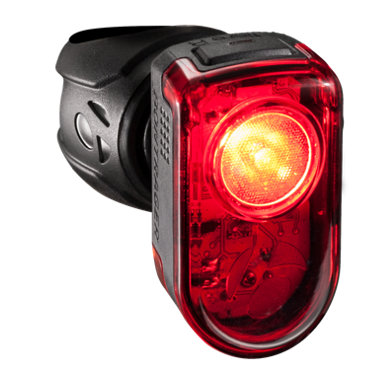

Bontrager has released a new light, engineered from scratch to provide groundbreaking daylight visibility to counteract the 80 per cent of cycle collisions that occur during daylight hours.
The Flare R is visible from up to two kilometers away in the daytime. The USB-rechargeable, 36g Flare R is a powerful 65 Lumen CREE LED, which is brighter than a car's tail light.
In the EU, daytime running lights have been compulsory on new cars since 2011. Bike lights are only required in the UK after dark.
The company claims that Bontrager's electronics development team studied flash patterns designed to catch the eye of drivers in passing vehicles, optimizing Flare R for maximum visibility in both flash pattern and intensity.
Bontrager, based in Wisconsin where the days are often long and grey. said in a statement:
“Studies on accidents resulting in the fatality of a cyclist show that in 40% of all bicycle vs. car accidents, the victim was struck from behind.
“Bontrager engineers began developing Flare R to combat these staggering statistics, with the ultimate goal of increasing confidence and safety with a lightweight, sleek, compact product that is relevant to every type of cyclist, from recreational to racer.”
Bontrager's Brand Manager & Marketing Director Michael Browne said: "We're cyclists and we share the same concerns and experiences as all riders.
"We're in a unique position to create something that can benefit all cyclists, and that's why we've spent such considerable R&D resources on Flare R. This is a light that should be on every bike, every ride. A helmet is a great thing, but not getting hit by a car is even better."
The Flare R alerts the rider to its battery status. When Flare R reaches a 25% battery life, the LED on the top of the light's on/off switch changes from green to red, allowing the rider to dial down the intensity if needed.
When the battery is run to 5% of its charge, Flare R automatically puts itself into low battery protection auto flash mode by kicking the Lumens down a few notches, providing the cyclist an additional 1-2 hours of run time.
A full charge takes 2.5 hours to complete.
Flare R flashes in four distinct patterns, two for daylight-riding and two designed for nighttime usage.
Day Flash mode will utilize all 65 Lumens in a strategically placed random flash pattern designed to draw a motorist’s eyes. Fully charged run time is 5.75 hours.
Day Steady mode uses 25 Lumens of steady illumination and is great for group rides. Fully charged run time is 4.25 hours.
Night Flash mode uses an irregular flash pattern punctuated by short pops of increased intensity. Fully charged run time is 23 hours.
Night Steady mode provides 5 Lumens of steady light great for consistent nighttime visibility. Fully charged run time is 21 hours.
The light has a US MSRP of $59.99 (£40) and is available to buy here. We look forward to testing one.











46 thoughts on “Bontrager announces new rear light – specifically designed for daytime use”
Main dangers for cyclists;
1.
Main dangers for cyclists;
1. Cars overtaking and immediately turning left.
2. Cars turning right across the carriageway in front of oncoming cyclists.
3. Cars not giving way at roundabouts.
4. Cars passing too close to cyclists out of pure spite/impatience/frustration (delete as appropriate).
This light would not be worth a flying fuck in any of these situations.
HalfWheeler wrote:This light
No, but as someone who regularly rides down sunny roads bordered by big trees, I consider a good rear light to be essential. A cyclist can be very easily lost in the shade of a hedge when viewed by a motorist squinting across a brightly-lit dashboard.
HalfWheeler wrote:This light
Errrr…obviously not. Its designed for the 40% of accidents where cyclists are hit from behind. How could anyone expect a *rear* light to prevent a car turning in front of you?
Kadinkski wrote:HalfWheeler
I find that statistic incredulous. Could you copy and paste your source? Or are you assuming that all those rear-enders were caused by lack of visibility and not by the driver attempting a punishment pass and getting it wrong?
HalfWheeler wrote:I find that
“Studies on accidents resulting in the fatality of a cyclist show that in 40% of all bicycle vs. car accidents, the victim was struck from behind.
“Bontrager engineers began developing Flare R to combat these staggering statistics…”
Source:
http://road.cc/content/news/147573-bontrager-anounces-new-rear-light-specifically-designed-daytime-use
Kadinkski wrote:HalfWheeler
So the rear enders are all due to a lack of visibility? Rather than, as I said before, punishment or careless passes going wrong? And you take the interpretation of those statistics, by a bicycle accessory company, at face value? Who just happen to be marketing a new light? Jesus wept…
HalfWheeler wrote:So the rear
So what’s the point you’re trying to make? They shouldn’t be trying to design a solution to the problem of cyclists being rear-ended because accidents at junctions are a much bigger problem? I genuinely don’t understand what you’re trying to say.
Kadinkski wrote:HalfWheeler
It seems very clear to me what the poster is saying.
They are saying that we don’t know that cyclists get rear-ended because they aren’t visible enough, rather than because drivers just don’t care, see the cyclist but pass too close and hit them anyway, or just aren’t looking (maybe the sun is in their eyes or their unborn baby kicked? Or maybe they were busy texting?).
FluffyKittenofTindalos
No. That’s not what they’re saying.
Read the first post again. I think they’re trying to say that a rear light won’t help in accidents that occur at junctions. But like I aleady said, that’s so obvious that theres really no point in making the point.
Kadinkski
No. That’s not what they’re saying.
Read the first post again. I think they’re trying to say that a rear light won’t help in accidents that occur at junctions. But like I aleady said, that’s so obvious that theres really no point in making the point.— FluffyKittenofTindalos
Read the first post again. My first comment wasn’t all about junctions;
“4. Cars passing too close to cyclists out of pure spite/impatience/frustration (delete as appropriate).”
My over-riding point is that being rear-ended by a car due to lack of visibility in daytime is an infinitely smaller danger than the very real dangers that cause the vast majority of collisions. It also places more responsibility on cyclists on trying to prevent bad driving that imperils them. Perhaps drivers should be more attentive or (crucially) less spiteful/impatient?
What next, asking pedestrians to wear full body armour in case they get knocked down? “Ah, you see I may have ran a red light and plowed straight into them but if they were wearing full body armour their injuries wouldn’t be so bad. They are partially to blame…”
Kadinkski wrote:HalfWheeler
At least Kadinski bothered to read the article…
pwake wrote:Kadinkski
At least Kadinski bothered to read the article…— HalfWheeler
I really don’t follow your point. Where in what you just quoted does it show that “all these rear-enders were caused by lack of visibility”? All it says is ‘in 40%…victim was struck from behind’. You aren’t saying that’s the same thing are you? Because that would be silly. Am I missing something here?
FluffyKittenofTindalos
Don’t know, don’t care. If you have an issue with the statistics, take it up with Bontrager – they’re the ones throwing a wad of cash and a team of people into solving the problem of cyclists being hit from behind. Maybe – during all their research and development – they didn’t even think of that.
Kadinkski
Huh? I don’t have ‘an issue with the statistics’ I have an issue with your interpretation of them. It seems you can’t actually justify that interpretation. Not much more to say, though I wonder why you bothered posting something you can’t actually defend.
To spell it out – you are the one arguing that cyclists are hit from behind due to lack of visibility. The evidence seems to go against that. As you can’t back it up, I assume you just invented it. How much a company spend on trying to make more profits has nothing to do with that.
FluffyKittenofTindalos
No, that’s not my argument. I said Bontrager developed the light for the 40% of cycling accidents that are rear-enders. Its what they say – right there in the article above. It does seem very high to me and others but thats irrelevant really. My argument is that they have developed the light to fix what they perceive to be an issue. Its more pointing out a fact than an argument really.
Kadinkski
No, that’s not my argument. I said Bontrager developed the light for the 40% of cycling accidents that are rear-enders. Its what they say – right there in the article above. It does seem very high to me and others but thats irrelevant really. My argument is that they have developed the light to fix what they perceive to be an issue. Its more pointing out a fact than an argument really.— FluffyKittenofTindalos
But that’s not what you said.
What you said was that the 40% figure in the article in itself answered the previous poster’s questioning whether these collisions were due to cyclists lacking visibility. Go back and look at your post. I’m saying that doesn’t logically follow, unless you also add in the assumption that rear-end collisions are entirely due to the cyclist lacking visibility.
You now seem to have changed your argument, so I assume you accept your original post was logically flawed?
FluffyKittenofTindalos
No, for like the 5th time. My argument is and always has been that they developed the light to fix the issue of 40% of accidents that are rear-enders. Thats what they said anyway. Like I say, not really an argument, just pointing out a fact really. You’re obviously hankering for a fight about the validity of the stats, maybe you’d have better luck giving Bontrager PR a call?
FluffyKittenofTindalos
Exactly what ‘evidence’ goes against it?
atgni
Exactly what ‘evidence’ goes against it?— FluffyKittenofTindalos
Well, do I have to link to the stories of motorists hitting people from behind due to the sun in their eyes or being distracted by the kicking of their unborn child? Or to point to the frequency of texting while driving?
Or point out that we’ve had a century of increasing visibility aids that has gone hand in hand with a massive reduction in people feeling safe to cycle or even to walk on country roads?
Conversely, as you are the one making the positive claim – that all (or a clear majority of) the rear-end collisions are due to the cyclist lacking visibility – can I ask where your evidence for that is? The burden of proof is on you. If you want to state that, you need to back it up.
We could just wait and see – make these lights compulsory and see if there’s a huge drop in the incidence of rear-end collisions. I suspect that motorists will just say ‘thanks very much’ and take the increased visibility as an opportunity to pay still less attention to the road and drive faster, leaving vulnerable road-users no better off than before. That tends to fit with what we know of psychology and with what has happened with other visibility aids.
FluffyKittenofTindalos
Exactly what ‘evidence’ goes against it?— atgni
Well, do I have to link to the stories of motorists hitting people from behind due to the sun in their eyes or being distracted by the kicking of their unborn child? Or to point to the frequency of texting while driving?
Or point out that we’ve had a century of increasing visibility aids that has gone hand in hand with a massive reduction in people feeling safe to cycle or even to walk on country roads?
Conversely, as you are the one making the positive claim – that all (or a clear majority of) the rear-end collisions are due to the cyclist lacking visibility – can I ask where your evidence for that is? The burden of proof is on you. If you want to state that, you need to back it up.
We could just wait and see – make these lights compulsory and see if there’s a huge drop in the incidence of rear-end collisions. I suspect that motorists will just say ‘thanks very much’ and take the increased visibility as an opportunity to pay still less attention to the road and drive faster, leaving vulnerable road-users no better off than before. That tends to fit with what we know of psychology and with what has happened with other visibility aids.— FluffyKittenofTindalos
I have made no claims. You demand others back up with evidence but don’t bother to do so yourself. Quite tedious reading.
I agree with you on that
I agree with you on that Halfwheeler but I’m still a firm believer in good rear light for daytime riding. I run an 80 lumen See.Sense whenever I go out on the bike. Some drivers are such morons that I feel that everything I do helps.
I always have rear lights on,
I always have rear lights on, even in the daytime. Not so much because I think it’ll help, but because it just gives them one less excuse.
Pretty sure the main cause of
Pretty sure the main cause of death for cyclists in the US is still from being hit from behind so seems like a good idea if it works.
Whilst it is perfectly
Whilst it is perfectly reasonable to want to run as bright a rear light as possible either during the day to warn cars or at night when riding on unlit country roads, I hate being stuck behind someone who is running a high output rear light at night during my urban commute. I find it distracting and obscures my vision of the road (and thus traffic) ahead. I’ve been in situations where up close I can’t look straight ahead due to the brightness of a rear light. In this sense, I think powerful rear lights on bicycles can be dangerous (or just very annoying) for other cyclists. From an engineering perspective I’m not sure what the solution is. From a personal PoV I either overtake or drop back, but still blindingly powerful rear lights are imo a pain in ****.
Also, I’m in agreement with the comments about the nature of accidents I see. Usually, there from drivers (or cyclists) not looking or proceeding without appropriate caution. A massively bright light won’t help in this cases. I have had near misses and been hit from behind so I’m not saying don’t run a rear light.
I’m in – mostly would use for
I’m in – mostly would use for rural daytime riding on lanes where you are often in/out of deep shade. Drivers are usually courteous but sometimes school run maniacs just too preoccupied. No roundabouts, left/right turners I will see/hear coming. So has its applications
Are we solving the wrong
Are we solving the wrong problem?
Being seen in the daytime is dependent on the driver in the first instance having her or her eyes on the road, not on a hand-held device, as was the case with Daniel Squire’s death.
I think far more casualties will be avoided by finding a way to stop drivers from using a mobile phone behind the wheel.
I think far more casualties
I think far more casualties will be avoided by finding a way to stop drivers from using a mobile phone behind the wheel.
I’m sure you could get a device that blocks mobile phone signals…but it’d probably be mains powered and highly illegal.
What we need is more bloody enforcement. More than the zero enforcement we have at the moment,
Sounds like a good
Sounds like a good product
Last weekend a chap pasted me climbing up our local hill climb, you normally notice the bike when someone passes you but on this occasion I noticed he had his back light switched on. He was a lot move visible as he disappeared into the distance so I think I will be getting one of these lights when I can find a local bike shop stopping the product .
The article doesn’t say the
The article doesn’t say the rear light will eliminate all cycle accidents! It clearly states its purpose is in helping to prevent those 40% of accidents cyclists suffer from being hit from behind. How any rear light would help prevent cars not giving way at roundabouts is beyond me and I’d image most cycle light manufactures. As a cyclist, you’re very much responsible for your own safety.
you could ride around with a
you could ride around with a mobile signal jammer. Although it may have the opposite effect and cause the idiot to spend longer on the phone trying to get the thing to work.
http://www.jammer4uk.com/mini-portable-cellphone-jammer-j260apro-p-22.html?zenid=u63aj1p68idlg5lbpekqtb0fv6
Here’s my daytime
Here’s my daytime light;
Cost me 10 quid, the price seems to have gone up a little. Batteries last ages and if you look directly at it in daylight it will still burn out your retinas. I think you’re paying 30 quid for the Bontrager name.
Critchio wrote:Here’s my
I use the same, a Smart Lunar R1, 1 watt, terrific. But it dims as the battery fades, like all the AA / AAA battery lights I’ve used. I do quite fancy a usb rechargeable with circuitry enough to maintain the thing’s brightness. Not this £40 fellow, though, maybe.
vbvb wrote:Critchio
i use a Smart due to the fact it uses batteries. The bontrager would have been useless for the 11hours riding I did the other day.
do you use NiMh rechargeable or alkaline batteries? I find my lamp stays fairly steady with NiMh but with a really rapid drop when nearly empty.
I have two red frog lights on
I have two red frog lights on the back of my bike, they fit on any of my bikes and can be switched from bike to bike in seconds. I’ve had them two years and I use them in flashing mode pretty much daily and haven’t had to change the batteries yet. Total cost from Chinese eBay site, £5.
Having been knocked off by someone turning right across my path whilst in a day glow jacket white flashing and constant lights on the front of my bike it is my opinion that it makes no difference, if the driver doesn’t look then they’ll never see you!!
Imo too many people cyclists, drivers and pedestrians alike go rushing around completely oblivious to their surroundings. It’s endemic of today’s society.
I have two red frog lights on
I have two red frog lights on the back of my bike, they fit on any of my bikes and can be switched from bike to bike in seconds. I’ve had them two years and I use them in flashing mode pretty much daily and haven’t had to change the batteries yet. Total cost from Chinese eBay site, £5.
Having been knocked off by someone turning right across my path whilst in a day glow jacket white flashing and constant lights on the front of my bike it is my opinion that it makes no difference, if the driver doesn’t look then they’ll never see you!!
Imo too many people cyclists, drivers and pedestrians alike go rushing around completely oblivious to their surroundings. It’s endemic of today’s society.
I rather doubt it’ll do much
I rather doubt it’ll do much about the ‘sun’s too low’ rear enders, unless it’s also capable of cleaning the rear of drivers’ windscreens as they approach..
New Product! I’m as disgusted
New Product! I’m as disgusted as the lot above.
Who do these manufacturers think they are?
This lot couldn’t even keep
This lot couldn’t even keep on the road: https://www.youtube.com/watch?v=cs0iwz3NEC0
Would anything protect cyclists from their driving?
First of all unless this
First of all unless this light has a replaceable battery (there is no mention of one in the specification – I checked), this light and like all USB rechargeable lights, has a predetermined maximum-life, I believe this is likely around two to three years. Lithium-ion technology batteries are no exception because they age (largely irrespective of how they’re used), after which the light’s operating time per charge will decline appreciably. Then it’s time to buy a new light. Even though the rest of the light should be working perfectly.
Secondly, 65 Lumens is not remotely bright-enough for daytime use. I believe it will be barely noticeable on a sunny day. Without knowing the beam geometry, it’s impossible to know whether it would be illegal at night, except if it dazzles – which is always illegal.
It will likely be useful in fog.
At sunset and sunrise – cannot tell.
It’s likely better than nothing. But beware. If you care for the environment – do not buy.
I run a light that is over twelve times as bright as this (over 800 Lumens on maximum) and it’s still not bright-enough on a sunny day, but it has a separate battery pack and it was a lot more expensive than this light.
I have no affiliation with any bicycle light manufacturers or suppliers or the bicycle industry apart from as a user of their products.
Yeah, fuck Bontrager! How
Yeah, fuck Bontrager! How dare they try to design a solution to a danger that is much smaller than another danger.
They remind me of those asshole medical professionals that are trying to cure HIV. Don’t they know that its an infinitely smaller danger than the very real cardiovascular dangers that cause the vast majority of deaths. Grrrrrr. Me so mad. Grrr. etc.
Kadinkski wrote:Yeah, fuck
I’m glad you’ve seen sense now.
HalfWheeler wrote:Kadinkski
I’m glad you’ve seen sense now.— Kadinkski
🙂
Kadinkski wrote:Yeah, fuck
But that’s a poor analogy. Its more like trying to solve cardiovascular disease by producing lower-fat crisps, say. I’m not saying its worth getting angry about it, but I just don’t see that its likely to have much effect on the problem it claims to be addressing.
Plus it will just be used as yet another pretext for victim-blaming, another excuse for running into people who don’t have one.
And even if everyone uses them, it will then be claimed that there are so many of them that any one such light doesn’t stand out so it’s _still_ acceptable for drivers not to see them (which is what seems to have happened with lights at night).
Edit – dammit, now I want crisps.
If Bontrager were in the
If Bontrager were in the business of driver education, then I’m sure they’d be pouring money into whatever R&D would be needed to produce courses that would teach drivers to pay attention… But they’re not, they’re in the business of making cycling accessories, so they’re pouring money into an element of the problem that they can assist with. How big that element is doesn’t really matter, as the other elements of the problem are not really within their remit.
‘f Bontrager were in the
‘f Bontrager were in the business of driver education, then I’m sure they’d be pouring money into whatever R&D would be needed to produce courses that would teach drivers to pay attention… But they’re not, they’re in the business of making cycling accessories, so they’re pouring money into an element of the problem that they can assist with.’
They’re pouring money into something which will make them more money, not into solving a problem.
Well I have one of these for
Well I have one of these for mostly semi-rural roads in the daytime and it’s a great light, you can see it from a huge distance and I have noticed cars mostly giving me a wider berth and hesitating behind me rather than just forcing their way past and I seem to be getting less close passes. A cheap smart light just isn’t bright enough for the daytime. It also has a really good adjustable mount and a great saddlebag clip rather than the usual crappy ones that bounce off. Any brighter than this would be too bright, I think. My only complaint is that I can’t see how the light can possibly be removed from the clip bracket if I ever want to attach it to the seatpost.