


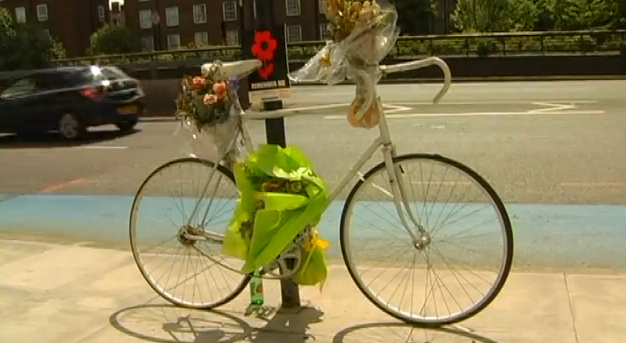

A short film focusing on the death of Brian Dorling, killed by a lorry as he rode his bike through Bow Roundabout on his way to work at London's Olympic Park last October, powerfully captures the impact of the death of a cyclist on those they leave behind, including an emotional interview with his widow, Debbie.
Directed and edited by Laura Borner, the film, called White Bikes, also features an interviews with Mike Cavenett of the London Cycling Campaign, who talks about how cycle safety in the capital can be improved, and Mayor of London Boris Johnson's former transport adviser, Kulveer Ranger.
The latter was at the centre of controversy during the London Mayoral election earlier this year when Labour Candidate Ken Livingstone repeatedly asked Mr Johnson whether it was true that Mr Ranger had said that the mayor's prioritising of traffic flow took precedence over implementing measures that could improve the safety of vulnerable road users such as cyclists and pedestrians.
Concerns about the safety of cyclists had been raised in a report produced by consultancy Jacobs ahead of the installation of the Barclays Cycle Superhighway that Mr Dorling had been riding on at the time of his death, and that report is also discussed in the film.
Comments by Alexandra Goodship of Transport for London that ensuring traffic flows smoothly is in everyone's interests – including cyclists – suggests that the lessons from the death of Mr Dorling and other cylists, including Svitlana Tereschenko who died at the same junction a fortnight later, have not yet been absorbed by those who make the decisions.
Towards the end of the film, new measures at Bow Roundabout including a kerbed cycle lane and cyclist-only traffic lights are featured, but it's clear that the latter in particular creates a new hazard that did not exist before, with cyclists possibly believing the signal gives them right of way, which would place them in the path of traffic coming from the right.








4 thoughts on “Video: Debbie Dorling speaks about impact of husband Brian’s death in White Bikes documentary”
As was stated in the film
As was stated in the film about TfL ignoring concerns raised in a report from Jacobs Consultancy about Bow Roundabout, back in 2007, TfL advised Buchanan engineers to ignore their concerns about cyclist safety at Kings Cross when assessing traffic flow through the gyratory system, despite Buchanan stating that most injuries were to cyclists and pedestrians.
http://kingscrossenvironment.com/2012/03/05/buchananreport/
It doesnt take Boris to answer Kens question about traffic flow being prioritised over safety measures for us to know that this is the case.
Frankly, TfL’s actions are criminal and need to be prosecuted.
My experience of dealing with
My experience of dealing with TfL over one dangerous junction on a key South London route is that both safety and traffic flow could be improved. But TfL is not prepared to listen and says there is no risk, despite a series of accidents at the junction. TfL says it has no record of any accidents, highlighting that its ability to collate crash data is dangerously flawed. This would also possibly explain TfL’s inability to improve junctions even when they are highlighted as being dangerous.
Hyper-capitalist countries
Hyper-capitalist countries (like the UK & USA) simply do not care about human life to the same degree as some other advanced societies.
Money is far more important than human lives. These people are driven by greed. It really is as simple as that.
Johnson, Cameron, Bush, Obama, Clegg, Romney whomever are merely opportunistic puppets who sell out the people in order to maintain the status quo so the elite of society (yes that 1 percent) can enrich themselves at the expense of others.
And yes “traffic flow” is about making a few extra pennies in the pockets of this 1 percent. If a child dies on a bicycle because of this then tough shit.
Ethics and morals are meaningless to these people.
Cycle through here almost
Cycle through here almost daily.
Very emotional and angry after seeing this film.
Feel like confronting the folks at City Hall and implementing a punch in the face for those culpable.
X(