


The autonomous driving tech firm Waymo has filed a patent to teach a self-driving car to read body posture so it can identify a falling pedestrian or cyclist and adjust its actions accordingly.
The patent, filed in July and published yesterday, contains drawings detailing cameras and laser sensors that scan people at several different points on their body, Patentlyze report.
“For example, in the instances of a pedestrian walking (or a bicyclist riding) towards the sensing system (e.g., an autonomous vehicle sensing system) or sideways to the sensing system, the upper-body reference points can include the nose, chin, top of the head, etc. and the lower-body reference points can include the ankle(s), knee(s), etc.” The patent says.
“In the instances of a pedestrian walking (or a bicyclist riding) away from the sensing system, the upper-body reference points can include ears, top of the head, center of the head, etc. and the lower-body reference points can include heel(s), ankle
(s), knee(s), etc.”
Despite the mention of the technology adapting to both pedestrians and cyclists, only a walker is reflected on the illustrative diagram.
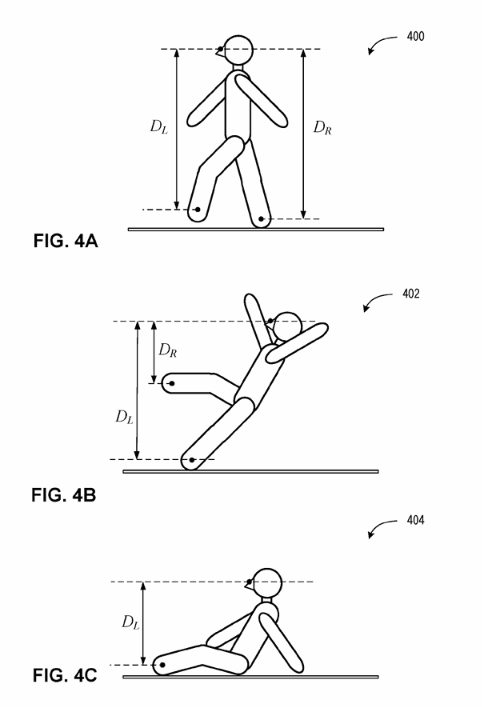
The sensors would be triggered to take action by an updating “lying-down score” where 0 refers to a fully standing or cycling body frame, and 1 refers to a person lying on the ground with vertical distinction between multiple tracked body parts. When the score suddenly increases, the car would then be instructed to either brake or swerve away from the fallen person in front of the car.
If the risk is deemed big enough, the car could also stop and ask a “remote assistant” for support, which could be either a human operator or rely on more computer software.
The patent, formally titled “Detection of loss-of-control vulnerable road users in automotive environments” is one of 19 patents published by the company in the last week alone, as the company seeks to secure its intellectual property in the self-driving car market.
> Waymo self-driving car lets cyclists pull out of blocked cycle lane
The patent’s publication does not mean it will be granted, with average US patent applications taking two to three years to be determined. However as a Big Tech company with several parent patents already approved, it is unlikely the application will be rejected.
Among the other patents published this week by Waymo, a subsidiary of Google, are “Coupled lasers for coherent distance and velocity measurements”, “Controlling vehicles for multi-lane turns” and “Road friction and wheel slippage assessment for autonomous vehicles”. But as the company has gained traction in the industry, cycling campaigners have criticised the company for its attitude to road safety.

Executive director of the San Francisco Bike Coalition, Christopher White, said in April that Waymo has told campaigners it is “normal practice” for the autonomous vehicles to veer into bike lanes and block cycling infrastructure.
“People always point out that unlike human driven cars, the AVs stop at lights and obey the speed limit,” White said.
“However, they are really only as good and effective and safe as they are programmed to be. Waymos pull over into bike lanes all the time for pickups and drop-offs and that’s neither legal nor safe.
“But the companies say that is a normal practice and that’s what customers expect.”
In a statement to road.cc, the company strongly denied the claims, saying “the Waymo Driver is designed to prioritise the safety of other road users and our riders, and to take the safest action available during the few minutes we spend picking up or dropping off.”
Closer to home the London Cycling Campaign has also stressed caution following the roll-out of trial vehicles in the capital earlier this year. Chief Executive Tom Fyans told road.cc “it’s really early days for the technology”.
“We talk to political leaders, innovators and private companies of all stripes all the time – to make sure everyone’s working hard to make London a better place for healthy, safe cycling for everyone. We hope new ride-sharing services will add to that, rather than detract from it.”




3 thoughts on “New patent enables driverless taxis to brake or swerve if a cyclist crashes, months after autonomous vehicle firm Waymo warned avoiding cycle lanes was “too high a bar””
Even if it’s powered by a ZX Spectrum, it still going to be safer for cyclists than an Audi, BMW, Stagecoach or BYD driver
@wtjs Says who? Waymo? Tesla? Audis BMWs will still be on the road in the same numbers. Are driverless taxis an extra as yet unquantified hazard?
I am concerned about the reported collisions in the US of driverless taxis with pedestrians and cyclists. Has enough work been done to ensure that the camera and software systems are sufficiently robust? What would be considered an acceptable collision rate to deem the trial successful?
Is there a danger that the path of least resistance will be taken to ban cyclists from certain roads or because it means companies like Waymo do not have to carry out expensive and time consuming software mods – a lot of profit is at stake and greed is a powerful force.