
Words and images James Startt:
As I approach my 40th Tour de France, I really can’t tell you how many times I have climbed Alpe d’Huez, but a select few stand out.
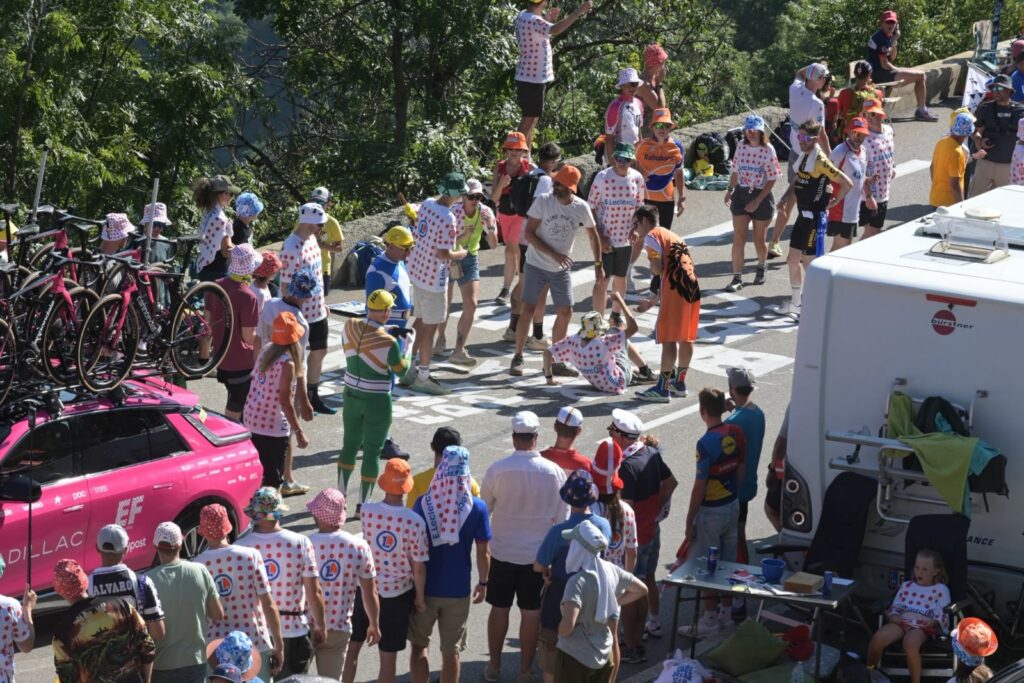
There was the first time, as a cyclist before a Tour stage in the early 1990s, when I was suddenly greeted by a tuba band of sunbaked Dutch fans, scantily clad and blasting Queen’s We Are the Champions at full volume. No fan encounter has ever topped that in my book.
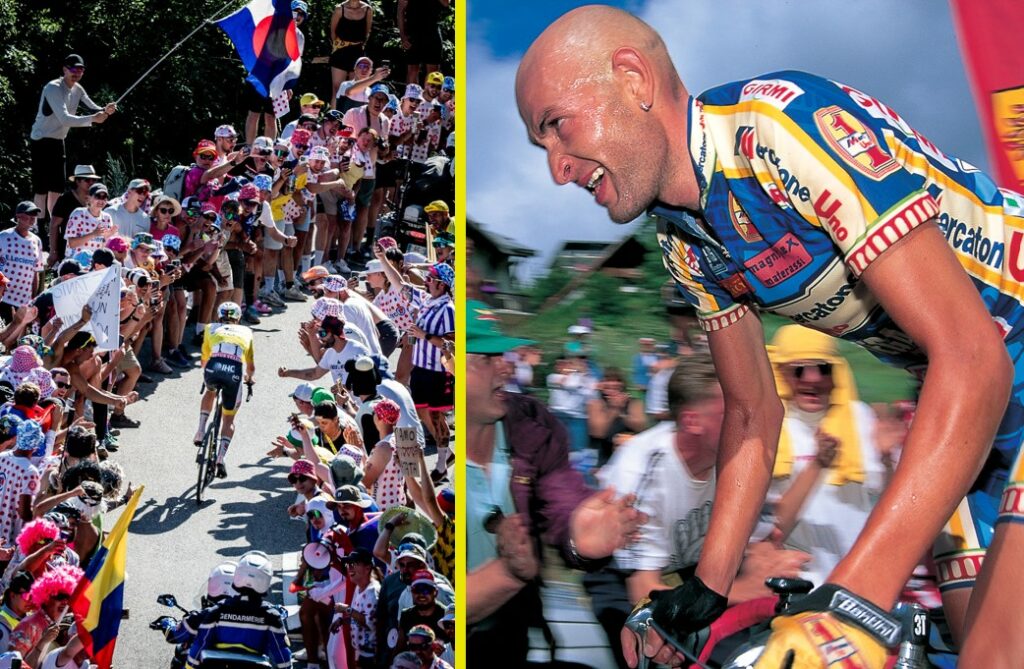
And then there were the two record rides, first by Marco Pantani and then, this past weekend, by Tadej Pogačar. But when I look at my photographs from those two rides, both for myself and for the race, I see a world of difference.
> “It’s like a football stadium on a mountain”: The chaotic duality of Alpe d’Huez
Back in 1997, my racing days were far from a distant memory, and I thrived on photographing right in the thick of the action.
I remember walking down to the entrance to the village of Alpe d’Huez. The crowds were intense, but I also wanted to photograph the riders racing past the town sign as a subtle way of placing them on the stage that is Alpe d’Huez.
Mind you, these were the days before mobile phones, Wi-Fi, or social media. The only way to know what was happening in the race was through race radio – or, in this case, a camper van. A camper van, you ask? Yes, a camper van, for the very simple reason that whenever you came across one with a crowd huddled outside, you knew it had a television connection. And if you were lucky enough to catch a glimpse of the screen, you had at least a chance of understanding what was happening in the race.
I honestly don’t remember what I saw, but I remember the moment the crowd erupted with cries of “Pantani! Pantani!” I knew immediately that Pantani was once again on the attack.
As the Italian approached, I took my position in front of the Alpe d’Huez town sign and did my best to hold my ground, pushing back against the wall of spectators while trying not to get clipped by one of the race vehicles passing just ahead of the race.
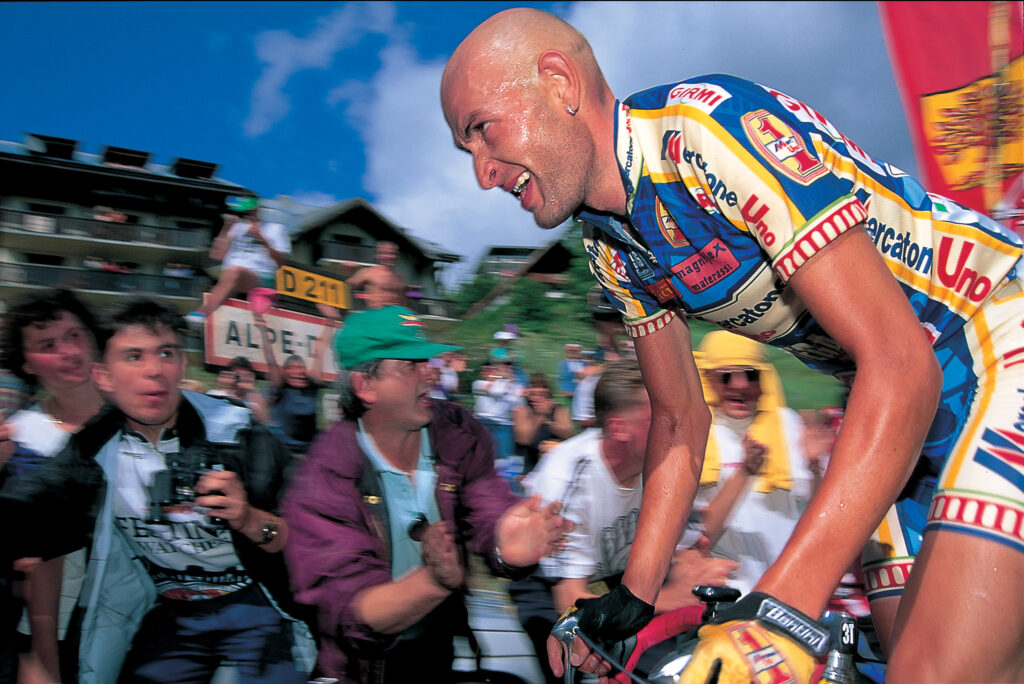
Then, as Pantani came into view, the sea of people suddenly parted just enough for him to pass. He rose out of the saddle as he powered by, and I did my best to time my shot.
I say my shot because I only had one. After all, 1997 was long before the days of digital photography and cameras capable of shooting 20 frames per second. Back in the days of film, you had only one chance, and you didn’t even know whether you had captured the image until the film was processed.
Needless to say, the success rate was much lower than it is today. But when you got the shot you were hoping for, the satisfaction was all the greater.
When I finally got my film back after the Tour, this image immediately stood out. Pantani was perfectly positioned in the frame, and without sunglasses or a helmet, the determination etched across his face is unmistakable. Sure, I would have preferred that the fan in the green hat hadn’t blocked the word “Huez” on the town sign, but there’s always an element of chance in photography.
No matter. This remains one of the photographs I am most proud of when I look back on my career. And every time I see it, the image takes me back to that place and that day on Alpe d’Huez.
What I didn’t know at the time was that it would soon become impossible to shoot from the same position again. In the years that followed, the Tour de France extended its roadside barriers to the final three kilometres, and later four, placing the town sign well outside the action.
Over the many years that followed, I found plenty of other places to shoot. After all, the possibilities on Alpe d’Huez are endless.
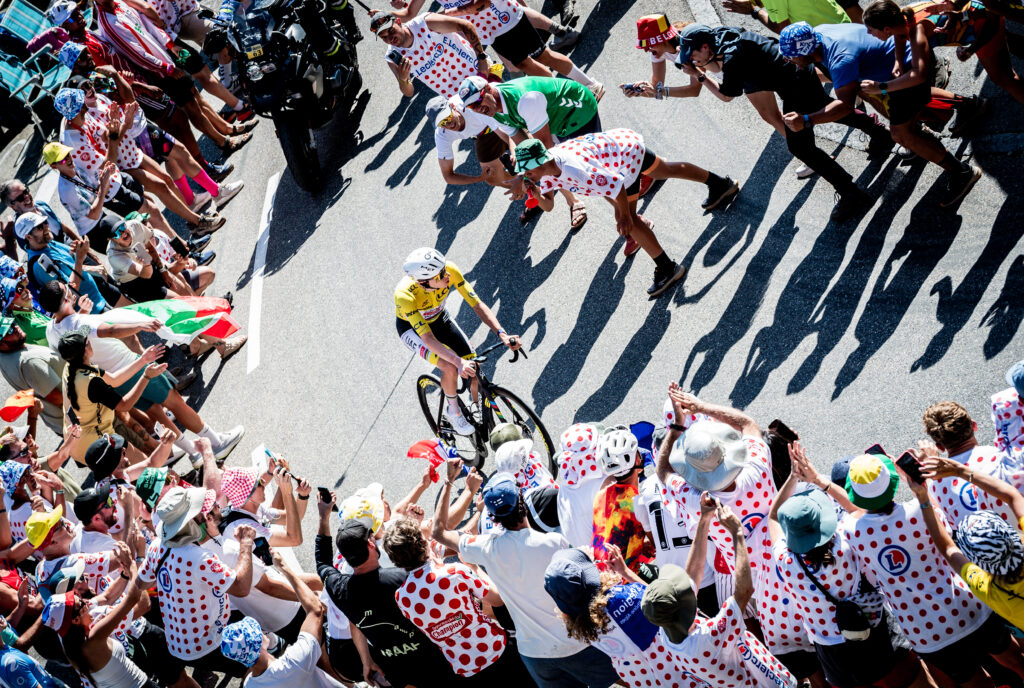
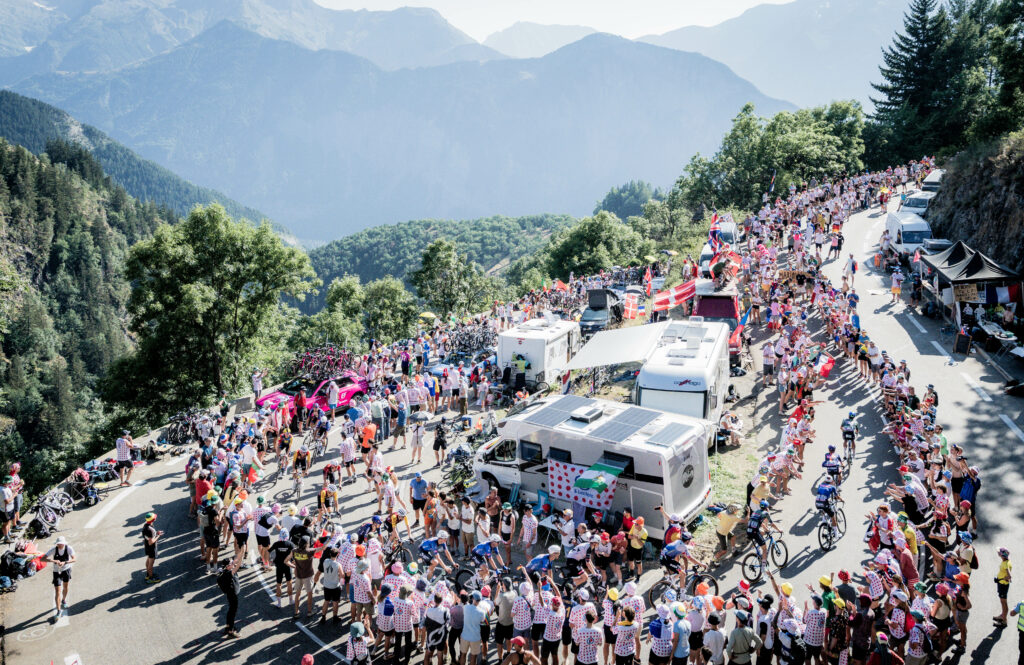
This year, however, I wanted to take an entirely different picture. Instead of being in the thick of the scrum, I wanted to be above it, in an effort to capture the magnitude of the riders navigating through the sea of fans.
My original plan was to shoot from the hill overlooking Dutch Corner, but when I arrived early in the afternoon, I quickly realised that Dutch Corner isn’t what it used to be. Why? Once again, because of the barriers, which now keep the fans at a considerable distance.
Much has been said about the fans and barriers this year of course, but my experience is that they create as many problems as they solve. While the barriers certainly make some areas safer, they also create bottlenecks at either end, where the chaos of the crowds is only heightened. But I digress, because this is not a piece about safety, only about visual impact.
Fortunately, about 500 metres beyond Dutch Corner, I found a wonderful hairpin free of barriers. Even better, there was a bluff above the rocks overlooking it. I knew immediately that this would be my spot.
What I didn’t know was that Pogačar had his sights set on breaking Pantani’s record this day.
With technology being what it is today, I quickly realised that Pogačar had attacked on the opening ramps of the climb and that the record was clearly in his sights. Below me, the crowd thickened as he approached, and I even considered abandoning my position to once again shoot from the midst of the scrum. But I decided to stay above it, as this vantage point offered several different perspectives.
As the yellow jersey came into view, I started shooting, first as he rounded the turn and then as he climbed through the tunnel of fans toward the next turn.
I’m not sure how many frames I managed to fire before he raced out of sight, but it was certainly more than the single shot I had of Pantani.
As I edited my images, two frames stood out. One showed Pogačar entering the turn, where there is a striking contrast between the rider, the shadows, and the fans. The other, one of the last frames I captured, shows him emerging from the tunnel of fans, rising out of the saddle in a small clearing before powering into the next turn.
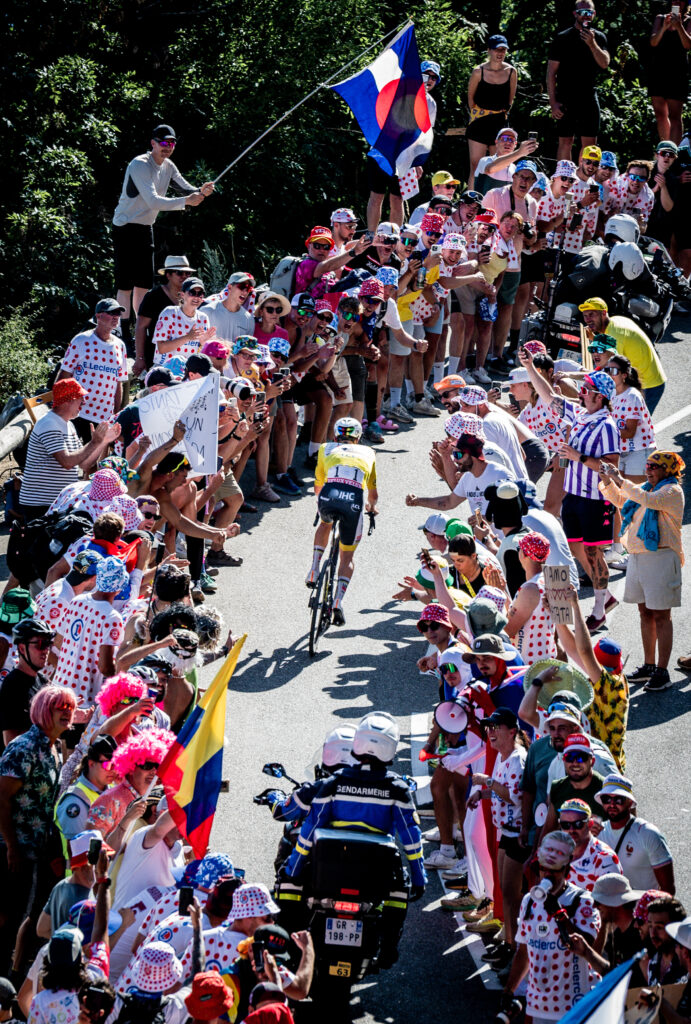
In the end, this is my favourite. Yet it stands in stark contrast to my photograph of Pantani from 1997. On that day, over three decades ago, Pantani appeared larger than life, while in this year’s image, Pogačar is instead a small but unmistakable detail within the larger scene.
I love both photographs, to be honest, and their different compositions say as much about where I am in my own photographic journey as they do about the race and the exploits of these two unforgettable days in Tour history.
To be honest, I never set out to become a sports photographer. My first photographic passion was street photography. And one thing I noticed about many of my favourite street photographers was that, as they matured, they often took a step back. No one exemplified this more than Joel Meyerowitz, who, after years of photographing the streets of New York, shifted to a more pastoral style with his seminal book Cape Light in the late 1970s.
While I certainly wouldn’t describe this year’s Alpe d’Huez photograph as pastoral, it does reflect my desire to step back and take a longer look at the sport. Rather than focus solely on the intensity of the moment, I wanted to capture the full magnitude of the spectacle that is professional cycling.
Both images capture the beauty and power of the sport in their own way, and when I look at them together, I am reminded of how they also document my own photographic journey along the roads of the Tour de France.
Paris-based American photographer James Startt is one of the longest-serving cycling journalists in the press room, with almost four decades’ experience in the sport. He is covering his 37th Tour de France and is a two-time winner at the World Sports Photography awards. James currently serves as the creative director of luxury cycle tour operator inGamba and has spent most of the 2026 Tour educating road.cc about fine French wines.