


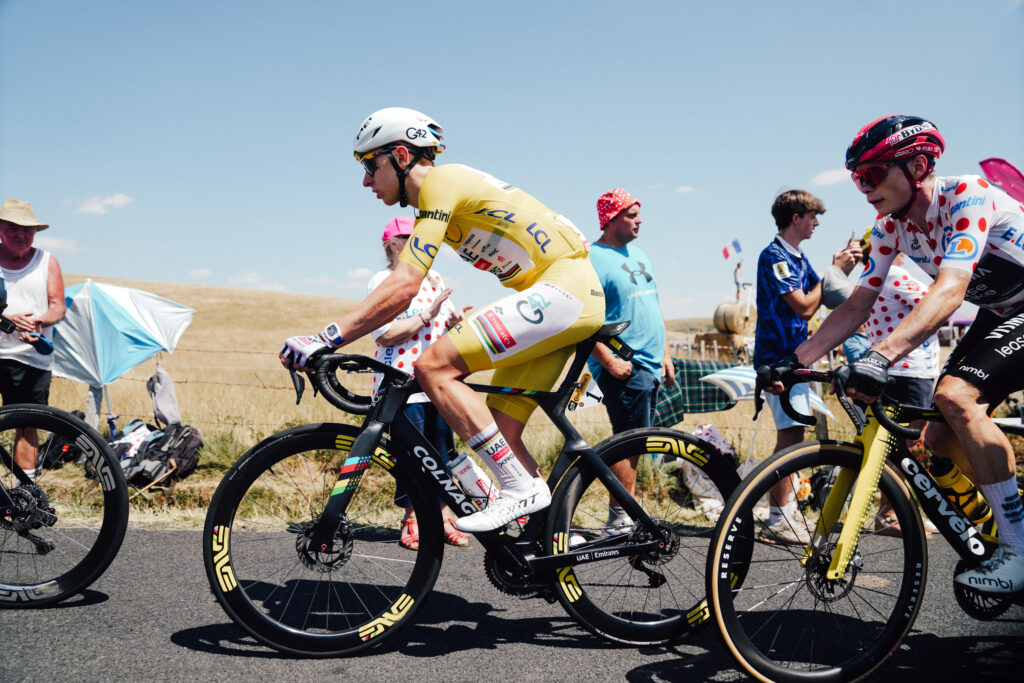

Tadej Pogačar and Jonas Vingegaard’s nocturnal doping tests at the Tour de France were carried out after being authorised by a judge in Paris before the race, according to reports in France.
L’Équipe reports that a source from within the anti-doping community told the newspaper that this is the first time this legal procedure, similar to a search warrant in a criminal context, has been implemented since it was introduced into French law in 2015.
In the early hours of Sunday morning, Pogačar and Vingegaard, the then-top two at this year’s Tour, were woken up at 5am and 2am respectively to submit samples to the International Testing Agency’s anti-doping officials.
However, it seems that Pogačar and Vingegaard are not the only riders to have their doors knocked by drug testers in the middle of the night. road.cc understands that multiple riders on at least two other unnamed teams have been subject to tests carried out in the early hours of the morning at this year’s Tour.
On the other hand, one source at an established Tour team told road.cc that, as far as the squad’s doctors can remember, their riders have never been required to submit an anti-doping sample between 11pm and 6am.
Vingegaard was forced to abandon the race during yesterday’s stage to Plateau de Solaison after breaking his collarbone with around 20km to go, prompting Pogačar to suggest that the Dane’s interrupted sleep may have caused a momentary lapse of concentration leading to his Tour-ending crash.
According to the UCI’s rules, anti-doping controls may be carried out outside the normal hours of 6am to 11pm (which, before 2016, were the only times tests could take place) if there is a “serious and specific suspicion that the rider may be engaged in doping”.
“Unless the rider has identified a sixty-minute testing window between the hours of 11:00 p.m. and 6:00 a.m., or has otherwise consented to testing during that period, the UCI will not test a rider during that period unless it has a serious and specific suspicion that the rider may be engaged in doping,” the governing body’s rules state.
Whether there is sufficient suspicion to carry out nocturnal testing must be approved by a judge of liberties and detention (JLD) at the Paris judicial court, with that judge also determining whether waiting until the morning could lead to the “risk of loss of evidence”.
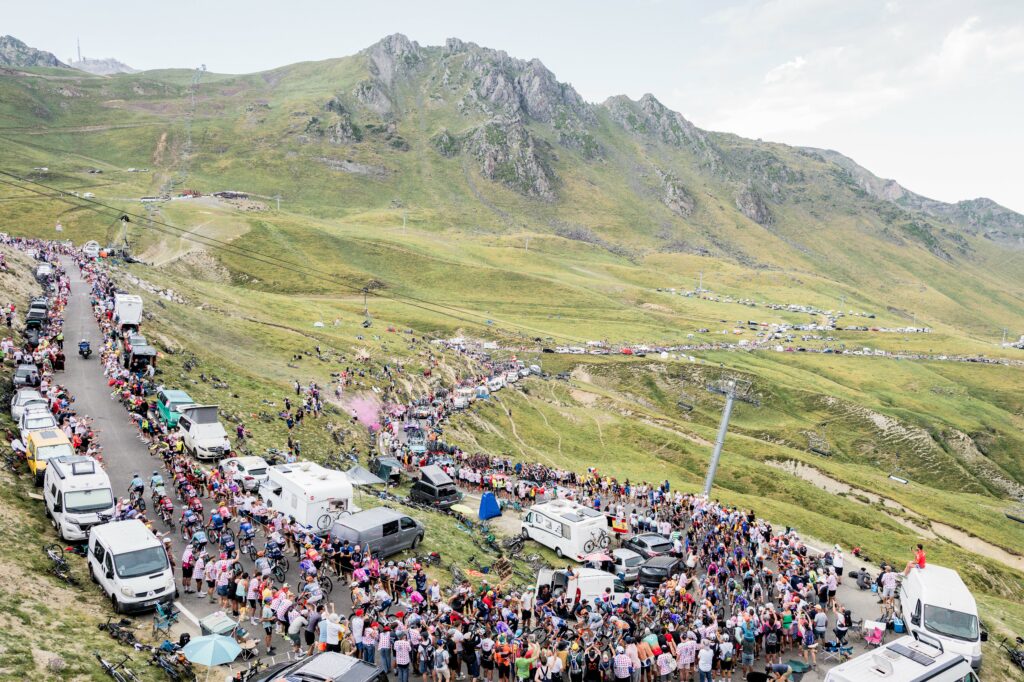
First permitted back in 2016, provided these conditions are met, nighttime tests enable anti-doping authorities to act on information they believe may indicate doping, especially if riders are using methods, such as micro-dosing, which mean certain products wouldn’t show up in their samples if the tests were carried out just hours later.
In a statement supplied to L’Équipe, the public prosecutor’s office in Paris said: “As is customary in the lead-up to the Tour de France, the public health divisions of the Paris and Marseille judicial courts, which have jurisdiction over doping matters, are in contact with the UCI (International Cycling Union) and the ITA.
“The judges of these two jurisdictions have concurrent jurisdiction to rule on requests for nighttime doping controls. A judge of liberties and detention in Paris was therefore indeed contacted by the ITA, pursuant to Article L.232-14-4 of the French Sports Code, to authorise the doping controls that took place on the night of July 18-19.”
According to French law, doping control operations must be carried out “under conditions guaranteeing strict proportionality between the infringements on the rights of the athlete and the stakes of the fight against doping in terms of fair competition and protection of his health. They are limited to the collection of samples and the gathering of observations from the athlete.”
In a statement released on Sunday night, the ITA said: “The ITA is conscious that night-time testing may be disruptive to riders’ rest and recovery. Due consideration has therefore been given to minimise as much as possible the impact testing activities have on riders.
“However, the ITA, on behalf of the UCI [the governing body], has the responsibility to ensure the effectiveness of the cycling anti‑doping programme and the integrity of cycling races.
“Effective testing must, in limited and justified circumstances, be capable to occur outside standard daytime hours. All testing activities conducted at the Tour are subject to the safeguards established under the world anti-doping code, the UCI anti-doping rules and French law, with due consideration for riders’ welfare, equity, and fundamental rights.”
The use of nighttime testing was criticised by a number of riders before and after stage 15, with Pogačar and his UAE Emirates teammate Florian Vermeersch describing them as “inhumane”.
And on Monday, the CPA riders’ union issued a statement questioning the “intrusive” methods seemingly favoured by the ITA at this year’s Tour.
“The Tour de France is a competition that demands exceptional physical effort,” the CPA said. “The quality of sleep and recovery is essential not only for performance but also for the health and safety of the riders.
“It is clear that this practice hinders athletes’ recovery during the most important and difficult race on the global calendar and runs counter to the intended objectives.
“Cycling contributes approximately €10m to funding the fight against doping within the ITA for the collection and analysis of samples, while at the same WADA spends, on average, only $5 million per year across all sports on basic research to develop new methods for detecting and identifying new doping substances.
“Would it therefore be more appropriate to invest more in scientific research and detection technologies, rather than increasing the number of particularly intrusive unannounced tests?”






21 thoughts on “Judge signed off on Tadej Pogačar and Jonas Vingegaard’s nighttime doping tests due to “serious suspicions” before Tour de France, according to reports”
If the issue was something discussed before the tour, why wait 2 weeks before acting on it?
If it genuinely had to be done, it should have been done to both riders at the same time – ideally before midnight. The 2am time is really unfair vs a 5am call.
Perhaps because the riders are going to fairly fatigued at this point of the race, and with a load of big stages still to come, so more likely to be using (if indeed they are)?
@Huw Watkins The thing is, this kind of doping simply wouldn’t make sense.
There are only two types of doping that could potentially make sense in the middle of a grand tour:
1. Blood transfusion – but nowadays it is easily detectable
2. Drugs – but that would’ve been easily detected in the morning.
The only case where at-night testing would make any difference vs a test in the morning is microdosing. The problem is, there is no evidence whatsoever of this kind of doping actually working.
So what was done here is a lose-lose-lose scenario:
1. Fans lost the spectacle by getting one of the strongest riders out of the race
2. ITA lost by making fools of themselves
3. (which should be no. 1): poor, poor Jonas, who lost health an a shot at GC because of some incompetent ITA idiot and a partial judge.
There is no possibility of a conspiracy between Pog and Jonas. A judge deciding about them both in one session, as if they were the same case, is obviously at odds with reality.
There’s no demonstrable link between the test and Vingegaard crashing out of the race – just some rather overblown speculation.
@mdavidford Well there’s evidence of it not being a link. Visma were riding hard to set up Vinny for an attack and the riders interviewed after the stage all said Jonas was on a good day and ready to go for it.
@Surreyrider Well, quite – plus there’s the video coverage of the event, which doesn’t show him making any obvious mistake, but rather shows the whole train of riders going wide through the corner and him getting cramped for space – not unlike many other crashes where there’s no suggestion that lack of sleep was an issue.
@tomlew microdosing EPO most definitely does “work” in terms of stimulating RBC production.
@Paul J Please show me any reliable evidence.
EPO tests already detect levels far below the minimum effective dose. With the recent state of the art, microdosing simply does not make any sense.
. reposted without direct link to paper.
@tomlew Sigh. I typed out a long reply to you, including a link to a very relevant paper (which itself references a number of other relevant studies), and it’s got lost in Road.cc’s blackhole of a moderation queue – cause I linked to a scientific paper.
Road.cc – can you please check the mod queue, and can you also please whitelist comments that reference URIs to major scientific publishing platforms? Thanks.
@Paul J That might be asking a bit much, given that links to road.cc’s own site are falling into the black hole.
@tomlew Where is the evidence for /your/ claim that existing EPO tests can reliably detect doping at far below minimum effective doses (you didn’t say “reliably”, but that seems a sensible qualifier – without that, you do not have an effective test)?
WADA actually funded research into developing tests for microdosing of EPO. I don’t know the background as to why, but I have to assume they did so because of problems with the prior tests in detecting microdosing. E.g., I think this paper is reporting on at least some such research (some of the work cited is simply the prior work of various subsets of the authors):
Wang, G., Durussel, J., Shurlock, J. et al. “Validation of whole-blood transcriptome signature during microdose recombinant human erythropoietin (rHuEpo) administration.” BMC Genomics 18 (Suppl 8), 817 (2017). DOI: 10.1186/s12864-017-4191-7
In the background it notes of the direct test for EPO microdosing: ” The main limitations of this direct approach are a variable and short detection window and low sensitivity. … Despite these advances, important limitations in detection of the direct approach have prompted a paradigm shift to the indirect identification of the effect of the prohibited method and/or substance. ”
And on the Athlete Bio-Passport (ABP) approach: “For example, the application of the ABP failed to reveal any evidence of rHuEpo microdosing (i.e. 20–30 IU∙kg−1 body mass rHuEpo twice weekly for 8 weeks) in 10 healthy male subjects [11]. In addition, the haematological parameters of the ABP may be confounded with factors such as altitude exposure, since hypoxia may affect the blood variables and vascular volumes [12, 13]. ”
And of course, all the top elite athletes (and their domestiques in cycling) are doing regular altitude camps, which – aside from the direct benefits on RBC – has the side-effect of making ABP data basically inadmissible (a useful side-effect IF you’re doing blood doping).
Despite the ABP not being able to detect micro-dosing, there is a clear effect on at least some blood values in the micro-dosing data (MDS). See Figure 3 and read the section “Haemotological analysis” on the MDS.
So… TTBOMK:
1. micro-dosing definitely has an impact on blood values – you can see it in the data there, and I definitely felt it (I was one of the subjects in the MDS).
2. Neither direct tests nor ABP can reliably detect EPO microdosing, according to that paper – and WADA believes it too, because they funded at least some portions of the work described in that paper (they funded at least the MDS portion).
Repost: Replace my direct link to the paper published on Springer with the text of the citation and the DOI (search that and you’ll find it), to appease Road.cc’s overzealous filtering.
But Vingegaard sideboard said he got back to sleep straight away (2am wake up) and Pogacar said he didn’t get back to sleep at all (5am wake up). I think I’d rather be woken up at 2 for that reason.
Wouldn’t happen to a French rider. French judge.
Is the “serious suspicion” just that these two are much better than everyone else rather than any actual evidence… oh and there is a good French rider at last so let’s help them out…
Surely if the police/prosecutors have sufficient evidence to convince a judge to allow extraordinary testing outwith the standard window they should be obliged to present said evidence to the riders when they carry out the testing?
As far as I understand it, specific evidence against a rider (or of actual doping in general) isn’t required for the judge’s approval – they just have to convince them that, on balance, the need for them to do this to maintain an effective anti-doping program outweighs the riders’ rights to privacy. The “serious suspicion” stuff comes from a comment to the UCI’s internal rules (and is contradicted by another set of rules) and isn’t really relevant to the judicial process.
@Rendel Harris I think there is a line in there about specific riders having broken anti-doping rules or could so – meaning they essentially have a whole lot more leeway to test.
After nearly 40 years of living in France and listening to thé démented chauvinism of French commentators I have to wonder if French riders would have had thé same treatment
@darnac Richard Virenque and his French Festina colleagues didn’t exactly get a free ride in ’98.
True,but I can’t count thé number of times I’ve seen him on TV as an invited expert for comments since