


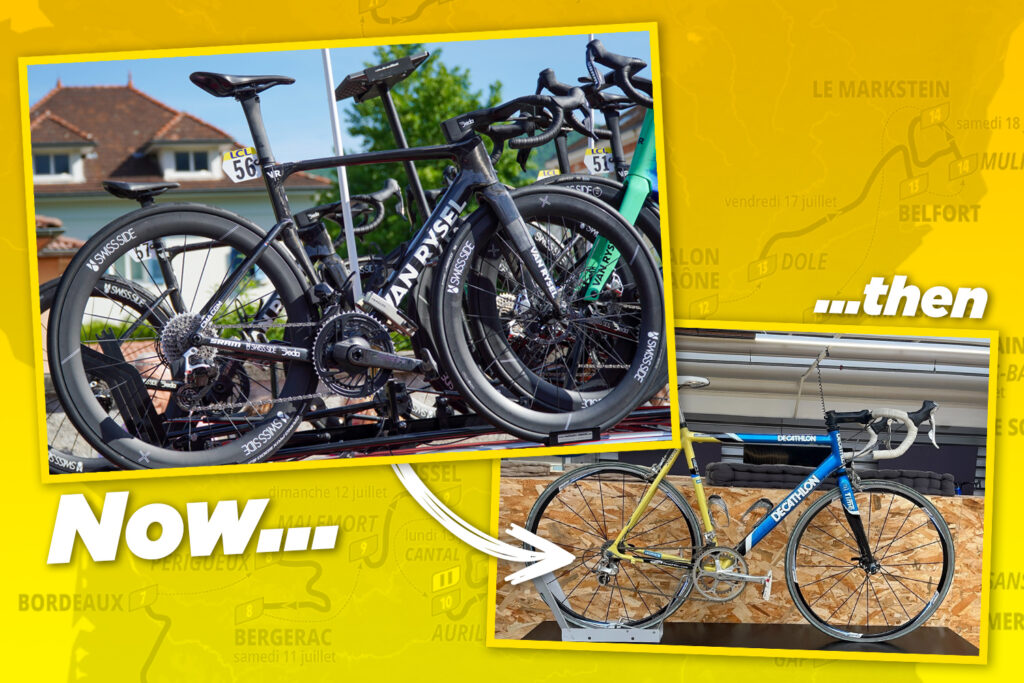

France’s Paul Seixas has been riding an unreleased Van Rysel in the 2026 Tour de France, and that’s a good excuse to look back at how Decathlon’s top-level race bikes have changed over the last 25 years.
Decathlon, the giant French sports retailer that owns Van Rysel, has a longer history in the Tour de France than you might think. It announced that it would become co-title sponsor of the Decathlon AG2R La Mondiale Team beginning in 2024, but its association with pro cycling goes back much further.
AG2R’s Decathlon Penta Pro from the early 21st century
This is the Decathlon Penta Pro ridden by AG2R’s Estonian sprinter Jaan Kirsipuu way back in the early years of the 21st century. It is displayed in the staff cafe at Decathlon’s HQ in Lille and we ran it as a Bike at Bedtime a couple of years ago (hence the massive logo on the first picture).
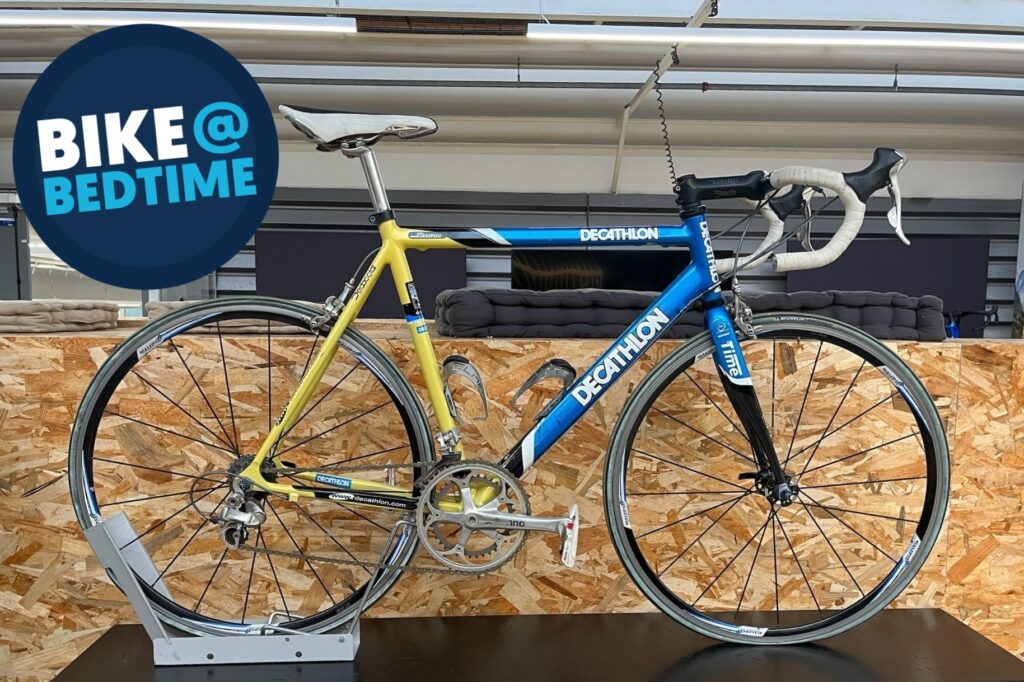
You get used to bikes developing incrementally year by year, and often the changes are barely perceptible – maybe a slightly more aero frameset, a couple of slimmed-down components, an extra sprocket on the cassette… When you take a step back and look at a race bike from a quarter of a century ago, though, you get an idea of how all those little advancements in technology really add up.
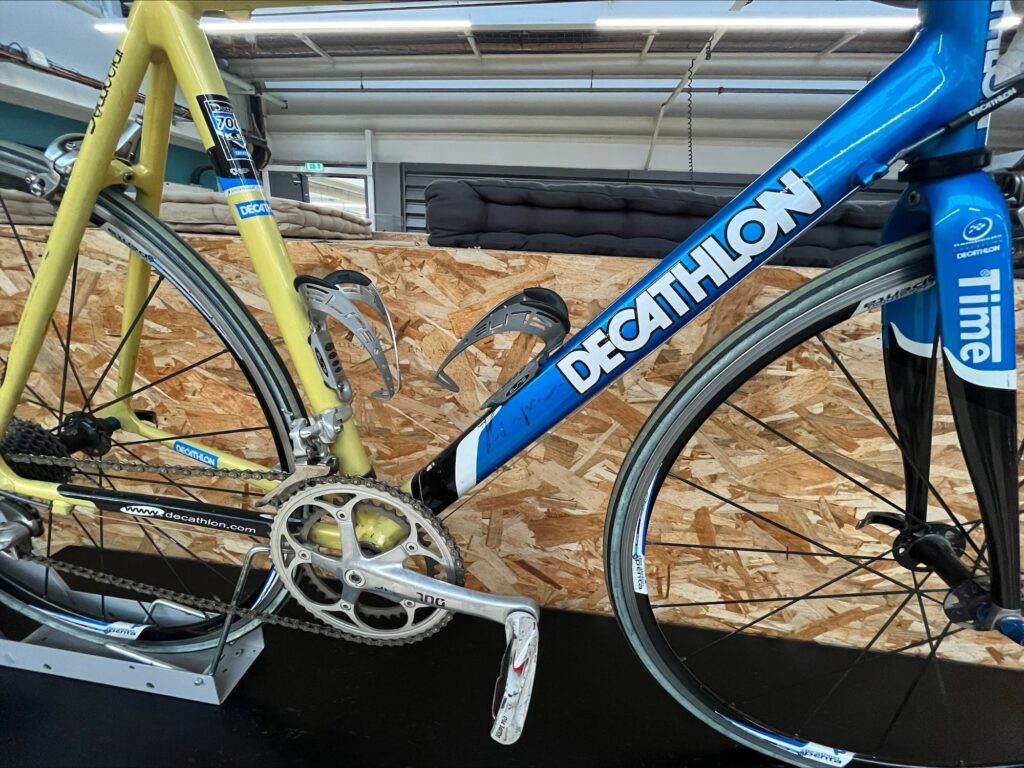
First of all, no one at Decathlon is 100% sure of this bike’s exact age. It looks like it’s equipped with a Shimano Dura-Ace 7700 groupset but with a 10-speed cassette. Dura-Ace 7700 was a 9-speed system, whereas Dura-Ace 7800, introduced for model year 2003, was 10-speed, so we’re a little confused.
Kirsipuu rode for AG2R from 2000 to 2004 and got three of his four Tour de France stage victories during that time. Campagnolo was sponsoring the team by 2002 so we’re dating the bike at 2000 or 2001, but we’re happy to be corrected by any sleuths out there. In fact, please do. We’re curious.
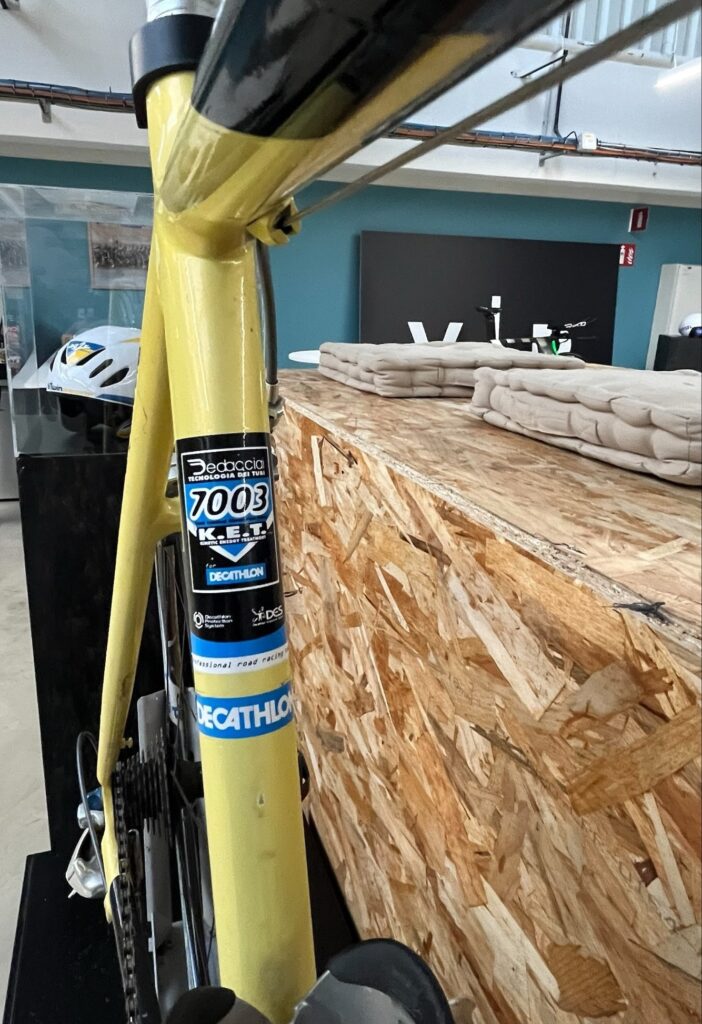
The first thing you’ll notice about the frame is that it’s metal. There are actual welds and everything! There are plenty of aluminium bikes around these days, of course, but not being raced at the very highest level. Carbon fibre has many benefits from a performance perspective but one of the advantages of aluminium was that the frame could be sized and custom-built for each rider relatively easily.
The tubes come from Italy’s Dedacciai. They’re 7003 aluminium alloy that’s undergone a KET (Kinetic Energy Treatment) process to increase surface hardness.
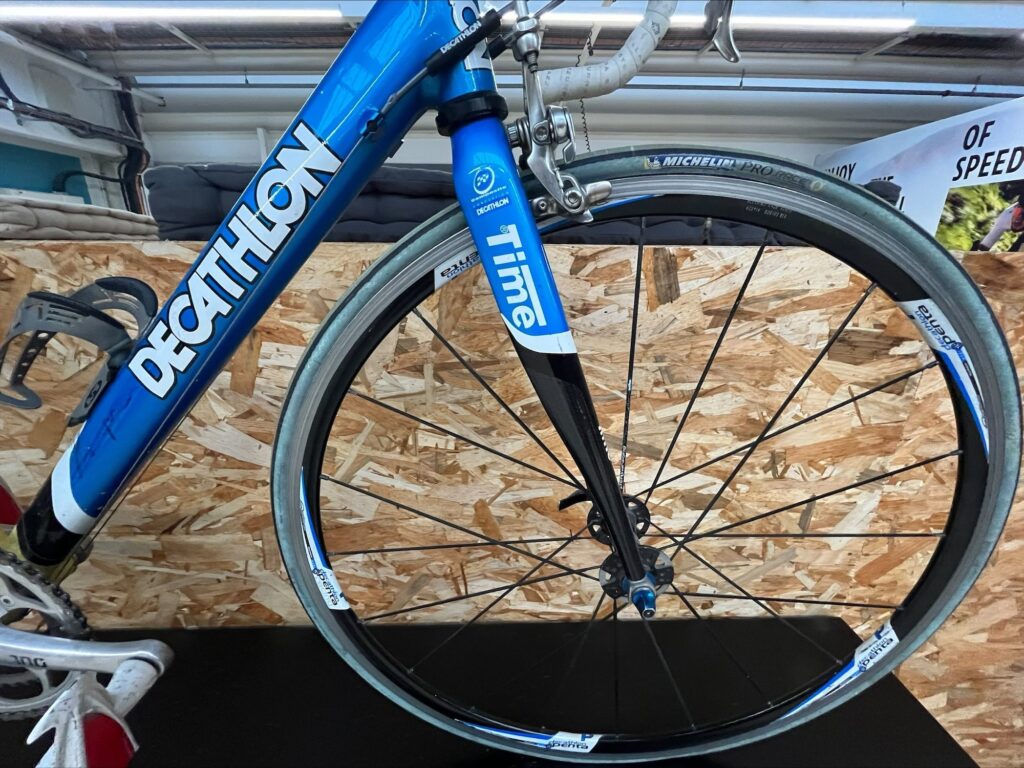
The fork that’s slotted in upfront isn’t aluminium, though. It’s a composite affair from Time, moulded from high-modulus carbon fibre and Vectran. The French brand still uses Vectran in its bikes today as a way to absorb vibration.
Of course, Kirsipuu’s Decathlon pre-dates disc brakes in the pro peloton by a long, long time, hence the Shimano rim brakes. Internal brake cable routing wasn’t really a thing back then; it’s no surprise to see external routing here.
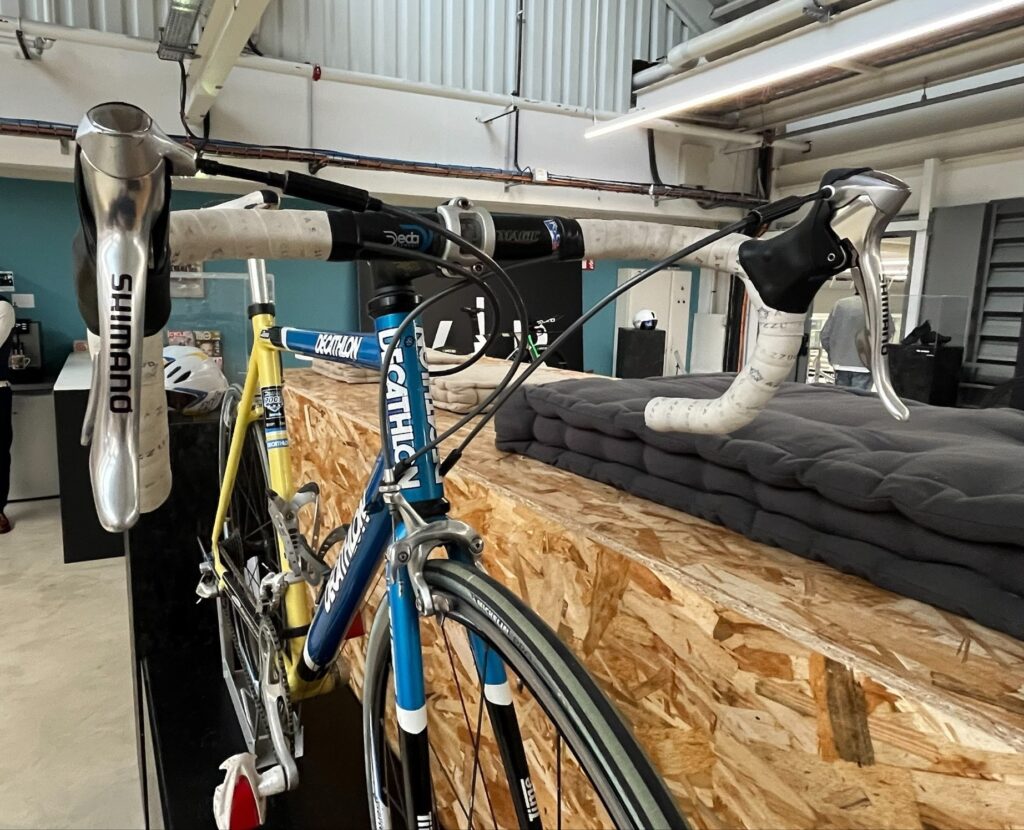
The gear cables were fully external too. It wasn’t until Dura-Ace 7900 was introduced in 2008 that Shimano first began to hide them under the handlebar tape.
The handlebar and stem are both Deda Elementi Magic, made from 6061 T6 aluminium.
The Decathlon Penta wheels are aluminium too, much shallower than we’ll typically see today and, of course, with a braking track around the rim. The tyres are Michelin Pro Race.
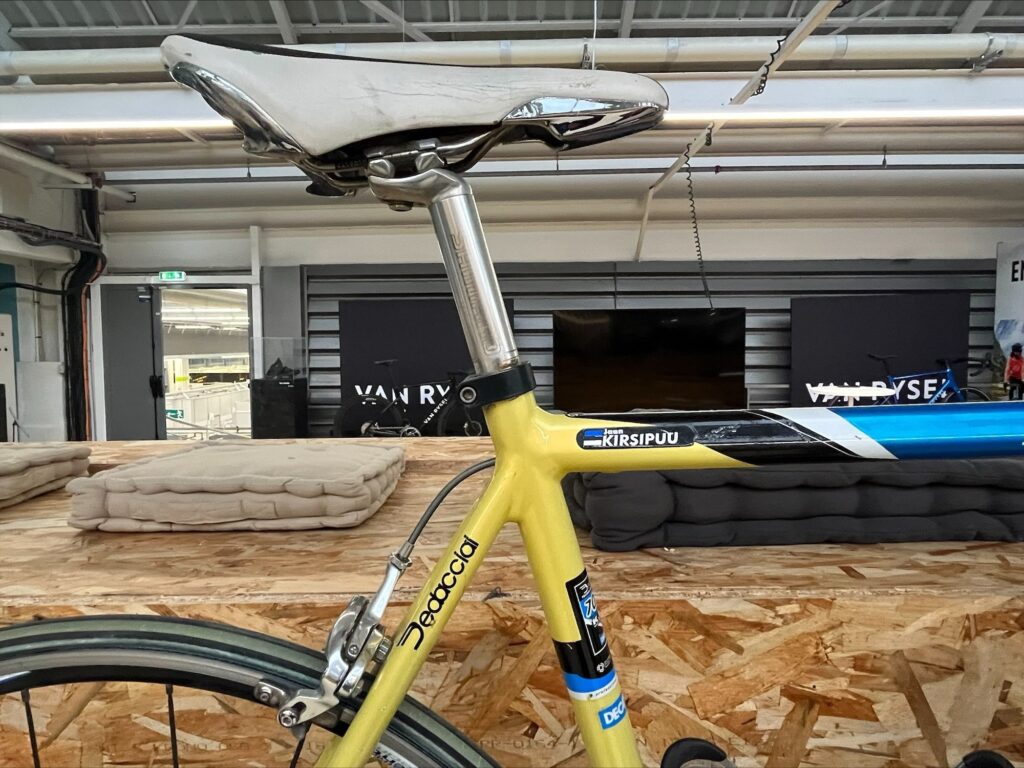
The bike is equipped with a well-padded Fizik Poggio saddle and Time’s Équipe clipless pedals, both of which were superseded in their respective ranges years ago, and Elite bottle cages.
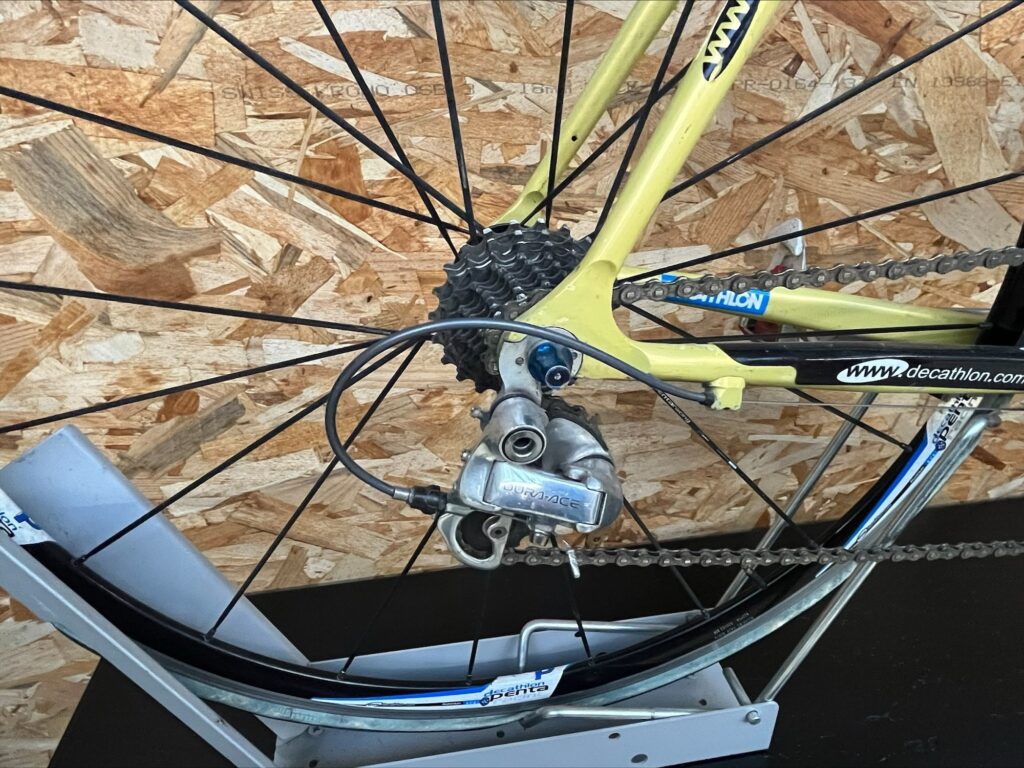
Although a couple of the model names remain, none of the major components on this Decathlon bike is still produced in the form you see here.
What do you reckon? Is that a shame, or do you think we’ve moved on for good reasons?
Paul Seixas’ unreleased Van Rysel
Paul Seixas of Decathlon CMA CGM is cycling’s man of the moment. No, he doesn’t have a CV to rival that of Tadej Pogacar or Mathieu van der Poel – not yet, anyway – but he’s just 19 years old. He has won the Ardèche Classic, La Flèche Wallonne and the Tour of the Basque Country this year, and got second in Strade Bianche and Liege-Bastogne-Liege. He earned himself a top-10 finish at the Critérium du Dauphiné last year at just 18.
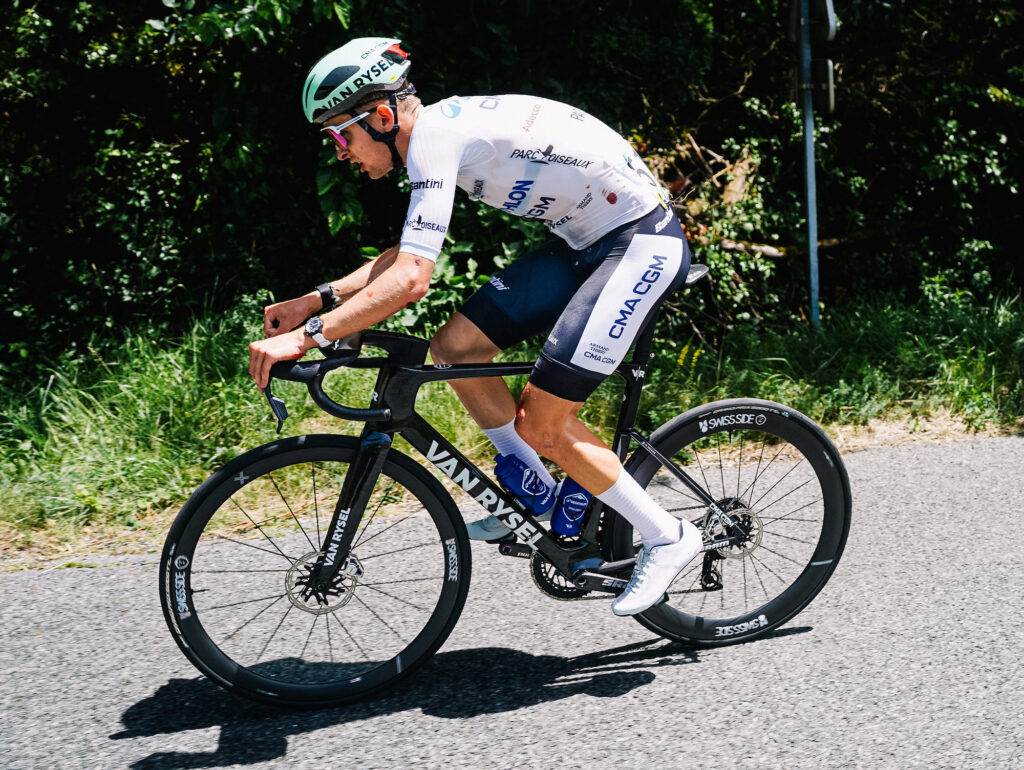
Seixas is very unlikely to win the Tour de France this year unless something extraordinary happens, but he’s undoubtedly the real deal.
Seixas has been riding an unreleased Van Rysel bike over recent weeks. He first had it at the Tour Auvergne-Rhône-Alpes, the new name for the Critérium du Dauphiné (we hope the organisers see sense and change the name back again soon because… well, the Dauphiné is just better, isn’t it?).
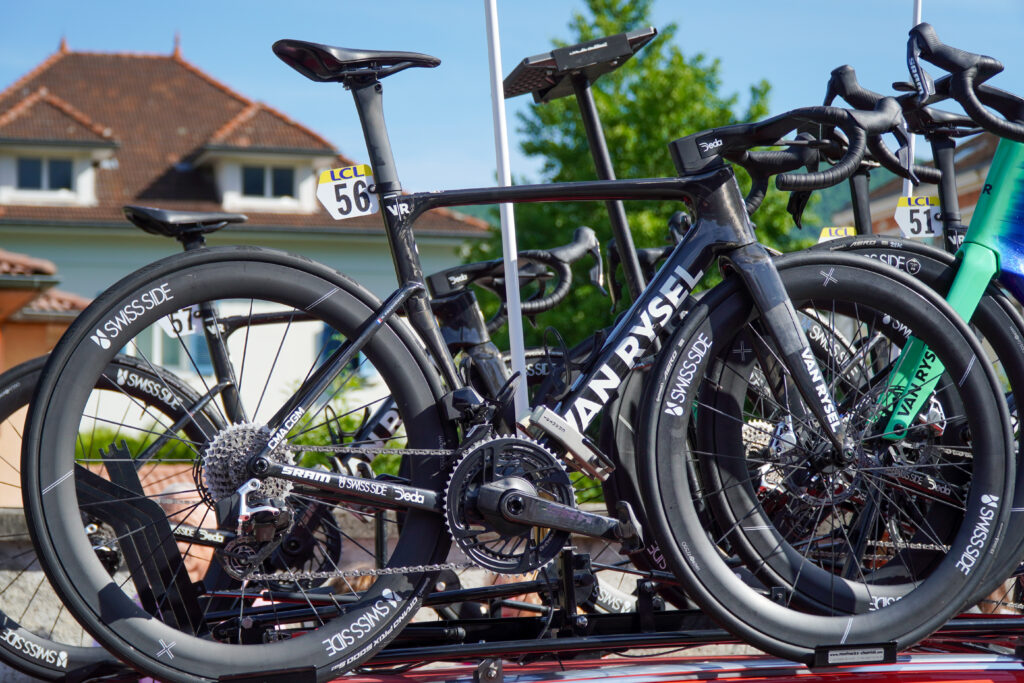
What is this new bike? Van Rysel has had a couple of bikes added to the UCI’s List of Approved Models of Framesets recently: the RCR-G2 and the VR-N2.
> A New, Aero-Looking Van Rysel RCR-Pro Spotted At Criterium du Dauphine
Whatever the name, it looks like Van Rysel is building on the success of its hugely popular RCR-R Pro bike, which featured aero-optimised tube shapes in a lightweight design. That bike, designed as an all-rounder, rides brilliantly and isn’t quite as expensive as most other pro-bikes. Okay, it’s far from cheap, but a Van Rysel RCR-R Pro equipped with a top-level SRAM Red AXS or Shimano Dura-Ace Si2 groupset is priced at £9,000, and that’s a lot less than similarly-specced rivals.

The head tube on the new Van Rysel bike is fairly similar to that of its RCR-F aero bike in that it’s pretty deep front to rear. There’s also a deep shroud to the rear of the stem, presumably for aero efficiency. Unlike the RCR-F, though, the fork crown isn’t integrated into a cutaway step at the junction of the head tube and the down tube.
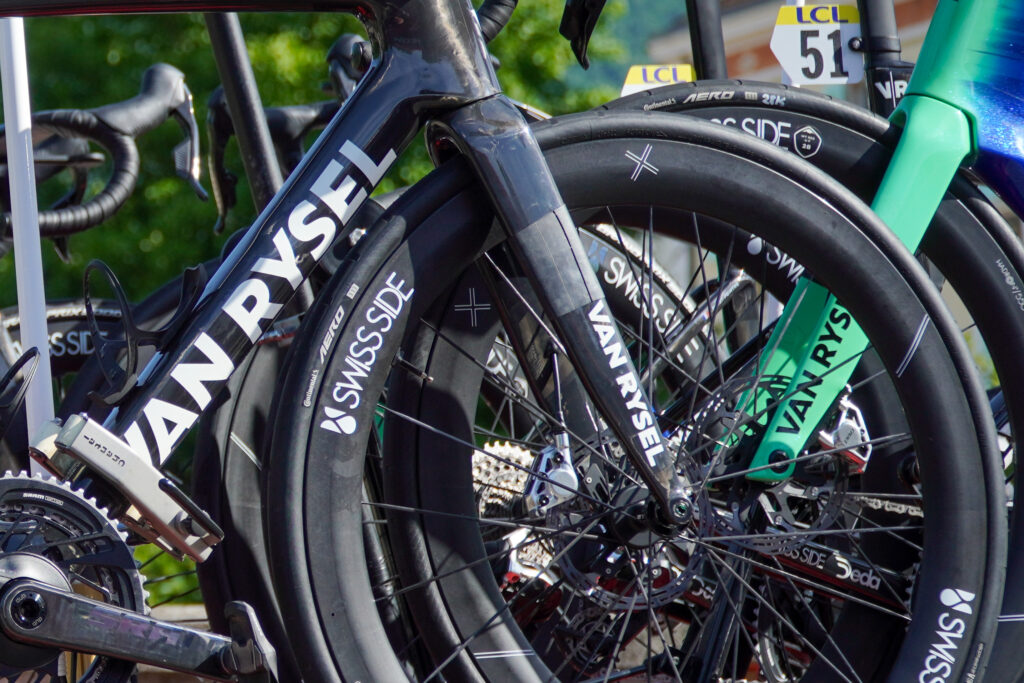
Speaking of the fork, the legs taper significantly from top to bottom. In fact, they’re pretty skinny by the time they reach the dropouts. How come? We’d guess that Van Rysel is looking to keep the weight down here, trying to get the bike as close as possible to the UCI’S 6.8kg minimum weight limit. We all know that race bike designers are always chasing lower weight or improved aerodynamics… Or both.
The down tube is heavily sculpted – narrow up at the front end before extending outward to shield the front bottle from the airflow. The rear bottle – where accessibility is less of a priority – sits really low on the seat tube. In fact, it could hardly be any closer to the bottom bracket shell. Bike designers often tell us that this is the best position for aero efficiency.
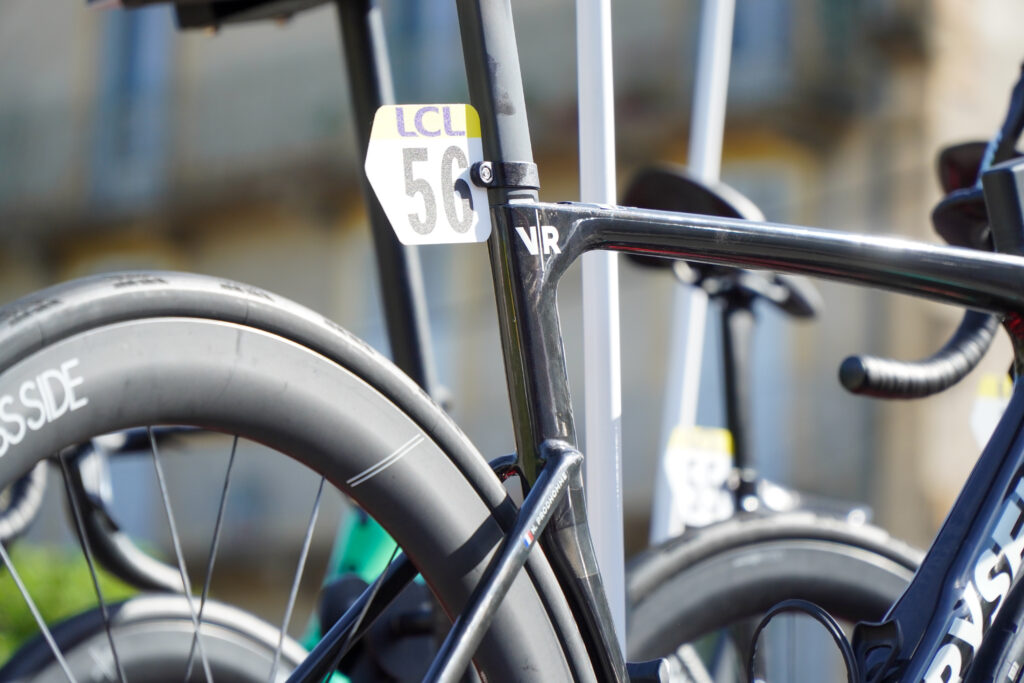
The seat tube itself is clearly shaped with aerodynamics in mind. The lower section is cut away around the leading edge of the rear wheel, while the upper section – which kinks forward slightly – is much deeper in profile. The seatstays junction is well below the top of the rear wheel so, in common with most race bikes these days, the rear triangle is small. We’re often told that this reduces drag while improving comfort. The seatstays sit well wide of the rear wheel along their full length, which is something that we’re seeing a lot more these days in pursuit of improved aero efficiency.
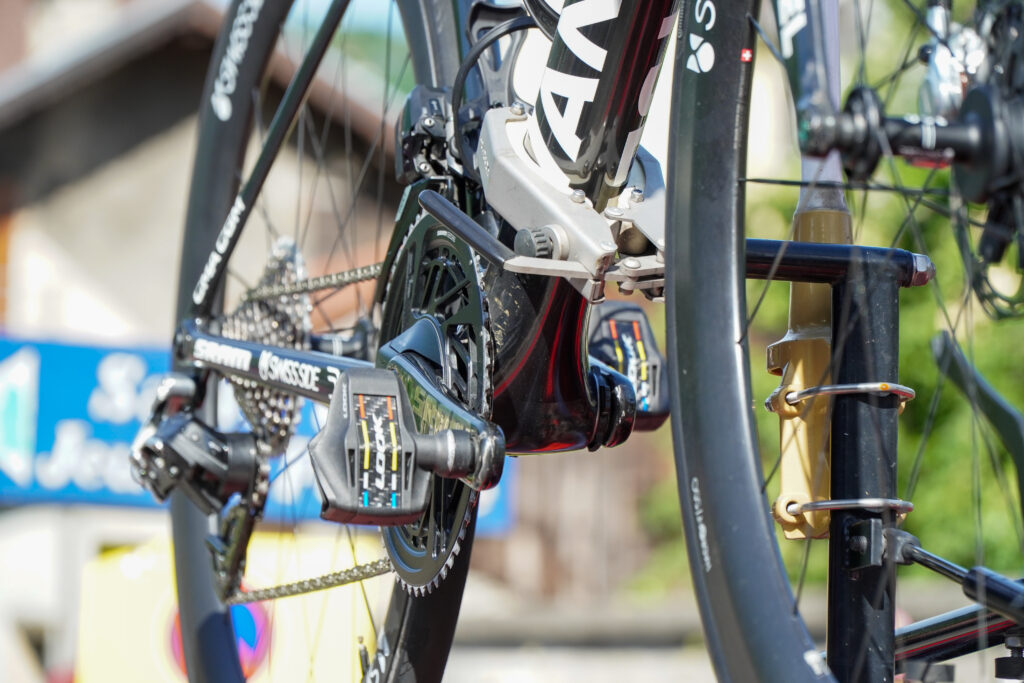
Seixas’ bike is built up with a SRAM Red AXS groupset with electronic shifting that relies on separate batteries located in the shifters and on both of the derailleurs. The hydraulic disc brakes are from SRAM too.
Decathlon CMA CGM riders use Swiss Side Hadron3 Ultimate wheels in 380, 550 and 650mm rim depths. Naturally, they’re carbon and designed with aerodynamics in mind. They come with hooked rims and are tubeless ready, fitted with Continental Grand Prix 5000 TT TR tyres.
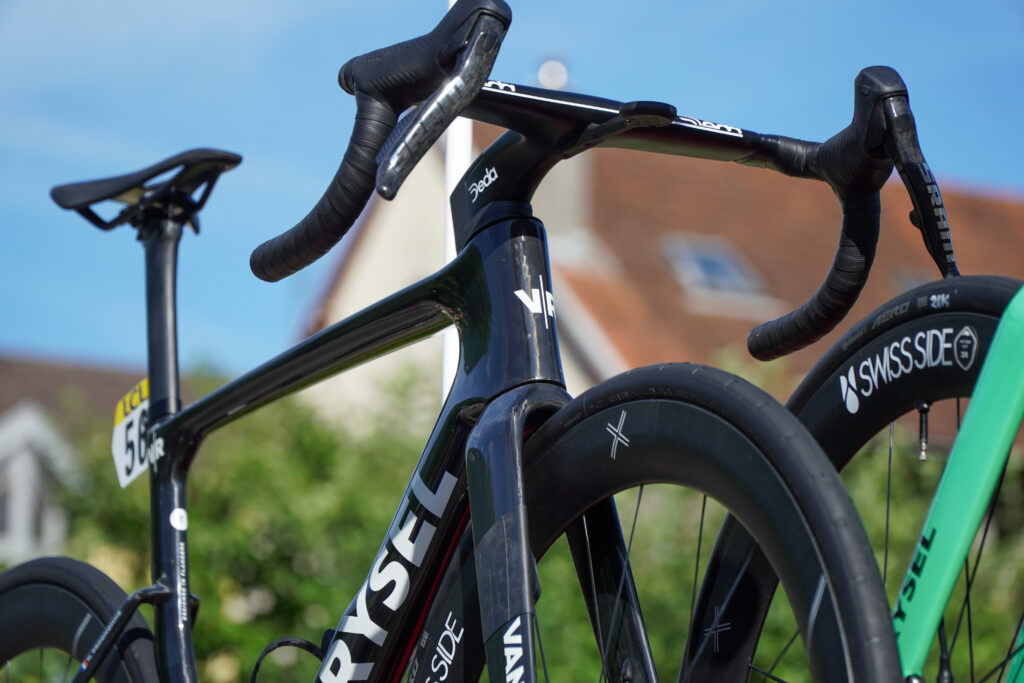
The handlebar/stem is a one-piece carbon unit from Deda, and Decathlon CMA CGM riders use Look clipless pedals.
The frame layout of Seixas’ 2026 Van Rysel is vaguely similar to that of AG2R’s Decathlon from 25 years ago in that UCI rules dictate that the frame must have a classic “double triangle” shape comprising top tube, down tube, seat tube and a rear triangle. Beyond that, though, there are far more differences than similarities. A carbon frame, disc brakes, electronic shifting, deep-section carbon wheels, tubeless tyres… Seixas’ bike is very different from its earlier counterpart.
Would you like to have a soft spot for bike tech of the past? Or is it best left to history?





13 thoughts on “Paul Seixas’ unreleased Van Rysel shows just how far Decathlon’s Tour de France bikes have come in 25 years”
What’s also evident, but somehow hardly ever mentioned, is how much more boring road bikes have become.
Black, matte frames, black rims, black parts and components.
Give me a nicely colored bike with silver parts any day.
@Sredlums Here’s a little collage of some of this year’s Tour bikes. I think if you look really hard you can see a bit of colour here and there…
@Rendel Harris Well, Rendel, I think if you look really hard you can see that I wrote “how much more boring road bikes have become” and not ‘how much more boring road bikes IN THE TOUR DE FRANCE have become”.
Simply look around you, when you see a group of road bikers pass by. Look in the bike shops. It’s black, black, more black, some dark grey, more dark grey, matte. And black parts, like on all the bikes you showed as an example.
Looking at Google shopping results for ‘road bike’, and then at a variety of retailer sites (Halfords, Decathlon, Sigma Sports, Ribble, Winstanleys, etc. etc., plus a couple of our local shops with ecommerce presence), on none of them are more than about one in eight black or dark grey, and often that’s just one of a number of colour choices. So if there are a preponderance of such bikes around, it seems like it’s less because bikes have become more ‘boring’ than it is because the people buying them have.
@Sredlums Well, Sredlums, I think if you look really hard you can see this is an article about how Tour de France bikes have changed, so if you were talking about road bikes in general (which you did not make clear) it was your comment, not my reply, that was not pertinent.
@Rendel Harris Except of course, Rendel, it is not.
This sentence is in the intro of this article:
“We compare Jaan Kirsipuu’s early-2000s AG2R race bike with Paul Seixas’ latest machine to chart a quarter of a century of tech progress”, and this is the sentence with which they end the article:
“Would you like to have a soft spot for bike tech of the past? Or is it best left to history?”.
Nowhere does it say they are looking only at bikes from the TdF. They honed in on these two specific Decathlon bikes to compare bike tech then with bike tech now.
@Sredlums Did you miss this bit?
See the words “Tour de France bikes” there? Easy to miss, only being in the headline and all…
@Rendel Harris Oh wait, so now the article is only about Decathlon’s TdF bikes? Because that’s in the headline?
That’s funny, because in your previous comment you said “I think if you look really hard you can see this is an article about how Tour de France bikes have changed”,.
So, which is it?
You can keep cherry-picking snippets of text, but it doesn’t change the fact that this article was *not* about these two bikes, nor was it about TdF bikes.
This article took these two bikes as examples of top road bikes of their time, to take a broader look at how road bike tech has changed in 30 years.
And my original comment was about exactly that; road bikes then and now.
@Sreedlums That’s hilarious, the article is literally about two Decathlon Tour de France bikes and comparing them. It says that everywhere, in the headline, in the subhead, in the body text. It says it’s “a good excuse to look back at how Decathlon’s top-level race bikes have changed over the last 25 years”, how on earth can you get from that to “this article was *not* about these two bikes”? Go on swearing black is white all you want, but you are totally wrong.
@Rendel Harris You know damn well what I mean, Rendel. The bikes here are just a nice angle to make their point about how tech has changed over the years. They could have easily used two other bikes for exactly the same purpose. They chose these because they already had an article that looked at the old bike in depth, and because Seixas’ bike is new.
You keep cherry-picking, to try to win this silly argument on semantics, but the intro actually says it quite clearly:
“We compare Jaan Kirsipuu’s early-2000s AG2R race bike with Paul Seixas’ latest machine TO CHART A QUARTER OF A CENTURY OF TECH PROGRESS”.
The article is not ABOUT these bikes, it USES these bikes to illustrate that tech progress, hence, the article is about that tech progress.
@Sredlums Here’s a little collage of some of this year’s Tour bikes. I think if you look really hard you can see a bit of colour here and there…
@Sredlums Give me a nicely colored bike with silver parts any day
Tastes differ. My ideal finish would be titanium-like brushed finish 953 right down to the forks with no logos. However, 26 years experience with the Merlin and 7 years of hammering the carbon forks of the El Cheapo Vitus gravel in all weathers have convinced me that there are good reasons even beyond the weight why almost all bikes these days have carbon forks. I can’t find any faults on the Vitus forks so it seems that carbon is not, as I still feel emotionally, an unnecessary expensive glamour material that cracks chips and crumbles at the first opportunity. So a custom 953 seems an expense too far and it’s still the 853 Fairlight Secan for me in 27
I would love it if bike manufacturers offered us more exciting paint jobs. Seems like some of the chinese brands are offering far more customisation in their framesets.
You see so many cool paintjobs on professionals bikes and then you look at the offerings to us mortals and its depressing. I know part of this is that they also reserve the more interesting or exciting paint jobs for the top end bikes to lure people up the price ladder but its a shame nonetheless.