


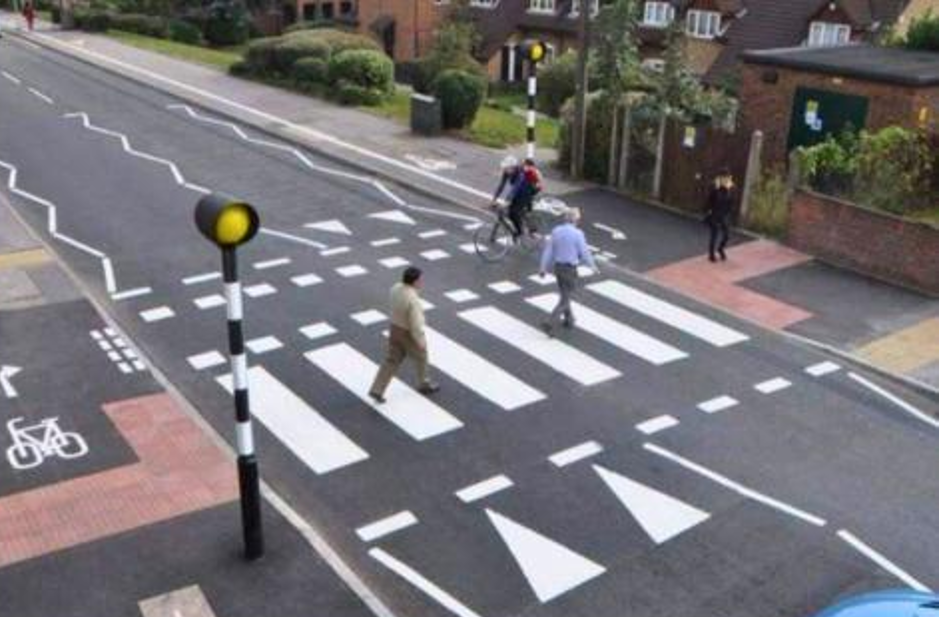

A major new roads project in Hereford, which the local council says will “boost safety for all users”, has been criticised by local active travel campaigners, who claim it does not comply with national standards for cycling infrastructure and will fail to slow down drivers while also pushing cyclists and pedestrians into conflict.
The scheme, focused on Holme Lacy Road in the south-west of Hereford, is expected to cost around £4million, with roadworks set to take place all year.
According to Herefordshire Council, the scheme aims to make the road, a busy corridor linking the Rotherwas industrial estate to the south of the city, “safer, smoother, and less polluting for everyone – whether they are in a car, public transport, walking, wheeling, or cycling”.
The local authority says the works will result in “fewer traffic jams and better alternatives for people who aren’t driving”, while boosting safety, providing better, flood-resistant road surfaces, and providing locals with more choice to “drive, walk, wheel, or cycle in their own dedicated spaces”.
The changes will include new traffic-calming measures, including ‘grip-it-and-slow surfacing’, special high-friction coating on the road, designed to help drivers stop quicker. The speed limit, however, will remain the same.
More shared paths, raised crossings, and new crossings will be introduced along the road to “improve connections” for people walking and cycling.
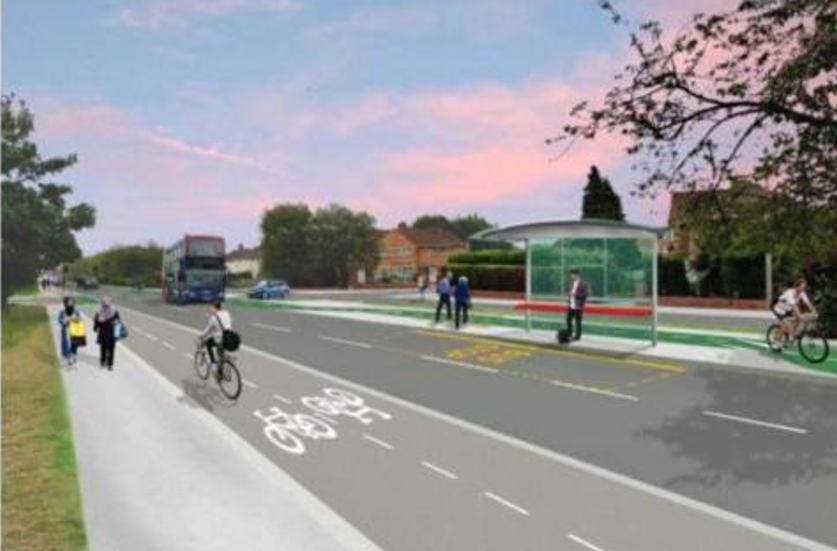
However, the scheme has been criticised this week by local campaigners in the Herefordshire Transport Alliance (HTA), who argue that the “multiple problems” with the project will not encourage more people to cycle in Hereford.
“The route also pushes cyclists and pedestrians together, creating conflict,” the group’s spokesperson Amanda Martin told the Hereford Times.
“I don’t think it’s any kind of improvement. They could deal with current problems across the city at a fraction of the cost.”
Martin noted that the council’s plans to revamp a roundabout on the road do not give priority to cyclists, while she says the “table-top” sections at junctions will do little to slow motorists, as intended.
“I suspect it was a case of spend it or lose it,” she continued, referencing the council’s acquisition of central government funding for the project.
“It allows the council to say they have invested in cycling infrastructure. But we are still not getting the radical measures we need.”
Meanwhile, local councillor and HTA member Jeremy Milln says the scheme does not appear to be compliant with the government’s LTN 1/20 national standards for local cycling infrastructure, which require schemes to provide direct, logical routes that are easy and comfortable to ride.
“Otherwise, confident cyclists won’t use it as they don’t want to start and stop. And families won’t view it as safe as it’s not segregated,” he said.
Martin also criticised recent improvements to the Great Western Way cycle route in the west of Hereford, which she claims “haven’t made it any wider, but have damaged the trees and plants alongside it”.
Describing the quoted figure of £648,000 for the work as “a lot for some tarmac and chain sawing”, Martin said: “It was unnecessary – other areas of the city need this kind of work more”.
Responding to the criticism, the Conservative-controlled council’s cabinet member for transport Philip Price said the local authority has “received positive feedback from residents on the improved visibility and condition of the route.”
He also noted that the Holme Lacy Road scheme is “is designed to make journeys safer and more reliable along a busy route into the city which had known issues previously”.
Hereford’s approach to active travel, including the state of its current cycling infrastructure, has proved a common topic of discussion in the city this year.
Just last month, local transport chief Price admitted that the number of people commuting by car in Hereford is “appalling”, that particular comment coming as rival politicians criticised the area’s cycling infrastructure and urged the local authority to give residents safe and accessible options that do not involve driving.
“We’ve got to encourage more alternatives,” he said, after noting that new figures suggest “16,000 people who live in Hereford, drive to work in Hereford”.
Price also expressed his belief that conflict on the roads could be addressed by improving active travel routes.
“If you’re a motorist, you don’t like the cyclists and if you’re a cyclist, you don’t like the motorist – mostly because of the infrastructure isn’t adequate,” he said.
Ben Procter, a Lib Dem councillor also pulled no punches when describing Herefordshire’s current provision as “some of the weirdest and worst cycle infrastructure I have ever cycled on around the United Kingdom”.
“A lot of that could have been addressed if there was better engagement in the detailed design,” he said.
“I hope that that will be a practice that we can encourage. If you can create an environment where more people in my ward feel safe to walk or cycle, then fewer of you will be sitting on Aylestone Hill because we will be cycling past you, not sitting in cars.”
The cross-party support for better cycling infrastructure continued when Green representative Toni Fagan urged a move away from infrastructure that is “completely disconnected”.
“We understand that Hereford is the focus of effort and resources, we feel the market towns are missing out a bit, especially on cycling investment,” she said.








10 thoughts on “New “safe” road scheme will push cyclists and pedestrians into conflict and fail to slow drivers, campaigners warn in city with “weirdest and worst” cycle lanes in UK”
There isn’t enough information to judge how good the plans are, but some of it looks great in the visuals.
Some plans etc. here: https://www.herefordshire.gov.uk/media/slfl2tm4/holme-lacy-road-raised-tables-cycleways_tagged-updated.pdf
It looks alright to me.
The only thing you can’t tell without local knowledge of the bigger picture is whether it provides a useful, joined-up route.
@mdavidford Thanks. It looks reasonable to me. They looked to have trimmed the carriageway down in places to have a largely segregated track and have set back continuous over side roads as per LTN1/20. Its just annoying that they dont look like they have enough space south of The Wyre Inn to join things up fully. There is patches of the less preferred shared use but they’ve probably had width constraints there.
You say “standards”, I say “more what you’d call guidelines…”
TBF in NL they also only have guidelines! But… there are much more effective feedback mechanisms so that authorities and even individuals can be accountable for failure. And on the “carrot” side there are national organisations which maintain and can supply evidence-backed solutions, so why wouldn’t people pick the current “standard”?
In England although “but there’s no money now” * surely people are aware that the whole “Blue Peter competition” ** approach to active travel infra will never change anything?
* There’s always a money crisis, never any “spare” money for active travel; though 10-100 times that still gets found for motoring strangely…
** Every so often there’s a competition, people send in their drawings (in crayon?) and a couple of winners get something vaguely like their design made.
“If you’re a motorist, you don’t like the cyclists and if you’re a cyclist, you don’t like the motorist”
Cyclists are easy to get around when I’m driving, and drivers who follow the rules are no problem when I’m cycling. Maybe if more drivers cycled too they’d not create this conflict, be more patient, and drive more safely around cyclists.
There is a crossing like the one in the top picture near me in Peckham, with a cycle crossing next to the zebra with give way markings to show cyclists have priority. At busy times it’s clear that as many as one motorist in twenty actually understands the concept and will stop; one can get across the road much more quickly by dismounting and walking over the zebra. At a minimum crossings like this should have signage on the approach warning cyclist crossing priority ahead.
Why is the cycle crossing so tiny? It’s about a quarter of the width of the pedestrian crossing. I mean – you couldn’t possibly have two cyclists going in opposite directions at the same time, could you?
And just how would you expect drivers or pedestrians to cope with cycle traffic from *two* directions, I ask you?
Especially when they can come out of nowhere (at any speed they like)!
Time to send everyone back to the “traffic garden” for a refresher (which would incidentally allow authorities to increase cycling “popularity” stats by an order of magnitude or two in most places).