


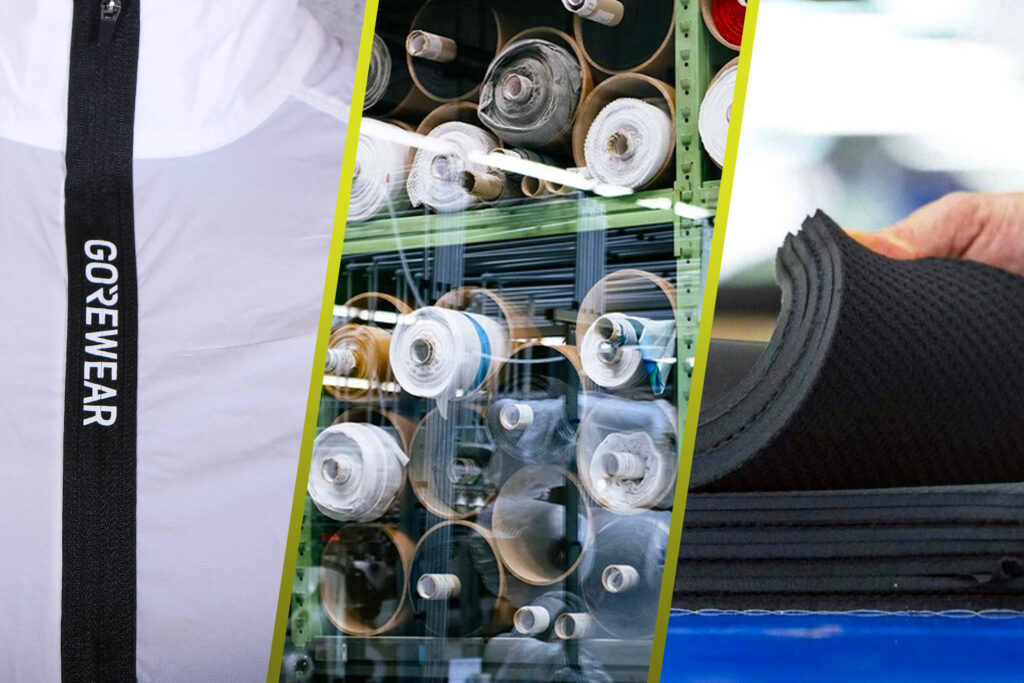

Earlier this year, the government announced its first plan to tackle polyfluoroalkyl substances (PFAS) ‘forever chemicals’, widely used in waterproof cycling kit and linked to serious health and environmental risks. With new materials starting to become available, a London exhibition called Performance Without Toxicity is showcasing the “future of performance wear”, highlighting some of the latest technologies that could soon make their way into cycling kit.

In recent years, consumer awareness of per- and polyfluoroalkyl substances (PFAS) often referred to as ‘forever chemicals’ has risen sharply, with scientific evidence showing how PFAS persist in the environment and can accumulate in the human body.
In February the government published a PFAS action plan, and a group of MPs have now called for a complete ban on the use of PFAs, in everything from frying pans to school uniforms. Pressure is also mounting from policymakers – the Environmental Audit Committee (EAC) is calling on the UK government to restrict all non-essential uses of PFAS in consumer products from 2027.
PFAS are widely used in performance apparel for water repellency, stain resistance and durability, and the whole waterproof/breathable textiles market has been hugely impacted by the need to move away from PFAS. Gore’s announcement of the discontinuing of its well-loved Shakedry fabric, used by a number of clothing brands, has been one of the best-known casualties in cycling.

The apparel industry, and textiles more broadly, has been developing sustainability roadmaps earlier than most other sectors. The advantages that have happened in what we often refer to as the ‘fast-fashion’ industry are now used as examples also in the cycling clothing market, and not only in connection with clothing.
We’ve already seen the shift in the cycling apparel industry as the discussion around the environmental impact of our waterproof garments surfaced and it’s encouraging to see the rise of genuinely eco-labelled cycle clothing. With the breadth of options now available, riders no longer have to choose between sustainability and performance – the two are increasingly proving not to be mutually exclusive.

So what does a more conscious choice look like, and what materials are available today? Performance Without Toxicity is a free exhibition at The Mills Fabrica in London running from 26 January to 26 June (Monday to Friday), showcasing the next generation of PFAS-free, bio-based materials, and regenerative business models. The show aims to highlight how high-performance clothing can still deliver comfort, protection, and durability while reducing toxic exposure and supporting human health.

It focuses on material innovations, most of which are still in development, but with potential applications in cycling. At the centre of the exhibition is the Japanese brand Goldwin, with innovations such as clothing made from Brewed Protein fibre, developed by Spiber.
Made primarily from sugar derived from sugarcane, the fabric has qualities similar to cashmere and wool while reducing water use and emissions during production. Goldwin also uses algorithmically optimised pattern cutting to minimise fabric waste at source. Other bio-based materials on display include wood-based fibres made from renewable cellulose, as well as flax, linen, and hemp.
Moving beyond neoprene and geoprene, one technology that could appear in overshoes and gloves is Yulex – the first natural, plant-based alternative. The company says their materials are deforestation-free and perform as well as, or better than, traditional neoprene and geoprene in all applications.
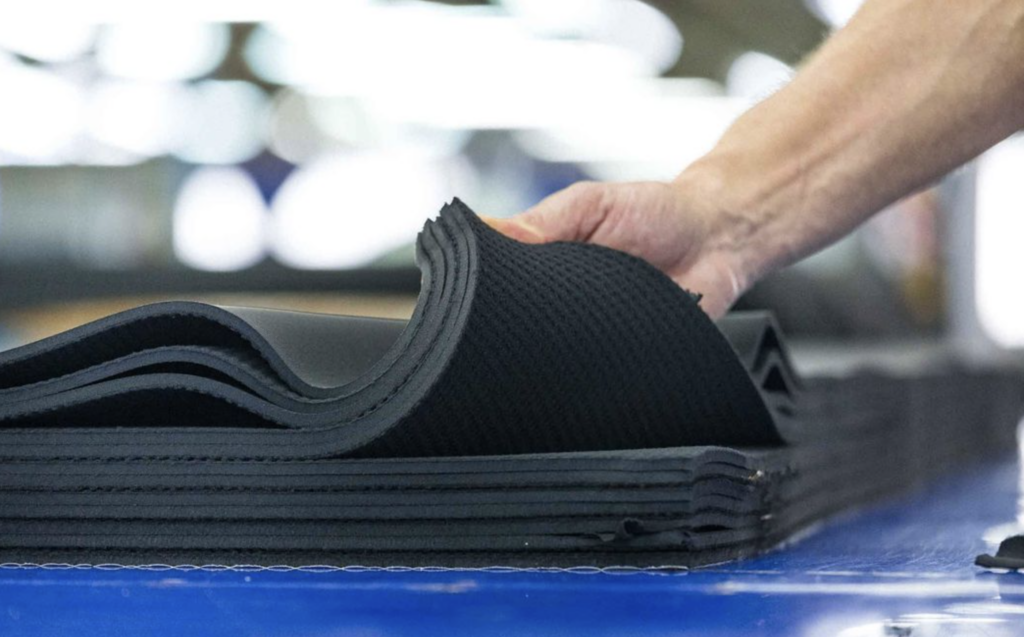
Another innovation comes from KUORI, whose flagship material BIOWA is a partially bio-based, biodegradable, and recyclable elastic made from second-generation food by-products like olive pits and nutshells. Designed for high-performance applications, it offers a sustainable alternative to conventional rubber and elastics while supporting a circular materials system.
While many cycling clothing brands focus on sustainable materials, true sustainability extends far beyond the fibres themselves. The exhibition also highlights innovations in circularity and longevity, including biodegradable coatings, non-toxic dyeing processes, and repair and remanufacturing systems, lead to performance kit that’s designed to last longer, shed fewer harmful substances, and eventually return safely to the system.
One smaller brand in the UK trying to challenge the existing model of manufacturing large amounts of garments is Kostüme. Kostüme is built on the concept of more frequent but smaller volume limited edition collections, which are only available to pre-order for a limited time. This reduces the waste and overproduction that is apparent in the apparel industry.
View this post on Instagram
The innovations on show at Performance Without Toxicity indicate that a post-PFAS future for cycling apparel is increasingly achievable. Bio-based fibres, plant-derived polymers, PFAS-free coatings, and biodegradable elastics demonstrate that technical performance does not have to rely on harmful chemicals. For cyclists, that could mean more informed choices when it comes to upgrading or replacing tired kit, with options that reduce toxic exposure and environmental impact.




















1 thought on “A recent exhibition shows the “future of performance wear” doesn’t have to mean worse-performing cycling kit in a post-PFAs world”
I totally understand that something needed to be done and applaud the shift toward a more environmentally friendly product. But the industry still has a long way to go. I still own 2 goretex shakedry jackets and although I wish it’d be different, nothing else comes close in terms of weight, waterproofing or breathability. Absolutely nothing.