



James May has criticised calls for a police crackdown on ‘speeding cyclists’, arguing that “very, very few people” can break the speed limit on a bike and that campaigns focused on speed “always demonise” cyclists.
The former Top Gear host also claimed that issues surrounding bikes and speeding in towns and cities centred on the use of illegal electric motorcycles and e-scooters, which he pointed out “are nothing to do with cycling”.
May made the comments earlier this week in response to a claim made by lawyer Nick Freeman in the Daily Mail that “thousands of cyclists, e-bike, and e-scooter riders are breaking the rules” and “getting away with it”.
According to the Mail, so-called “two-wheeled terrors” have triggered speed cameras 1,200 times since 2023 across the UK, with 220 ‘bicycles’ caught breaking 30mph limits during that period.

According to Freeman, otherwise known by his Mr Loophole nickname, the lawyer famous for obtaining not guilty verdicts for celebrities charged with driving offences, these figures demonstrate the need for the government to introduce cycling licences and number plates.
“The huge increase in usage dictates that they must become subject to the same law that applies to motorists, motorcycles, and mopeds,” Freeman told the Mail.
“Any law that doesn’t include a registration system is useless because most riders don’t stop when involved in an accident, and therefore it’s unlikely the rider will ever be traced.
“Imagine taking number plates off cars. There would be mayhem. By making riders accountable, they become more responsible and if they don’t, the law will then be there to punish them.
“The time has come to marry encouragement with legal responsibility and have legal parity for all these groups.”
In a post on Twitter, Freeman continued: “Thousands of cyclists, e-bike, and e-scooter riders are breaking the rules and yet no one is being held accountable.
“The law simply hasn’t kept pace. If we want safer roads, we need proper regulation, identification, and enforcement.”
However, Freeman’s comments were criticised by former Top Gear host May, a noted cyclist who has previously voiced his support for cycling infrastructure while arguing that driving a car doesn’t give you any “extra rights on the roads”.

“Very, very few people are capable of breaking the speed limit, even the 20mph one, on a bicycle,” May commented under Freeman’s post.
“Legal electric-assist bicycles in the UK are limited to 15mph. The problem being identified here is with illegal electric motorcycles and e-scooters, which are nothing to do with cycling.”
As noted by May, the term e-bike generally refers to an electrically assisted pedal cycle (EAPC), legal electric cycles that can be treated the same as a conventional pedal cycle, provided the user is age 14 or over.
They must have pedals that can propel the bicycle, have an electric motor with a maximum continuous rated power not exceeding 250 watts, and cut off electrical assistance when it reaches 15.5mph. Riders of these compliant e-bikes do not need to register or insure their bicycle.

However, the use of illegal electric motorbikes – which do not cut off electrical assistance at 15.5mph and often do not have pedals – has become increasingly prominent on Britain’s streets in recent years.
Cycling campaigners have long pointed out the danger in incorrectly calling these electric motorbikes ‘e-bikes’, with incidents involving high-power vehicles often wrongly attributed to legal EAPCs by the public and press.
Nevertheless, despite this clear distinction, May’s contribution to the ‘speeding cyclists’ discussion inevitably sparked a heated debate on the social media platform.
“You should try crossing a street in London, James. Cyclists are f***ing awful and are a law unto themselves. Sit this one out,” WebbSixty6 told May.
“I live in London and have crossed many streets,” the broadcaster replied.
Some commenters, meanwhile, claimed that new 20mph limits have led to people on bikes “routinely” overtaking motorists on urban streets.
“Many cyclists, with modern bikes, are capable of around 30mph on the flat, a great deal more going downhill,” said Felix.
“Once 20mph limits became the norm, cyclists are now routinely exceeding the speed limit, apparent as they overtake/undertake cars doing 20.”
“Absolute balls,” May hit back. “30mph on the flat on a bicycle is Tour de France stuff.”
He continued: “Pretty much everybody can ride a bike but only committed cyclists can ride at 20mph and above.”
And when asked why it mattered what type of electric bike was being used to break the speed limit, May said: “It matters because these stories and campaigns always refer to, and demonise, ‘speeding cyclists’.”
May’s social media ‘discussion’ on speeding cyclists and e-bikes comes in the same week the Metropolitan Police confirmed that it is training officers to distinguish between legal e-bikes and illegally modified electric motorbikes.
Active travel charity Cycling UK spent the day with members of the Met this week as they carried out Operation Lexand, the force’s crackdown on the illegal, high-powered machines.
“It was clear the focus is on illegal modifications and dangerous riding, not everyday cycling,” Cycling UK said in a statement.
“Officers are being trained to distinguish between legal e-bikes and illegally modified e-motorbikes, and there’s strong awareness of the need to protect positive perceptions of cycling.”





56 thoughts on ““Very, very few people can break the speed limit on a bike”: James May slams Mr Loophole’s call for clampdown on ‘speeding’ cyclists, claiming problem is with illegal e-motorbikes and “nothing to do with cycling””
I like James May. He always has sensible things to say about cycling and road safety.
And his wonderfully slow paced reassembler introduced me to the JIS Japanese Industry Standard type crosshead screwdriver.
There is a reason why your standard Phillips type crosshead will destroy your Shimano adjustment bolts.
Shimano started using 2mm hex for derailleur limit screws in 2015. Most of their groups now use those rather than JIS. This happened in the second generation 11sp road, so R7000/R8000 all use this, all the 12sp stuff as well, Tiagra from 4700 10sp, all GRX, CUES. Some lower end groups (Sora/Claris) do still have JIS screws and of course older stuff, I do still have bikes with them.
Fine knowledge.
I’m still running late 90s xtr and early to mid 90s xt.
And that’s why the rest of us should be as well 🙂
They didn’t increase the number of gears so that cyclists had better ratios, they did it because the chain rings and cassettes wear out much faster
Mr Loophole -“Thousands of cyclists breaking the rules”
Me – “Millions of motorists breaking the rules”
70% of drivers in our village over the speed limit.
“According to the Mail, so-called ‘two-wheeled terrors’ have triggered speed cameras 1,200 times since 2023 across the UK, with 220 ‘bicycles’ caught breaking 30mph limits during that period.”
So, comparable to number of motorists committing speeding offenses on the 500m stretch of main road nearest my house last week. and the week before. and so on.
Bicycles can’t pedal themselves so they can’t break the limit and it doesn’t apply to cyclists do they can’t break it either so where exactly were these 220 occurrences of the law being broken?
The problem is that “bicycles” is being used here to describe unregistered electric motorbikes, and the speed limit does apply to them. (As do the laws requiring motorcyclists to have licences, insurance, helmets, etc.)
Nick Freeman knows they don’t apply to pedal cyclists because he’s a lawyer, but he’s using deliberately misleading language because he’s a dick and the Daily Mail pay him.
“the speed limit does apply to them”
Well, sort of. But they shouldn’t be being ridden at all in the first place, at any speed. Exceeding the speed limit is just an additional offence on top.
And that would be different to now how exactly?
I also see a lot of cars this winter with numberplates completely obscured with grime.
Yes. And some of those obscured number plates will be cloned.
His standard of living would drop massively…
Absolutely!
I have an “ebike” – but a UK legal one
So the motor cuts out at 15.5 mph (it makes sense in kph!) and anything after that is just me pedalling a bike that is much heavier that an normal bike and with a motor adding drag
so that won’t happen.
Even in a 20mph zone then I would be pushed to break the 20mph unless it was a steep downhill!
Therefore, any “bike” exceeding a 30 mph speed limit is NOT an ebike
it is a motorbike – no ifs or buts – it is a motorbike
probably unregistered, no MOT, no plate, no insurance
and mostly the ride is not licensed and is not wearing a helmet
so the laws needed are there already
and have been for many years
Recently I managed to get my TERN up to 24 mph – that was going down a very long decline from Hampstead. The road was clear and wide so I thought I’d give it a go. It didn’t feel comfortable at that speed either. To sustain 20mph on an e bike is very difficult, unless it’s downhill – 30mph is impossible.
Rome mate, you are giving us all a bad name…
Was she fully loaded, were the kids screaming on the back?
Why are there no line breaks?
Or are we going for the middle class niche, like the G?
Before a baffling and unresolved problem with the timing chain continually falling off, the youngest and 1 got the unassisted school run tandem into the 20s on the slight decline on our street, well we triggered the unhappy face at least.
Any advice on the timing chain issue would be welcome, it’s not tension, I’ve destroyed a couple of BBs testing that theory.
I assume that you’ve checked the alignment, measuring each chainring’s distance from the centre line? Also are you using chainrings with full height teeth, if they are intended for double chainring setups they will have lower teeth that the chain will ride off easier.
Agreed – my Tern seems to settle quite nicely around the cut off level. Exceeding the assistance cut-off speed requires either gravity, or a level of effort that just feels a bit wrong on a sit-up bike.
Not sure what ebike you have but specialized ones are much easier to use above 15mph. I can do 20 on the flat if the wind is not against me.
Absolutely, when I had an ebike, Orbea Gain e-road bike, it was very easy to ride at 20 mph, in fact on a commute easier than on my standard bikes because so much of the energy in riding goes into spinning up to speed, once you get to 20 mph it’s fairly easy to sustain. The extra weight of an ebike makes little difference once you’re up to speed because at 20 mph nearly all your effort is going into overcoming wind resistance; I actually felt that the flywheel effect of the non-running hub motor actually provided a significant aid to maintaining a good cruising speed.
Sorry to say, I do have an “if or but” – I also ride an unmodified ebike (cube reaction) and I can hit 40mph down some of the hills here in Sheffield. I can’t pedal faster than about 26mph, so the rest is gravity …
Freeman was commenting in the Daily Heil. Says it all.
When a petrol head states the obvious about everyday cycling, velosipedists may feel grateful.
Regardless of the merits of the argument, anyone who ties their jumper over their shoulders like that is automatically wrong.
Mr Loo Pole. Famous for finding legal loopholes to excuse his clients on technical grounds. Fails to realise that speed limits are for motor vehicles. Cyclists are not breaking the speed limit, they are not motor vehicles. Simples.
well? if it has an electric motor, and it carries somone and moves, that makes it a motor vehicle!
Actually, these days the “carries someone” might no longer be relevent, what about an amazon droid delivery thinghy, that never saw a human bottom in its life?
“Motor vehicle” has a specific legal definition, and EAPCs are specifically outside it.
It’s a bit like how air rifles are legally firearms, despite not using ignition to propel their ammunition.
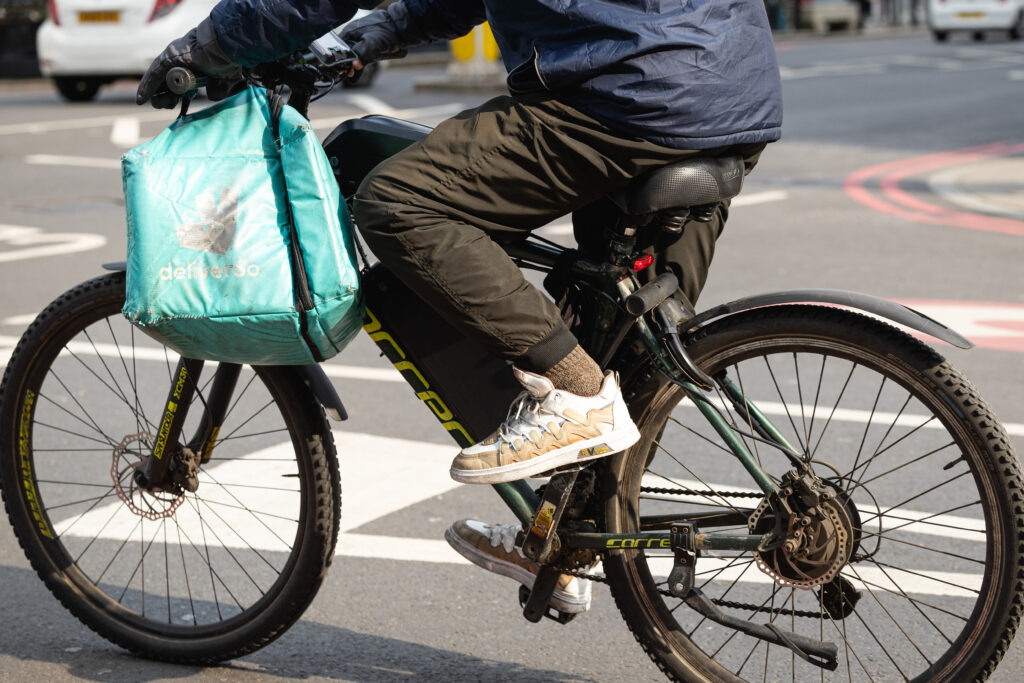
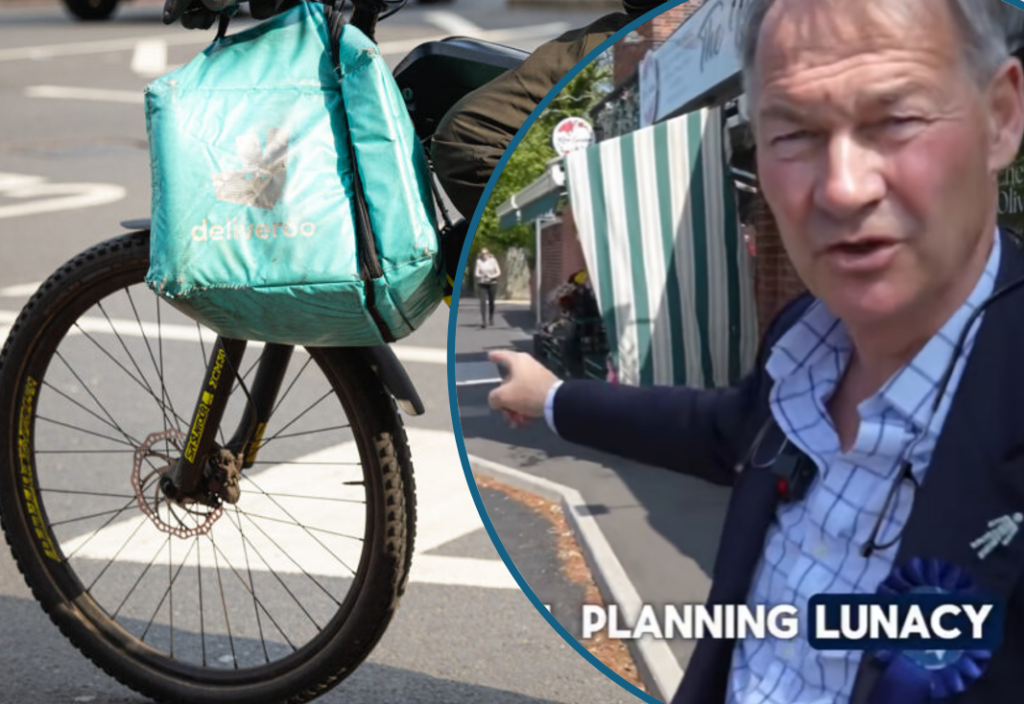
The image you’ve used of a deliveroo rider could well be a legal bike. It’s a geared ebike hub (which can’t handle massive watts, due to plastic planetary gears).
I’m not saying it’s totally legal but it definitely could be.
Anyone who can provide proof it is illegally modified is welcome to respond. Can’t see a throttle or anything like that.
I have already registered my cycle numberplate, ready for the day Farage ascends to power :
Front Plate
FR33M4N IS 4 CUNT
Rear Plate
F4R4G3 IS 4 W4NK4R
Whilst I commend Mr May’s comment, it’s no earthly use him ‘guilding the lily’; my average cycling speed (up hill and down dale) is 18 mph (which must include stretches well over 20 mph), and I easily achieve speeds on the level of 35-8 mph. Bearing in mind I have never been a competition cyclist, I’m 78, (I cycle for exercise and shopping), and I’ve got osteoarthritis in my knees, Mr May is rather over-stating the case! Where I live it’s is mostly unwise to cycle at high speeds; our roads are too uneven and full of potholes for that to be safe, plus too many car drivers, seeing a cyclist, believe they MUST overtake them, regardless of speed, safety, and speed limits. Good luck everybody.
Impressive. As an ex-racer of 20 years and “only” 62 I am so far off the pace comparative to your claims of 35-8mph on the flat – even in km that is a stretch. Whilst out I regularly pass people on everyday cycles on the famously well engineered Stevenage cycle paths and (as commuters/shoppers) they are generally moving at around 10-12mph. My lovely wife who attends regular spin and HIIT classes celebrates avge 12mph when out for a road based 20 miles. All of my cycling buddies (most with some amateur competitive history behind them) are in a similar boat as me. I find Mr May speaks for me. I hasten to add that most people are abjectly unable to guess the speed of any moving object be it human powered or with motor. I was yelled at by a gammon last week whilst in a 20mph Zone. I pointed out that I was travelling up hill at 20kph. Concur that the Loophole is a self-promoting jerk.
Without wishing to cast aspersions on your veracity, I respectfully think you must be mistaken if you believe you can achieve 38 mph on the flat (and that “easily”); that’s getting pretty close to the speed professional sprinters achieve in the last 15 seconds of a Tour de France stage and is very considerably faster than the record for your age group in a 200m flying sprint on the track. Is your speedometer by any chance set to km/h rather than mph?
I easily achieve speeds on the level of 35-8 mph. Bearing in mind I have never been a competition cyclist, I’m 78, (I cycle for exercise and shopping), and I’ve got osteoarthritis in my knees
Obvious fantasist, which is another name for liar. What possesses people to make up stuff like this?
This actualy makes more sense if you transpose the speeds; 35 downhill & 20mph on the flat.
But given the responses I doubt that they’re willing to stick their head above the parapet to clarify the matter. 😉
“Any law that doesn’t include a registration system is useless because most riders don’t stop when involved in an accident, and therefore it’s unlikely the rider will ever be traced”
Most riders involved in an accident do in fact stop, as they are lying in the road injured.
Freeman is an ignorant knobhead, and I do wish karma would come to him in the form of a 2 ton car being driven by someone in excess of the speed limit whilst off their tits on ketamine and fiddling with their phone.
I’m not all that fast, but on the flat in no wind I absolutely can sprint to 30+ MPH on my gravel bike. It’s not even an aero bike frame. I’m done after ten seconds though.
With a little bit of tailwind or slight downhill, 20+ is easy and sustainable. Just this morning I was cruising at 22-24 MPH for a couple of miles of my commute thanks to a 10-15 MPH tailwind.
Last year I was chased by a very enthusiastic dog on a country road, and I can see on Strava I got up to 27 MPH for a couple of tenths of a mile. I wasn’t even trying my hardest, just enough to keep the dog getting smaller in my mirror.
And when asked why it mattered what type of electric bike was being used to break the speed limit, May [should have] said:
“Because the speed limit only applies to some of them”
So he want more laws that no one will enforce? Great Idea!
Mr Loophole lies through his teeth when it comes to cyclists
What does rule 124 of the Highway Code say about bicycles?
Oh, nothing. Quelle surprise.
It’s a mistake to try to gatekeep the term “e-bike” (or “ebike”). In popular usage and by logic, an e-bike is any vehicle with two wheels, one in front of the other, and an electric motor.
An EAPC is legally defined. An e-motorbike is an e-bike that exceeds the power or speed limits for an EAPC. They’re all e-bikes because they’re all bikes that are electric.
It’s easy to advocate for maintaining and enforcing the existing laws on e-bikes (both EAPCs and e-motorbikes) without trying to police the language that people use.
That’s fine in popular usage but it still needs to be hammered home to the press that differentiation has to be made between legal and illegal ebikes, either by using the term “illegal” when necessary or using an alternative term such as electric motorcycle. Otherwise ordinary members of the public seeing headlines such as “Ebike muggers terrorise estate” or “Man killed by ebike rider” develop an unjustified hostility towards the riders of legal EAPCs and the clamour for their unnecessary registration, insurance, compulsory helmets et cetera will only get louder and that will eventually spread to pedal cycles as well.
Solution one: keep calling our EAPCs ebikes, and try to make everyone else limit the term “ebike” to a specific subset of ebikes. Complain when the press refer to an electric vehicle with one wheel in front of the other as an “ebike” as though we own the term.
Solution two: call EAPCs EAPCs and call ebikes ebikes. Yes there are ebike muggers. Yes people can be killed in ebike collisions. Yes there are ebikes that have no numberplates and go up to 50mph. Yes they ought to be illegal. Yes they are illegal.
There’s clearly a lot of confusion among people who don’t take much of an interest and get annoyed by deliverypeople riding overpowered ebikes, and scared of criminals riding even more dangerous machines. Among the general public, there is a lack of understanding about the difference between a 250W speed-limited EAPC and an 8000W Sur-Ron.
But we don’t clear up that confusion by trying to insist that an ebike isn’t an ebike. In popular parlance, a “bike” is anything that gets you from place to place on two wheels, one in front of the other. A Harley Davidson, a road bicycle, all bikes. It stands to reason that an ebike is a bike that’s electric. There is no legal definition of the term “ebike”, and language is not proscriptive.
If you want a protected term for a legal, power-restricted and speed-restricted ebike, there already is one: EAPC.
Or, rather than trying to persuade the public to learn a whole new term, you could just call illegal ebikes illegal ebikes, job done.
A mugger is mugging on an ebike. It’s reasonable for journalists not to headline the illegality of the bike, as there’s no question that the mugger is already a criminal.
[replying to D Jameson]
By the same token it’s reasonable for them to not mention the bike at all. Either it’s relevant what form of conveyance they’re using, or it’s not, and if it is, then it’s relevant to be specific.
Illegal ebikes are a favoured tool of muggers, particularly phone snatchers, at least round my way, so it’s understandable that they become part of the story in exactly the same way that reporters will mention if the muggers were using a moped. In other stories they are central to the crime, if someone’s knocked down by an illegal ebike doing 40mph that’s important to mention, and very important that it’s made clear it was an illegal bike to avoid the already-burgeoning misconception that ebike=danger per se.
On the whole, I’m with DJameson on this one – ebike naturally describes a wide category of vehicles, and the UK Government uses it to refer to both EAPCs and electric motorbikes.
In practice, if someone reads negative press about ebikes, in most cases I think they will picture the Deliveroo or Surron rider zooming along without pedalling (and that is likely who the press is about). I’m not persuaded that general use of the term ebike is directing any misplaced ire towards EAPC users. Is there any evidence for the assertion in the article that the press has wrongly attributed incidents involving high power vehicles to EAPCs?
Terminology is important, in order to stem the perpetuation of flawed concepts.
For instance many people conflate “Right of way” with “priority” – they are completely different things and use of the former, where the latter is the correct term, merely conveys an incorrect sense of ability to just proceed, regardless.
I normally commute on my conventional hybrid bike but had to use my e-gravel bike, recently
I stopped to chat to a guy and his dog,who I regularly encounter and he said “oh , you’ve got an e-bike… how fast does that thing go?”
Preconceptions are already there…
Mr Loophole doesn’t seem to have spotted the loophole involving cyclists not being subject to speed limits
It might be somewhat futile to try and police the language, but I don’t think it’s a mistake. The language people use does affect their perception of the situation, and it certainly seems some of the current vogue of hostility towards legal cyclists (not just legal EAPCs) is driven by the illegal and antisocial use of electric motorbikes.
I’m not saying it’s logical, but I think it is the case nonetheless, and the language used feeds into this – the language implies all ebikes are the same, and their riders are all “cyclists”.
Terminology is important, in order to stem the perpetuation of flawed concepts.
For instance many people conflate “Right of way” with “priority” – they are completely different things and use of the former, where the latter is the correct term, merely conveys an incorrect sense of ability to just proceed, regardless.