


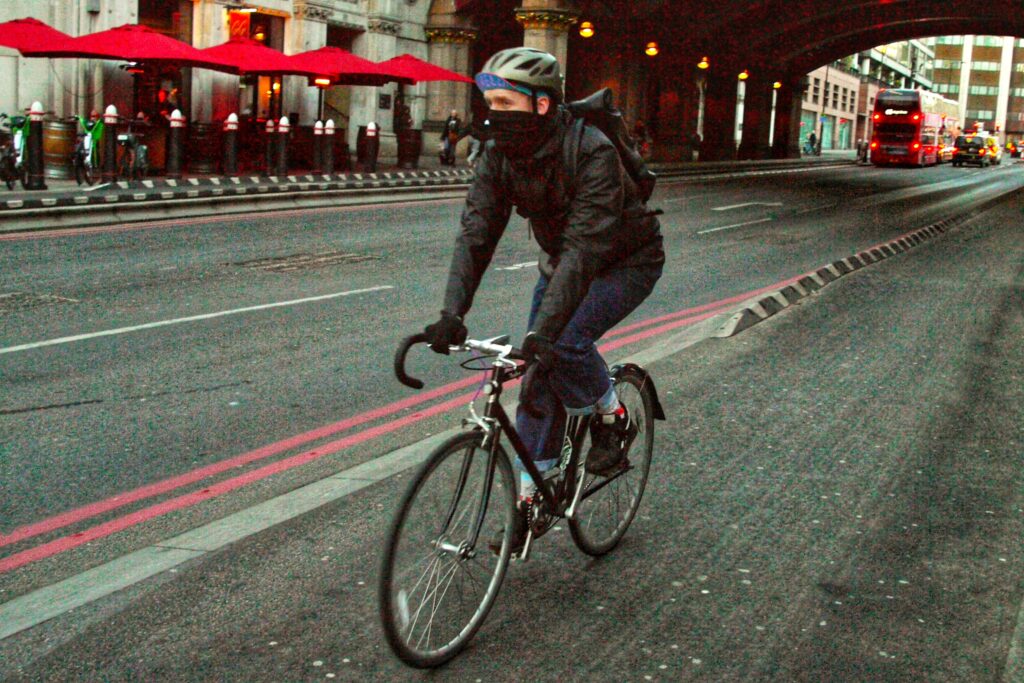

New research from University College London supports “the growing evidence that cycling infrastructure helps protect cyclists” and found that riders are more likely to experience dangerous incidents when using routes without bike lanes or cycle paths.
The study, titled ‘Spatiotemporal and behavioural correlates of cycling near misses: evidence from helmet-mounted video data’ and published in Accident Analysis & Prevention, focused on urban riding of cycle commuters in London.

For a two-week period, 60 cyclists recorded their commutes on 360-degree helmet cameras. This gave researchers 317 hours of footage and 94 ‘near miss events’, defined as where a crash between a cyclist and another road user or pedestrian was narrowly avoided.
During the fortnight none of the 60 London-based participants were involved in a crash, but the 94 near misses gave transport academics at UCL the opportunity to analyse the location, time and nature of incidents with computer modelling and by viewing the camera footage.
Of the 94 incidents, 69 happened on roads without cycling infrastructure. The most common were close passes, followed by drivers right or left-hooking cyclists by turning across their path. Drivers pulling out from side roads or parking spaces was reported as the third most common.
Unsurprisingly, 58 of the incidents happened during the peak commuting hours of 07:00-09:59 in the morning and 17:00-19:59 in the afternoon.
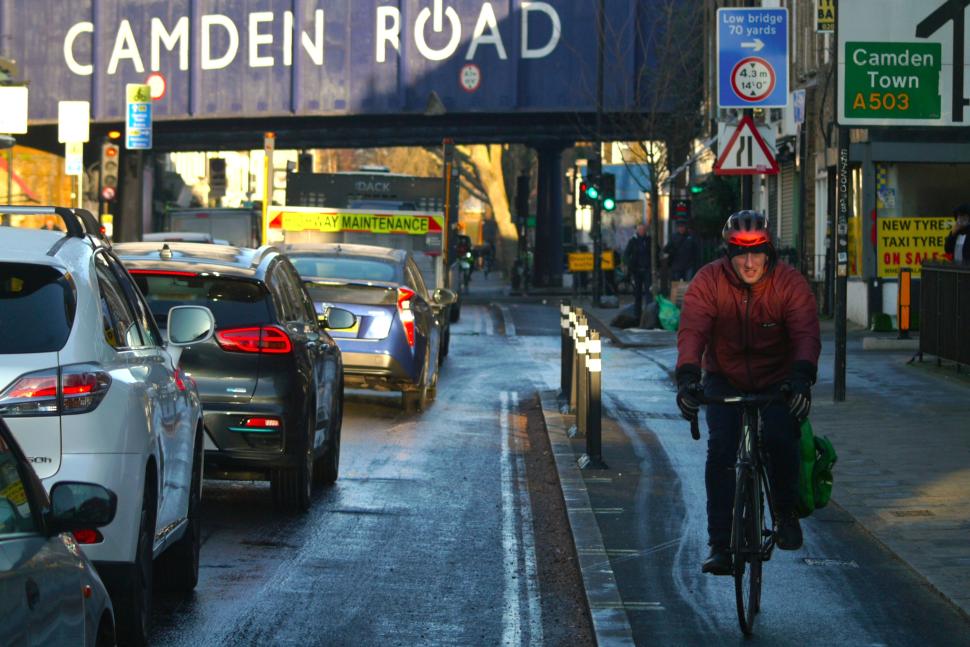
Time spent on 30mph roads was linked to higher near miss rates, while time spent on cycleways away from main roads was linked with fewer near misses, as was cycling at higher speeds.
Drivers of cars were the most commonly involved road user, making up 52 of the 94 incidents, while van drivers were involved in 13 and pedestrians in 11 of the incidents. The research noted that no incidents involved heavy goods vehicles.
One of the study’s senior authors, Nicola Christie, said cycling near misses were often “overlooked” in official statistics as they sometimes go unreported. Calling them “crucial indicators of road safety”, the professor explained that the findings “show that most near misses happen on roads without cycling infrastructure, and that junctions are particularly hazardous”.
“One of the benefits of using helmet-mounted cameras and voice-activated reporting as we did in this study is that they offer an easy and effective way to gather data on cycling safety, which can be used to evaluate the impact of infrastructure changes and safety campaigns,” she explained.
“This research adds to the growing evidence that cycling infrastructure helps protect cyclists and that Transport for London’s action plan to improve cycling safety is paying off.”

Fellow author, Dr James Haworth suggested the findings support the idea that dedicated cycling infrastructure and well-planned routes for cyclists have a “positive impact on road safety”.
“Cycleways navigating through quieter residential streets – formerly called ‘quietways’ – were associated with fewer near misses, despite the fact the rider shares the lane with motor vehicles,” he said. “We believe the reason for this is that these roads often have less traffic, 20mph speed limits and no space to overtake.
“That being said, we did observe near misses on segregated cycle ways – formerly called cycle superhighways in London – where riders and vehicles come into conflict. This was evident where vehicles have to pull out from side roads across the cycle way, for example, or have to turn across oncoming traffic into a side road, particularly in congested periods where visibility is limited.
“So I would say that there is some evidence that using quiet, residential streets for cycle ways is working as a policy because it keeps bicycle traffic away from car traffic.
“There were also some slightly surprising findings in our study, such as faster riders experiencing fewer near misses. One theory that could explain this is that 20mph limits bring the speeds of vehicles and bicycles closer together – but that’s something that would require further investigation.”

The research was funded by the Road Safety Trust and supported by the Transport for London and the All Party Parliamentary Group on Cycling.
The Road Safety Trust’s chief executive Ruth Purdie OBE said it is important for policymakers to “fully understand” what cyclists experience on the road to inform road improvements and infrastructure projects.
Just last week we reported another similar study which found that physical barriers, such as kerbs and bollards, are most effective in making streets appealing to pedestrians and cyclists.
The study, conducted by experts from the Centre of Transport and Society, based at the University of the West of England, also suggested that bad behaviour is the biggest contributing factor towards streets hostile to walking and wheeling.
In June, a six-year study by academics at the University of New Mexico and University of Colorado Denver concluded that protected cycle lanes encourage significantly more people to cycle than painted routes.











23 thoughts on “Bike lanes crucial to preventing cycling near misses, major new study suggests”
And in other news, rain is
And in other news, rain is wet. It turns out if you wear a waterproof jacket, it can keep you dry, even when it’s raining!
Not if I’m cycling, it can’t
Not if I’m cycling, it can’t – I just get wetter than I would without it.
Despite separation there were
Despite separation there were near misses at junctions you say? Who would have thought!
I’m not up to date on what the state of London’s junctions are but a) this is vital to get right b) … and inherently “contentious” because junctions are the bottlenecks for everyone c) in the past TfL have come up with some … less than stellar designs.
In general I believe the UK is somewhat handicapped by some rules / conventions in practice about traffic directional flows (and a lack of “smarter lights” with eg. traffic detection including cyclists). Although … I keep reading eg. professionals like Ranty Highwayman chipping away at “not possible in UK because law” issues. And of course if politicians were willing law could be changed – albeit the major problem is the time it would take for the population to adapt new behaviours in response (or … not).
The fact is that for the most
The fact is that for the most part where drivers are required to give way to cyclists they either don’t know or don’t care, and therefore simply don’t give way.
I’d rather ride on the main road where I can see better, can be seen better, and people know what they’re supposed to do.
Right now I would use any UK
Right now I would use any UK cycle infra new to me … cautiously … the first few times, certainly. I haven’t been for years now but I would not have those doubts in eg. NL – apart from a short time while i got used to it again obviously.
We have been repeatedly asking everyone in practice whether they’re happy cycling amongst motor traffic (as well as tons of surveys) and the majority answer is “no” unfortunately. So for any change (even just so the likes of you or I can stay in the roads but have a better experience) that needs addressed.
Visibility is a function of design – if that’s an issue then the design is bad. Which is the case on some of our standard road infra also:
I agree that drivers need to adapt – but history shows they can. And the best cycle infra designs don’t leave you relying on drivers (or no more so than any time you’re crossing or even near a road). They position you to best be able to manage your own safety – example:
https://www.aviewfromthecyclepath.com/2014/05/the-best-roundabout-design-for-cyclists.html
Well, duh
Well, duh
The writer has clearly never
The writer has clearly never been forced off the road by a car driving 10mph over the speed limit on the wrong side of the road, due to there being cars parked on the right side. Apparently, giving way to incoming vehicles doesn’t count when you can bully them out of the way with threats of death.
bensynnock wrote:
Huh? How do you get to that from anything in the article?
I guess it relates to the use
I guess it relates to the use of quieter residential streets as cycle routes.
OK – but (a) ‘the writer’ is
OK – but (a) ‘the writer’ is only reporting what’s in the study, without really offering anything by way of commentary, and (b) nothing there suggests that incidents can’t happen on quiet streets, so the comment seems like a complete non sequitur.
My point was just that I find
My point was just that I find smaller residential roads no safer than main roads. If anything they are worse because the drivers who aren’t maniacally trying to find their way around any kind of queue are happily sitting at the lights waiting their turn while those who are desperate to shave 3 seconds off their journey time are rat running the side roads.
That may be your subjective
That may be your subjective experience, but ‘the writer’ isn’t offering their subjective experience – they’re reporting data, and that data appears to show the opposite:
Yep, by far the worst
Yep, by far the worst encounters I have with cars are head on. The number of people who will just drive at me despite me already being overtaking parked cars is amazing. Doesn’t matter whos side those cars are on. They will just drive at me. I can be in the middle of the road and they will drive at me.
Had a lovely middle aged chap in a massive land rover speed up agressively towards me as I was overtaking a bunch of parked cars on his side of the road. You could see the anger on his face at the suggestion that he should wait for some fucking cyclist.
Dr James Haworth wrote:
That is only one part of “working” though. This comes back to the UK’s long “safety – at cost of convenience” philosophy (or simply “but we can’t reduce capacity for motor traffic” – which in many cases is baked into development and highway engineering rules).
While “streets” can indeed be safe for cycling:
… too often in the UK the “obvious solution” is to simply declare that these are now “routes” for cycling. It involves much less conflict with all those through-motorists on main routes, and avoids almost all actual building (just add signs).
But even the “quiet streets” in the UK frequently have quite a bit of motor traffic (due to our “all-ways permeable” designs). They’re normally lined with parked cars, giving conflicts where drivers pull in / out / open doors. The surface quality is not infrequently bad. They may lack “social safety”. And finally too much emphasis on this can mean that the motor traffic gets a direct route while cyclists literally go round the houses, having some route-finding challenges and potentially having to stop at dozens of small cross-roads or junctions.
Ultimately we need lots of things working together for serious change to occur: an overall motor traffic reduction everywhere, measures to reduce through traffic in local residential areas (or other “destinations”), safe AND convenient provision for cycling on major “desire lines” (usually the roads – which were ridden and walked before cars…) with “gold standard” junction designs … but eventually network-level “unbundling” so that eg. cyclists and motorists simply don’t need to interact that often.
A whole lot of data just to
A whole lot of data just to say “Well, DUH!!!!”
It would seem so – but they
It would seem so – but they do have the data, which is vital evidence for planners and politicians. Remember, what you and I know, is not necessarily what the majority believe.
Yes, but that’s also an
Yes, but that’s also an optimistic view!
Politics of course, so that means that at best this is evidence to *defend* against nonsense claims (some brave politician having already made the decision to do this).
And which may or may not be terribly helpful to do so. Because (especially looking at current politics) the charge may be “you’re wasting money on a few priveledged middle class men (or illegal gig workers etc) AND taking road space from vital services / hard-working people / the old, young, disabled” etc.
And in other news: water is
And in other news: water is wet shock!
OldRidgeback wrote:
I’d like to disagree with that – water can wet other things, but it doesn’t get itself wet. (Incidentally, humans can’t sense “wetness”, unlike some insects which do have hygroreceptors)
Equally, sugar isn’t sweet,
Equally, sugar isn’t sweet, because it can’t taste itself. Which is good news – I can eat as many cakes as I like, because they can’t be sweet things.
mdavidford wrote:
Does that mean that my tongue is sweet?
Incidentally, I found out the other day that the only part of your reflection that can be licked is your tongue
This is not as cut and dry as
This is not as cut and dry as you might think.
Obvious.
Obvious.