



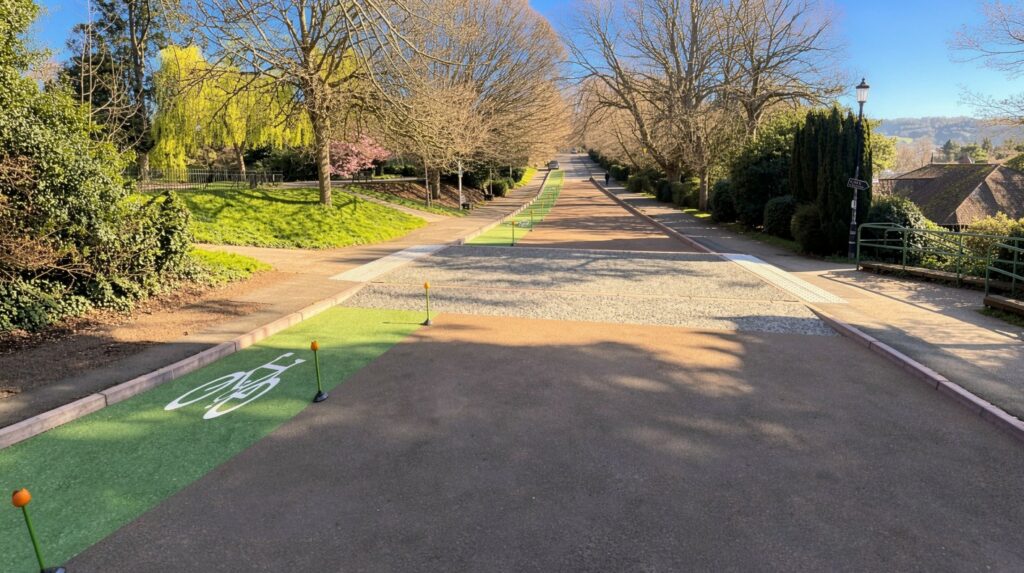
In what might be one of the least surprising cycling studies we’ve reported in recent times, new research from the US has found that protected bike lanes encourage more people to cycle than painted lanes or areas without any infrastructure.
Unsurprising as it may be it is still of course necessary to see hypotheses backed up by research and evidence. This six-year study by academics at the University of New Mexico and University of Colorado Denver does exactly that, suggesting that areas with protected cycling infrastructure experienced bicycle commuter increases 1.8 times larger than areas with ‘standard bicycle lanes’, 1.6 times larger than areas with ‘shared-lane marking’ and 4.3 times larger than areas that did not install bicycle facilities at all.
The study analysed six years of longitudinal data across 14,011 block groups in 28 US cities. For each infrastructure type, bicycle commuting changes were studied while controlling for socioeconomic status and built environment factors via three complementary analyses.
The researchers say the results “suggest that cities that wish to encourage more biking activity seem justified in installing bicycle facilities toward that end, and lower-stress bicycle facilities — such as PBLs (protected bike lanes) and BBLs (buffered bicycle lanes) — tend to be significantly associated with larger increases in ridership at the block group level than higher-stress bicycle facilities such as SBLs (standard bicycle lanes) and SHRs (shared-lane markings).”

While they admit shared-lane markings correlated with increased bicycle commuting relative to no new bicycling infrastructure in the initial analysis, the “shift became weaker once accounting for extant levels of bicycle commuting in the second DID analysis, and then insignificant once other bicycle facilities were accounted for in the third multivariate analysis”.
Exploring the “build it, and they will come” mantra commonly heard when discussing active travel infrastructure, the study found that “protected bicycle lane mileage installed was significantly associated with bicycle commuter increases 52.5 per cent stronger than standard bicycle lane mileage and 281.2 per cent stronger than shared-lane marking mileage”.
“The results suggest that lower-stress bicycle facilities — such as protected bicycle lanes — are significantly associated with larger increases in ridership at the block-group level compared with higher-stress facilities such as standard bicycle lanes and shared-lane markings.”

Emphasising the point, “cities that seek to boost bicycle commute mode shifts should focus on implementing low-stress bicycle facilities if they want to best facilitate the sizeable population of less-confident potential riders”.
In 2023, researchers from Australia made this point too, suggesting that policymakers need to design cycling infrastructure specifically for “the trips that aren’t taken” currently, enabling people who want to cycle but are put off by road danger and ineffective bike lanes.
> Cycling infrastructure needs to be built with women in mind, study suggests
Specifically the researchers argued that cycling infrastructure should be built with women in mind as their survey of 717 women across 10 areas of Melbourne showed that “gender differences were stark in terms of the barriers” to cycling.
Compared to men the survey showed that the women were less comfortable with the idea of cycling near traffic, and would be encouraged by segregated cycle lanes. Nearly half of the women surveyed said well-lit areas are an enabler of them cycling.









10 thoughts on ““If you build it, they will come”: Protected cycle lanes encourage significantly more people to cycle than painted routes, study finds”
Interesting research.
Interesting research.
The comments about shared use facilities are somewhat cryptic, but I guess they reflect complexity.
It would be useful to have a statistic that says clearly, ‘dedicated cycle facilties increase cycling by x%, shared use by y%’.
HarrogateSpa wrote:
That’d be a difficult statistic to produce accurately as they’d be comparing different areas with different people. Even if they find places that have tried both types, they’d be comparing across different times.
research wrote:
That’ll hardly be a surprise to most here. Good to have “research” but even the evidence of people’s own eyes doesn’t seem to have much effect on changing things in the UK – certainly not quickly.
I think all the billions of cash in the motoring, road freight, fuel/power and construction industries might have something to do with that. Plus the tens of millions owning cars and driving daily…
As Carlton Reid pointed out – if you want significant shift it’s not sufficient to build it (even well). They will only come if it isn’t easier and more normal to drive.
FWIW I think there will be a
FWIW I think there will be a lot of “other factors” here – especially all the places where the protection isn’t. Principally – junctions! And stuff like whether the sides of the roads already trashed when they put these in, whether / how often these are cleared (things like the Edinburgh blocks with wands on seem really good at collecting and retaining dirt / rubbish / snow), what are the widths, what are the speeds / volumes of traffic (buses and coaches?) on the roads they run next to? And of course overall coverage.
And we’re also almost certainly talking about “places still with really low percentages of trips cycled” so small fluctuations due to odd local factors might be more significant.
Best would be to do studies where we add “protection” and then remove it (or vice versa) – but again likely other things will change in between.
Meanwhile other places are just getting on with rolling out / improving actual separated mobility infra and sorting junctions…[1] [2], even here.
A lot fewer cyclists would be
A lot fewer cyclists would be killed if the police stopped motorists for random drug and alcohol tests.
Trouble is that many UK
Trouble is that many UK drivers are just too lazy or selfish to cycle no matter how many arguments are made for the benefits of cycling. The only way that this will work is if we do what the Dutch did; make driving and parking expensive as well as restrict acess for cars. In the Netherlands the cost of getting a licence is high. Also, they have to pay a subscription to park anywhere. That, coupled with better cycling and walking infrastructure is what will make them come.
I agree that it’s push as
I agree that it’s push as well as pull… and what they have done has involved removing some cat parking (and even car parks)…
… but (at least a few years back) in many places it was not super expensive for driving. And there was quite a bit of free parking (eg. at shops). (In Amsterdam they’re still building car parks – albeit sometimes to get the parked cars off the residential streets.).
https://www.aviewfromthecyclepath.com/2014/09/does-free-car-parking-make-people-drive.html
The Dutch own a LOT of cars and the authorites provide for them.
https://www.aviewfromthecyclepath.com/2019/08/the-car-free-myth-netherlands-is-great.html
What the “culture” is doing has been and can be argued about, but initially they started by engaging people on the most popular concern: children’s safety.
https://www.aviewfromthecyclepath.com/2012/03/who-do-we-campaign-for.html
They tackled growing car use by providing lots of good alternatives to driving.
Public transport, active travel – I think even looking at how and where development was done so they didn’t end up with so much car- dependent places.
They also sorted out more “organisational” stuff eg. categories of roads (what is a given road primarily for), the philosophy of travel (“sustainable safety”) and even how this all feeds back to ensure the authorites have some flexibility but are held responsible if they fail to deliver safe infra and healthy places.
chrisonabike wrote:
Shameful feline discrimination – what are they supposed to do when they need to pop in for a kilo of biscuits?
I have no problems with cat
I have no problems with cat park attendants telling them to meowve elsewhere.
Some interesting points,
Some interesting points, thanks. Certainly will be a case of pushing as well as pulling; likely to be a case of push coming to shove tbh given the anti-cyclist atitudes here. There are some hopeful signs but we’ve got a long way to go.