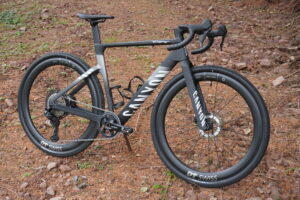
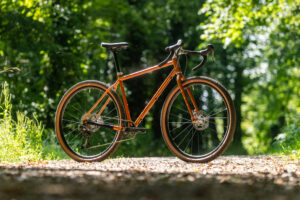
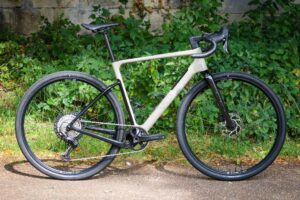
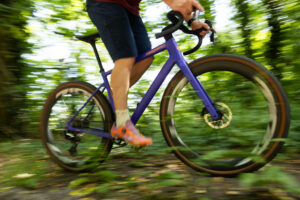
This new Open U.P. 2.0 is described as a light, nimble gravel speed machine – and it definitely doesn’t disappoint. Its low mass, stiffness and slippery aero characteristics make it a hugely responsive frameset that’s fun to ride and hugely rewarding for those who put performance above all else.
Open U.P. 2.0 – Technical details
Ten years after the original U.P. hit the market, the U.P. 2.0 brings the platform bang up to date with current trends and technical advances. The most notable change is probably being the dropped drive side chainstay being, er… dropped. In its place are chunky-looking straight stays on both sides.
Open has also upped the tyre clearance, from 40mm to 46mm. Still not massive by today’s standards, but more than enough to compliment the U.P. 2.0’s lightweight, racy nature. Other key updates are the adoption of the T47 bottom bracket standard, the inclusion of a universal derailleur hanger (UDH) and a switch of production to Portugal (actually the last few years of the first version’s run were built there too).

The new carbon composite frame weighs 995g including paint and the T47 threaded shell, while the U-Turn Aero fork weighs 390g (or 380g for the U-Turn Adventure, which has shallower legs and mounting points for cargo). Instead of the usual three bolts for mounting though, the Adventure version uses slots which allow bags to be fitted without cargo cages. You can still fit cages if you so wish.
Open has also launched an even lighter version of this bike, the U.P.PER 2.0, which has a frame weight of 800g. All weights are +/-3%.
The front end of the U.P. 2.0 now focuses heavily on aerodynamics, with a sculpted head tube that blends seamlessly into the down and top tubes. It certainly makes the frame look very purposeful. As you’d expect with an aero-orientated frame, the brake hoses run entirely internally for a very clean look.

Towards the rear the top tube becomes more svelte before flowing into the seatstays for increased comfort, while the down tube maintains its D-shaped profile to maximise stiffness into the huge bottom bracket section. Likewise, the seat tube is all about stiffness at the BB end, with the profile morphing from square to round as it rises to the top tube junction.

The U.P. 2.0 uses a standard 27.2mm diameter seat post. You get a carbon one as stock, but should you want to upgrade then replacements will be easy to find. The frames are compatible with dropper posts too, and there’s a small hole on the seat tube to help you make sure you have enough post inserted.
Other neat details include hidden mudguard mounts and the Smartmount system, which removes the need for an adaptor when using a 160mm rotor on either the frame or fork.
Open U.P. 2.0 – Geometry
The frame is available in five sizes, as are the two fork designs – they can be tailored to the frame size. Crown shape and height varies from size to size, which Open says is to create the best stiffness and compliance balance each time. Sizes XS to XL cover approximate rider heights of <1.65m to >1.88m.
Geometry-wise the U.P. 2.0 has an effective reach that’s roughly 10mm longer the previous iteration, and when taking all measurements into account you can see that this is a bike designed for speed.

The medium frame has a top tube of 545mm, with stack and reach of 570mm and 380mm respectively. The seat angle is 73.5 degrees – well suited for getting the power out through the pedals – while the 71.5 degree head tube angle is steeper than adventure bikes would run. The wheelbase is 1,024mm with a 425mm rear centre, and the bottom bracket has a drop of 75mm.
Open U.P. 2.0 – Finishing kit & pricing
The U.P. 2.0 is sold as a frameset for £3,999 in a raw carbon, ready-to-paint finish, or £4,199 painted in either this Farn colour option or Sand. The Adventure model with that cargo fork comes in Orange Pearl.
As a frameset it’s supplied with a lot more finishing kit and accessories than some. Beyond the frame and the U-TURN Aero fork you get a seatpost, UDH hanger, headset, an Open x Wolftooth chain catcher and a computer/GoPro mount. You also get Open’s cool B.A.R. (Break All Rules) handlebar, which is a carbon fibre integrated design with built-in stem length adjustability.

There are ten size options: four 38cm widths, two 40cm ones and three in 42cm (which actually measure 42.5cm). Lastly there’s one 43cm bar.
Stem length choices run from 60mm to 130mm, but there’s 15mm of length adjustment on each bar thanks to an internal wedge-style clamp that can be tweaked in 5mm increments.
You can obviously build up your U.P. 2.0 however you desire, but Open UK distributor Silverfish specced ours with Easton’s EC90 ALX wheelset, Michelin’s Power Gravel tyres, SDG Overland saddle and an EC90 SL chainset (also from Easton). A very bling build, but one which highlights how capable the U.P. 2.0 is when decked out with high-end finishing kit.

The U.P. 2.0’s price puts it in line with some of the higher-priced brands on the market, such as 3T. Its aero-focused 3T Racemax 2 Italia – which I reviewed recently – is even more at £5,310 for the frameset.
Cervelo offers its new, aero Aspero-5 as a frameset only, and it comes with a seatpost and full carbon cockpit for £5,000.
OPEN U.P. 2.0 – Performance
The U.P. 2.0 is aimed at the performance end of the gravel bike spectrum, focusing on low weight, stiffness and aerodynamics, and as I’ve said it doesn’t disappoint! For a rider like me who comes from the road side of things, the U.P. 2.0 literally feels like a road race bike for off-road. Optimised as it is for 35mm to 46mm tyres, it can also serve as an incredibly capable all-road machine.
The lower half of the frame is as tight as drum, so hard efforts on the flat or when climbing feel rewarding, and the Open just generally feels very quick everywhere. How much of that is down to the aero tweaks is hard to quantify, but when it comes to efficiency, the U.P. 2.0 delivers. This might all sound a bit gushy, but I can’t really think how else to describe it. It’s just one of those bikes that feels brilliant to ride, and I don’t think I’d ever getting bored of its performance, or the way it rides.
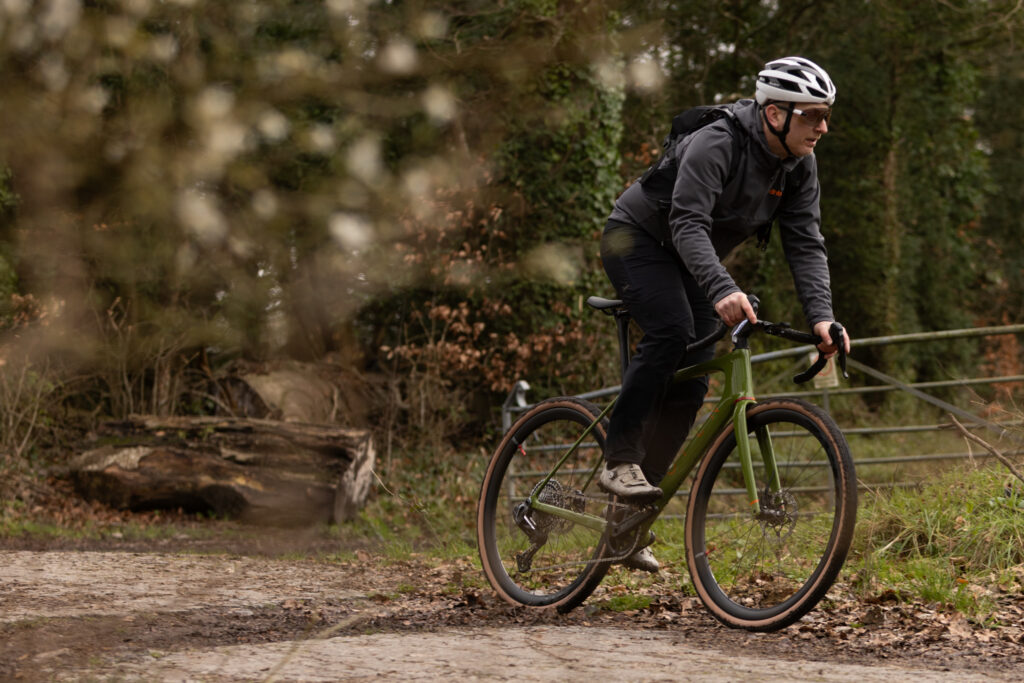
The geometry works really well. The weather during the review period was mixed to say the least, so I got to test the Open on dry dusty trails and wet, muddy, slippery ones too. The handling was spot on whatever; quick enough that the steering is pretty much point-and-shoot on fast, dry ground, but not so quick that it’s a twitchy handful when things get technical or loose. The wheelbase is tuned to match the steering, in that it’s lengthy enough to promote stability, but still short enough to retain the nimbleness required for a fun ride.
My main gravel route uses a lot of wide-open hardpacked tracks, with odd sections of singletrack and technical descending chucked in. The U.P. 2.0 is one of those bikes that feels perfectly designed for both, with no compromises anywhere.
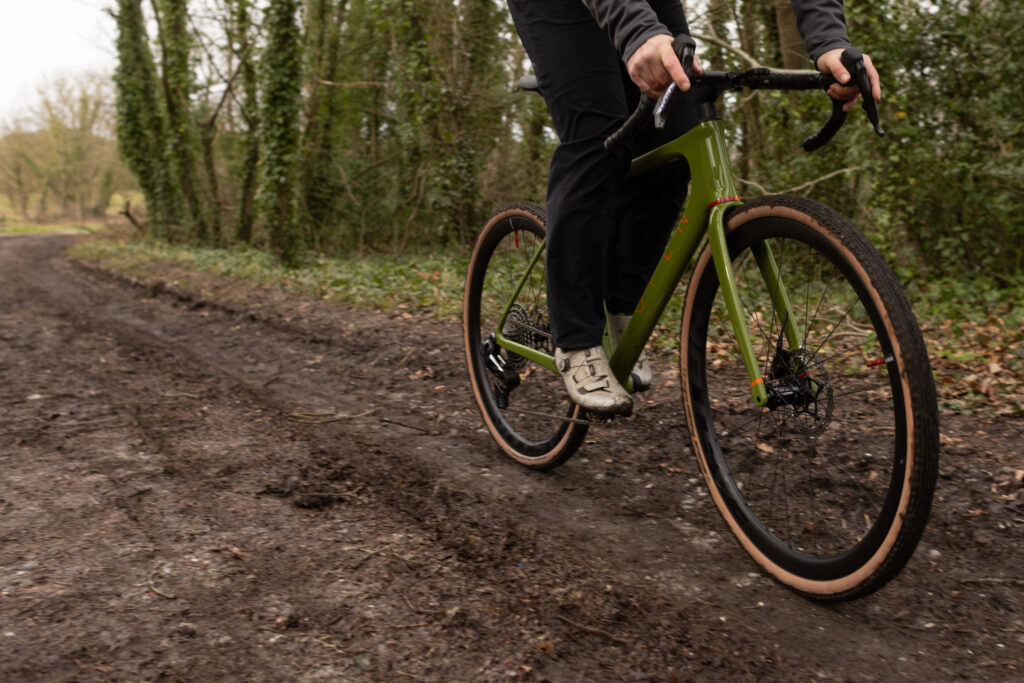
Comfort is great too. It would be easy to rely on large volume tyres to mask a stiff frame, but the seatstay design here creates a smooth rear end, and even the boxy sections of the main triangle don’t create any form of harshness. This Open might be designed for performance, but it isn’t going to shake your fillings out on those long jaunts through the countryside.
OPEN U.P. 2.0 – Verdict
From a ride point of view, the U.P. 2.0 really does get a glowing reference. I can’t actually fault it.
This is a bike that did everything I asked, and did it well, whether it was an hour’s blast around the local woodland or a big trek along less technical gravel trails. It’s certainly not cheap, but against some of its real competition it actually represents decent value for money – especially when you take its almost faultless performance into account.
Test Report
What does the manufacturer say about this product?:
Open says, “10 years after the OPEN U.P. defined the performance gravel bike, we have perfected it.”
Tell us some more about the technical aspects of this product:
Open says:
Deep headtube: The headtube is crucial for aerodynamics, as it is the first frame member to hit the airflow. The deep shape works wonders here, while underneath the carbon layup ensures the comfort stays high. A true win-win.
Straight chainstays: Offer the best power transfer yet still provide great tire clearance (up to 46mm – 44mm for the U.P.PER. CONCE.PT). As always, you should measure the tire when mounted on your rim, as the tire labels are not always accurate.
Wire-Stays: Thin seatstays provide compliance, while their bowed shape “pre-set” its flex for the best possible vibration absorption. For the new frames, the direction of the pre-set is rotated 90 degrees, so they bow out sideways instead of downward.
27.2mm round seatpost: The most boring seatpost size may not look like a design choice, but it is. It is light, offers great compliance and is compatible with a long list of seatposts, including many dropper and/or suspension posts should you desire to use one of those.
T47: is the new standard for threaded BBs, embraced by the leading BB makers. It’s spacious enough for any crank axle (oversized 30mm, SRAM DUB, Shimano, 24mm) and combine that with a wide 86mm BB shell to maximize the connection to the chainstays.
How does the price compare to that of similar products in the market, including ones recently tested?:
It’s priced well against similar bikes from the likes of Cervelo or 3T, as mentioned in the main review.
List the components used to build up the bike:
The U.P. 2.0 is sold as a frameset, but this build from distributor Silverfish is as follows:
Galfer Shark Road rotors
Easton EC90 ALX Wheels
Lizard Skin DSP Ultra Tape
Michelin Power Gravel
SDG Overland Carbon saddle
Easton EC90 SL Cranks
Easton Direct Mount ring
Included with the frameset:
Frame + Fork
OPEN B.A.R.
Seatpost
Headset
UDH RD Hanger
OPEN x Wolftooth chain catcher (except CONCE.PT)
Computer mount & GoPro mount
Noise-Reduction Foam Sleeves
Tell us what the bike is for and who it’s aimed at. What do the manufacturers say about it?:
“A light, nimble gravel bike for fast racing or riding. Even an overnighter or fast tarmac group rides are possible thanks to its comfort, efficiency and speed.”
This is a fun bike, with racing intentions and geometry that also works well on longer, less performance orientated rides.
Where does this model sit in the range? Tell us briefly about the cheaper options and the more expensive options:
The U.P. 2.0 range is available in three versions:
U.P. 2.0: Aero all rounder
U.P. 2.0 Adventure: As the U.P., but with cargo-carrying options.
U.P.PER 2.0: Superlight frame, aero fork.
Tell us about the build quality and finish of the frame and fork:
Excellent quality throughout, including the paintjob.
Tell us about the materials used in the frame and fork:
Both the frame and fork are carbon fibre.
Tell us about the geometry of the frame and fork:
The geometry is typically gravel, but with a racy edge.
How was the bike in terms of stack and reach? How did it compare to other bikes of the same stated size?:
The stack and reach figures are well within the range I’d expect for this style of bike and frame size.
Was the bike comfortable to ride? Tell us how you felt about the ride quality:
Ride comfort is very impressive, especially at the rear end thanks to the seatstay design.
Did the bike feel stiff in the right places? Did any part of the bike feel too stiff or too flexible?:
The lower half of the frame and the front end are built for stiffness, and they deliver.
Was there any toe overlap with the front wheel? If so, was it a problem?:
No.
How would you describe the steering? Was it lively, neutral or unresponsive?:
Responsive.
Tell us some more about the handling. How did the bike feel overall? Did it do particular things well or badly?:
The handling is quick for precision, but without being over the top and twitchy.
Which components had the most effect (good or bad) on the bike’s performance? Would you recommend any changes?:
The Easton wheels balance a small amount of aero with a low weight for a boost to performance.
Any issues with drivetrain durability?:
No.
Tell us some more about the drivetrain. Anything you particularly did or didn’t like? Any components which didn’t work well together?:
It’s a high-end component mix which suits the performance of the frameset.
Any issues with wheel durability?:
No.
Tell us some more about the wheels. Did they work well in the conditions you encountered? Would you change the wheels? If so, what for?:
The wheels work well, offering low weight and plenty of stiffness.
Tell us some more about the tyres. Did they work well in the conditions you encountered? Would you change the tyres? If so, what for?:
Good all rounders that offer plenty of durability in winter conditions.
Any issues with brake durability?:
No.
Tell us some more about the brakes. Did they work well in the conditions you encountered? Would you change anything? If so, why?:
Solid braking in all conditions.
Any issues with controls durability?:
No.
Tell us some more about the controls. Any particularly good or bad components? How would the controls work for larger or smaller riders?:
Some well-specced components that work really well with U.P’s frameset.
Did you enjoy using the product? Yes
Would you consider buying the product? Yes
Would you recommend the product to a friend? Yes
Use this box to explain your overall score
The U.P. 2.0 is well designed in terms of performance, comfort and the geometry. It’s also exceptionally well made, so ticks all the boxes.
About the tester
Age: 46Height: 180cmWeight: 76kg
I usually ride: This month’s test bikeMy best bike is: B’Twin Ultra CF draped in the latest bling test components
I’ve been riding for: Over 20 yearsI ride: Every dayI would class myself as: Expert
I regularly do the following types of riding: Time trialling, Commuting, Club riding, Sportives