


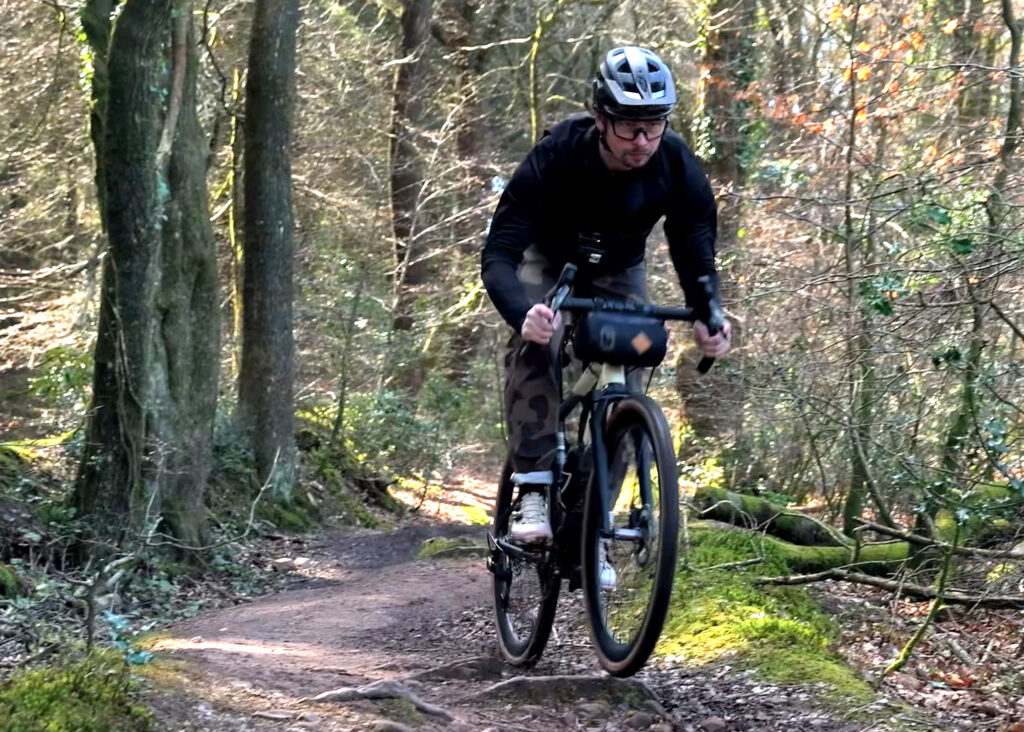

Whenever we publish a story on a gravel bike that may or may not be equipped with suspension, we receive a raft of comments on our socials screaming “it’s just an old school mountain bike!”, or “you may as well buy a cross-country bike at this point”. So I headed out to ride one of my favourite loops to really put those statements to the test.
I’ve said it loads, gravel is a remarkably broad genre, and while many of the bikes are pretty much identical, they’re packed with nuance that makes some better at some things than others. With UCI-style racing becoming common, bikes are taking inspiration from their road-going counterparts and being loaded with aerodynamic features in pursuit of speed. But if we take a look at the other end of the spectrum (which I believe is ‘true’ gravel), we’ve got machines built for adventure.
A bike that sits firmly on the latter end of that scale is what I’ve chosen to explore the Quantocks aboard. In fact, it’s the RockShox Rudy-equipped Boardman TRVL. I then loaded it up with some aero wheels from Yoeleo plus kit from Granite and Funn, so I could revel in some aero gains, while keeping my bike rolling should the worst happen… or if I needed to drop my seatpost all old-school style.
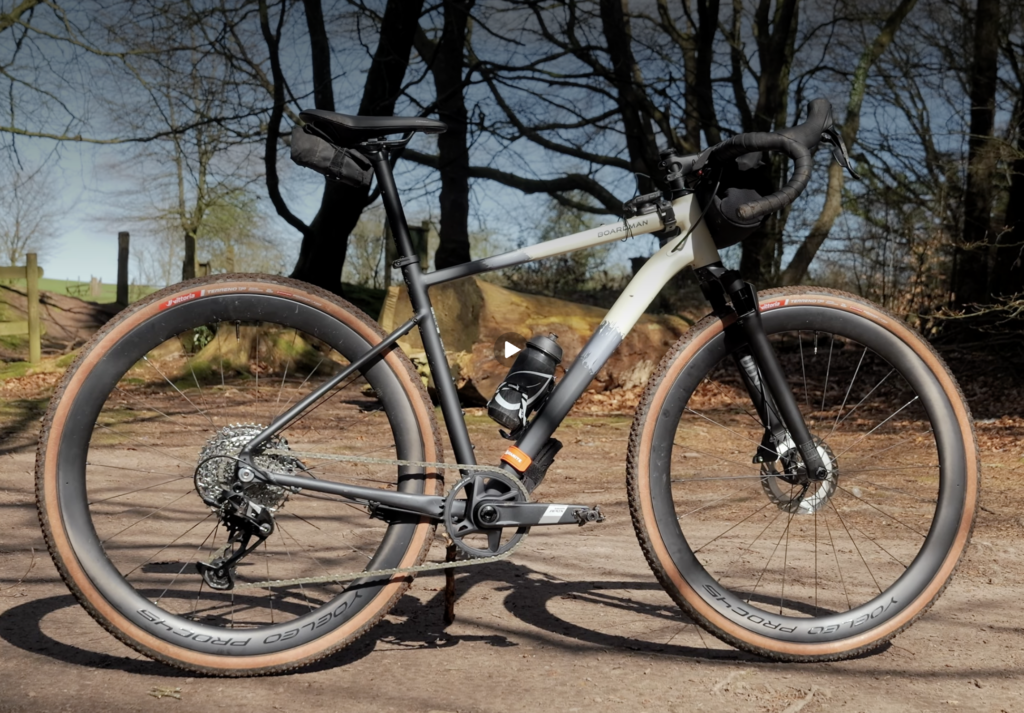
The set up:
Bike: Boardman TRVL 8.9 DB
Wheels: Yoeleo Pro C45 carbon wheels
Tyres: Vittoria Terreno T90 Mud Gravel Endurance
Tools: Granite Stash RT Ratchet Tool Kit & Granite Rocknroll TQ Torque Ratchet Tool Kit
Pedal: Funn Tactic Clip-in pedals
Now, I chose to tackle the Quantocks Killer Loop on a gravel bike because it was made famous in the noughties by our friends at another mountain bike website. The loop is probably best done on a cross-country bike these days, but if people are knocking gravel bikes because they’re old school gravel bikes, I thought that an old-school mountain bike route would be the perfect place to figure out whether there’s any truth in that.
It’s a 30km loop that’s well worth a crack if you’re in the area. It’s remarkably varied, chock full of singletrack and more technical rocky sections that would be child’s play on a mountain bike. But it definitely threw up a few interesting challenges on skinny tyres.
Anyway, check out the video, watch me struggle, and generally, have a fantastic day adventuring on trails that push the gravel boundaries.








8 thoughts on “Rediscovering an old school MTB route on a gravel bike: Are gravel bikes really old school mtbs?”
Sorry but I am calling emperor’s new clothes on this whole gravel bike thing. I know the industry desperately wants everyone to rush out and buy a gravel bike but this video just shows how ridiculous that is. This ride would be 100% more fun on any hardtail. Just having the width of the handlebar for balance and 100mm of travel would make it all much more stable and just as fast. And you would be able to get up that hill (though to be fair you could probably do that on the gravel bike with 40T at the front). I get that gravel bikes are faster on the more roady bits, but that doesn’t justify needing to be so sketchy and unstable on the proper off road stuff.
Even he confesses, about 5:20, the bike comes into its own on the bits that are like “fire roads”, which is where I understood “gravel” bikes evolved.
We don’t really have fire roads in the UK, so no wonder that gravel bikes can find themselves in something of a compromise.
I chose a gravel bike because I did not want a highly strung pure road bike, didn’t want the weight and complexity of a sprung mountain bike, did want the ergonomic flexibility of drop bars, reasonable speed on road and not too delicate to do tow paths etc. I would have gone for a touring bike, but they had all but died out, kind of replaced by gravel bikes. But a mountain bike it isn’t, which is one of the reasons I chose it.
Replying to Sriracha, isn’t forestry commission land cris crossed with fire roads?
@ktache – the fragments of forest I’ve cycled in the last decade or so (mostly up and down the east coast / Scottish central belt) have tended more to either fully tarmacked or “dirt/muck/roots” than gravel. Even though it should be a bit drier on the east coast…
Caveat – this isn’t a major part of my cycling diet.
I believe that the US has a much greater fraction of forested land than the UK. And my informant (Bill Bryson in “A Walk in the Woods”) noted that the forestry service there spent a great deal of its budget building roads – perhaps they favour gravel for cheap?
I am calling emperor’s new clothes on this whole gravel bike thing
And I’m disagreeing. Far from the gullible dupe of Big Bike portrayed, I’ve had my steel gravel bike since October 19 and it’s the most useful and used bike I’ve ever had. Much of the revelatory nature of this purchase was due to features which are not exclusive to gravel bikes: cable disk brakes, moderately wide tyres, rigid carbon fork and 700C/ 46-30 and 11-34. However, the package mostly comes automatically with a gravel bike, especially the cheaper end. It’s done Pennine Cycleway, Pennine Bridleway and C2C, all from home to home, camping and cycling all the way. I would have no trouble with this Quantock Loop, even with the camping trailer. Gravel bikes are great and the term is a useful one.
Photo was omitted by the system
“Sorry but I am calling emperor’s new clothes on this whole gravel bike thing.”
I think it depends on where you live and what is on your doorstep. It might be a small island globally, but the terrain is quite expansive.
For people who have off-road and more technical riding on their doorstep, a mountain bike may well be better for them. For others, and myself included, I need to ride to get to the better off-road stuff, and while that is possible on a XC mountain bike, it isn’t as quick or as fun as on a gravel bike.
Out of choice, and when only riding from the doorstep, I would choose a gravel bike, and that still gives the option to head off onto some more technical riding.
Add in a train to take me to a spot closer to the riding, and it tips the balance more towards a mountain bike. And I am sure everyone has a different story, with which terrain and routes are accessible near them.
That is a fair comment and perhaps I should take back my original statement. I just think these kind of articles are misleading when they don’t point out the obvious – that ride would be better on a hardtail. I do agree that a gravel bike is useful for many things, and is in many ways the perfect option if you only have one bike, or live near where it will be primarily useful. I just think hardtails are being left out of things unfairly in the rush to promote gravel bikes (and I have heard some in the cycle industry say the same thing).