



Gravel bikes are changing. Wider tyres are becoming the norm, some new bikes are getting slacker geometry, while others are embracing the aero-fuelled race scene in search of those extra seconds to clinch victory, as the sport continues to evolve, unite and divide. One constant across all categories is that prices are rising. But with the rapid changes in bikes and geometry, some say modern gravel bikes are much like hardtails from a decade or two ago. To put that theory to the test, I decided to build a bike from the frame up, using a mountain bike frame sourced from China, to create something capable of doing everything a modern gravel bike can do, and potentially more.
The main goals were to keep the weight low, maintain a geometry that was both enjoyable and capable, and keep the build on a budget, although that was somewhat bypassed by having some high-end components available for testing at the right time.
The foundation of the build was a carbon XC frame bought directly from China – the Airwolf T1100, complete with a rigid fork and carbon seatpost. Sadly, there’s no connection to the 1980s TV series that I enjoyed so much, although I was hoping it might fly up climbs with the same speed as the supersonic helicopter. The bare frame itself was impressively light at just 990g, but some of the finishing kit was rather less so. The supplied bolts felt bargain-bin at best, the bearings weren’t exactly confidence-inspiring, the seatpost clamp was basic, and there was a noticeable gap between the clamp and the seatpost it came with, so it didn’t hold firm.
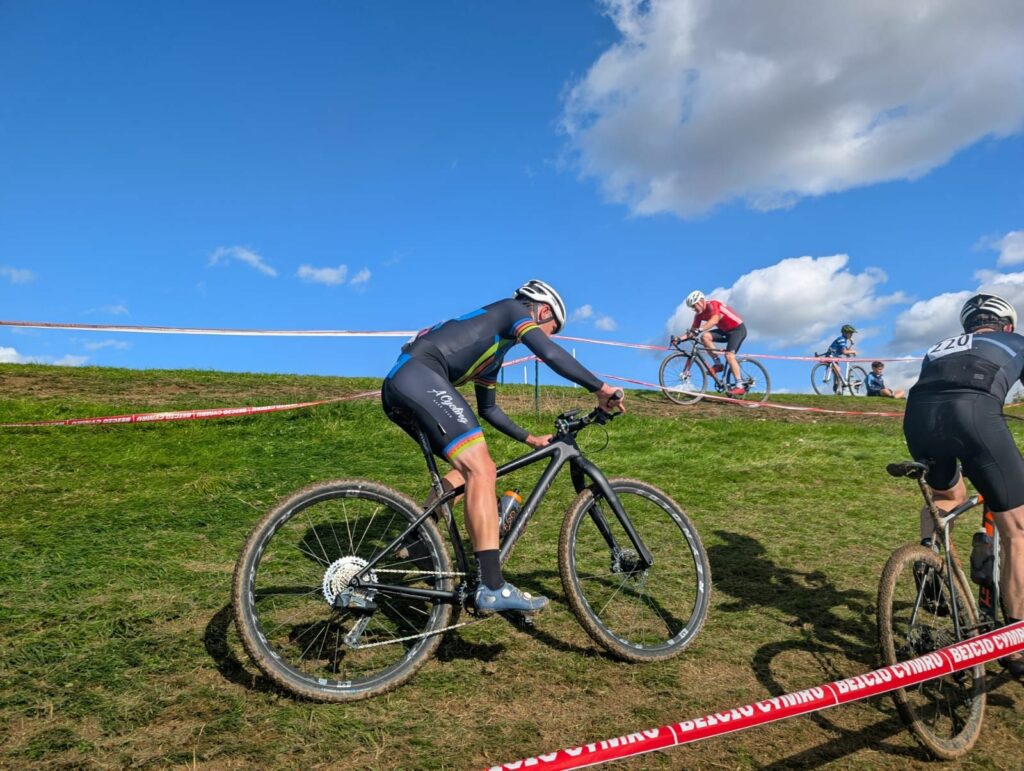
Initially, the build came together quickly, and with standard MTB components, including older XC mountain bike tyres and a narrower flat handlebar. I used it to race cyclocross in the local Welsh league (outside British Cycling National races, the 33mm tyre size limit does not apply). It proved a strong option, delivering a third place in the V40 series and third in the V40 Welsh Championships.
As great as that all was, could I transform this frame into my ultimate drop bar machine, for less money than just going out and buying a complete bike? It certainly didn’t involve less faff, to give you a small spoiler… here are the lessons I learned along the way, plus my verdict on going DIY with a frame from the Far East vs buying off-the-peg.
Lesson one: chainring sizes and clearance
Most gravel bikes will have clearance for, and be specified with, a 38-tooth or larger chainring, with a 44-tooth chainring possible for some more race-style frames. The 73mm bottom bracket shell limited me to a mountain bike chainset, and the available clearance meant the biggest I could fit was a 36-tooth chainring. Some XC mountain bike frames would even struggle to fit a 36-tooth, to be fair.
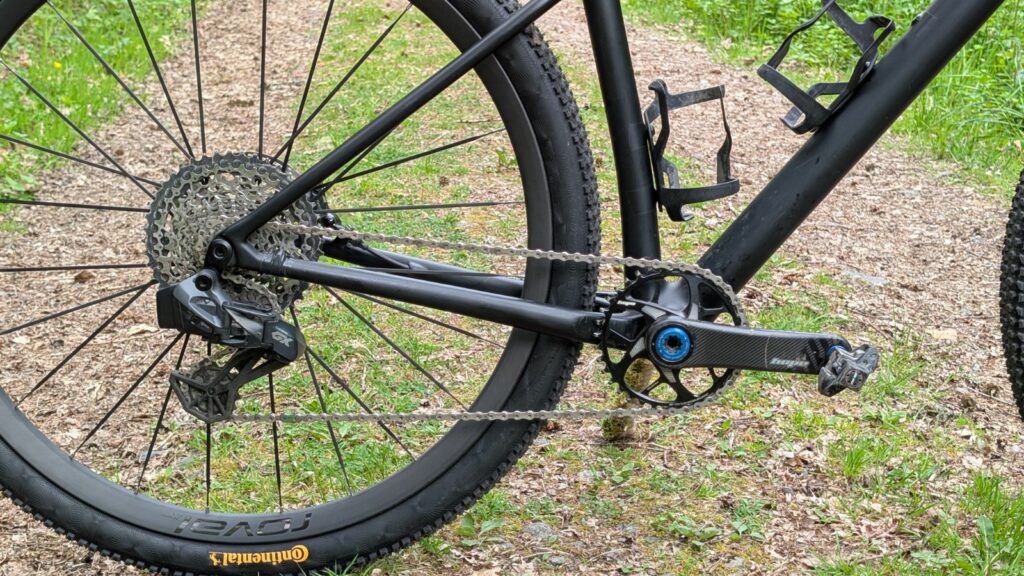
Combined with a 10-tooth smallest-tooth cassette sprocket, I hoped it would still provide a large enough gear for racing, but it has already led to compromises. Using a cassette such as the e-thirteen Helix Race with a nine-tooth lowest cog might be a potential solution. The crankset also has a wider stance and Q-factor than many gravel bikes, which could be a factor for some riders considering this route.
Lesson two: modern mountain bike forks are tall!
Axle-to-crown is the standard way to measure fork height, and when you see geometry figures quoted for a bike, they will be based around a specific axle-to-crown measurement. Change the fork, and you change the geometry on the whole bike. The Airwolf frame I bought has geometry figures based around a fork with a 506mm axle-to-crown, which is typical for a 100mm suspension fork.
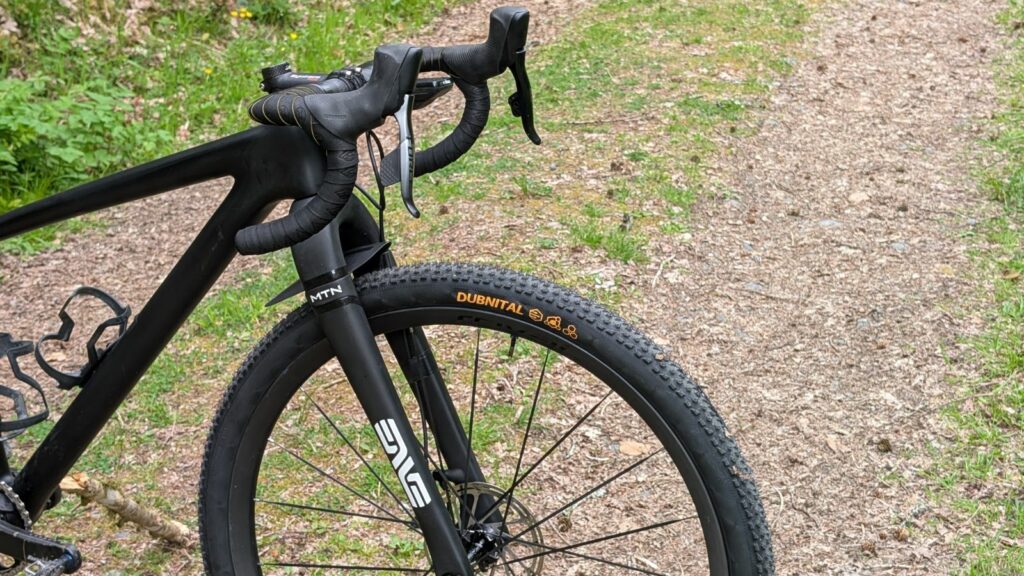
The carbon fork supplied with the frame has an actual axle-to-crown of 485mm, with the difference taking into account the typical sag measurement for a 100mm fork, but after winter, I picked up a now-discontinued ENVE MTN non-boost rigid fork second-hand, which has a 470mm axle-to-crown. Swapping to a shorter fork was intentional, but it has a knock-on effect everywhere else. I compiled geo figures from an online geometry calculator, and the fork changed the geometry by steepening the head angle from 68.5 to 70.2 degrees and the seat tube angle from 74 to 75.8 degrees. The reach was also increased by 18mm, and the BB dropped by 13mm, reducing the trail by 10mm.
Lesson three: standards don’t always match
Cycling has so many standards that there is effectively no standard, and that is true for almost every part of the bike, but they become even more complicated when trying to merge mountain bike and gravel components. Typical axle widths and diameters limit wheel choice, although adapters are available for some setups. Axle and brake spacers can allow non-boost wheels in a boost frame, for example, and in the case of the ENVE fork, I found an adapter to reduce the axle diameter from 15mm to 12mm, while keeping the 100mm width the same.
Brakes are another problem area. The frame and fork use post mount, as my mountain bikes do, but almost all gravel groupsets now use flat mount. I tried a few adapters with no success and ended up buying older SRAM Force post-mount calipers second-hand. Lots of calipers might not be officially compatible with road brake levers, but the most important factor to consider is that they both use the same fluid (mineral oil or DOT).
Gearing and pull ratios are another potential nightmare. My simple solution was to use older SRAM AXS components, which are now appearing at more reasonable second-hand prices, allowing straightforward mixing of MTB and gravel drivetrain parts.
Lesson four: reach
It is one thing to look at numbers on paper, but that does not compare to sitting on the bike and feeling the fit. Modern mountain bikes are designed around flat, wide handlebars and shorter stems, so the reach and top tube length will usually be longer size-for-size. Dropping down a frame size is a good starting point (as we saw at last year’s Leadville), but it will not always be that simple. You also need to factor in which brake and shifter units you are using, as different brands and models have different reach dimensions. Newer SRAM hoods have a longer reach than previous-generation models, so it is worth considering your groupset choice before settling on frame size.
Lesson five: frame space
This will not matter to everyone, but if you are planning bikepacking or longer adventures with bags, it is worth noting that a mountain bike frame will usually have less internal space for bottles and bags than a gravel frameset. That becomes even more noticeable when you factor in the likely need to size down on frames.
Lesson five: price creep
What might seem like a cheap frame as a starting point can soon build up when you consider all the changes that might be needed. Brake adapters, axle spacers, new hydraulic brake cables and fittings all add up. Even if you have a pile of parts and spares already, the chances are you might need some of the smaller parts to finish a build.
How my Chinese MTB-framed gravel bike rides
After multiple false starts, and with the bike finally finished, how does it ride, and was it worth it? Perhaps the easiest way is to say it feels different and compromised.
Depending on what you want to achieve, it might work, but it falls short of the best alternatives. Even with a shorter fork and a slammed -17-degree stem, the front end still feels tall. On paper, the figures suggest a reasonably quick-handling setup, but in the real world, it feels slow around some corners. The higher position can make it feel confident, but I found I had to lean the bike over far more than on any comparable gravel bike, and on initial rides, I found myself going wide and understeering through the corners.
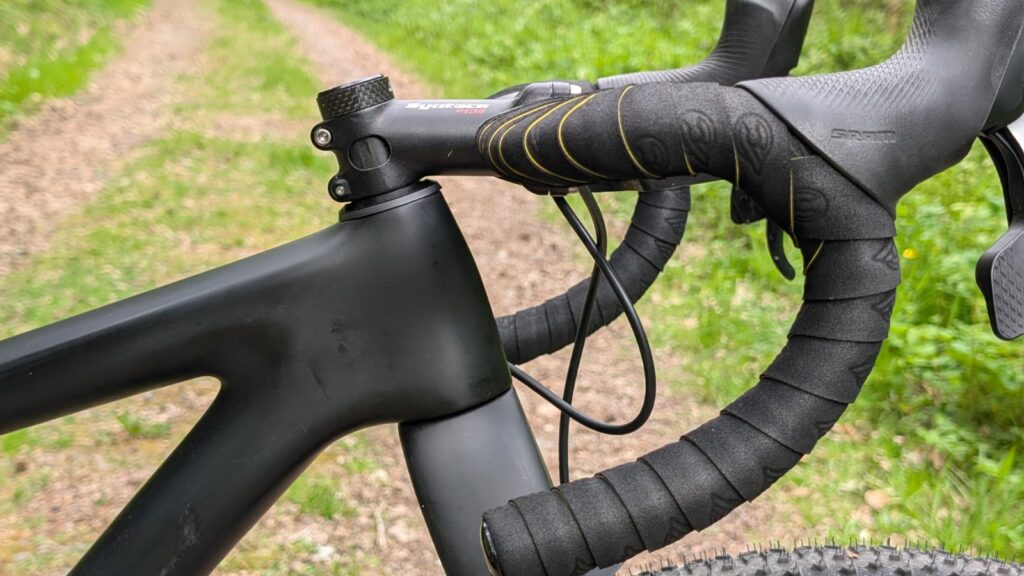
Despite a reasonably short stem, a size small frame, and an inline seatpost with a saddle as far forward as I could get it to keep the weight distribution as forward as possible, the reach and front-centre are still long. One benefit is that toe-overlap was miles away from being a problem, and this is something that I have had issues with on multiple gravel bikes, which have clearance for 50mm+ tyres and using them.
Are wider tyres all they are cracked up to be for gravel riding? Sometimes, but I would argue that tyre quality and construction are the most important factors on the entire bike. Choosing a basic, cheaper pair of mountain bike tyres will not make you any faster. Gravel tyres are getting wider, and some mountain bike tyres are being reduced in size for gravel use, but what the fastest options have in common is that they are top-tier models. Wider tyres will only be fast if they have a supple carcass that can deform around the terrain beneath you, fast rubber compounds, and reasonably low weight.

If you enjoy the process of building and tweaking, you might enjoy both the process and the result. Otherwise, there is probably already a better bike on the market that has been designed to fit wider tyres and deliver the kind of riding you are looking for. For example, the Whyte Verro was my bike of the year for 2025, and for riders who are not interested in racing, it stood out for its ability to blend mountain bike and gravel riding into a ready-to-go package. It costs £1,799, so going the MTB frame conversion route can be cheaper, depending on the bargains you find.
But for this franken-gravel bike, I spent £400 on the frame, £300 on the fork and about £100 on adaptors and other small parts; the rest I sourced as test kit, and had sat in my trusty spares bin. Assuming you can pick up a second-hand Shimano GRX group for less than £300, a carbon MTB-framed gravel bike can be assembled for around £1,100. Of course, there are some other components to consider, like the saddle, seat post and tyres, so that price will likely creep a little higher.
For those looking to race or simply ride fast, there are fewer options at lower price points, but the end result of an MTB/gravel conversion is still likely to be compromised, largely because of the higher front end that you are almost certain to end up with.
If I started over, what would I do differently?
I would start by looking for a 29er hardtail frameset with a 142x12mm rear end, but also a hardtail that was considered slack for its era. If you start with anything featuring a 70-degree-plus head angle and then reduce the fork height, the result is going to be sketchy, because the head angle will steepen further. Don’t be afraid to mix and match wheels, and consider hubs that can be converted to fit your prospective bike, such as the DT Swiss 240. You will thank yourself for avoiding axle spacers that fall out every time you remove the wheel.
Search around and keep an eye out for older, discontinued products that might be exactly what you need. Expect a few hurdles along the way and accept that the end result will probably involve compromises, but those compromises might still be manageable.
Who can this benefit the most?
If you understand geometry and how changes can affect the ride, are confident enough with mechanics to build a bike from scratch, and you are willing to spend time sourcing the right parts, then this kind of project can make sense.
It is likely to suit riders looking for a gravel bike geared more towards adventure, exploration and general riding, rather than flat-out racing, particularly if you can spot a bargain among older second-hand kit online.
Most importantly, it suits those with patience, spare time, and a willingness to tweak and change parts to find a setup that fits and rides exactly how they want. If that sounds like you, then it is possible to build something that works well, with a minimum number of compromises. Still, I think for most people in the market for a gravel machine, buying a complete bike is still going to be more cost-effective and far less time-consuming, all things considered.
















18 thoughts on “I built a gravel bike from a Chinese MTB frame… and it wasn’t plain sailing”
Really the “Chinese” in the title is clickbait and completely irrelevant.
What you’ve done is taken a XC MTB with modern slack(ish) geometry and come to the conclusion that it isn’t a gravel bike. It’s a moderately interesting, although not surprising outcome. Taking an older, upright MTB might work a bit better, although you aren’t likely to find one in the 29″ you will need to fit the wheels in the frame and forks.
How about getting a Chinese gravel bike frame and building a gravel bike from that with relatively inexpensive parts. It would be a nice change of pace from the super expensive bikes we often see on the site.
Of course it’s going to feel compromised. It’s mountain bike with accommodations for gravel. If you just had to go this route, it would have made more sense to start with a 20 year-old Rockhopper or Schwinn Mesa frame, like MTB Refugee suggested.
As is being noted, if the author wanted a gravel bike he shouldn’t start with an MTB frame. If he wanted to test the assertion that ‘modern gravel bikes are much like hardtails from a decade or two ago’ then I guess he has an answer.
Well, no surprises here. Except maybe fitting an ENVE fork to a Chinese frame!
BTW, I recently helped a friend upgrade his Trek Checkpoint ALR because its braking power wasn’t sufficient.
What surprised me was that the fork has a threaded brake mount, but the thread spacing is NOT PM. It’s a proprietary mount designed for a proprietary adapter used with the stock FM caliper!
Once we sorted that out, we wanted to fit a 4-piston caliper, which forced us to go with a PM unit. But since there don’t seem to exist any FM-to-PM adapters that keep the rotor size unchanged, we had to size up the rotor.
Luckily for the project, a 180 mm rotor had always been Plan B, so we ended up where we wanted to be anyway.
Quite an experience, letmetellya.
Not sure that it’s really ‘clickbait’. (How would that even work anyway? Are there really people out there clicking on items just because they see the word ‘Chinese’?)
It’s more that it’s being used as a euphemism for ‘cheap’ – the point being to see if this is a route to getting a ‘gravel’ bike on the cheap* – so it would have been clearer to just write “from a cheap MTB frame”.
[* Which it turns out, no – at the end of the day the savings weren’t great, when taking into account the compromises entailed.]
“some say modern gravel bikes are much like hardtails from a decade or two ago. To put that theory to the test…”
you’d get one of each and compare them, surely?
I’m not sure of relevance of using a modern MTB frame.
The premise was the geometry of a 20 year old MTB.
I built a “Dutch bike” (well, city bike) out of a mountain bike, but that wasn’t really worth the cost and effort either.
Next: Bagpuss discovers that mouse’s idea of making chocolate biscuits from breadcrumbs and butter beans doesn’t really stack up.
My clickbait comment is based on the use of Chinese blah blah blah in the title which is a common in many articles to get views.
Some Youtubers such as Trace Velo specialise in the Chinese market, which is their thing and relevant to their content. In this case it was completely irrelevant to the article and set out the article under a false premise. Hence “clickbait”
China is from whence the cheapest carbon frames are obtainable, it’s an article about trying to build a gravel bike on the cheap and the author bought the frame from China, it’s entirely relevant to the article to mention the source of the frame, just as it would be to say I built a gravel bike from an eBay MTB frame or a car boot find frame. It’s of interest and perfectly legitimate to include it in the title.
Did the same thing in 2016 with a Twin6 Ti MTB frame. I was not particularly fond of the geometry on the early gravel bikes. The manufacturers would slap the gravel tag on cyclocross bikes without any changes whatsoever. I’ve been very happy with the bike going into its 11th year now.
[citation needed]
Again – why would mere use of the word ‘Chinese’ particularly ‘get views’.
Counterpoint I’m loving mtb to gravel conversion, based on an On One Whippet with fairly old school geometry. The high stack means I can get in an aeroish postion without dying and the mtb slacker geo and longer wheel base is far more sendy than a pure gravel bike down hill. It suits the Southdowns where gravel is mud in winter and flinty horse ruts in summer… Cost wise it was “just older Sram axs levers and mech which work with Sram Level calipers which whippets come with”
@mdavidford And even supposing it does, why is it a shock and a sin that a journalist would include something in a headline calculated to draw the reader in and persuade them to peruse the article? That’s kind of what headlines are for.
Been there, done that.
£150 carbon frame (AliExpress sale)
£25 carbon CX forks (eBay)
£160 SRAM Force 1x hydro groupset (FB marketplace)
£120 WTB i23 wheels (inc cassette and Riddler tyres)
£100 AliExpress carbon bars, alu stem, carbon seatpost and secondhand Fizik saddle and shiny anodised bolts for a bit of bling.
£550 all in for an 8kg carbon gravel bike that takes 50mm tyres. It can keep up with the chain gang with road tyres on and can handle everything at Thetford and most stuff at Cannock with MTB tyres on.
I’m running an 11-46 cassette on a 46-36 chainring. You will notice I said I had a 1x groupset. Both rings are narrow wide – the 46t is fine for 90% of the rides I do (1:1 bottom ratio) but if I’m doing an epic climb or tough off road terrain, the 36t gives me all the bottom range I need and I can still ride at 40kph without spinning out.
I think the point is that, as it has become common for consumers to buy frames directly from Chinese sellers, often the cost saving needs to be balanced against the risks of going down that route. There are various potential pitfalls involved – poor quality or poor QC, delays and unexpected tariffs/duties, unusual standards, strange sizing/geometry etc. All of which are issues that would be largely avoided by buying a frame from a western brand and/or local retailer (even if the frame itself may well have been manufactured in China originally).
The headline makes it sound like the writer stumbled into some of those issues. However, that is not the case: instead, all the issues that made it “not plain sailing” were the inevitable consequence of trying to fudge a gravel bike build from a mountain bike frame.
“I’m running an 11-46 cassette on a 46-36 chainring. You will notice I said I had a 1x groupset”
How do you put two chainrings on a 1x chainset?
Going this route, you may want to size down on the MTB frame, even if it’s an older one with more modest reach. Just use a longer seat post.
The greater stack means that you’ll need LESS reach to achieve a given seating position for a given bar reach/stem length combination. Why? Well, the head tube sits at an angle and you’re measuring from closer to the BB now.