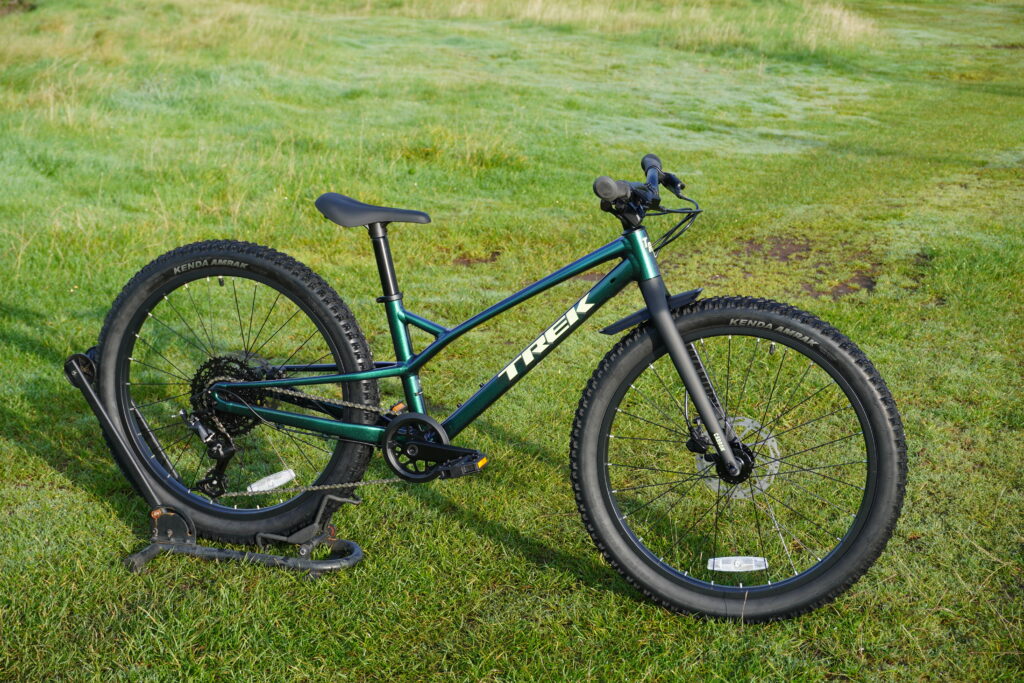

For many young riders, the Trek Wahoo 24 Trail will be their first real step into mountain biking. With chunky tyres, a slacker head angle for a more confident feel, and a handful of thoughtful design touches, it looks every bit the part. Just try not to dwell on the weight, or you might feel a touch of sympathy as they grind their way up the climbs.
- Kids Ride Shotgun Dirt Hero kids bike review
- Islabike Beinn 20 Pro Series
- Kids Ride Shotgun Quick Fit MTB Tow Rope review
Trek Wahoo 24 Trail – Technical Details
The Wahoo line-up covers 20″, 24″ and 26″ wheels, although it’s split between the Wahoo Path in 24″ and 26″, aimed more at recreational use, and the Wahoo Trail in 20″ and 24″, built for proper off-road riding.
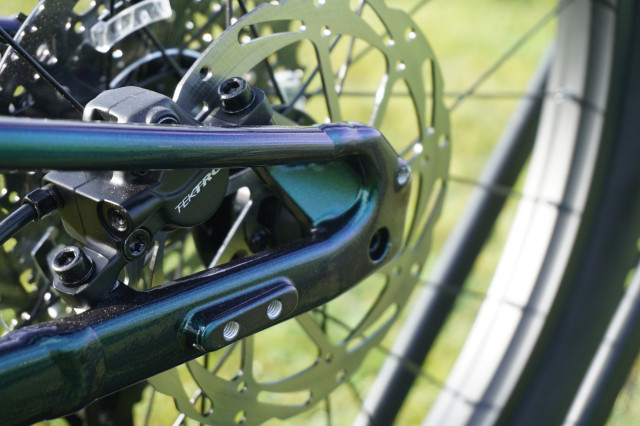
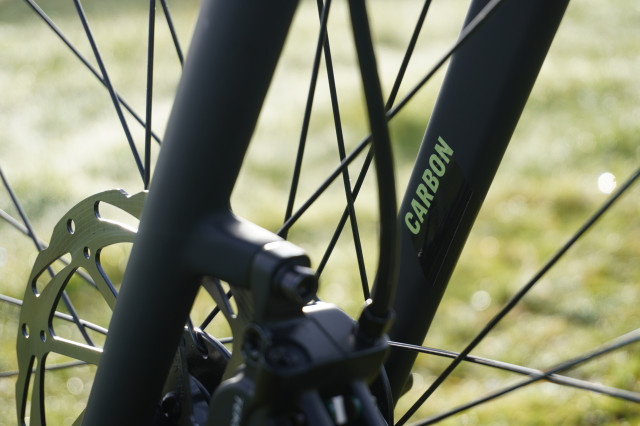
The frameset is aluminium, using Trek’s Alpha Silver grade, paired with a carbon fork. The paint finish is excellent, with a contrasting effect that really stands out and has already earned my son’s approval. Both the fork and frameset use Trek’s ThruSkew system, essentially a clever reworking of the old quick-release concept. It functions like a bolt-through axle secured with a 5mm Allen key, saving weight and simplifying the design. Given the size and weight of the riders this bike is aimed at, stiffness isn’t a concern, and the system delivers a straightforward and secure setup. Spacing is 100mm at the front and 135mm at the rear, echoing the quick-release era.
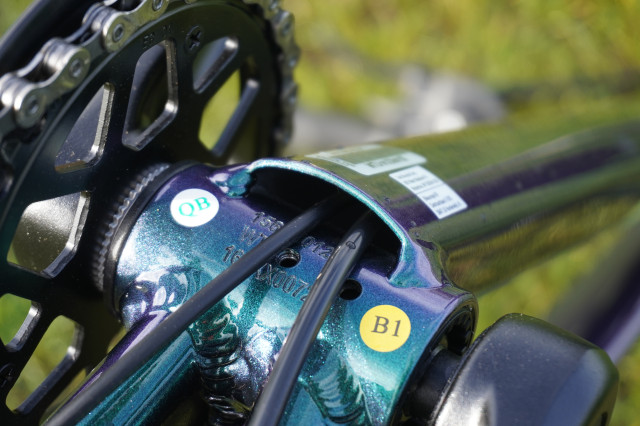
Cable routing is internal, with a generous port near the bottom bracket that should make maintenance easier. There’s also provision for a dropper post if you decide to fit one later.
Trek suggests the frame suits riders between 130cm and 150cm. It’s a broad recommendation, and the same range is quoted for the Wahoo Path despite its smaller tyres, so I would strongly recommend trying it in a shop to confirm fit.
Bike weight is always a challenge for youth models, often due to safety standards, component availability and price point constraints. At 10.94kg, the Wahoo 24 Trail is still one of the lightest 24″ bikes genuinely designed for off-road use. For context, there are 29″ full-suspension cross-country bikes that weigh less, which puts things into perspective when you consider that, for many young riders, the bike will come in at roughly half their own body weight.
Trek Wahoo 24 Trail – Componentry
Perhaps the biggest and easiest element to notice on the Wahoo Trail 24 is that it is a rigid bike. When I was a kid, having suspension on my bike was all that mattered, but the years of riding taught me that suspension is not that important for a kid’s bike, particularly on a bike at this price point. A cheap suspension fork will add weight and is unlikely to give any improvement in performance, so I am pleased to see that it is rigid.
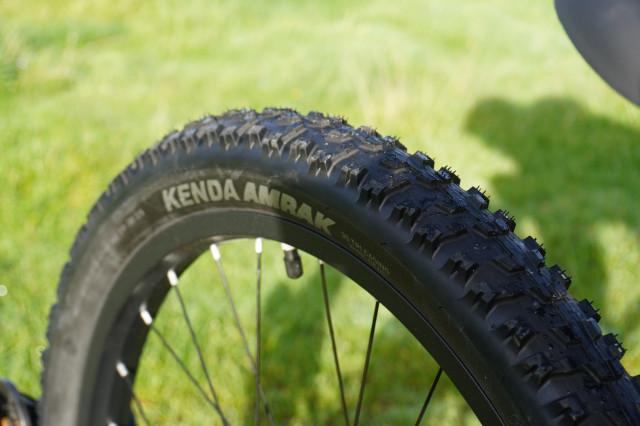
Geometry and components make a more positive difference, and that is what Trek have managed to create. The wheels might be only 24”, but the tyres are as wide as many adult bikes, at 2.2”.
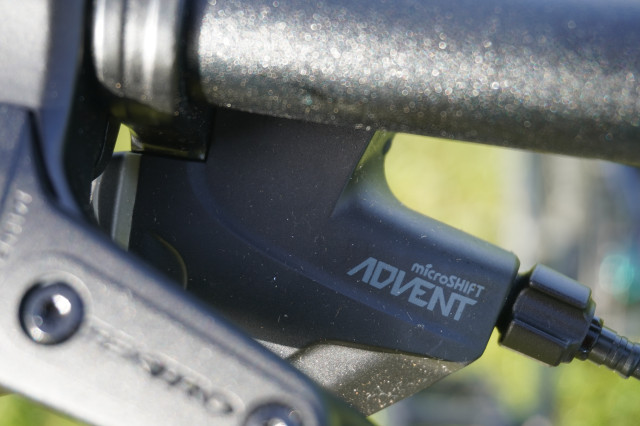
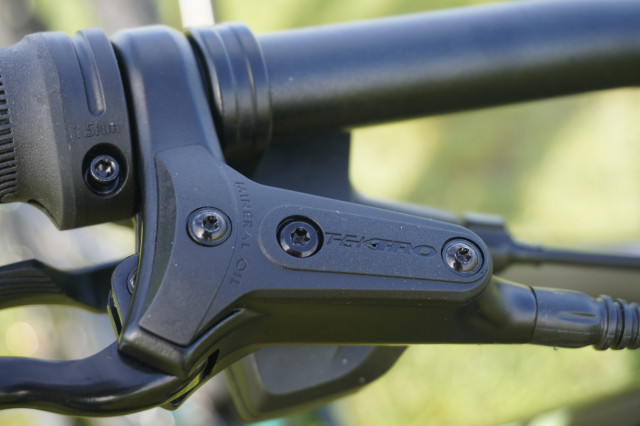
Many elements of the bike are components that are tailored for smaller riders, including the Microshift Advent drivetrain. The nine-speed version fitted has a shorter reach on the shifter, and compared to the adult drivetrain, with a grippy thumb shifter and a visual display to help keep tabs on which gear they are in. It might be junior-specific, but it does still have some features you would expect to see on adult bikes, with a clutch rear derailleur and narrow-wide chainring. The Tektro brakes are junior-specific as well, and while they might be basic, they also have a short lever reach.
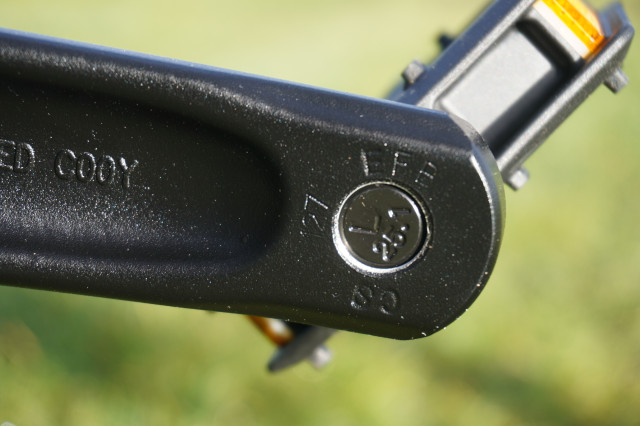
The drivetrain features a 30-tooth chainset with 127mm chainset length on a standard 68mm square taper bottom bracket, which should allow simple and cheap changes, with an 11-42 tooth cassette. Given the space available on the wheel for a long cage, and the type of riding, and the riders the bike will be used by, I think this is sufficient, and together we have ridden up some challenging climbs, although I have felt sorry for him pedalling a bike weighing almost half his body weight.
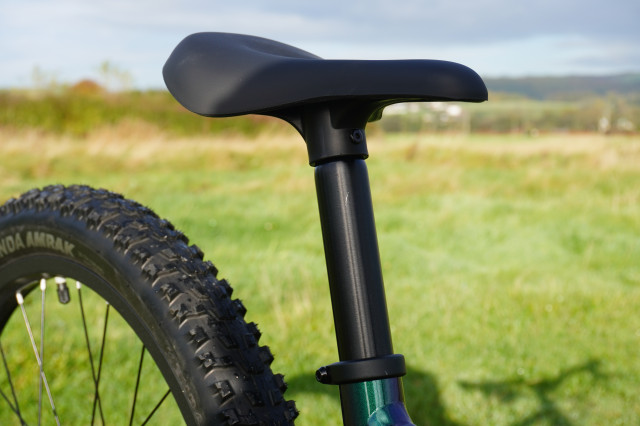
Trek has fitted its own-brand cockpit, with a short 45mm stem and 600mm wide handlebars. These use a standard 31.8mm width, which is pleasing to see as it makes adding any accessories simple, or changing for preference. The seatpost and saddle are a fixed, integrated design and another feature to save weight. It does mean no there’s ability to change the angle of the saddle, or the fore/aft position, but I think these are unlikely to be major factors of concern, and again, saving weight is a bigger issue. The saddle is bolted onto the seatpost, which means in the event of a breakage or issue, it should be replaceable.
The wheelset is built with Formula hubs, laced onto wide but basic non-tubeless rims. Trek doesn’t provide a specification for the rims, but my measurements suggest an internal rim width of 31mm, which is generously wide for a youth bike.
The wheels are undoubtedly a big element of the overall bike weight, and together with the Kenda Amrak 2.2” rigid tyres, which are 800g per tyre, put a big dent into the overall bike weight. Should you wish, there is space within the frame to increase the tyre size, with the official maximum tyre size from Trek at 2.4”, which is impressive for such a small bike size.
Trek Wahoo 24 Trail – Performance
Setting up the Wahoo 24 Trail took very little time, and it was reassuring to see that the component sizing is standard and in line with adult bikes, which isn’t always the case with youth models. The 31.8mm stem and handlebar, along with the 31.6mm seatpost, mean that making changes or fine-tuning fit should be straightforward.
After a short ride to get used to the sizing and steering compared to his previous bike, I was amazed at how quickly he adapted. Our second outing took us straight onto a pump track and then into the trail network at Nant yr Arian in Mid Wales.
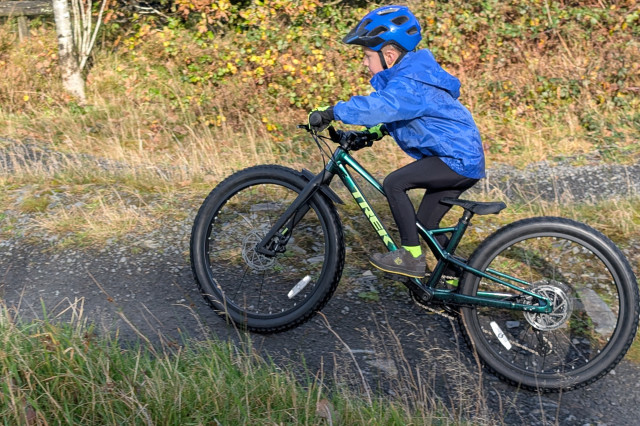
He is a strong rider, but still young and barely over 20kg, so watching him ride a bike that amounts to around 50% of his own weight was quite something. I had a Kids Ride Shotgun Quick Fit tow rope with us, but he is competitive by nature and prefers to ride solo whenever he can, which he did. The bike’s weight on the climbs at least gave him a chance to make full use of the gearing, which feels well-suited to the type of riding the Wahoo 24 Trail is aimed at.
Across everything we’ve used the bike for, from riding to school, mountain bike adventures, general rides and cyclo-cross races, I’ve never seen him either over-geared or under-geared. Route choice clearly plays a role, but the gearing range has felt spot on throughout.
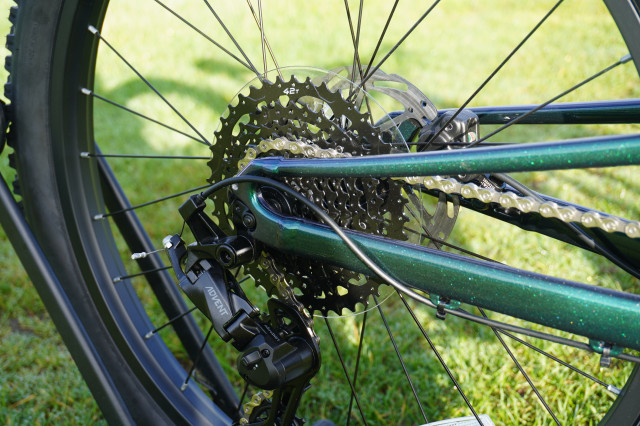
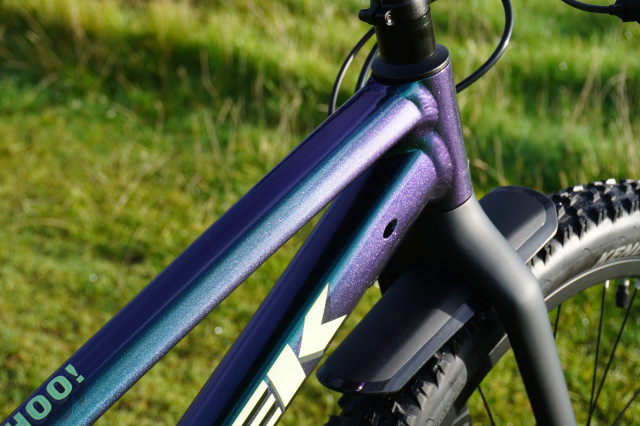
While the frame design is likely intended to maximise strength and standover clearance, the small extra tube between the top tube and seat tube provides a very handy grab point for lifting and manoeuvring the bike. Taller adults may be able to roll the bike on its rear wheel, but smaller children cannot, and this section of tubing is perfectly placed for them to pick it up.

The Tektro brakes are excellent, with a sharp feel and plenty of power available early in the lever stroke, exactly what young riders need. The 160mm rotors might be more than necessary for smaller riders, and some brands have saved weight by fitting 140mm discs instead, but performance here is hard to fault.
His confidence on descents has noticeably improved, helped by the geometry. The relatively slack head angle for this category of bike and the longer wheelbase should make the Wahoo Trail feel more stable, and I’ve watched him tackle technical features he previously wouldn’t have considered. He’s also taken some less-than-ideal lines and still ridden them out, which says a lot about how forgiving the handling is.
The wheels are something of a double-edged sword: the wide rims and tyres offer grip and comfort, but they are heavy and not tubeless-compatible. Aftermarket 24” wheels are difficult to find, which limits upgrade options. Prevelo, a brand specialising in performance children’s bikes, offers tubeless-ready wheels on models like the Alpha Four and Zulu Four, and the Cube Elite range also includes tubeless options, so alternatives do exist, but there are just very few aftermarket choices.
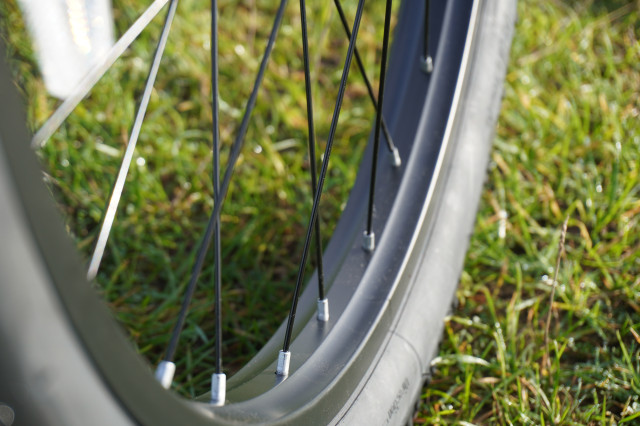
The rims aren’t the only weak point. The basic Formula hubs developed a slight but concerning noise when coasting on the freehub. It hasn’t caused any functional issues and has never slipped under power, but it’s worth noting.
Trek supplies a front mudguard with the bike, though it offers virtually no real protection and feels more like an aesthetic addition. On wetter rides, I fitted a Crud Catcher XL up front and a Win Wing MTB at the rear, both of which provide proper coverage and still fit within the frame and over the wheels well.
Trek Wahoo 24 Trail – Verdict
The Specialized Riprock 24 is likely to be one of the main alternatives. It is considerably cheaper at £550, but if the spec sheet is correct, the gearing looks harsh for a children’s bike, with a 40-tooth chainring matched to an 11-42t cassette, and longer 140mm crank arms that won’t suit younger riders.
Cube, meanwhile, has pushed the limits with the Elite 240 range, placing a strong emphasis on low weight. The 6.7kg C:62 SLX and 6.9kg C:62 PRO are impressive, featuring sub-900g frames, carbon forks, carbon tubeless rims, 11-speed groupsets and carbon cockpits. They are, however, £2100 and £1700 respectively, and despite the premium spec, the gearing still seems big, and the 69-degree head angle isn’t groundbreaking.
As a parent with a child who wants to ride off-road, explore more technical terrain and go on longer adventures, it has been difficult to find a genuinely suitable option. The Trek Wahoo 24 Trail has been a revelation in certain key ways. I’ve loved watching him develop as a rider, taking on features he wouldn’t have attempted before. The geometry and most of the components suit the type of riding we do, supported by excellent brakes and a gearing range he adapted to quickly, helping him tackle everything we’ve pointed the bike towards.
Overall, the Trek Wahoo 24 Trail offers a capable and confidence-inspiring platform for young riders who want to push on with their off-road progression. Despite its weight and heavy non-tubeless wheels, it has delivered a brilliant riding experience and opened up a world of trails for us.
You might also like:
- How to buy the best mountain bike for your child – whatever their age
- Buyer’s guide to kid’s mountain bike helmets: how to choose the best lid for your child
- Mountain Bike Icons – the Evie Richards story
About the bike
Tell us what the bike is for, and who it’s aimed at. What do the manufacturers say about it? How does that compare to your own :
Frame
Alpha Silver Aluminium, 24″
Fork:
Wahoo 24″ carbon, post-mount disc brake, ThruSkew 5 mm QR
Wheels:
Hub front – Formula DC-20, alloy, 6-bolt, 100 mm
Skewer front – 135×5 mm bolt-on
Hub rear – Formula DC-22, alloy, 6-bolt, Shimano 8/9/10 freehub, 135×5 mm
Skewer rear – 169×5 mm bolt-on
Tyre:
Kenda Amrak, 30 tpi, 24×2.20″
Max tyre size
24×2.40″ with or without mudguards
Drivetrain
Shifter – microSHIFT Advent Quick Trigger Pro SL-M6295, 9-speed
Rear derailleur – microSHIFT Advent RD-M6195M, 40-46T max cog
Crank – Alloy, 30T steel chain ring w/ guard. 127 mm length
Bottom bracket – Sealed cartridge, 68 mm
Cassette – microSHIFT Advent H093, 11-42, 9-speed
Chain – KMC X9
Pedal – VP-225 nylon platform
Max. chainring size: 1x: 30T
Components:
Saddle – Kids’ padded, integrated seat post, Blendr light mount, 31.6×270 mm
Handlebar – Bontrager alloy, 31.8 mm, 20 mm rise, 600 mm width
Stem – Bontrager alloy, 31.8 mm clamp, 6-degree, 45 mm length
Head set Integrated, sealed cartridge bearings
Brake – Tektro HD-J285 hydraulic disc
Brake rotor – Tektro, 6-bolt, 160mm
Rotor size – Max brake rotor sizes: 160 mm front and rear
Accessories:
Mudguard – Trek custom
Weight:
10.50 kg / 23.15 lbs
Weight limit
This bike has a maximum total weight limit (combined weight of bicycle, rider and cargo) of 175 lb (80 kg).
State the frame material and method of construction. List the components used to build up the bike.:
Trek says:
Wahoo 24 Trail is a light and tough kids’ bike that’s ready to roll off-road. Its sturdy aluminium frame is easy to manoeuvre as they weave their way down the trail, but rugged enough to handle the tough stuff. A 9-speed 1x drivetrain gives them plenty of gears for pedalling up steep trails and disc brakes provide next-level stopping power to slow their roll or help them stop on a sixpence on the way back down. Perfect for riders between 130 and 150 cm tall.
Frame & Fork
How much suspension travel does the fork have?:
Was the bike comfortable to ride? Tell us how you felt about the ride quality.:
How was the bike in terms of sizing and angles? How did it compare to other bikes of the same stated size and intent?:
Overall rating for frame
How much suspension travel does the rear end have?:
Did the bike feel stiff in the right places? Did any part of the bike feel too stiff or too flexible?:
Tell us about the build quality and finish of the frame:
Tell us about the geometry of the frame:
Seat tube angle – 30cm
Head tube length – 9cm
Head angle – 67 degrees
Trail – 8.1cm
Wheelbase – 103.2cm
Standover – 53cm
Frame reach – 39cm
Frame stack – 45.8cm
Tell us about the materials used in the frame:
Riding
How did the bike transfer power? Did it feel efficient?:
How would you describe the steering? Was it lively, neutral or unresponsive?:
Tell us some more about the handling. How did the bike feel overall? Did it do particular things well or badly?:
He seems to really improve on his descending and confidence. The longer wheelbase would have helped, but also the more relaxed 67-degree head tube angle.
Rate the bike for sprinting:
Any comments on sprinting?:
Rate the bike for high speed descending
Any comments on high speed descending?:
Rate the bike for technical descending:
Any comments on technical descending?:
Rate the bike for flat cornering:
Any comments on flat cornering?:
Rate the bike for technical climbing:
Any comments on technical climbing?:
Rate the bike for climbing efficiency:
Any comments on climbing efficiency?:
Rate the bike for agility:
Drivetrain
Rate the drivetrain for performance:
Any comments on drivetrain performance?:
Rate the drivetrain for durability:
Rate the drivetrain for weight:
Tell us some more about the drivetrain. Anything you particularly did or didn’t like? Any components which didn’t work well to:
Rate the drivetrain for value:
Wheels & tyres
Rate the wheels for performance:
Any comments on wheel performance?:
Rate the wheels for durability:
Any comments on wheel durability?:
Rate the wheels for weight:
Any comments on wheel weight?:
Rate the wheels for comfort:
Any comments on wheel comfort?:
Rate the wheels for value:
Tell us some more about the wheels.Did they work well in the conditions you encountered? Would you change the wheels? If so, wha:
Rate the tyres for performance:
Rate the tyres for durability:
Rate the tyres for weight:
Any comments on tyre weight?:
Rate the tyres for value:
Controls
Rate the controls for performance:
Any comments on controls performance?:
Rate the controls for durability:
Rate the controls for weight:
Rate the controls for comfort:
Rate the controls for value:
Any comments on controls value?:
Tell us some more about the controls. Any particularly good or bad components?:
Anything else you want to say about the componentry? Comment on any other components (good or bad):
Summary
Did you enjoy riding the bike?:
Would you consider buying the bike?:
Which components had the most effect (good or bad) on the bike’s performance? would you recommend any changes?:
Would you recommend the bike to a friend?:
Rate the bike overall for performance:
Rate the bike overall for value:
Use this box to explain your score:
All the deals displayed on our review pages are pulled from a constantly updating database feed of the best affiliate deals available. The criteria for deciding on what are the best deals is who is offering the lowest, delivered price. In most cases we will be showing the very best deal available online, but sometimes you may be able to find an item cheaper. If you can please feel free to post a link in the comments box below. To find out more about affiliate links on road.cc click here.