[Images by Drew Lawson]
There’s so much of the old “American Dream” about the free and easy story of the Californian klunker crew and the birth of mountain biking – a tale still regularly told today (including by me), and rightly so. However, as the American founding fathers acknowledge, bodging and building flat bar bikes and ripping them off-road was also happening elsewhere at a similar time, even earlier, particularly in the UK.
- What’s behind Isla Short’s best season yet? The Scottish XC star talks ADHD, “racing against people on six-figure salaries”, and refining her approach to training and racing
- “YouTube alone is getting harder to make a career of”: The reality of being a cycling YouTuber
- Rising from the Dust – the Lachlan Morton interview
Although it’s widely acknowledged that Rough Stuff Fellowship, founded in the UK in the early 1950s, was the first true off-road cycling club in the world, they mostly rode on dropped-bar bikes. After a decade of refining his off-road-specific bike ideas, in the late 1970’s Geoff Apps (RIP) launched his first Cleland Cycles high-rise, flat-bar, off-road bikes in the UK, and thus the ideas pot began to simmer.
Other brands were also slowly working on the new off-road concept, and Ridgeback did import some mountain bikes in the early 80s, but Muddy Fox, a new brand, was about to make mountain biking great in the UK.
What follows is a very small part of one of British mountain biking’s most romantic folk tales, which is largely untold or misstold. This was related to me by the two founders of Muddy Fox – Scotsman Drew Lawson and Cypriot Ari Hadjipetrou.
An unlikely meeting of an unlikely pair
Scottish graphic designer and screen printer Drew Lawson quit his 9-5 to hitchhike to India with his then-girlfriend. A few years along the way, he ended up working for a publishing company in the UAE for a while.
It was here that fate intervened – in a bar, when Drew met a young Cypriot entrepreneur (Ari). The pair hit it off, and over a few drinks, they came up with the wild idea of creating a finance company and advertising agency in the UK, as Drew picks it up; “Then I met Ari, had a few drinks… and never made it to India. Next stop – London”.
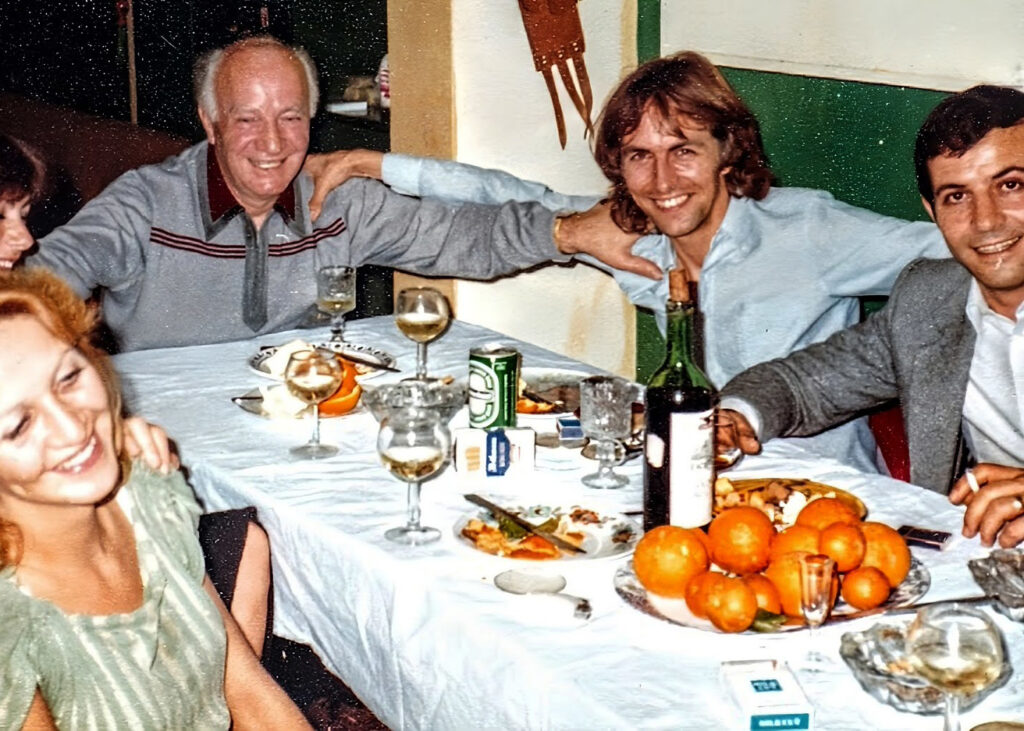
The ad agency never happened, but the finance business was doing well. One of their French clients happened to produce sewing machines, shotguns, and bikes. Noting that they had no UK distributor, they decided to have a crack at it themselves.
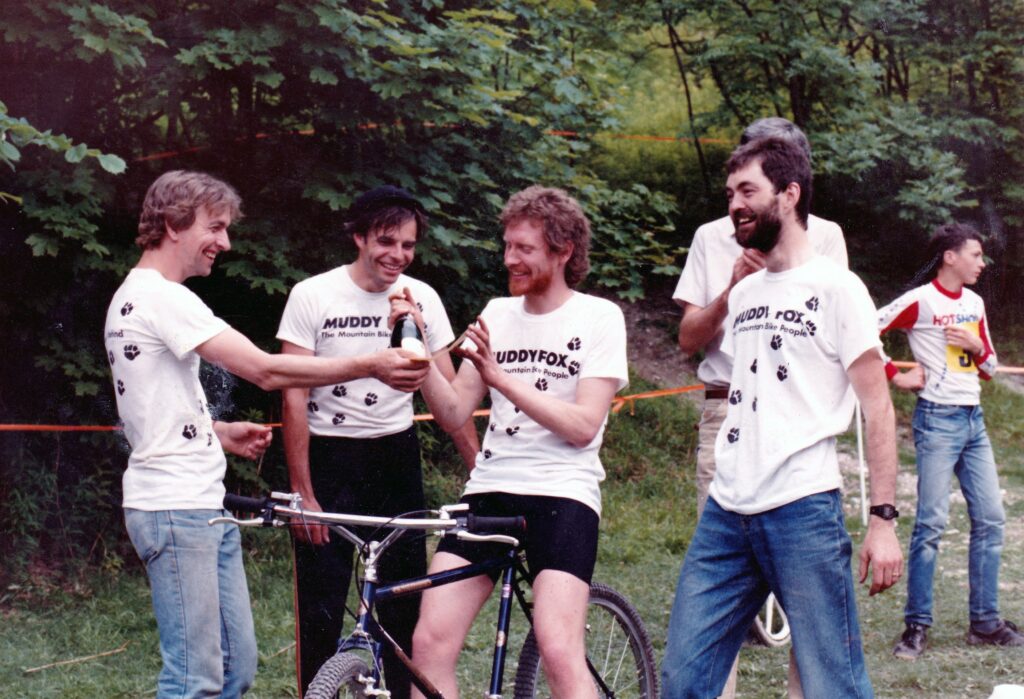
Things were going well until the French outfit went bust, leaving them with bike shops wanting more of their bikes, and so they decided to find an alternative supplier. They managed to link into a Japanese rim and bike manufacturer (Araya), and as things took off, they decided to go all in on selling bikes. They first imported a mixed container of bikes, with some being what they identified as mountain bikes, with Muddy Fox on the frames. They hoped to persuade Araya to expand the partnership, but it didn’t want to compromise their OEM relationships with UK brands; thus, Muddy Fox eventually emerged in its own right – along with its famous paw print logo.
Drew explains how that came to be, “we could have picked any name – we’d already changed our name from Security & General Finance to S&G Distributors and then S&G Cycles – but Araya’s MTBs bore the name Muddy Fox, which struck a chord, and when Ari asked, they said we could use that as they had no intentions of marketing their bikes internationally”.
As for their iconic paw print logo? “So, I just needed a compliant fox… lacking that, I placed a large sheet of paper on the ground, and we lifted an old English sheepdog puppy onto a dirty puddle and then the paper. I picked one, and we had our logo”.
The duo knew little about making bikes, but made the right connections and employed the right people from the off. “Initially, we knew nothing, but had enough sense to know we knew nothing, so we took advice from people who knew their stuff. It was only when we really knew what we were doing that we actually designed the bikes ourselves.
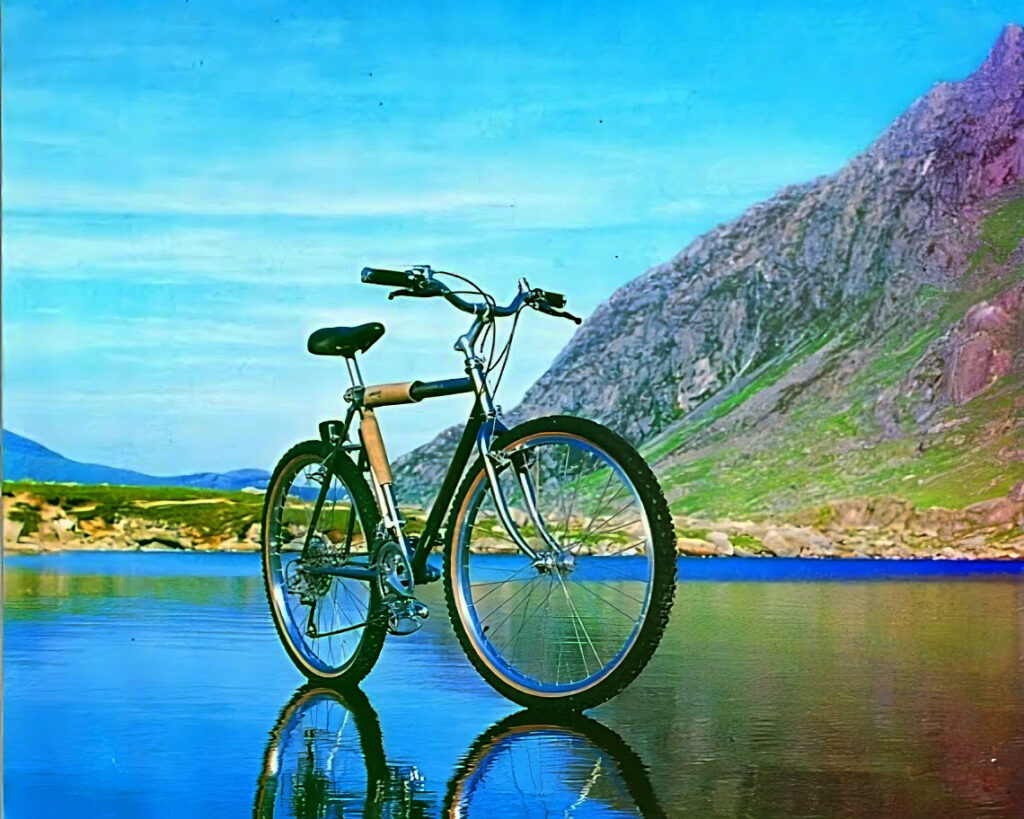
“When you have as large a range of bikes as we did, it comes down to working with your suppliers to select the right frame geometry, material and construction techniques, while pairing components of different qualities and taking the cost of absolutely every component into account.
“When we started, there was nothing; no events, no demand, no market – nothing. We were monitoring the US magazines and, of course, Charlie Kelly’s Fat Tyre Flyer, and it became obvious that something big was brewing. We figured that by being the first, we could gain a foothold in what would hopefully be a burgeoning market, so we decided to take the gamble, drop all our bikes, apart from MTBs, and promote ourselves as Muddy Fox – with the tagline “The Mountain Bike People.
“Technically, Ridgeback pipped us by a couple of months in bringing some sample MTBs in, but Ridgeback was a general bike company, albeit with a few MTBs, whereas we were the first British wholly mountain bike company.”
The Muddy Fox adverts and marketing were a breath of fresh air, and some were a tad shocking to the established bike industry, especially the famous bare back pay print ad.
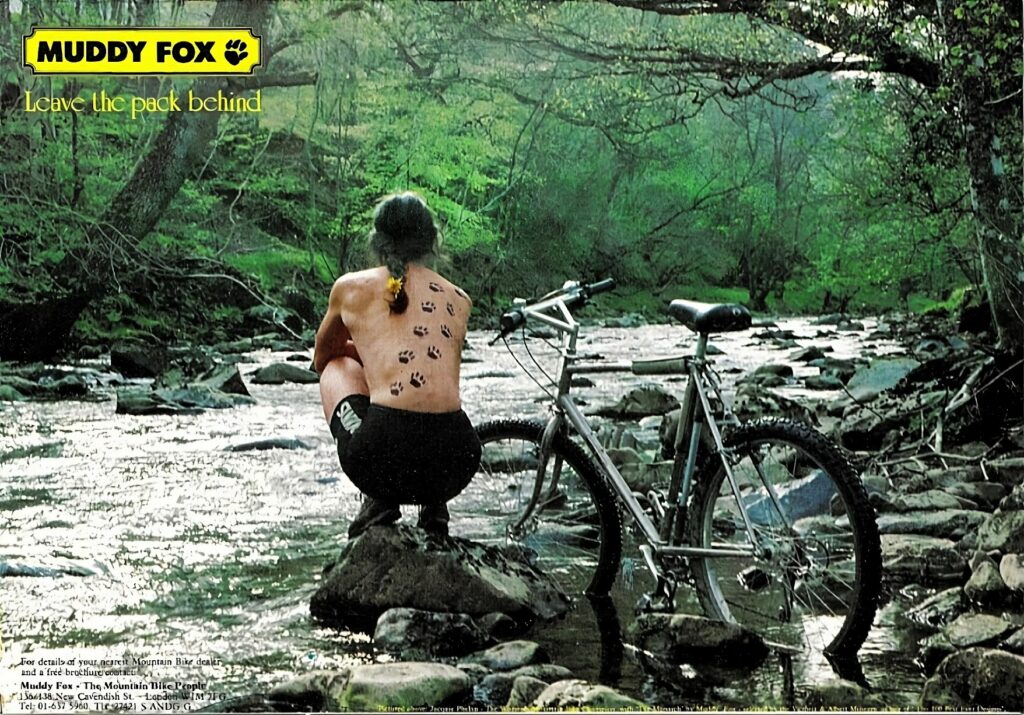
“We were riding in Wales, and Jacqui Phelan (an early US star on MTB) came up with this idea. I drew the paw prints (on her back), then took the photo. This one was unplanned. Rhoda Morrison and I just captured the moment. When Jacqui saw it, she was astonished that I was publishing a full-page ad with the bike only a centimetre tall – “In America, the bike would fill the page!” She said”
Great expectations, or a shot in the dark?
With a virtually unknown kind of bike and little industry knowledge, what were the hopes when setting out? Ari picks up the tale, “We saw that 10% of the total US annual (bike) sales market was mountain bikes. Drew and I knew what happens in America today usually happens in the UK a couple of years later, followed shortly by the rest of Europe.
“We were determined and confident that with creativity, application, and a little wisdom, we could take on a calculated risk to add more than ten per cent to the UK bike market – and be the first! It was done in less than a few years.”
How did the old school bike industry take to them? “The big names were laughing at us. They were saying, “There are no mountains in England!”
“When Raleigh eventually came in, it refused to adopt the name mountain bike (perhaps because Muddy Fox were already known as ‘The Mountain Bike People’), and for years Raleigh called them all-terrain bikes (ATBs) and not mountain bikes (MTBs). ATB was actually a pretty accurate term, but to us, it smacked of tweed and bicycle clips. MTB seemed so much cooler, and we pushed the media very hard to stick with that”.
Indeed, Ari and Drew proved their point and helped quieten the opposition that was against it.
“We were well aware that there are no mountains in England, but you see more Range Rovers in London and the major cities than you’ll ever see in the mountains. The Muddy Fox Courier proved our point not long after; it filled the streets of the major UK cities. We did create some of the best and the best-selling, largest range of MTBs of the time.”
The Muddy Fox approach was bold, and yet there were many doubters around.
“People then thought we were a pair of nutters. We think a lot, are very serious in many ways. We’re both shy, and don’t say much unless we have to, but when it comes to vision, creativity, implementation, adventure and action, we are, very possibly, nuts”.
Against any pre-conceived outside odds, they hit the mark with buyers, and held 50% of the UK MTB market at the time – but which bikes mean the most to Ari? “The Muddy Fox Courier was the bike that broke the MTB price barriers, by retailing at £199. The other equivalents close to the Courier quality and spec were £299 plus. No competitor’s model could come close to our price. We sold over 20,000 Couriers in one exhibition in London”.
“The streets of London and major cities were full of white Courier Muddy Foxes”.
Then the curtain falls – have no regrets
Sadly, during the mid-1990s, through another unforeseen twist of fate, Muddy Fox fell on hard times, and the rug was pulled. Drew and Ari‘s original Muddy Fox vision was no more. The brand did, and still does live on, albeit now in a Frasers Group skimmed-down way. Thanks, in no small part, to Drew and Ari’s Muddy Fox ventures in mountain biking rapidly became popular in the UK, and this greatly helped shape the image and direction of the sport and industry from then on. The pair are still friends, and they look back at the wild ride into making bikes with nostalgic smiles and without regrets.
You might also like:
- “That’s when it really hit us, the track wasn’t just about biking or sport. It became a safety net”: Claudio Calouri talks Pump for Peace
- Rising to the Top – Puck Pieterse’s amazing rainbow adventure
- 51 days in a Russian jail: Sofiane Sehili reveals all on his trans-Eurasia record attempt… and its spectacular failure