



[Images by Steve Thomas]
“Just look sideways and admire the mist and snow-covered high Alpine peaks below. It’ll be ok, but don’t look down or lose your footing.”
If I did slip, then I’d have the longest and fastest bare-ass toboggan ride of all time – and probably set a new speed record in with it!
- “I love running races for people that enjoy doing races… I never want to stop doing it.” Scott Fitzgerald at Southern Enduro on the state of MTB racing in the UK, and how riders can keep the scene alive
- On and off the record with Kevin Vermaak – Cape Epic founder
- The mountain bike race where drop bars reign supreme — everything you need to know about the 2025 Leadville Trail 100 MTB race
This was early February ’94/95, and I found myself on this, and later on other KL Lance speed ski slopes around the Alps several times during the ’90s.
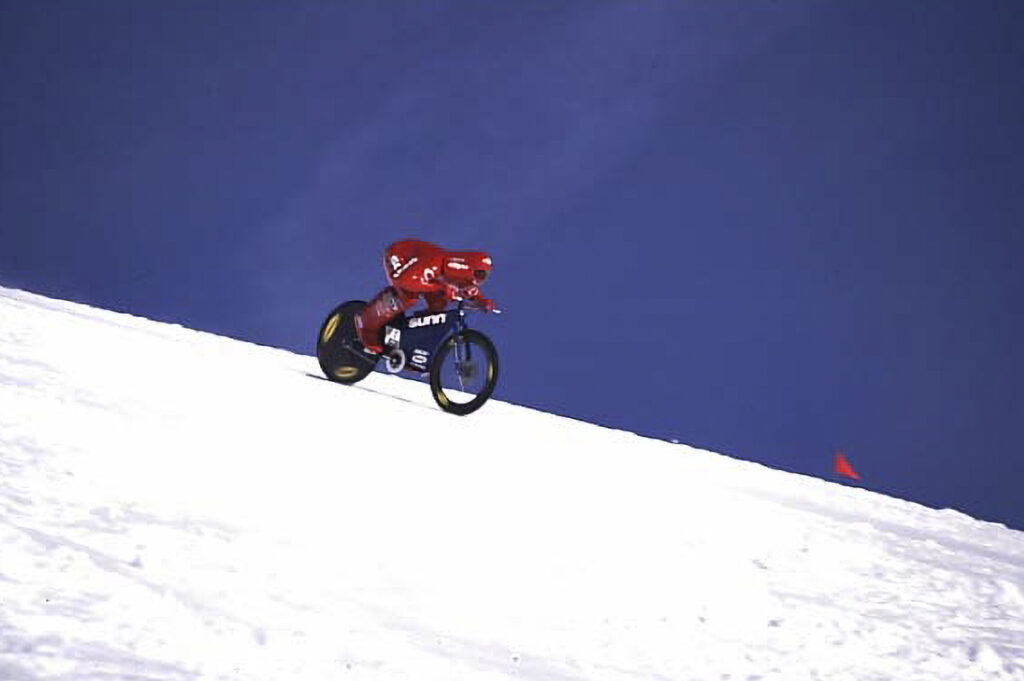
It was the steepest and fastest piste on earth – the Vars KL Lance. I was there with a camera, a vertigo quiver and a winter morning shiver to shoot the first-ever edition of what would be the fastest, and probably the maddest and most extreme mountain bike tournament on earth, known as Bike Speed. Sadly, most of my old film images from that era are long gone, but those of us involved in this amazing, yet charmingly ludicrous project still remember it fondly.
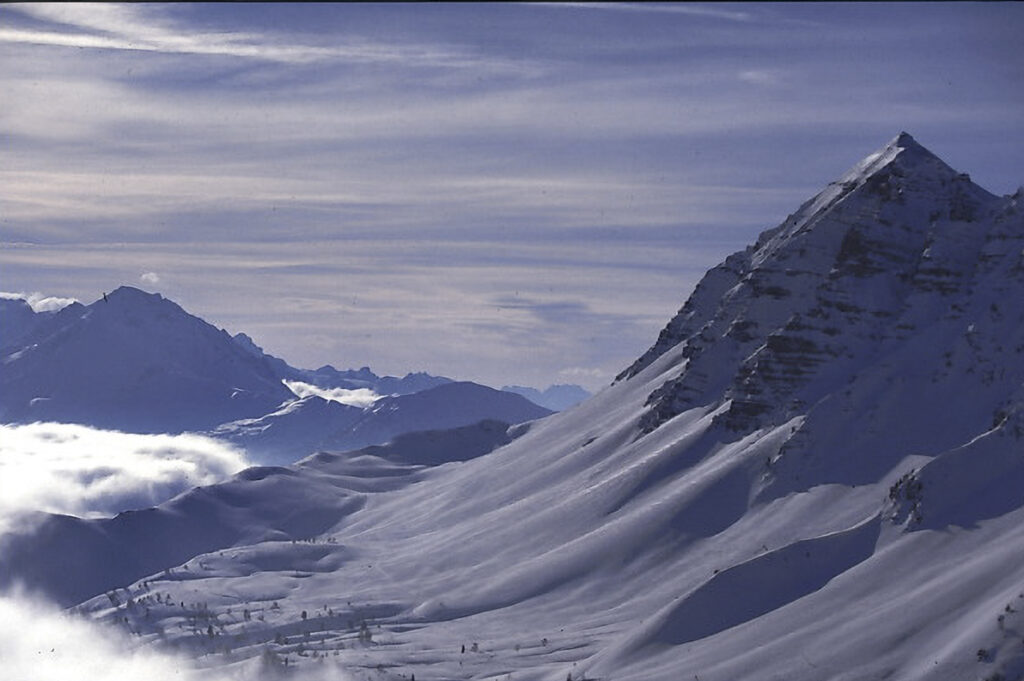
The idea was for a very select and small band of the world’s fastest and craziest downhillers to throw themselves off the top of the mountain. Launching straight into a 98% gradient, on 1km long snow-covered speed ski slope, and one with just a short run out to stop with – if they made it that far, and some didn’t quite get there in one piece.
The great quest to become the world’s fastest downhill mountain biker kicked off after top French Downhiller Christian Taillefer lost a bet with a mate, and the forfeit was to attempt a speed record on snow. The KL Lance was clearly defined as the place to have a crack at something that had yet to be attempted.
In 1994, Christian set a previously unheard-of speed of 147kph on an adapted bike that he aero tested on the roof of his brother’s car. Almost before the news had reached the far shores and pages of the analogue world, a little-known French downhiller named Eric Barone went out solo and upstaged Taillefer by cracking his new record, and he did it on a regular Motobecane full suspension bike, thus the gauntlet of speed was well and truly hurled down.
Although Barone was then virtually unknown as a mountain biker, he was a well-known movie stunt double who had doubled for the likes of Sylvester Stallone & Jean Claude Van Damme. In real life, he was as intimidating as the characters he took the falls for, while Taillefer was a complete contrast, a smiley, pristine kinda fella.
Settling speed scores?
Soon after this, French race organiser George Edwards (Megavalanche, etc) convened a showdown speed tournament between the pair in Vars. Having been to all of these tournaments (I think), things kind of mesh into a whiteout of old. I seem to remember the first edition being between Taillefer and Barone, but soon enough the field was opened up to a very select bunch of established downhill stars, and those brave and crazy enough to risk the ride: Swiss pioneer Philippe Perakis, a young Anne-Caroline Chausson, and Italian stars Giovanna Bonazzi and Paolo Caramellino.
The magnificent machines
Having been the first to attempt the record and having gained vital experience, Taillefer was very much leading the technical charge. His Peugeot-branded and boldly painted rigid singlespeed monocoque bike was home-made, and one of the most amazing bikes I’d ever seen. Not only did this space-aged rocket on wheels catch the eye of the media, but it was also perhaps the fastest out there… at first.
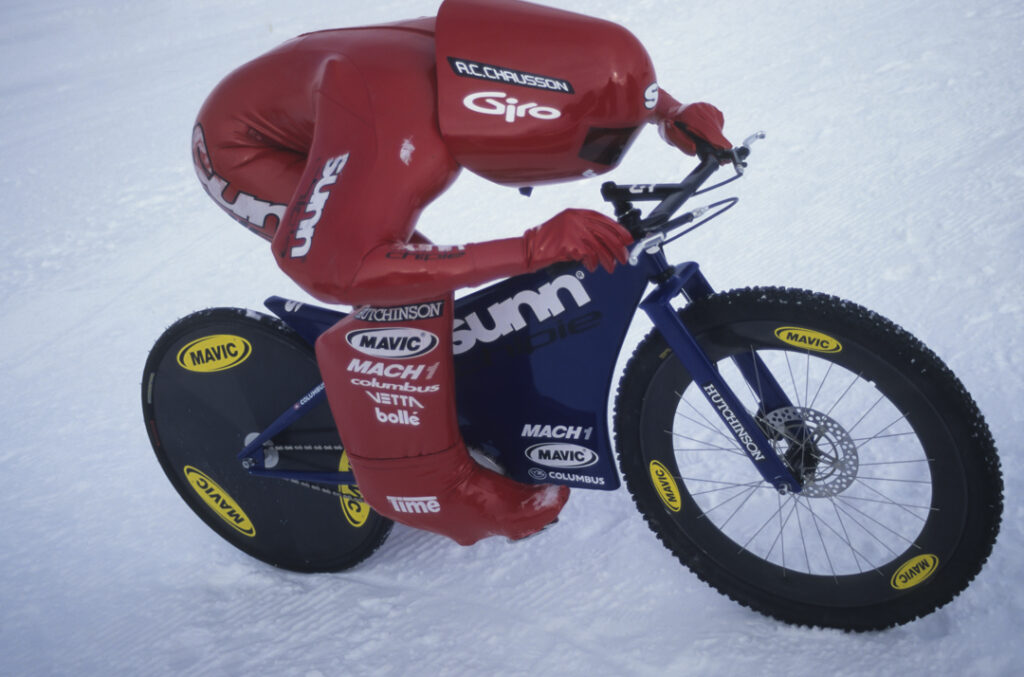
Initially Barone started on his box standard Motobecane bike, but very soon after he teamed up with SUNN, and both he and Chausson rode aboard ever-evolving rigid SUNN branded bikes with fairings, screw-studded tyres and motorbike disc brakes – not that you had much chance to use them, but regular bike brakes of the time would not have been that effective at such speed, to say the least.
Meanwhile, Perakis rode aboard a home-modified Cannondale full suspension downhill bike, Bonazzi on a modified Kastle with fairings and an amazing paint job, while Caramellino also rode a slightly adapted regular downhill bike, all of which were a few technical KPHs behind Barone and Taillefer’s rigs.
The dress of the day was full speed ski suits and helmets, complete with lower leg fairings, and riders looked like a cross between welders and Starship Troopers, and there was little in the way of protection underneath these.
How it all worked
The Bike Speed tournaments were held at both Vars and Les Arcs, on the KL Lance slopes. For logistical and safety reasons (and sponsorship), these were very high-profile, yet very compact events, which came with a whole lot of knife-edge organisation and detail, and with a huge potential risk factor, which all added to the aura.
First up, you couldn’t and wouldn’t simply show up and throw yourself down the KL Lance, or at least not legally, if you want to survive. The monitoring, the infrastructure, and Mother Nature all have to align on your side. Snow conditions have to be perfect; two degrees Celsius either way, and the consequences could be catastrophic.
The downside of this was that we spent many a pre-dawn morning in the Office du Tourism’s monitoring centres waiting for the green light. On several occasions, it took a few days of waiting, and on some occasions simply didn’t flash green; game off, and let’s meet somewhere in a couple of weeks and try again.
When the green light did shine, time was generally limited – because as the sun rises, so things warm up, so it was all systems go. Don’t look down, don’t hesitate, don’t hold back and do keep it all together, and then find a way to stop without killing yourself. A fairly narrow piste with a few small red flags marks the way, as at speed and with the intensive vibration and speed wobbles, it can be incredibly hard to stay on line. The timing station is near the bottom of the slope, while a rigged start gate is pinned to the side of the slope.
Initially riders start lower down, where the grade can be down to 52%, gradually learning the limits of their bikes and their nerve. The higher you go, the faster you go, and for the brave few, that eventually means dropping off the ledge at the top. The 98% slope here gives faster acceleration than an F1 race car, so you can imagine the leap of faith it took to launch off, then the G-Force and the battle to stay upright, and aero. One slight hesitation or loss of concentration, and it could be your final ride in life – literally.
Sometimes it was just one single run per rider, but sometimes it was a few, if time and conditions played out over the few days allotted.
The battle continues
Although Bike Speed as a tournament lasted just a few winters, the battle between Barone and Taillefer during that time pushed the speed to over 212kph for Taillefer by 1998, the same year he won the Les Gets round of the World Cup. As for the ‘Red Barone’, he broke the speed barrier again in 1999. In the year 2000 he did it again, hitting a staggering 222kph. He never really let the brakes off on his quest for maximum speed.
As well as chasing speed on the snow, he also raced regular downhill. In 1994, he became the Masters World Downhill Champion, and in 1999, he also hit 118kph on gravel in Hawaii. In 2002, he took to the volcanic slopes of Cerro Negro in Nicaragua, where, after hitting 172kph, his prototype machine broke in half, ripping his helmet off and throwing him into one of the scariest crashes you’ll ever see. Either way, he still holds the non-snow downhill speed record, although Austria’s Markus Stockl has the record of 167.7kph for a non-modified mountain bike.
Although Eric decided not to return to the hard stuff after his crash, against the odds he continued pushing the speed limit on snow. In 2017, at 56 years of age, he cracked his own all-out downhill speed record to hit 227.72kph, a record which still holds fast today.



















2 thoughts on “Aero skinsuits, crazy monocoque bikes and 141mph top speeds (in the snow): Remembering Bike Speed, the most extreme MTB spin-off of all time”
I remember seeing Barone practicing at Les Arcs (Arc 2000) the year he set that speed record. Absolute nutter! When not in use, the KL is a very steep off piste bump run, worth a try if you like to feel the vertigo.
Interesting to see what Lord Buckethead got up to before he went into politics.