



Jan-Willem van Schip, the Dutch Continental racer famed for his aerodynamic designs that regularly fall foul of race commissaires, has been disqualified for the third time in the past year amid confusion over the enforcement of UCI regulations.
Riding for the third-division Azerion/Villa Valkenburg team in the Ronde de l’Oise, a fourth tier race comprising World Tour development teams and amateur clubs, Van Schip was first fined 200 Swiss Francs after stage 2 on Friday for using a “non-compliant position on the bike,” despite his race set-up being approved by commissaires before the start of the race.
View this post on Instagram
The same offence led to Van Schip’s disqualification from the Tour of Holland in October, though he was disqualified due to his upturned seatpost rather than his unorthodox handlebars. Then, local race commissaires approved his bike set-up before cycling’s governing body, the UCI, intervened.
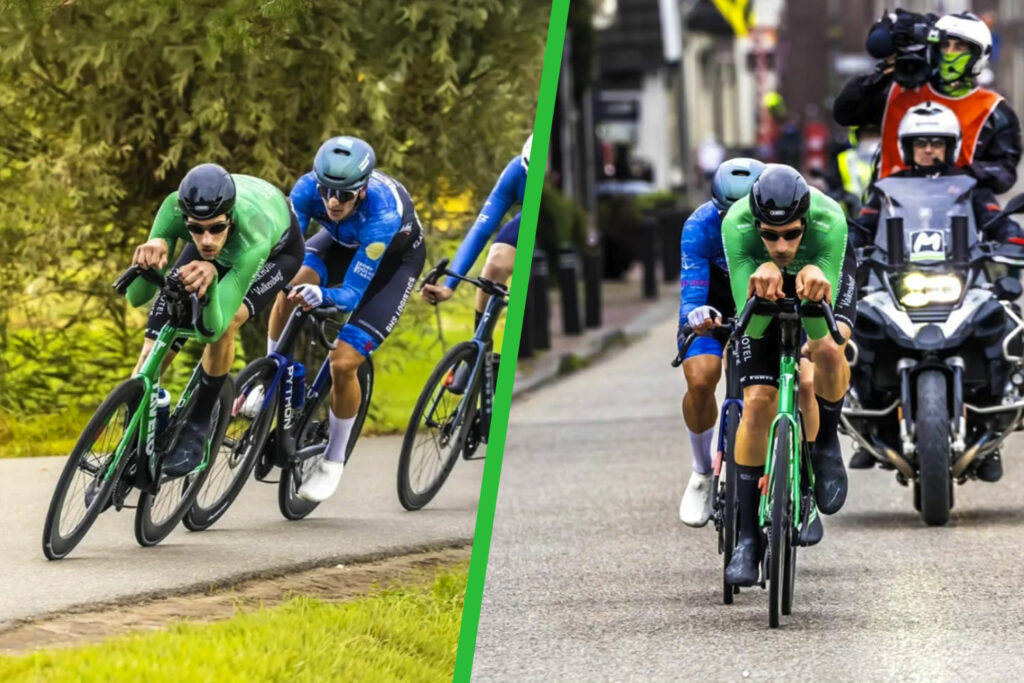
He was also disqualified last month for his bike position at the Tour of Hellas, leading Van Schip to comment, “The bike is completely legal, the seatpost is fine — but they’ve found something to screw me over again. It hurts.
During the final stage yesterday, Van Schip was disqualified from the breakaway. The official race communique issued after the stage reports the 31-year-old was banned for “non-compliant clothing”, although in a video (in Dutch) posted on Instagram, Van Schip says he was disqualified “because I had a bottle in my jersey.”
Riders are permitted to carry bottles under their jersey, and domestiques are regularly seen storing bottles under their jersey when they return from the team car on behalf of their teammates. However, UCI regulation 1.3.032 states that “Clothing and other items or accessories worn by a rider (including but not limited to helmets, glasses, shoes or in-race communication devices) may not modify the morphology of the rider.”
“Moreover, any non-essential element or device which is added on (or under) or integrated in any clothing, or other item or accessory worn by a rider shall be forbidden. A non-essential element shall be any element which does not have a purpose which is exclusively of clothing or protection, or which is not strictly necessary for the functionality of the clothing, or other item or accessory. This shall also apply regarding any material or substance applied onto the skin or clothing and which is not itself an item of clothing or another item or accessory worn by a rider.”
Consequently, it appears as though Van Schip was in breach of race regulations, but he was disqualified on the wrong basis by race organisers.
Today, French radio station RMC Sport report that Van Schip was apprehended by police and brought to the ground after refusing to leave the race. An photo has also circulated on social media showing a police officer on a motorbike bent over Van Schip lying in the grass on the side of the road. However, when contacted by road.cc, Van Schip denied that happened or that he was detained by police. His team, Azerion/Villa Valkenburg has also been contacted for comment.
Dutch Bluesky user Tonke speculated that “he says “he lost it” for a moment (ik was het heel ff kwijt) it looks more like the motard is trying to help him calm down but not in a forceful way but more in a consoling way, but maybe it’s projecting what I hope happened.”

Van Schip, a World and European Champion on the track, has become a divisive figure among cycling fans, with some likening his aerodynamic innovations to Graeme Obree, and others accusing him of being a nuisance who undermines the safety of the peloton.
The UCI has long-taken a critical view towards organic aerodynamic developments from the peloton, including during Obree’s career. In a press release published on Friday, the UCI announced it would ban pockets on the front of rider jerseys after the body “observed that several riders were wearing jerseys featuring front internal pockets containing nutritional products that were generally not consumed because they were extremely difficult – or even impossible in race conditions – to access.
“These pockets result in significant alterations to the riders’ body shape. This trend follows the recent publication of studies demonstrating the aerodynamic advantage provided by this practice. Given the established link between aerodynamic gains, increased speed and the severity of accidents, and considering that the practice also raises issues of sporting fairness, the UCI has decided that jersey pockets must be located exclusively on the rear of the garment.”
The ban will take effect on the 1st July in time for the Tour de France, but will not apply to front jersey pockets used for race radios. Other rule changes included in the briefing are new restrictions on the size of on-board computers, the lifting of restrictions on Belarussian athletes competing under their own flag, and confirmation of the 2027 WorldTour and Women’s WorldTour calendars. Changes include the Vuelta a Espana Femenina moving from spring to autumn, taking place after the men’s equivalent, which is also pushed back to take place entirely in September in order to accommodate the road World Championships in France.



















2 thoughts on “Confusion as Jan-Willem van Schip disqualified for third time in a year after putting bottle under jersey – but UCI jury claims ejection was due to ‘non-compliant clothing’”
He started his glorious DSQ career headbutting other riders on the track and cursing at commissaires, now he’s garnering fame and attention collecting DSQs on the road by just pushing at the rules all the time – and regularly getting it wrong (regardless of whether there is a pending rule update to /specifically/ ban pockets in the front of the jersey, he knows fine well there already is a long-standing general rule banning adding stuff to change the shape of the rider). All this because he can no longer win races at UCI x.2 level, never mind UCI x.1.
He’s just being an annoying ekel at this point.
> will not apply to front jersey pockets used for race radios
Time to launch a line of very expensive, very lightweight, very aero race radios….